
Explain identification in fmt for 3 rd year mbbs student
Reading File
Now let me search the medical library for FMT (Forensic Medicine and Toxicology) content on identification.
Finding Sources
Finding Sources
Excellent! Found a dedicated section. Let me read it now, along with additional searches for more context.
Reading File
Finding Sources
Good content coming in. Let me read more of this important section:
Reading File
Reading File
Now I have comprehensive content. Let me read the remaining portions covering DNA, dental, and other key identification methods:
Reading File
I now have enough comprehensive content to deliver a thorough, well-structured answer. Let me also fetch the fingerprint pattern image:
Loading Image
Reading File
I now have all the content needed. Let me compile the comprehensive answer.
Identification in Forensic Medicine and Toxicology (FMT)
For 3rd Year MBBS Students
Source: The Essentials of Forensic Medicine and Toxicology, 36th Edition (2026) - Parikh's Textbook of Medical Jurisprudence, Forensic Medicine and Toxicology
What is Identification?
Identification in forensic medicine is the process of establishing the identity of a living person, a dead body, or skeletal remains for medicolegal purposes. It may be needed in cases of:
- Unknown dead bodies (mutilated, decomposed, skeletal)
- Disasters (mass casualty, aircraft accidents)
- Criminal investigations (suspect identification)
- Disputed identity (impersonation, insurance fraud)
- Missing persons
Methods of Identification
1. ANTHROPOMETRY (Bertillon System)
Introduced by Sir Alphonse Bertillon (1882); now largely replaced by dactylography.
Principle: After age 21, skeletal dimensions remain fixed, and the ratio of different body parts varies considerably between individuals.
Data recorded:
- Body appearance - color of hair, eyes, complexion, shape of nose, ears, chin
- Body marks - moles, scars, tattoo marks
- Body measurements:
- Height, anteroposterior diameter of head and trunk
- Span of outstretched arms
- Length of left middle finger, left little finger, left forearm, left foot
- Length and breadth of right ear, color of left iris
- Front view photograph + profile view of right side of head
Limitation: Photographs alone are not always reliable as a sole means of identification.
2. DACTYLOGRAPHY (Fingerprint System)
Also called Dermatoglyphics or the Galton-Henry system - the MOST RELIABLE and WIDELY used method.
Key History:
- First used in India in 1858 by Sir William Herschel (West Bengal)
- Systematized by Sir Francis Galton in 1892
- First Fingerprint Bureau established in Kolkata
Principle: Fingerprints are impressions of papillary (epidermal) ridges of fingertips. Ridge pattern appears between 12-16 weeks of intrauterine life, completed by 24 weeks.
Fingerprint Classification (Fig. 4.44):
| Pattern | Frequency | Subtypes |
|---|---|---|
| Loops | 60-70% | Radial, Ulnar |
| Whorls | 25-35% | Concentric, Spiral, Double spiral, Almond-shaped |
| Arches | 6-7% | Plain, Tented, Exceptional |
| Composite | 1-2% | Central pocket loops, Lateral pocket loops, Twinned loops, Accidentals |
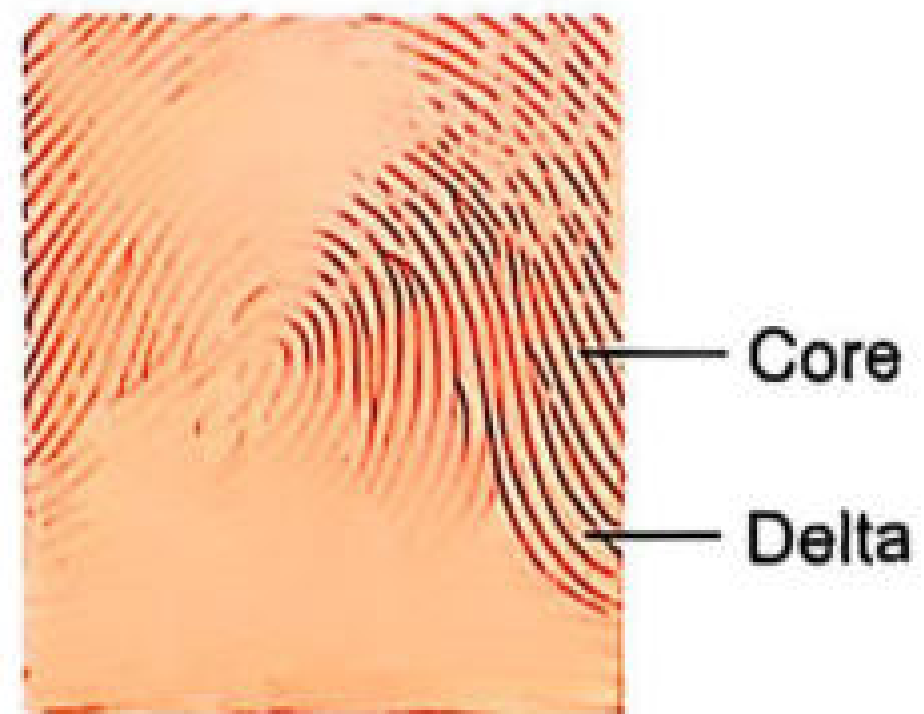
Identification Process (Key Exam Points):
- Final identification is by comparison of ridge characteristics, not patterns alone
- Ridge characteristics: ridge endings, bifurcations, lake formations, island formations
- Minimum 8 points of comparison for positive identification (Supreme Court ruling)
- Fingerprint patterns are NOT inherited - paternity cannot be proved through them
- Pattern is different even in identical twins
- Patterns are permanent and distinctive throughout life
3. POROSCOPY
Described by Henry Locard - further study of fingerprints.
- Ridges are studded with microscopic pores (mouths of sweat gland ducts)
- Each mm of ridge contains 9-18 pores; thousands per cm²
- Pores are permanent, vary in size, shape, width
- Useful when fingerprint is too smudged for ridge detail comparison
4. FOOTPRINTS AND FOOTMARKS
- The walking gait pattern (stride) can be individualized
- Step length: adult woman = 45-55 cm; adult male = 63-70 cm
- Footmarks are recorded by photography, casts, or lifting
- Prints in yielding soil indicate shoe size, approximate weight, and peculiarity of gait
- Imprint on hard surface is smaller than actual foot; on mud/clay is larger
5. PALATOPRINTS
- Rugae (ridges) in the anterior hard palate are individual-specific and permanent
- Categorized (Lysell) as: Primary rugae (>5 mm), Secondary rugae (3-5 mm), Fragmented rugae (2-3 mm)
- Used similarly to fingerprints
6. LIP PRINTS (Cheiloscopy)
- Fissures and grooves of lips are characteristic of the individual
- 6 patterns described by SUZUKI - vertical, branched, intersected, reticular, etc.
- 24 characteristic details identified; identification established if 7-9 characteristics tally
- Found on crockery, cloth, paper, windowpanes, cigarette ends
7. EAR PRINTS
- Four basic ear shapes: oval, round, rectangular, triangular
- Three prints taken from suspect: functional pressure, gentle pressure, more pressure on glass
- Most ear prints found on doors or windows
- Made visible and photographed like fingerprints
8. SKULL-PHOTO SUPERIMPOSITION
- Technique applied by Glaister and Brash (1935) in the famous Ruxton case
- Used to determine whether a skull belongs to a person in a photograph
- The photo is enlarged to natural size; skull is mounted and aligned with the face outline
- Points compared: eyes within orbital plates, nasal bones, chin, zygomatic arch, etc.
- Useful when only skeletal remains are available
9. OCULAR (EYE) BIOMETRICS
Retinal scan:
- Retinal blood vessel pattern is unique to each individual
- ~70 times more accurate than iris scan
- Nearly impossible to fake
- Limitation: retina decays quickly after death; altered in cataract, glaucoma, retinal degeneration, diabetes
Iris scan:
- Iris is structurally unique despite genetic contribution to coloration
- Iris is located using landmark features; distinct shape allows feature isolation
- Does not decay after death as quickly as retina
10. DNA FINGERPRINTING (Most Definitive Modern Method)
- The most scientifically reliable method of identification
- Can identify from blood, semen, hair roots, saliva, bone
- Useful in mass disasters, paternity disputes, criminal investigations
- Unlike conventional fingerprints, DNA patterns ARE inherited and can prove paternity
- Different from dermatoglyphic fingerprints (which cannot prove paternity)
11. DENTAL IDENTIFICATION
- Dental records, X-rays, and unique tooth patterns are used
- Requires antemortem dental records for comparison
- Highly resistant to fire and decomposition
- No central dental database exists (unlike fingerprint or DNA databases)
- Used extensively in mass disaster victim identification
Summary Table for Quick Revision
| Method | Key Person | Key Point |
|---|---|---|
| Anthropometry | Bertillon | Body measurements; replaced by dactylography |
| Dactylography | Galton-Henry / Herschel | Min 8 points; not inherited; permanent |
| Poroscopy | Locard | Sweat pore patterns; useful in smudged prints |
| Skull superimposition | Glaister & Brash | Ruxton case (1935) |
| Lip prints | Suzuki | 6 patterns; 7-9 points to confirm identity |
| DNA fingerprinting | - | Most definitive; can prove paternity |
| Retinal scan | - | 70x more accurate than iris; decays after death |
High-Yield Exam Points
- Most reliable method of identification = DNA fingerprinting (or fingerprints for classical forensics)
- First fingerprint bureau = Kolkata; First used in India = Sir William Herschel (1858)
- Fingerprint ridge pattern appears at 12-16 weeks of intrauterine life
- Loop patterns are most common (60-70%)
- Minimum 8 points of comparison for positive fingerprint identification (Supreme Court)
- Fingerprints are different even in identical twins
- Paternity CANNOT be proved from fingerprint patterns (patterns not inherited)
- Poroscopy = study of sweat pores on ridges (described by Locard)
- Skull-photo superimposition - first used in Ruxton case by Glaister & Brash
- Step length: male = 63-70 cm; female = 45-55 cm
- The Essentials of Forensic Medicine and Toxicology, 36th Edition (2026), pp. 94-99
- Parikh's Textbook of Medical Jurisprudence, Forensic Medicine and Toxicology
This is a shared conversation. Sign in to Orris to start your own chat.