
draw a diagram of sach foot madras foot and jaipur foot
- SACH foot (USA): A high-tech microprocessor-controlled prosthetic foot used for above/below knee amputees, with dynamic ankle response.
- Madras foot (Chennai, India): A basic single-axis wooden/resin foot designed for low-activity users, inexpensive and durable.
- Jaipur foot (India): The most widely used prosthetic foot in developing countries - made of rubber, allows ankle dorsiflexion/plantarflexion AND inversion/eversion, enabling squatting and walking on uneven terrain barefoot.
A clear educational diagram comparing three types of prosthetic feet side by side: 1. SACH Foot (Solid Ankle Cushion Heel) - left panel: shows a simple wedge-shaped prosthetic foot with a solid ankle, cushioned heel wedge made of foam/rubber, rigid keel, no moving parts, labeled parts: rigid keel, cushioned heel, toe filler, no ankle joint 2. Madras Foot - center panel: shows a wooden single-axis prosthetic foot from India, basic design with a single pivot ankle joint, wooden foot shell, rubber sole, labeled parts: wooden body, single pivot joint, rubber sole, toe section 3. Jaipur Foot - right panel: shows the iconic Indian rubber prosthetic foot with multi-axis movement, toe separation for thong sandals, rounded heel, labeled parts: vulcanized rubber construction, toe separation (for chappal), multi-axis ankle allowing dorsiflexion + plantarflexion + inversion + eversion, rounded base for squatting Each foot shown from the side (lateral view). Title at top: "Comparison of Prosthetic Feet: SACH vs Madras vs Jaipur". Clean medical diagram style with black labels, white background, anatomical orientation arrows showing movement directions.
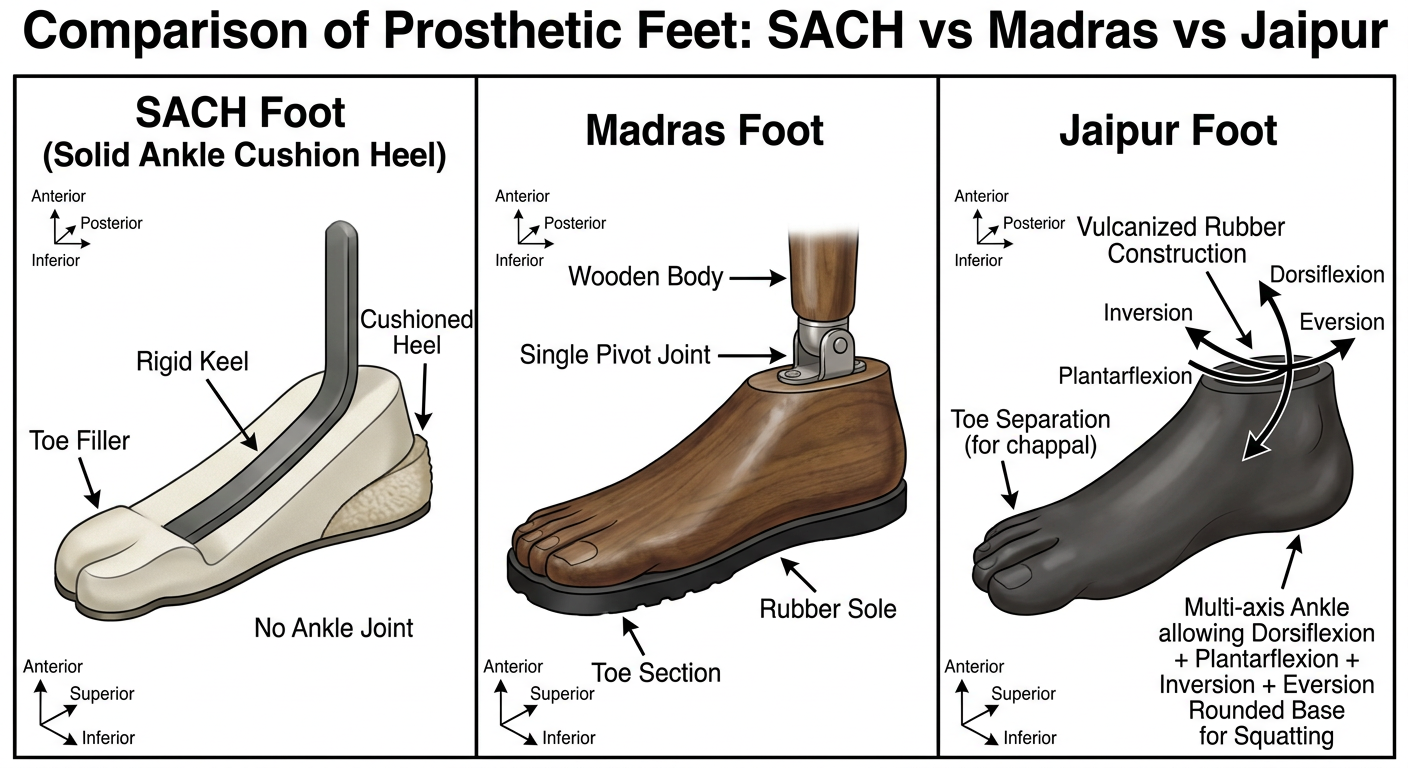
SACH Foot (Solid Ankle Cushion Heel)
- Origin: Developed in the USA in the 1950s
- Design: No moving ankle joint - the ankle is solid/fused
- Mechanism: A soft foam/rubber wedge at the heel compresses on heel strike to simulate plantarflexion
- Movement: Plantarflexion only (via heel compression); no true inversion/eversion
- Use: Low to moderate activity; widely used as a basic standard prosthetic foot globally
- Limitation: Cannot squat, walk on uneven ground easily, or wear thong sandals
Madras Foot
- Origin: Developed at the Rehabilitation Institute, Chennai (Madras), India
- Design: Single-axis wooden foot with a pivot ankle joint
- Movement: Allows some plantarflexion and dorsiflexion via the hinge
- Use: Budget prosthetic option; suited for low-activity rural users
- Limitation: No inversion/eversion; not ideal for uneven terrain
Jaipur Foot (Jaipur Limb)
- Origin: Developed in 1968 by Dr. Pramod Karan Sethi and master craftsman Ram Chandra Sharma in Jaipur, India
- Design: Vulcanized rubber construction with a toe separation gap for wearing chappals/thong sandals
- Movement: Multi-axis - allows dorsiflexion, plantarflexion, inversion, AND eversion
- Special features: Rounded heel allows full squatting; can walk on uneven terrain, muddy fields, and go barefoot
- Cost: Extremely low cost (~$45-50), making it accessible in developing countries
- Impact: Over 1.3 million fitted globally; considered one of the best low-cost prosthetic solutions for developing-world conditions
draw a diagram of ptb tsb kbm suprcondylar suprapatellarquadrilateral ischial containment mas socket diagrams
A detailed medical educational diagram showing 7 prosthetic socket designs arranged in two rows, clean anatomical illustration style, white background, labeled: ROW 1 - BELOW-KNEE (TRANSTIBIAL) SOCKETS: 1. PTB Socket (Patellar Tendon Bearing) - cross-section side view showing: prominent patellar tendon bar pressing on patellar tendon, relief over fibular head, relief over tibial crest and tibial tubercle, total contact with stump, below patella suspension 2. TSB Socket (Total Surface Bearing) - cross-section side view showing: even pressure distribution over entire stump surface, gel liner/silicone sleeve inside, pin lock mechanism at distal end, no specific pressure bar, uniform contact throughout 3. KBM Socket (Kondylen Bettung Munster) - cross-section side view showing: supracondylar trim line extending above femoral condyles, medial and lateral condyle enclosure for suspension, higher proximal brim than PTB, self-suspending design without sleeve 4. Supracondylar Socket - cross-section side view showing: trim line extending above and enclosing femoral epicondyles, wedge or removable medial wall for donning, suspension by condyle capture, higher than KBM 5. Supracondylar-Suprapatellar Socket - cross-section side view showing: trim line covering both femoral condyles AND patella anteriorly, patella enclosed within socket, highest brim of transtibial sockets, maximum mediolateral stability ROW 2 - ABOVE-KNEE (TRANSFEMORAL) SOCKETS: 6. Quadrilateral Socket - top-down cross-section view showing: rectangular/quadrilateral shape, posterior shelf (Scarpa's triangle) for ischial tuberosity weight bearing, anterior wall higher than posterior, adductor longus channel on medial side, flat posterior brim 7. Ischial Containment Socket (Normal Shape Normal Alignment / NSNA / CAT-CAM) - top-down cross-section view showing: narrow ML width, ischial tuberosity INSIDE socket (contained), more oval/anatomic shape, medial brim captures ischium and ramus, better adductor muscle control BONUS - 8. MAS Socket (Marlo Anatomical Socket) - top-down cross-section view showing: very low anterior trim line, high lateral wall, ischium and ramus fully contained, sub-ischial design, maximum comfort sitting Title at top: "Prosthetic Socket Designs: Transtibial and Transfemoral". Each socket clearly labeled with name and 3-4 key anatomical landmarks marked with arrows. Use blue for bony landmarks, red for pressure-bearing areas, green for suspension zones.
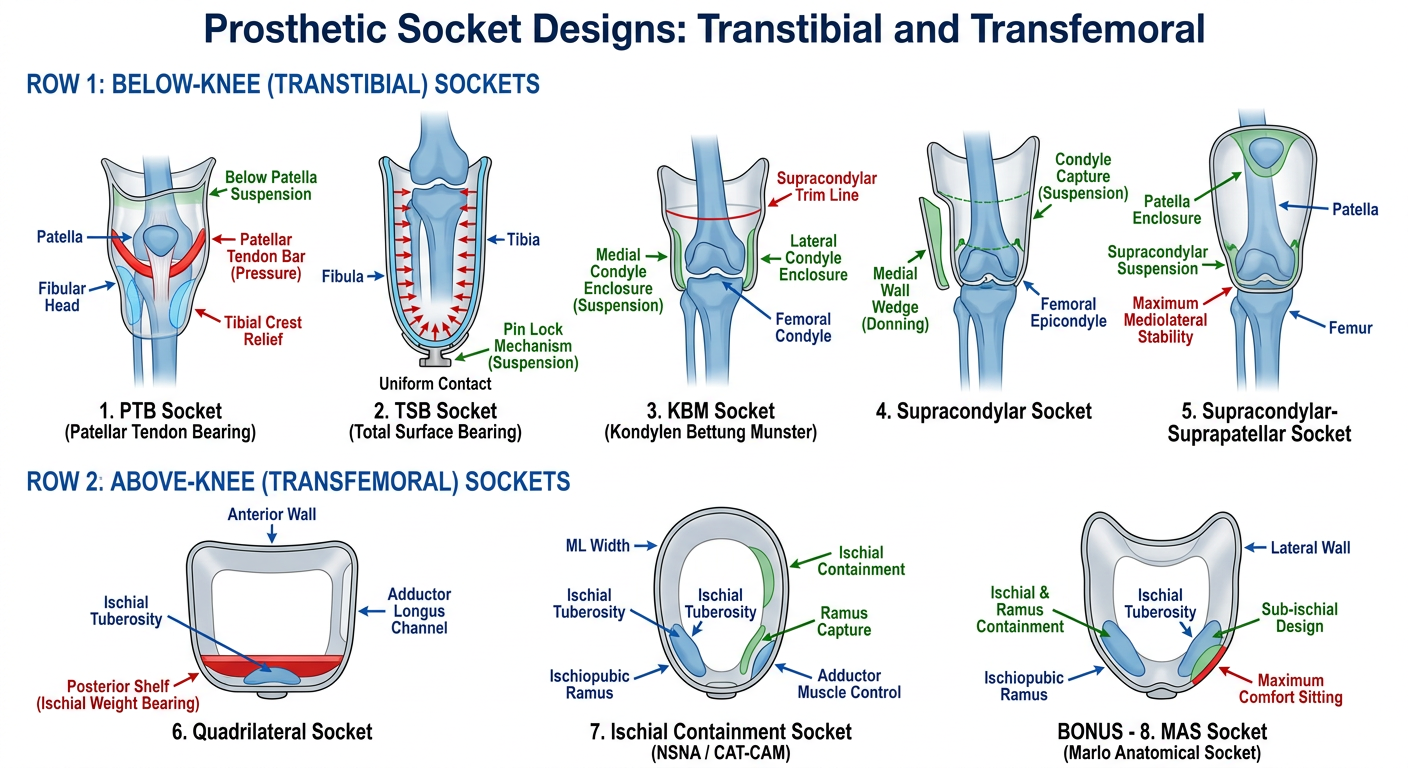
TRANSTIBIAL (Below-Knee) Sockets
1. PTB - Patellar Tendon Bearing
- Weight bearing: Primarily on the patellar tendon bar (the flat area just below the patella)
- Pressure relief areas: Tibial crest, tibial tubercle, fibular head, distal tibia
- Suspension: Usually via supracondylar strap, sleeve, or cuff
- Trim line: Just below the patella proximally
- Key feature: Selective loading - NOT total contact in the traditional sense
2. TSB - Total Surface Bearing
- Weight bearing: Distributed uniformly across the entire residual limb
- Interface: Silicone/gel liner worn against the skin; pin lock or lanyard at the distal end
- Suspension: Pin-lock or suction via the liner
- Key feature: Reduces pistoning, improves proprioception, better for sensitive stumps
- Modern standard: Has largely replaced PTB in high-income settings
3. KBM - Kondylen Bettung Munster (German origin)
- Proximal trim line: Extends above the femoral condyles medially and laterally
- Suspension: Self-suspending - the condyles are captured within the socket walls
- No sleeve needed for suspension
- Key feature: Good for short or fleshy stumps where sleeve suspension fails
- Limitation: Restricts knee flexion slightly due to higher brim
4. Supracondylar Socket
- Proximal trim line: Rises above and encloses the femoral epicondyles
- Suspension: Condylar capture (medial wall is removable/wedge for donning)
- Difference from KBM: More complete condyle enclosure; distinct removable medial wall design
- Key feature: Self-suspending without any external sleeve or strap
5. Supracondylar-Suprapatellar (SC/SP)
- Proximal trim line: Covers both femoral condyles AND the patella
- Suspension: Maximum condylar + patellar capture
- Key feature: Best mediolateral (ML) stability; used for very short transtibial stumps
- Trade-off: Limits full knee flexion; cosmetically bulkier proximally
TRANSFEMORAL (Above-Knee) Sockets
6. Quadrilateral Socket
- Shape: Roughly rectangular when viewed from above
- Weight bearing: Ischial tuberosity rests ON TOP of the posterior brim (outside the socket)
- Walls: Anterior wall is tallest; posterior brim is flat as a shelf for ischium
- Adductor channel: Medial wall has a relief groove for the adductor longus tendon
- Historical: Dominant design from 1950s-1980s; now largely replaced
- Limitation: Tends to cause lateral socket shift; femoral adductors compressed
7. Ischial Containment Socket (IC / CAT-CAM / NSNA)
- Shape: Narrow ML width, more anatomically oval
- Weight bearing: Ischial tuberosity is INSIDE the socket (contained), not resting on top
- Key feature: Medial brim captures the ischium and inferior pubic ramus - creates a true bony lock
- Benefits: Better adductor function, improved gait, less pelvic drop (Trendelenburg)
- Current standard: Preferred design for most transfemoral amputees today
8. MAS Socket - Marlo Anatomical Socket
- Developed by: Marlo Ortiz (prosthetist), Mexico
- Shape: Very low anterior trim line (sub-ischial); high lateral wall
- Weight bearing: Ischium and ramus fully contained; weight through lateral femur and soft tissue
- Key feature: Dramatically improved sitting comfort; allows greater hip flexion
- Use: Active patients; gaining popularity as an alternative to standard IC sockets
- Trade-off: Technically demanding to fabricate; not suitable for all stump shapes
Quick Comparison Table
| Socket | Level | Ischium Position | Suspension | Key Advantage |
|---|---|---|---|---|
| PTB | BK | - | Cuff/sleeve | Simple, proven |
| TSB | BK | - | Pin/suction liner | Uniform pressure |
| KBM | BK | - | Self-suspending (condyles) | Short stumps |
| Supracondylar | BK | - | Self-suspending (condyles) | No sleeve needed |
| SC/SP | BK | - | Condyle + patella | Very short stumps, ML stability |
| Quadrilateral | AK | ON brim (outside) | Suction/belt | Historical standard |
| Ischial Containment | AK | INSIDE socket | Suction | Better gait, adductor control |
| MAS | AK | Fully inside | Suction | Best sitting comfort |
draw a diagram of silicone gel polyurethne pur custom soft liners diagrams
A detailed medical educational diagram comparing 4 types of prosthetic residual limb liners, arranged side by side, clean anatomical illustration style, white background, cross-sectional and external views shown: 1. SILICONE LINER (leftmost panel): - External view: smooth, semi-transparent sleeve shape, tapered distally - Cross-section cutaway showing: thick uniform silicone wall (medium thickness ~6mm), distal pin/locking mechanism at tip, fabric outer layer bonded to silicone, wave-pattern inner surface texture for skin grip - Labels: silicone matrix, fabric reinforcement layer, distal pin lock connector, uniform wall thickness, high friction inner surface - Color: translucent blue-grey 2. GEL LINER (second panel): - External view: soft gel-filled sleeve, slightly thicker walls - Cross-section cutaway showing: outer fabric layer, middle gel layer (thickest, cushioning), inner thin silicone layer touching skin, distal locking pin, variable wall thickness (thicker at bony prominences) - Labels: tri-layer construction, gel cushioning core, fabric outer shell, distal locking pin, thicker walls at tibial crest relief zones - Color: translucent amber/yellow gel core 3. POLYURETHANE (PUR) LINER (third panel): - External view: firm outer surface, matte finish sleeve - Cross-section cutaway showing: polyurethane foam matrix layer, thin inner contact layer, distal lanyard loop attachment (no pin), sealed distal end, slightly textured outer surface - Labels: polyurethane matrix, lanyard suspension attachment, no pin (suction/lanyard based), lightweight construction, lower friction than silicone, good for sensitive skin - Color: white/cream colored 4. CUSTOM SOFT LINER (rightmost panel): - External view: irregular shaped custom-molded sleeve matching specific stump anatomy - Cross-section cutaway showing: thick soft EVA/silicone foam padding at bony prominences (tibial crest, fibular head), thinner walls in non-bony areas, custom relief cutouts/pads, no standard suspension mechanism, fits directly into hard socket - Labels: custom-molded shape, differential padding thickness, relief pads at bony prominences, cast from patient's residual limb, used inside hard socket as interface - Color: skin-toned soft material Each panel shows: TOP = external sleeve view, BOTTOM = cross-sectional cut view Small icons showing: durability rating (stars), skin sensitivity suitability, activity level recommendation Title at top in bold: "Prosthetic Liner Types: Material Comparison" Subtitle: "Interface between residual limb and prosthetic socket" Footer comparison table showing: Material | Durability | Cushioning | Suspension | Skin Sensitivity | Cost
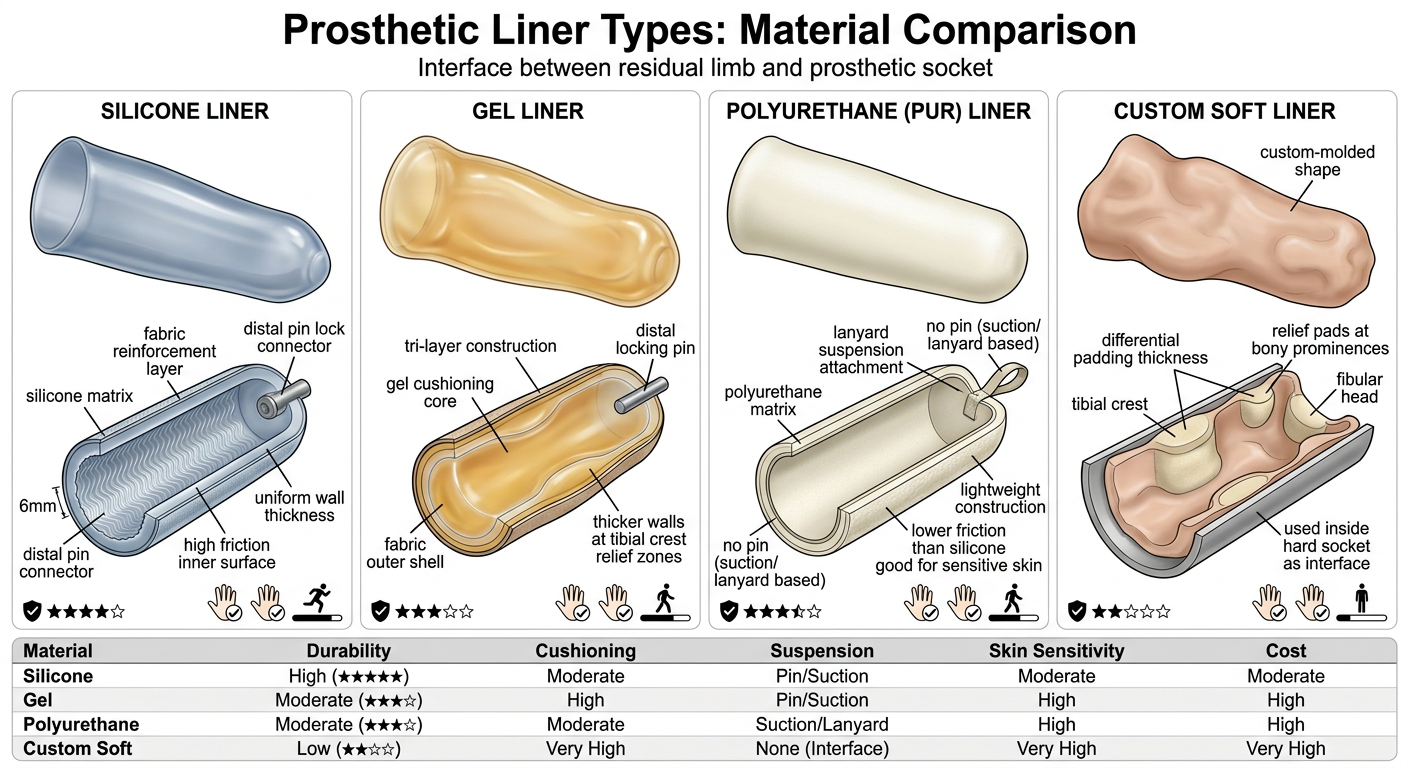
1. Silicone Liner
- Material: Medical-grade silicone elastomer
- Wall thickness: Typically 3mm, 6mm, or 9mm - uniform throughout
- Inner surface: High-friction texture that grips the skin directly - rolled on inside-out
- Outer surface: Fabric reinforcement layer bonded to silicone for durability
- Suspension: Distal pin-lock mechanism (most common) or lanyard; also used with suction
- Properties:
- Highest durability of all liner types (12-18 months typical lifespan)
- Moderate cushioning
- Excellent suspension via pin
- May cause sweating due to non-breathable material
- Best for: Active users, stable mature stumps, those needing reliable suspension
- Common brands: Ossur Alpha, Otto Bock 6Y series
2. Gel Liner
- Material: Tri-layer - outer fabric + middle mineral oil/gel core + inner silicone skin contact layer
- Wall thickness: Variable - thicker over bony prominences for targeted cushioning
- Key feature: The gel core provides superior shock absorption and pressure redistribution
- Suspension: Distal pin-lock or locking lanyard
- Properties:
- Best cushioning of all liner types
- Ideal for sensitive, scarred, or grafted residual limbs
- Shorter lifespan than silicone (~6-12 months) - gel can degrade
- Heavier than silicone
- Best for: Patients with skin breakdown, bony prominences, pain at tibial crest or fibular head, diabetic stumps
- Common brands: Ossur Iceross, Ohio Willow Wood Alpha Hybrid
3. Polyurethane (PUR) Liner
- Material: Polyurethane foam/elastomer matrix
- Wall thickness: Uniform, slightly firmer feel than silicone
- Inner surface: Lower friction than silicone - easier to don, less shear force on skin
- Suspension: Typically lanyard or suction based (often no pin)
- Properties:
- Lowest friction of the three - reduces skin shear
- Good for patients with fragile or hypersensitive skin
- Moderate cushioning
- More breathable than silicone
- Moderate durability (~9-12 months)
- Slightly higher cost
- Best for: Skin-sensitive patients, those with allergies to silicone, high-shear environments
- Common brands: Ottobock Derma series, Streifeneder PUR liners
4. Custom Soft Liner (Pelite / EVA / Foam)
- Material: Expanded polyethylene (Pelite), EVA foam, or closed-cell foam
- Design: Individually fabricated by casting directly from the patient's residual limb
- Structure: Differential thickness - thick padding over bony prominences (tibial crest, fibular head, distal tibia), thin over soft tissue areas
- Suspension: None intrinsic - sits inside a hard socket as an interface layer; suspension comes from the outer hard socket
- Properties:
- Fully customized to individual anatomy
- Excellent for irregular stump shapes, prominent bones, or post-surgical stumps
- Cheap to fabricate
- Heat-moldable - can be adjusted chairside
- No pin/suction - dependent on socket fit for suspension
- Lower durability (needs replacement every few months as stump changes)
- Best for: New amputees with changing stump volume, very bony stumps, low-resource settings
- Common materials: Pelite (standard), Aliplast, PPT foam
Comparison Table
| Feature | Silicone | Gel | Polyurethane | Custom Soft |
|---|---|---|---|---|
| Cushioning | Moderate | Best | Moderate | Good (variable) |
| Durability | Best (12-18 mo) | Moderate (6-12 mo) | Good (9-12 mo) | Poor (3-6 mo) |
| Suspension | Pin/suction | Pin/suction | Lanyard/suction | None (socket-dependent) |
| Skin friction | High | Moderate | Low | Low |
| Skin sensitivity | Moderate | Best | Best | Good |
| Cost | Moderate | High | High | Low |
| Breathability | Low | Low | Moderate | High |
| Customization | Off-the-shelf | Off-the-shelf | Off-the-shelf | Fully custom |
| Best use | Active users | Sensitive/bony stumps | Fragile skin | Irregular stumps, new amputees |
Clinical Selection Guide
- New amputee with changing stump volume → Custom soft liner (easy to modify)
- Mature stump, active user → Silicone pin-lock liner
- Painful bony prominences / skin breakdown → Gel liner
- Skin allergy to silicone / high shear → Polyurethane liner
- Low-resource / developing world → Custom Pelite soft liner
draw adigarm of endo exo pylon dynamic pylon telescopic pylon
A detailed medical educational diagram comparing 5 types of prosthetic pylons arranged side by side, clean technical illustration style, white background, full lateral (side) view of each pylon assembly: 1. ENDOSKELETAL PYLON (leftmost): - Shows a below-knee prosthesis in cross-section/cutaway - Central metal/carbon tube (pylon) running down the center - Soft foam cosmetic cover surrounding the tube, shaped like a leg - Outer cosmetic stocking/skin-colored cover over foam - Pyramid adapter at top connecting to socket - Foot attached at bottom - Labels with arrows: central load-bearing tube (titanium/aluminum/carbon), soft cosmetic foam cover, cosmetic skin cover/stocking, pyramid adapter, modular components, lightweight - Color: show cutaway revealing inner tube within flesh-colored foam cover 2. EXOSKELETAL PYLON (second): - Shows a below-knee prosthesis with hard outer shell as the structure - Hard laminated plastic/fiberglass shell IS the structural element (no inner tube) - Hollow inside - Thicker rigid outer wall - No soft foam cover - the shell itself is the cosmetic and structural component - Labels: hard outer laminated shell (load bearing), hollow interior, no separate pylon tube, crustacean/shell structure, durable but heavy, carved wooden/plastic appearance - Color: hard tan/beige rigid shell appearance 3. STANDARD/RIGID PYLON (third): - Simple straight metal tube (aluminum or titanium or carbon fiber) - No cosmetic cover shown - Pyramid adapter at proximal end - Bolt attachment at distal end to foot - Labels: straight rigid tube, aluminum/titanium/carbon fiber, no energy storage, pyramid adapters top and bottom, modular connection system, standard length - Color: metallic silver/gray tube 4. DYNAMIC/ENERGY-STORING PYLON (fourth): - Carbon fiber pylon with curved/tapered design - Shows slight flex/bend in the tube with motion arrows indicating spring action - Curved carbon fiber tube that stores and returns energy - Labels: carbon fiber construction, dynamic flex zone (mid-section), energy storage and return, arrows showing compression and rebound, reduces impact forces, used in running/sports prosthetics, lighter weight - Color: black carbon fiber weave pattern with yellow arrows showing energy direction 5. TELESCOPIC PYLON (rightmost): - Shows two-part sliding pylon assembly - Outer tube with inner sliding tube inside (like a telescope) - Locking mechanism shown at junction - Compression spring or hydraulic element inside - Labels: outer tube, inner sliding tube, locking collar/clamp, adjustable length, shock-absorbing spring element, allows length adjustment during ambulation, vertical shock absorption arrows - Color: metallic two-tone showing inner/outer tubes Each pylon shown in full assembly: socket adapter at top, pylon in middle, foot at bottom Small comparison icons below each showing: weight rating, durability, cost, activity level suitability Title at top in bold: "Prosthetic Pylon Types: Structural Comparison" Subtitle: "Endoskeletal vs Exoskeletal vs Dynamic vs Telescopic"
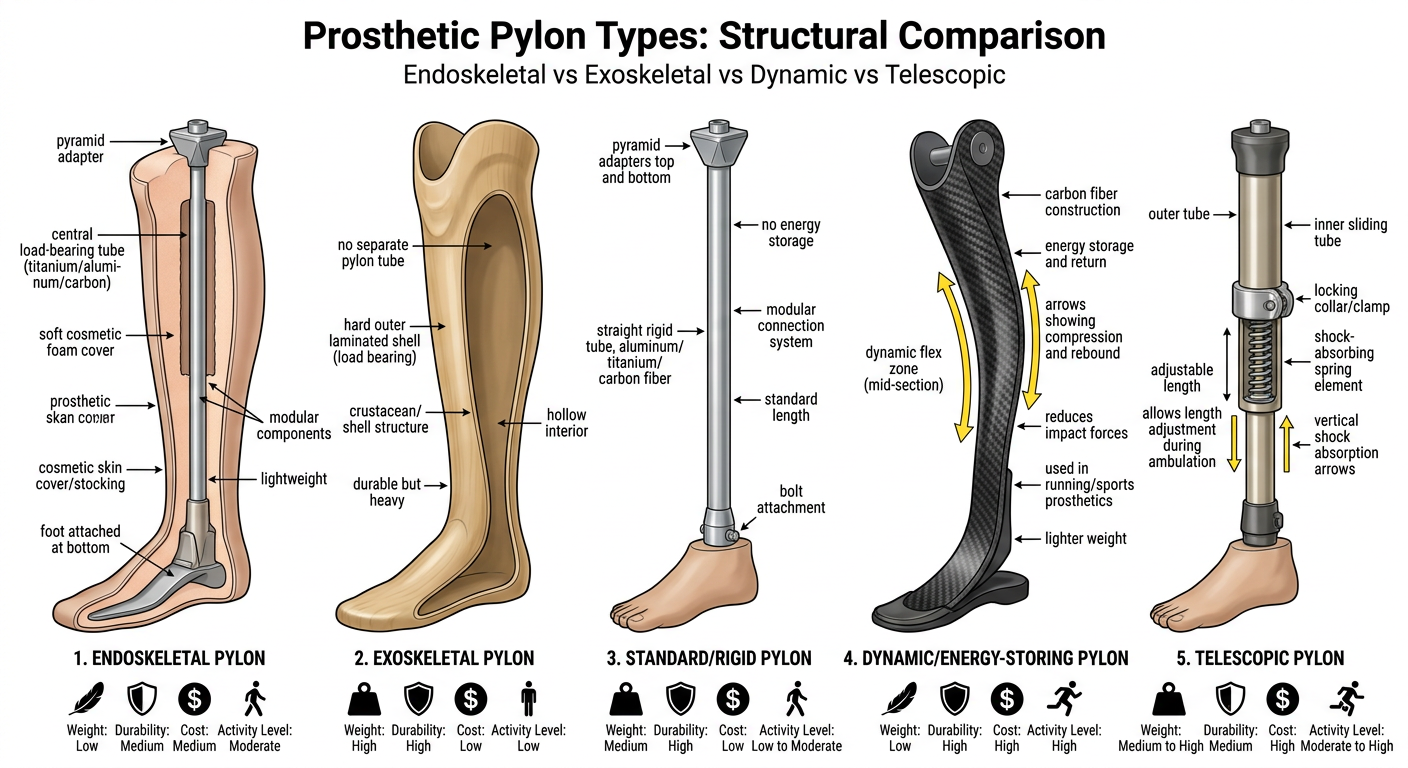
1. Endoskeletal Pylon ("Endo" / Modular)
- Structure: A central load-bearing tube (the pylon) runs through the core, surrounded by a soft foam cosmetic cover and an outer skin-like stocking
- Materials: Pylon tube in aluminium, titanium, or carbon fiber; foam cover in polyurethane; outer cover in nylon/silicone stocking
- How it works: All structural forces pass through the inner tube; the outer foam and stocking are purely cosmetic and bear no load
- Connection: Pyramid adapters (top and bottom) allow modular attachment to socket, knee unit, and foot - each component can be replaced independently
- Advantages:
- Lightweight
- Fully modular - easy component changes and alignment adjustments
- Better cosmetic appearance with cover
- Dominant design in modern prosthetics
- Disadvantages: Foam cover tears and degrades; less durable cosmetically
- Used in: Most modern transtibial and transfemoral prostheses
2. Exoskeletal Pylon ("Exo" / Crustacean / Conventional)
- Structure: The hard outer shell IS both the structural and cosmetic element - no inner tube, no soft cover
- Materials: Hard laminated fiberglass, carbon fiber, or polyester resin over a carved foam core; or carved wood (historically)
- How it works: Load passes through the rigid outer shell wall, like a crustacean's exoskeleton
- Connection: Integrated - components are built into the shell, not modular
- Advantages:
- Extremely durable outer surface - resists abrasion, mud, water
- No cosmetic cover to replace
- Better suited for heavy labor and harsh environments
- Disadvantages:
- Heavy
- Cannot easily adjust alignment after fabrication
- Difficult to repair or upgrade components
- Poor cosmesis once worn
- Used in: Developing world settings (Jaipur limb is partly exo-style), heavy-duty work environments, pediatric prostheses (durable for active children)
3. Standard Rigid Pylon
- Structure: A straight, rigid metallic or carbon fiber tube with no energy-storing or shock-absorbing properties
- Materials: Aluminium (most common, cheapest), titanium (lighter, stronger), carbon fiber (lightest, most expensive)
- Connection: Pyramid adapters at both ends - fully modular
- Properties:
- Transmits all ground reaction forces directly and rigidly upward into the socket
- No flex, no energy return, no shock absorption
- Simple, cheap, reliable
- Advantages: Low cost, easy to source and replace, widely compatible
- Disadvantages: Higher impact forces transmitted to stump and residual joints; no dynamic benefit
- Used in: Budget prostheses, low-activity users (K1-K2 ambulators), developing world
4. Dynamic / Energy-Storing Pylon
- Structure: A carbon fiber pylon with a curved or tapered profile designed to flex under load and rebound on push-off
- Materials: Woven or unidirectional carbon fiber composite
- How it works: The pylon deflects (bends slightly) during stance phase, storing elastic energy, then releases it during late stance/push-off - similar in concept to a carbon fiber running blade
- Key zones: A defined "dynamic flex zone" in the mid-section where controlled bending occurs
- Advantages:
- Reduces peak impact forces on the stump and proximal joints
- Returns energy for more efficient gait
- Reduces metabolic cost of walking
- Lighter than metal pylons
- Disadvantages: Higher cost; not suitable for very heavy users (may fatigue/fracture)
- Used in: Active users (K3-K4), sports prosthetics, running prostheses, young active amputees
- Examples: Ottobock Taleo, Ossur Flex-Run concept pylons
5. Telescopic Pylon (Shock-Absorbing / Length-Adjusting)
- Structure: Two concentric tubes - an outer tube and an inner sliding tube - that can compress axially
- Internal mechanism: Contains a spring, elastomer bumper, or hydraulic element that resists compression and then rebounds
- Two functions:
- Shock absorption: Vertical compression during heel strike reduces impact forces
- Length adjustment: Some versions allow manual length setting for height fine-tuning
- Advantages:
- Significant reduction in vertical impact forces - protects stump, hip, and spine
- Improves comfort on stairs, ramps, uneven ground
- Reduces socket pistoning
- Some allow rotational (torsional) accommodation as well
- Disadvantages: Heavier than standard pylons; adds a potential failure point; more expensive
- Used in: Active users with back/hip pain, bilateral amputees, patients with osteoporosis or sensitive stumps, off-road/outdoor users
- Examples: Ottobock Torsion Adapter, Fillauer ShockMaster, College Park Tru-Step
Quick Comparison Table
| Feature | Endoskeletal | Exoskeletal | Standard Rigid | Dynamic | Telescopic |
|---|---|---|---|---|---|
| Weight | Light | Heavy | Moderate | Lightest | Heavy |
| Durability | Moderate | Best | Good | Moderate | Good |
| Modularity | Full | None | Full | Full | Full |
| Energy return | None | None | None | Yes | Partial |
| Shock absorption | None | None | None | Partial | Yes |
| Cosmesis | Good (with cover) | Good (integral) | Poor (bare tube) | Poor (bare) | Poor (bare) |
| Cost | Low-Moderate | Moderate | Lowest | High | High |
| Best user | Most users | Heavy labor/rural | Budget/low activity | Active/sports | High impact/back pain |
draw a diagram of suprcondylar suprapatellar sleeve sction pin locking lanyard elevated vaccum suspension diagram
A detailed medical educational diagram comparing 6 prosthetic suspension systems for transtibial (below-knee) amputees, arranged side by side, clean anatomical cross-section illustration style, white background: 1. SUPRACONDYLAR SUSPENSION (leftmost): - Side view of below-knee socket on a leg - Socket trim line rises above and wraps around the femoral medial and lateral epicondyles - Medial wall shown as removable wedge for donning - Bony condyles highlighted in blue captured inside socket walls - Arrow showing condyle capture zone - Labels: proximal trim line above condyles, medial removable wedge, lateral condyle captured, self-suspending (no sleeve), bony lock mechanism - Color: tan socket with blue bony highlights 2. SUPRACONDYLAR-SUPRAPATELLAR (SC/SP) SUSPENSION (second): - Side view showing socket extending above condyles AND covering the patella anteriorly - Patella shown enclosed within anterior socket wall - Higher proximal brim than supracondylar - Labels: patella enclosed anteriorly, condyles captured medially/laterally, highest brim of BK sockets, maximum ML stability, limits full knee flexion - Color: tan socket with blue patella and condyles highlighted 3. SLEEVE SUSPENSION (third): - Side view showing silicone/neoprene sleeve rolled over the outside of the socket and up onto the thigh - Sleeve shown as semi-transparent covering both socket proximal brim and thigh skin - No liner pin shown - Labels: silicone or neoprene sleeve, rolled over socket and thigh, creates suction seal, 6-8cm onto thigh skin, easy to don/doff, can tear with use - Color: translucent blue sleeve over socket 4. PIN LOCKING SUSPENSION (fourth): - Cross-section view showing silicone liner inside socket - Distal pin protruding from bottom of liner - Pin clicking into ratchet lock mechanism at distal socket end - Ratchet/lock housing shown at socket base - Release button on socket side - Labels: silicone gel liner, distal locking pin, ratchet lock mechanism, release button, audible click confirms lock, most common suspension system, pistoning controlled - Color: grey liner, metallic pin and lock shown in gold/yellow 5. LANYARD SUSPENSION (fifth): - Cross-section view showing liner inside socket - Cord/strap (lanyard) attached to distal liner tip, threaded through small hole at socket base, pulled up and attached to Velcro strap on outer socket wall - Labels: liner distal attachment point, lanyard cord, through-hole at socket base, Velcro or buckle strap, tension prevents pistoning, no metal pin, suitable for sensitive distal stumps - Color: liner in amber, lanyard as yellow cord, strap in orange 6. ELEVATED VACUUM SUSPENSION / EVS (rightmost): - Cross-section showing liner inside socket - Electric vacuum pump unit shown attached to socket side - Pump draws air OUT of space between liner and socket wall - Negative pressure zone shown with dotted shading between liner exterior and socket interior - Sensor and tubing shown - Labels: electric vacuum pump, negative pressure zone (sealed air space), sensor monitors pressure, maintains consistent vacuum during gait, reduces pistoning to near zero, improves proprioception, battery-powered pump unit, best suspension available - Color: white socket, pump in dark grey, vacuum zone in light blue shading Title at top: "Prosthetic Suspension Systems: Transtibial Comparison" Each panel clearly labeled with system name, show residual limb anatomy (tibia, fibula, femoral condyles, patella) in blue outline inside each socket Footer: small rating icons for Security, Ease of Use, Activity Level, Cost under each system
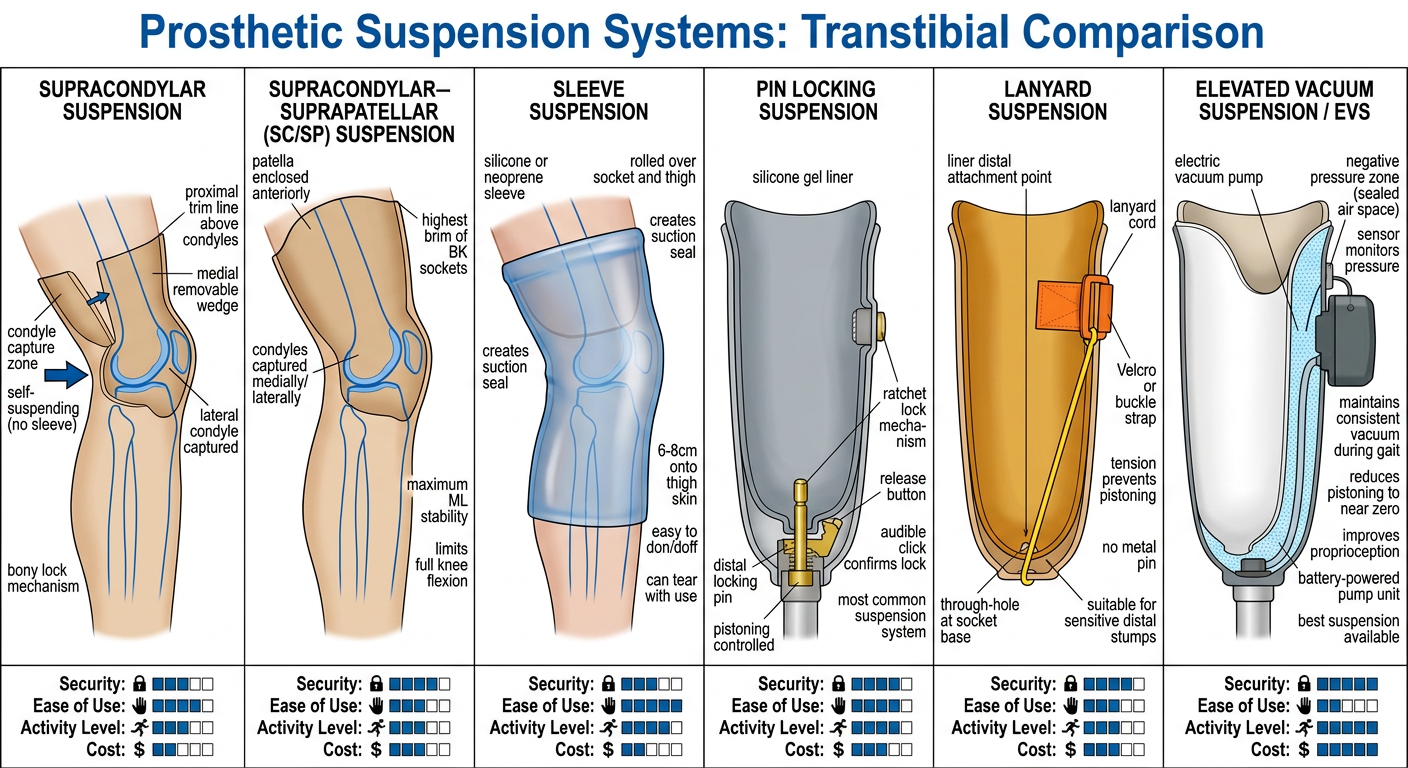
1. Supracondylar Suspension
- Mechanism: The socket's proximal trim line extends above the femoral medial and lateral epicondyles, physically capturing the bony condyles within the socket walls
- Key feature: A removable medial wedge is taken out to allow the stump to slide in, then reinserted to lock the condyles inside
- No liner or sleeve needed for suspension
- How it holds: Bony interlock - the condyles are wider than the socket opening at rest, creating a mechanical lock
- Advantages:
- Simple and reliable
- No external components to wear out
- Good for short stumps or patients who struggle with sleeves
- Disadvantages: Slightly limits knee flexion; bulkier socket proximally; not suitable for obese or very fleshy thighs where condyles are not palpable
- Best for: Short-to-medium transtibial stumps, low-to-moderate activity
2. Supracondylar-Suprapatellar (SC/SP) Suspension
- Mechanism: Extends the supracondylar principle further - the trim line also rises anteriorly to enclose the patella
- Three-point bony capture: Medial condyle + lateral condyle + patella all enclosed
- Provides maximum suspension security of all purely bony/mechanical suspension designs
- Advantages:
- Strongest bony suspension
- Best mediolateral stability - useful for very short stumps
- No external components
- Disadvantages:
- Most restrictive - limits knee flexion significantly (cannot fully flex knee with patella enclosed)
- Cosmetically bulkier
- Difficult to don with limited hand dexterity
- Best for: Very short transtibial stumps, patients with weak quadriceps needing anterior stability
3. Sleeve Suspension
- Mechanism: A stretchy silicone or neoprene sleeve is rolled over the outside of the socket and up 6-8 cm onto the bare thigh skin above the socket brim
- How it holds: The sleeve forms an airtight friction seal between the socket brim and the thigh skin - negative pressure builds during swing phase, resisting pull-off
- No liner pin or pump needed
- Advantages:
- Simple to use
- Inexpensive
- Works with almost any liner or socket
- Good suspension for moderate activity
- Disadvantages:
- Sleeve degrades and tears (replace every 3-6 months)
- Rolls down in hot/sweaty conditions
- Restricts knee flexion slightly if too tight
- Not suitable for very active users (pistoning occurs during running)
- Best for: K2-K3 users, elderly patients, patients with skin sensitivity to pin mechanisms
4. Pin Locking Suspension
- Mechanism: The silicone or gel liner has a threaded metal pin protruding from its distal tip. As the patient pushes the stump into the socket, the pin engages a ratchet lock mechanism at the socket base - an audible click confirms engagement
- Release: A push-button on the side of the socket disengages the ratchet to remove the prosthesis
- How it holds: Mechanical positive lock - pin physically locked into ratchet; cannot pull out without pressing release button
- Advantages:
- Highly secure and reliable
- Audible/tactile confirmation of donning
- Simple mechanism - low maintenance
- Most widely used suspension system globally
- Disadvantages:
- Pin can cause distal end-bearing pressure if stump is very sensitive
- If patient gains/loses volume, pin may not engage fully
- Pistoning still occurs between the liner and the skin (not between socket and liner)
- Best for: Most transtibial amputees, K2-K4 activity levels
5. Lanyard Suspension
- Mechanism: Instead of a metal pin, a cord (lanyard) is attached to the distal tip of the liner. The lanyard threads through a small hole at the base of the socket and is then secured to a Velcro strap or buckle on the outer socket wall - tension in the cord prevents the liner (and stump) from pulling out
- How it holds: Tensile force through the cord - pulling the liner distally is resisted by the anchored cord
- Advantages:
- No metal pin - better for distal-sensitive stumps
- Allows some distal end relief while still suspending
- Cheap and simple
- Works well with polyurethane liners (which often don't have pin attachments)
- Disadvantages:
- Less secure than pin lock - cord can slip or loosen
- Lanyard can fray or break
- Slightly more pistoning than pin lock
- Requires manual tightening/adjustment
- Best for: Patients with distal stump sensitivity, hypersensitive scar tissue, or those using polyurethane liners
6. Elevated Vacuum Suspension (EVS)
- Mechanism: A battery-powered electric vacuum pump (worn on the prosthesis) continuously draws air out of the sealed space between the liner exterior and the socket interior wall, maintaining a defined negative pressure (typically -50 to -80 mmHg) throughout the gait cycle
- Components: Pump unit, sensor, tubing, one-way valve, sealed socket
- How it holds: Atmospheric pressure difference - the higher external air pressure pushes the liner-covered stump into the socket; the pump removes any air that leaks in
- Advantages:
- Near-zero pistoning - the gold standard for suspension security
- Dramatically improved proprioception and ground feel
- Reduces residual limb volume fluctuation (negative pressure maintains limb shape)
- Better gait symmetry and energy efficiency
- Reduces skin breakdown from shear
- Disadvantages:
- Most expensive suspension system
- Requires battery charging
- Heavier (pump unit adds weight)
- More complex maintenance
- Pump failure = loss of suspension
- Best for: K3-K4 highly active users, athletes, bilateral amputees, patients with significant volume fluctuation
Comparison Table
| System | Security | Ease of Use | Activity Level | Cost | Pistoning |
|---|---|---|---|---|---|
| Supracondylar | Good | Easy | K1-K3 | Lowest | Moderate |
| SC/Suprapatellar | Best (bony) | Moderate | K1-K2 | Low | Low |
| Sleeve | Moderate | Easy | K2-K3 | Low | Moderate |
| Pin Lock | Good-High | Easy | K2-K4 | Moderate | Low |
| Lanyard | Moderate | Easy | K1-K3 | Low | Moderate |
| Elevated Vacuum | Best | Complex | K3-K4 | Highest | Near Zero |