
Tell about heart failure
Reading File
Finding Sources
Searching Images
heart failure pathophysiology diagram
Reading File
Reading File
Finding Sources
Reading File
Reading File
I need to read the Harrison's heart failure section more accurately, and also get the treatment/management section from Family Medicine.
Finding Sources
Reading File
Reading File
Reading File
Reading File
Reading File
Reading File
I now have comprehensive material from multiple authoritative sources. Let me also read the treatment section from Harrison's and the NYHA classification for management, then compile the full answer.
Reading File
I now have comprehensive, authoritative content from multiple textbooks. Let me compile the full answer.
Heart Failure
Definition
Heart failure (HF) is a complex clinical syndrome with symptoms and signs that result from any structural or functional impairment of ventricular filling or ejection of blood. The European Society of Cardiology emphasizes cardinal symptoms — breathlessness, ankle swelling, and fatigue — accompanied by signs such as elevated jugular venous pressure, pulmonary crackles, and peripheral edema, due to a structural and/or functional abnormality of the heart resulting in elevated intracardiac pressures and/or inadequate cardiac output at rest or during exercise.
Because some patients present without signs of volume overload, the term heart failure is preferred over the older term "congestive heart failure."
— Harrison's Principles of Internal Medicine 22E, p. 2019
Epidemiology
- ~6.7 million American adults are currently treated for HF; over 56.2 million people live with HF globally
-
600,000 new cases diagnosed each year in the United States
- Prevalence increases markedly with age: 1–2% at age 40–49 → ≥10% in adults over 80
- Lifetime risk: approximately 1 in 4 persons will develop HF
- Mortality remains ~50% within 5 years of diagnosis
- One-month rehospitalization after discharge is approximately 25%
— Harrison's Principles of Internal Medicine 22E, p. 2020; Textbook of Family Medicine 9e
Classification
By Ejection Fraction
| Type | EF | Mechanism |
|---|---|---|
| HFrEF (HF with reduced EF) | < 40–50% | Impaired LV systolic contraction |
| HFpEF (HF with preserved EF) | > 45–50% | Impaired LV filling/relaxation (diastolic dysfunction) |
HFpEF and HFrEF are nearly equally common. Fluid retention and pulmonary congestion are hallmarks of HF but are not universally present in either type.
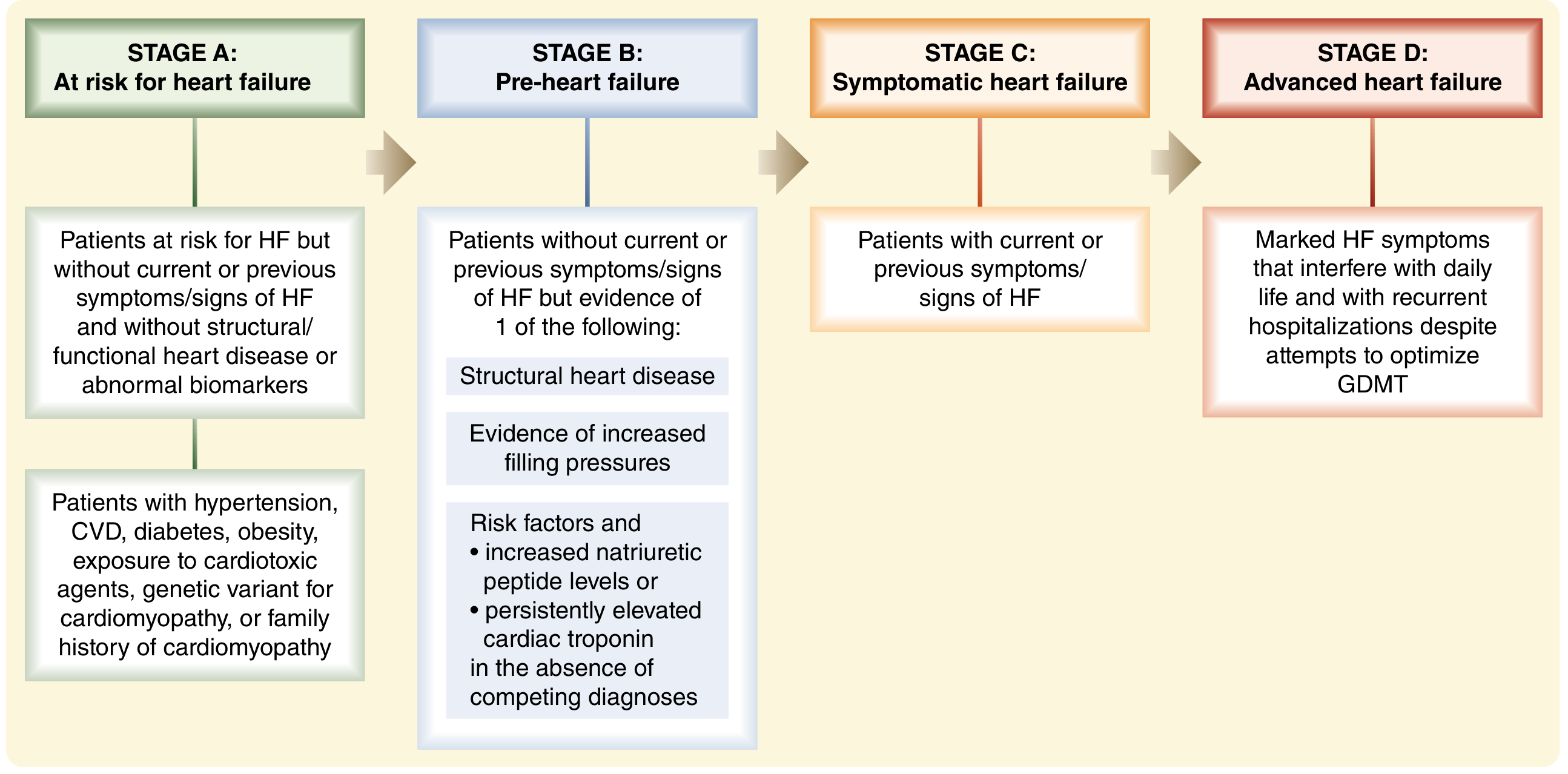
ACC/AHA Stages of Progression
| Stage | Description |
|---|---|
| A | At risk for HF but no structural disease or symptoms |
| B | Structural heart disease but no symptoms |
| C | Structural heart disease with prior or current symptoms |
| D | Refractory HF requiring advanced interventions |
NYHA Functional Classification
| Class | Limitation | Assessment |
|---|---|---|
| I | None | Ordinary activity does not cause symptoms |
| II | Mild | Comfortable at rest; ordinary activity causes symptoms |
| III | Moderate | Comfortable at rest; less-than-ordinary activity causes symptoms |
| IV | Severe | Symptoms at rest, worsen with any activity |
— Harrison's Principles of Internal Medicine 22E, p. 2024
Etiology
Common causes include:
- Ischemic cardiomyopathy (most common in adults in developed countries)
- Idiopathic dilated cardiomyopathy
- Hypertension (long-term pressure overload)
- Valvular heart disease (aortic stenosis, mitral regurgitation)
- Viral myocarditis
- Congenital heart disease
- Infiltrative conditions: amyloidosis, sarcoidosis
- Hypertrophic/restrictive cardiomyopathy
- Metabolic: diabetes mellitus, alcoholism, anemia, hyperthyroidism (high-output HF)
— Sabiston Textbook of Surgery, p. 1120; Textbook of Family Medicine 9e, p. 688
Pathophysiology
LV Remodeling
The central concept in modern HF pathophysiology is left ventricular remodeling — stretching and dilation of the LV with subsequent reduction in function. This is triggered by an index injury (MI, pressure overload, toxic exposure, etc.) and is — crucially — reversible with appropriate therapy.
- Concentric hypertrophy: increased mass out of proportion to chamber volume → pressure overload (e.g., hypertension, aortic stenosis)
- Eccentric hypertrophy: increased cavity size → volume overload (e.g., mitral/aortic regurgitation)
- Both are accompanied by myocyte hypertrophy, interstitial fibrosis, altered calcium-handling proteins, and re-expression of fetal genes
Neurohormonal Activation
Regardless of the precipitating injury, two major systems are activated and perpetuate remodeling:
-
Renin-Angiotensin-Aldosterone System (RAAS)
- Angiotensin II promotes myocyte apoptosis, hypertrophy, and ventricular fibrosis
- Aldosterone augments these effects and promotes adverse remodeling
- Aldosterone "escapes" angiotensin suppression — so selective aldosterone blockade is needed on top of ACE inhibitors/ARBs
-
Sympathetic Nervous System (SNS)
- Elevated catecholamines suppress β-adrenergic receptors
- Direct cardiotoxicity via cAMP-dependent calcium overload of myocytes
- Increased myocardial O₂ consumption and risk of fatal arrhythmias
Additional mediators include endothelin-1 (vasoconstriction), pro-inflammatory cytokines, matrix metalloproteinases (cardiac fibrosis and collagen deposition), and vasopressin (fluid retention).
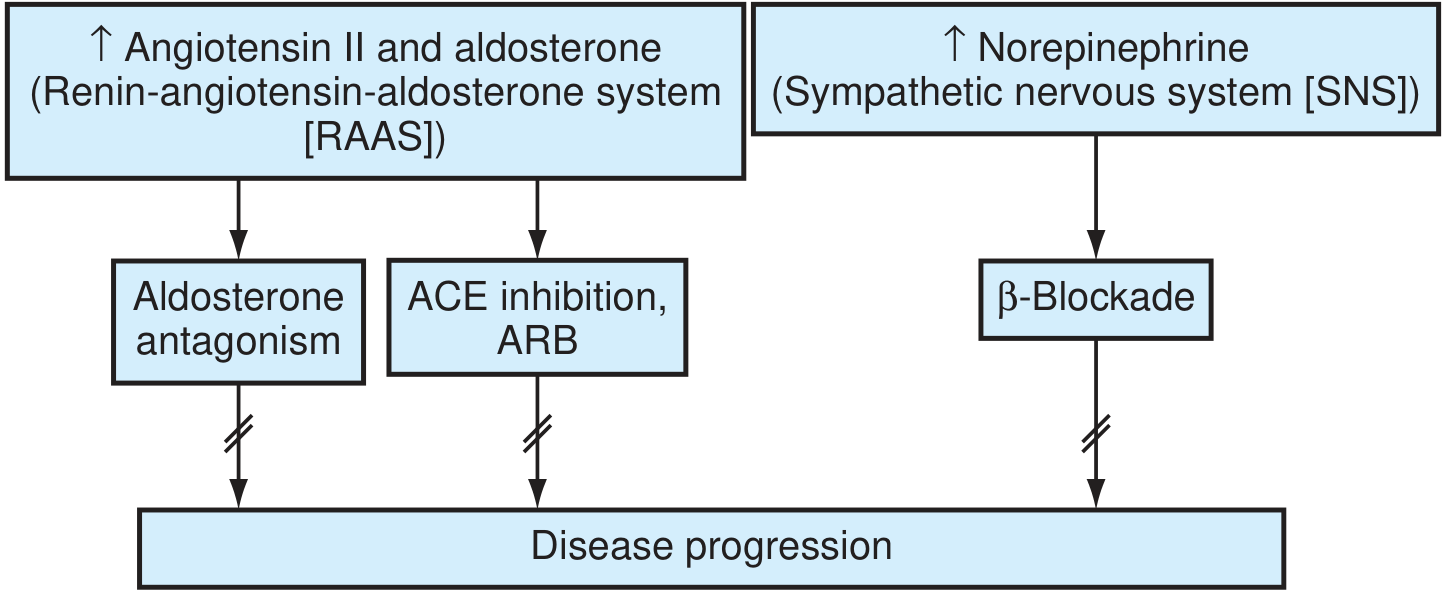
The renin-angiotensin-aldosterone and sympathetic nervous systems are key treatment targets in HF. (Textbook of Family Medicine 9e)
Frank-Starling Compensation
Early compensation increases preload → elevated end-diastolic volume → maintained stroke volume despite reduced EF. However, this raises pulmonary venous pressure, causing edema and eventually becoming maladaptive.
— Harrison's Principles of Internal Medicine 22E, p. 2021–2022; Textbook of Family Medicine 9e, p. 688–689; Sabiston Textbook of Surgery, p. 1120
Clinical Features
Symptoms
- Dyspnea: cardinal symptom of left HF — exertional dyspnea → orthopnea → paroxysmal nocturnal dyspnea (PND) → dyspnea at rest
- Orthopnea: dyspnea in the recumbent position, relieved by sitting up; occurs within 1–2 min of lying down
- PND: episodes that awaken patient from sleep; requires 30+ min upright for relief; may be accompanied by wheezing ("cardiac asthma")
- Bendopnea: dyspnea when bending forward — associated with elevated filling pressures
- Fatigue, reduced exercise tolerance
- Ankle and leg edema (right HF)
- Cheyne-Stokes respirations in advanced HF
Physical Examination Signs
- Elevated JVP (jugular venous pressure) — right atrial pressure estimate; hepatojugular reflux positive
- Pulmonary rales at lung bases (or throughout in severe HF)
- S3 gallop — implies volume overload and severe hemodynamic compromise; negative prognostic marker
- S4 gallop — seen in HFpEF with hypertension
- Displaced, diffuse apical impulse (dilated cardiomyopathy) or sustained (pressure overload)
- Bilateral pleural effusions (dullness to percussion at bases)
- Pulsus alternans — alternating strong/weak pulse due to incomplete ventricular recovery
- Holosystolic murmurs of mitral/tricuspid regurgitation in advanced HF
- Peripheral edema, hepatomegaly, ascites (right HF)
- Low-grade fever from cytokine activation in severe HF
— Harrison's Principles of Internal Medicine 22E, p. 2026–2028
Diagnosis
Key investigations include:
- ECG: arrhythmias, LVH, prior MI pattern
- Chest X-ray: cardiomegaly, pulmonary vascular congestion, pleural effusions
- Echocardiography: essential — measures EF, wall motion, diastolic function, valve disease, pericardial effusion
- BNP/NT-proBNP: biomarkers of myocardial wall stress; elevated in HF; useful for diagnosis and prognosis
- Laboratory: CBC (anemia), metabolic panel (renal function, electrolytes), thyroid function, LFTs
- Cardiac MRI: for cardiomyopathy characterization
- Coronary angiography: if ischemic etiology suspected
Management
Lifestyle Modifications
- Weight reduction, regular physical activity
- Sodium and fluid restriction
- Abstinence from alcohol, tobacco, and illicit drugs
- Optimization of comorbidities: diabetes, hypertension
Guideline-Directed Medical Therapy (GDMT) for HFrEF
Four pillars of evidence-based pharmacotherapy that reduce mortality:
| Drug Class | Examples | Mechanism |
|---|---|---|
| RAAS inhibitors ± neprilysin inhibitor | ACE inhibitors, ARBs, ARNI (sacubitril/valsartan) | Block angiotensin II/aldosterone harmful effects |
| Beta-blockers | Carvedilol, bisoprolol, metoprolol succinate | Block SNS toxicity, reduce remodeling |
| Mineralocorticoid receptor antagonists | Spironolactone, eplerenone | Block aldosterone-mediated fibrosis |
| SGLT2 inhibitors | Dapagliflozin, empagliflozin | Reduce HF hospitalizations and cardiovascular mortality |
Additional agents in select patients: hydralazine + nitrates (especially in Black patients), ivabradine (rate reduction), vericiguat (guanylate cyclase stimulator), diuretics (loop diuretics for congestion relief).
Device Therapy
- ICD (Implantable Cardioverter-Defibrillator): reduces sudden cardiac death in HFrEF with EF ≤35%
- CRT (Cardiac Resynchronization Therapy): biventricular pacing for patients with left bundle branch block and symptomatic HF — improves function and reduces mortality
- Transcatheter edge-to-edge repair (TEER): for secondary mitral regurgitation in advanced HF
Advanced/Refractory HF (ACC/AHA Stage D)
- LVAD (Left Ventricular Assist Device): durable mechanical circulatory support — used as bridge to transplant or destination therapy
- Heart transplantation: definitive therapy for eligible Stage D patients; improves survival and quality of life
- Absolute contraindication: pulmonary vascular resistance >6 Wood units
- Relative contraindications: PVR 4–6 Wood units, age >70, active malignancy, uncontrolled diabetes with end-organ damage
— Sabiston Textbook of Surgery, p. 1121; Textbook of Family Medicine 9e, p. 689; Harrison's Principles of Internal Medicine 22E
Prognosis
- 50% mortality within 5 years of diagnosis
- One-month readmission rate ~25%
- NYHA Class IV: 1-year mortality can exceed 50%
- Elevated BNP, low sodium, low EF, reduced peak VO₂, and elevated creatinine are adverse prognostic markers
- GDMT with all four drug pillars significantly reduces mortality and hospitalization
Sources: Harrison's Principles of Internal Medicine 22E | Textbook of Family Medicine 9e | Sabiston Textbook of Surgery | Braunwald's Heart Disease
This is a shared conversation. Sign in to Orris to start your own chat.