
Boy present with undefined breath sound but no other complain but telling ear block
Reading File
The clinical picture here is a boy with diminished/absent breath sounds + ear blockage (aural fullness) with no other complaints. This strongly points to a middle ear effusion / Eustachian tube dysfunction - but the combination of breath sound changes needs consideration for Foreign body in airway, pleural effusion, or mediastinal mass pressing on airways AND Eustachian tubes. Let me search the textbooks now.
Searching sources...
Finding Sources
Finding Sources
Finding Sources
Reading File
Reading File
Finding Sources
Loading Image
Finding Sources
This is a classic and important pediatric clinical scenario. Here is a thorough clinical analysis:
Clinical Analysis: Boy with Diminished Breath Sounds + Ear Blockage (No Other Complaints)
The Key Clinical Clue
The combination of unilateral/abnormal breath sounds + aural fullness/ear block in a child with no other complaints (no fever, no cough, no respiratory distress) is a highly specific pointer. This pattern should immediately raise suspicion for:
Most Likely Diagnosis: Foreign Body Aspiration (Bronchial)
This is the classic presentation, especially in young children (ages 1-3 most at risk).
Why this fits:
| Feature | Explanation |
|---|---|
| Diminished/absent breath sounds (usually unilateral) | Foreign body acting as a ball-valve in a mainstem or lobar bronchus - air enters on inspiration but cannot fully exit on expiration |
| "Ear block" sensation | Referred sensation or Valsalva-like pressure effect from the child bearing down; also, toddlers often describe unusual sensations from the chest as "ear block" or throat/ear discomfort |
| No cough, no fever, no distress | Classic asymptomatic interval after the initial choking event - the child may have adapted; parents may not have witnessed the aspiration |
| Child (male, young age) | Boys are more commonly affected than girls |
The Asymptomatic Interval
According to Rosen's Emergency Medicine and K.J. Lee's Essential Otolaryngology:
"Often the initial aspiration event is not observed... An observed choking event may be followed by an asymptomatic interval."
This is why the child appears well - they may have aspirated a smooth object (peanut, bean, small toy part) that partially obstructs a bronchus without completely blocking it.
Physical Exam Pearls (from Rosen's)
- Unilateral diminution of breath sounds is present in over 1/3 of pediatric cases
- Complete obstruction of a mainstem bronchus = absent ipsilateral breath sounds
- A foreign body acting as a one-way valve causes hyperinflation of the involved lung (hyper-resonance to percussion)
- Breath sounds can be transmitted across the thorax - so seemingly bilateral sounds don't rule it out
The Chest X-Ray - What to Look For
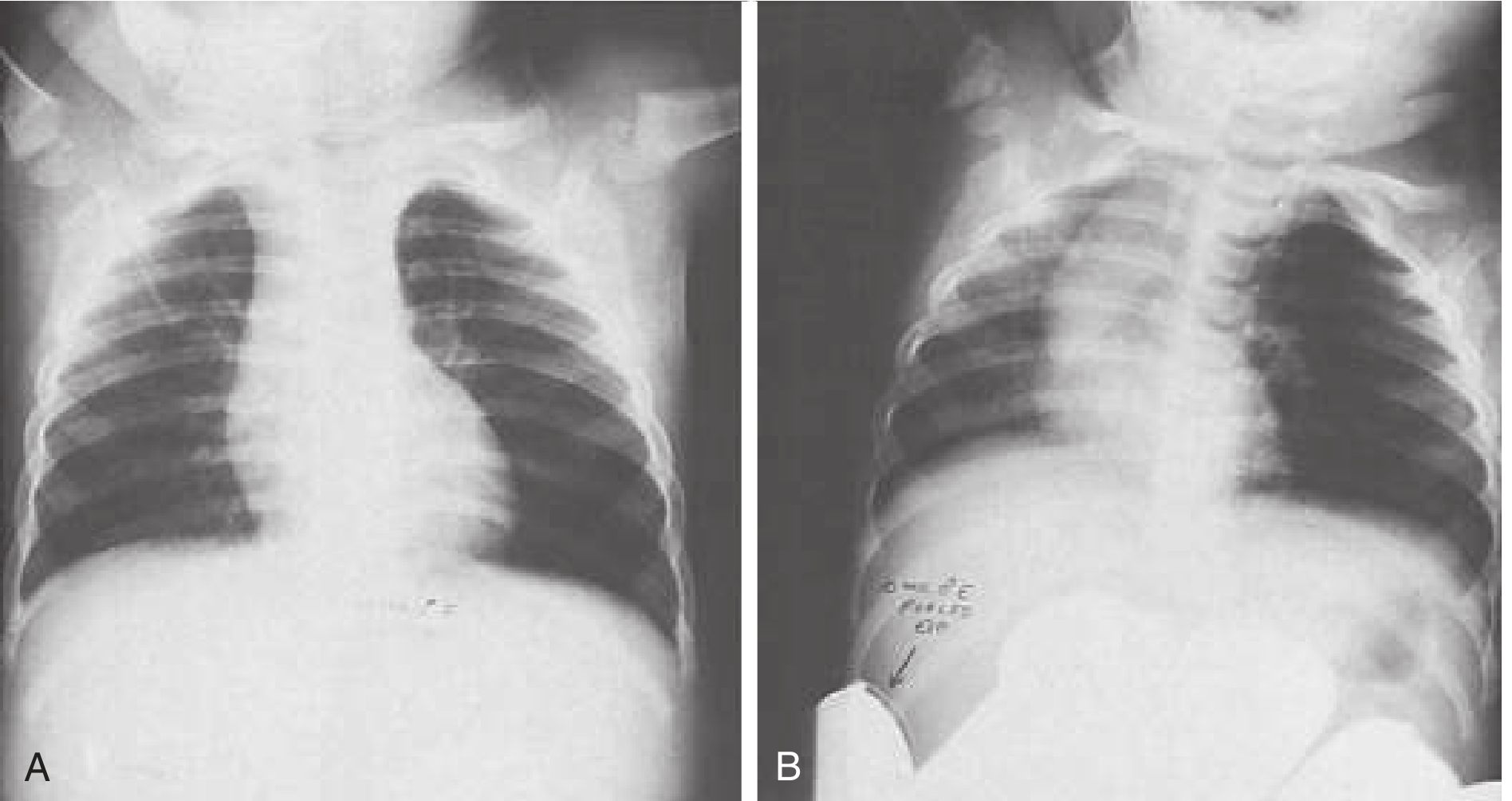
From Rosen's Emergency Medicine: (A) Normal inspiratory film in a child with left mainstem bronchus foreign body. (B) Forced expiratory view shows expanded/hyperinflated lung on the left with mediastinal shift to the uninvolved right side.
- Inspiratory CXR may look completely normal - this is the trap!
- Request bilateral decubitus views or forced expiratory views:
- The affected side fails to deflate normally on expiration
- Mediastinum shifts away from the obstructed (hyperinflated) side
- Only radiopaque foreign bodies are directly visible (minority of cases)
- May see obstructive emphysema, atelectasis, or consolidation as late findings
Differential Diagnoses to Consider
| Diagnosis | How it fits / doesn't fit |
|---|---|
| Foreign body aspiration (bronchial) | TOP diagnosis - fits perfectly |
| Esophageal foreign body | Large FB in esophagus can compress trachea posteriorly, causing breath sound changes + pressure/fullness sensation. Check for drooling, dysphagia |
| Mediastinal mass (lymphoma, etc.) | Can compress airways + Eustachian tubes via superior vena cava syndrome. Look for facial puffiness, dilated neck veins |
| Otitis media with effusion (OME) | Could explain ear block, but would NOT explain the breath sounds |
| Wax/foreign body in ear canal | Explains ear block alone - would NOT explain breath sounds |
| Pleural effusion | Would cause dull percussion + decreased breath sounds but typically has other features |
Immediate Management Steps
- Do NOT force coughing or perform blind sweeps if child is stable
- Chest X-ray (PA + lateral; add forced expiratory or bilateral decubitus views)
- Neck X-ray if esophageal FB suspected (lateral soft tissue neck)
- ENT + Pulmonology consultation
- If foreign body aspiration is suspected - rigid bronchoscopy under general anesthesia is both diagnostic AND therapeutic
- "Bronchoscopy indicated whenever diagnosis is suspected. All signs and symptoms need not be present. Performing a negative endoscopy is much better than neglecting an occult foreign body." - K.J. Lee's Essential Otolaryngology
- Examine the ear canals for a foreign body as well (children sometimes insert objects in multiple orifices simultaneously)
Bottom Line
This boy's presentation - decreased breath sounds + ear block + no other complaints - is the textbook presentation of subacute bronchial foreign body aspiration during the asymptomatic interval. The ear block may be:
- A referred/misattributed sensation from intrathoracic pressure changes
- A concurrent ear canal or middle ear foreign body (children insert objects in ears AND noses AND mouths)
- Eustachian tube dysfunction from nasopharyngeal involvement
Do not be reassured by the absence of distress. Urgent evaluation with imaging and bronchoscopy planning is warranted.
Sources: Rosen's Emergency Medicine, p. 785 | K.J. Lee's Essential Otolaryngology, p. 940 | Cummings Otolaryngology Head and Neck Surgery
This is a shared conversation. Sign in to Orris to start your own chat.