

skin rash in an 55 year old male on metformin since last 8 years
Reading File
Finding Sources
Finding Sources
Searching Images
annular erythematous plaques forearm skin rash diabetes
Finding Sources
Finding Sources
Loading Image
Reading File
Loading Image
Clinical Analysis
Patient: 55-year-old male, T2DM on metformin × 8 years, forearm rash
Looking at the image: multiple annular/arcuate erythematous plaques with raised borders and partial central clearing scattered over the forearm extensor surface — this is a classic figurate/annular eruption pattern.
Top Differential Diagnoses
1. Granuloma Annulare (GA) — Most Likely
The morphology closely matches this reference case:
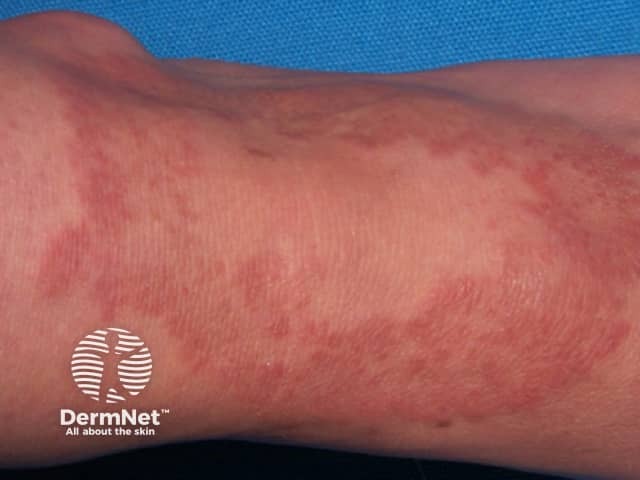
- Smooth, slightly raised annular/arcuate plaques with no or minimal scale, flesh-pink to red
- Located on extensor forearm — the classic site
- Association with diabetes mellitus is well documented, primarily T1DM but also T2DM. The histopathologic similarity with necrobiosis lipoidica diabeticorum supports a shared mechanism — Fitzpatrick's Dermatology, p. 597
- Long-standing diabetes + middle age = higher likelihood of generalized GA
- Metformin is not a typical trigger, but drug-induced reactive granulomatous dermatitis (interstitial granulomatous drug reaction) has been reported with various agents
2. Tinea Corporis (Ringworm) — Must Exclude First
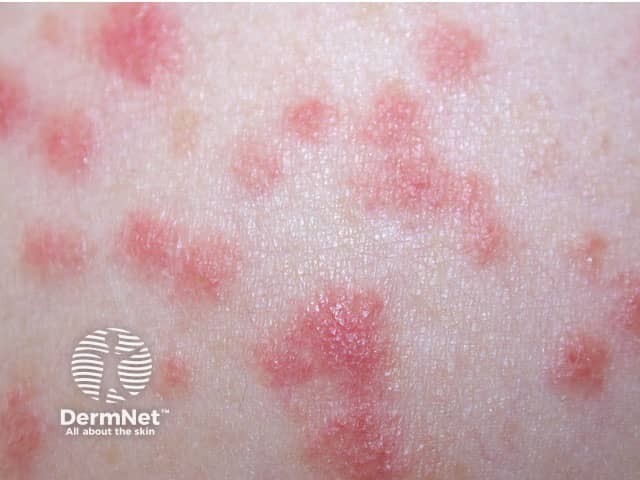
- Annular plaques with peripheral scaling and central clearing
- Diabetics are immunocompromised → higher susceptibility
- The image does show some surface change/scale at lesion edges — this cannot be excluded clinically
- KOH preparation is mandatory before any other workup
3. Erythema Annulare Centrifugum (EAC)
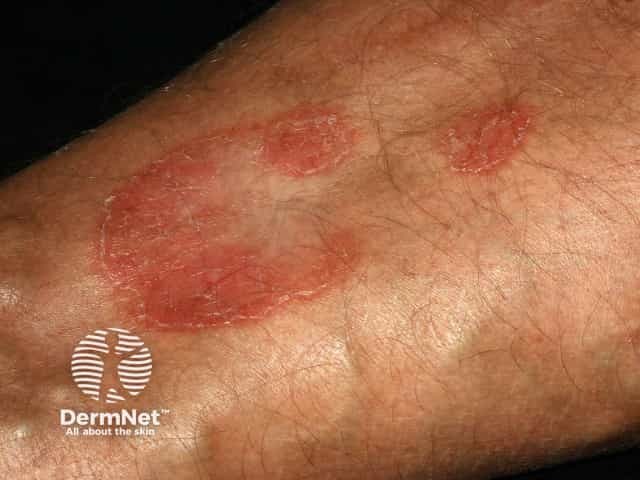
- Migrating annular erythema with trailing inner scale
- Can be triggered by drugs, infections, or systemic illness
- Less likely here given static morphology and diabetes context
4. Subacute Cutaneous Lupus Erythematosus (SCLE)
- Annular photodistributed plaques
- Can be drug-induced (metformin is not a classic inducer, but other medications may be co-prescribed)
- Check ANA, anti-Ro/SSA
5. Nummular Eczema
- Coin-shaped, pruritic, crusted plaques — less annular, more eczematous
Immediate Workup
| Test | Purpose |
|---|---|
| KOH scraping | Rule out tinea corporis (most urgent) |
| Fungal culture | Confirm dermatophyte if KOH equivocal |
| Punch biopsy | Confirm GA (palisading granulomas + mucin deposition) vs other |
| FBG / HbA1c | Assess diabetes control — poor control associated with GA |
| Lipid profile | GA associated with dyslipidemia (Fitzpatrick's, p. 597) |
| ANA, anti-Ro/SSA | If SCLE suspected |
| TSH | GA also associated with thyroid disease |
Key Points on Metformin
Metformin itself is not a well-established cause of annular skin rashes. However:
- It can rarely cause a lichenoid drug eruption (flat-topped violaceous papules, not annular)
- Drug-induced interstitial granulomatous reactions have been described with various drugs, which can mimic GA clinically
- If biopsy confirms interstitial/palisading granulomatous dermatitis and no other cause is found, consider whether metformin is contributing — though this would be a diagnosis of exclusion
Management Approach
- Perform KOH — if positive, treat with topical antifungal (clotrimazole/terbinafine)
- If KOH negative, punch biopsy for histopathology
- If GA confirmed:
- Localized: potent topical corticosteroids (clobetasol) under occlusion, or intralesional triamcinolone
- Optimize glycemic control (check HbA1c)
- Many cases resolve spontaneously over months to years
- Review all concurrent medications for potential drug-induced granulomatous reactions
Note: This is a clinical analysis to assist a healthcare provider. Definitive diagnosis requires in-person examination, KOH microscopy, and likely skin biopsy.

First time report what should be done further
This is the HbA1c report for Mr. Sunil Malhotra, 51Y male, dated 23 April 2026.
Report Interpretation
| Parameter | Value | Reference | Interpretation |
|---|---|---|---|
| HbA1c | 7.00% | 4.2–5.7% (normal) | Above normal |
| Average Estimated Glucose | 154.20 mg/dL | — | Elevated |
ADA Therapeutic Goals (Age >19 years):
- Goal of Therapy: <7.0%
- Actions Suggested: >8.0%
➡️ This patient is at goal (HbA1c exactly 7.0%) but right at the threshold — glycemic control is adequate but borderline.
Connecting to the Skin Rash
This is the first HbA1c report you are sharing. Given the prior discussion (55-year-old male on metformin × 8 years with annular forearm rash):
Note: The report shows age 51Y 3M — please verify if this is the same patient as discussed earlier (noted as 55Y).
The HbA1c of 7.0% tells us:
- Diabetes is reasonably controlled on metformin
- However, even well-controlled T2DM can be associated with Granuloma Annulare (GA) — the association exists regardless of control level, though poor control may worsen it
- This makes a drug reaction to metformin less likely as the sole cause, since diabetes-associated GA remains the leading diagnosis
What Should Be Done Next
Immediate (This Visit)
| Step | Action |
|---|---|
| 1. KOH scraping | Scrape active border of a lesion — must exclude tinea corporis first before any steroid treatment |
| 2. Fungal culture | If KOH equivocal |
| 3. Punch biopsy (4mm) | From the raised active border of an annular lesion — this is the definitive step if KOH is negative |
Lab Workup (Order Now)
| Test | Rationale |
|---|---|
| Lipid profile (fasting) | GA strongly associated with dyslipidemia; also important in T2DM |
| TSH | GA associated with thyroid dysfunction |
| ANA, anti-Ro/SSA | Rule out drug-induced or idiopathic SCLE |
| CBC | Rule out lymphoma-associated GA (less likely but important in adult-onset generalized GA) |
| Serum creatinine / eGFR | Baseline renal function on long-term metformin |
| Vitamin B12 | Metformin × 8 years causes B12 malabsorption in ~30% of patients — can cause neuropathy and other systemic effects |
If Biopsy Confirms Granuloma Annulare
| Management | Details |
|---|---|
| Topical clobetasol under occlusion | First-line for localized GA |
| Intralesional triamcinolone acetonide (10 mg/mL) | For persistent/thicker lesions |
| Optimize glycemic control | Already at goal (7.0%) — maintain |
| Reassurance | Localized GA often self-resolves in 1–2 years |
| Monitor for generalized spread | Generalized GA warrants more aggressive workup |
Priority Summary
- KOH scraping today — if positive, start topical antifungal, stop steroids
- Punch biopsy if KOH negative — confirms GA histologically (palisading granulomas + mucin)
- Check B12, lipids, TSH — all actionable findings on long-term metformin + T2DM
- Do not apply topical steroids empirically before KOH — will worsen tinea if present (tinea incognito)
This analysis is intended to assist a clinician. Definitive management requires in-person evaluation and histopathologic confirmation.
This is a shared conversation. Sign in to Orris to start your own chat.