
Explain in detail about amiodarone in clinical practice
amiodarone mechanism of action antiarrhythmic drug structure

This clinical photograph depicts drug-related photosensitivity affecting the nose and periorbital skin in a patient on amiodarone therapy. Modality: Clinical photography; a frontal close-up view of the face under color-balanced illumination highlights symmetrical erythema around the nasal dorsum and both eyelids with mild periorbital edema. The nasal skin shows diffuse erythema with small papillose papules, consistent with photodistributed dermatitis. The periorbital regions display accentuated redness and edema; surrounding cheek skin is relatively unfected. The image demonstrates features typical of amiodarone-associated photosensitivity: sun-exposed cutaneous regions develop erythema, edema, and possible scaling, often bilateral and facially distributed. The clinical significance lies in recognizing drug-induced phototoxicity or photoallergic dermatitis in patients on amiodarone, guiding sun protection, dose assessment, and potential drug substitution. This photograph is relevant for dermatology and pharmacovigilance education, illustrating differential diagnoses such as rosacea-like photodermatosis, contact dermatitis, and lupus-related photodermatosis. Clinically, this supports diagnostic considerations for photosensitive eruptions in the periocular/nasal regions, with implications for monitoring ocular surface irritation, ensuring photoprotection, and coordinating care with cardiology for antiarrhythmic management. The image underscores the importance of documenting drug-induced cutaneous reactions to refine treatment decisions, educate patients on sun avoidance strategies, and alert clinicians to potential ocular complications requiring multidisciplinary management.

This is a high-resolution clinical photograph (dermatology photography) of the left lateral face focusing on the malar region in a patient receiving long-term amiodarone therapy. The image demonstrates diffuse slate-blue to gray-blue discoloration of sun-exposed facial skin, most prominent on the cheeks and periorbital areas, with relative sparing of hidden folds. The pigmentation is flat and diffusely distributed, without edema, ulceration, or textural change, and appears symmetric across analogous facial sites. The color change is characteristic of amiodarone-induced cutaneous hyperpigmentation, which results from deposition of drug-related lipofuscin-like pigment in the dermis and increased melanin in response to ultraviolet exposure. The clinical significance lies in recognizing a medication-related pigmentary change that correlates with cumulative dose and duration of therapy; it may prompt drug history review and consideration of dose modification or discontinuation if pigment progression or systemic toxicity occurs. Differential considerations include minocycline-induced hyperpigmentation, argyria, or solar lentigines; however, the pattern, distribution, and medication history favor amiodarone. This image is relevant for dermatology education, psychophysical color assessment, and pharmacovigilance case documentation, illustrating drug-induced dermal changes and serving as a visual aid in patient counseling, clinical correlation with hepatic/thyroid monitoring, and research on cutaneous adverse reactions of antiarrhythmic therapy.
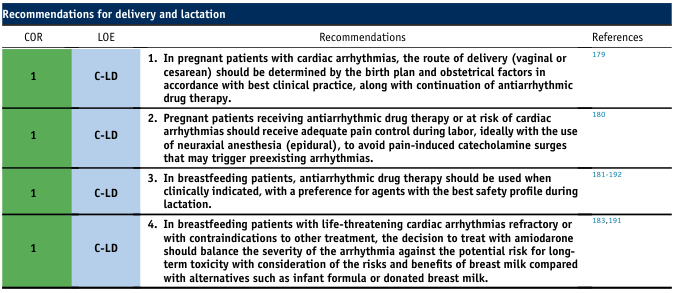
Recommendations for delivery and lactation <table><thead><tr><th>COR</th><th>LOE</th><th>Recommendations</th><th>References</th></tr></thead><tbody><tr><td>1</td><td>C-LD</td><td>1. In pregnant patients with cardiac arrhythmias, the route of delivery (vaginal or cesarean) should be determined by the birth plan and obstetrical factors in accordance with best clinical practice, along with continuation of antiarrhythmic drug therapy.</td><td>179</td></tr><tr><td>1</td><td>C-LD</td><td>2. Pregnant patients receiving antiarrhythmic drug therapy or at risk of cardiac arrhythmias should receive adequate pain control during labor, ideally with the use of neuraxial anesthesia (epidural), to avoid pain-induced catecholamine surges that may trigger preexisting arrhythmias.</td><td>180</td></tr><tr><td>1</td><td>C-LD</td><td>3. In breastfeeding patients, antiarrhythmic drug therapy should be used when clinically indicated, with a preference for agents with the best safety profile during lactation.</td><td>181-192</td></tr><tr><td>1</td><td>C-LD</td><td>4. In breastfeeding patients with life-threatening cardiac arrhythmias refractory or with contraindications to other treatment, the decision to treat with amiodarone should balance the severity of the arrhythmia against the potential risk for long-term toxicity with consideration of the risks and benefits of breast milk compared with alternatives such as infant formula or donated breast milk.</td><td>183,191</td></tr></tbody></table>
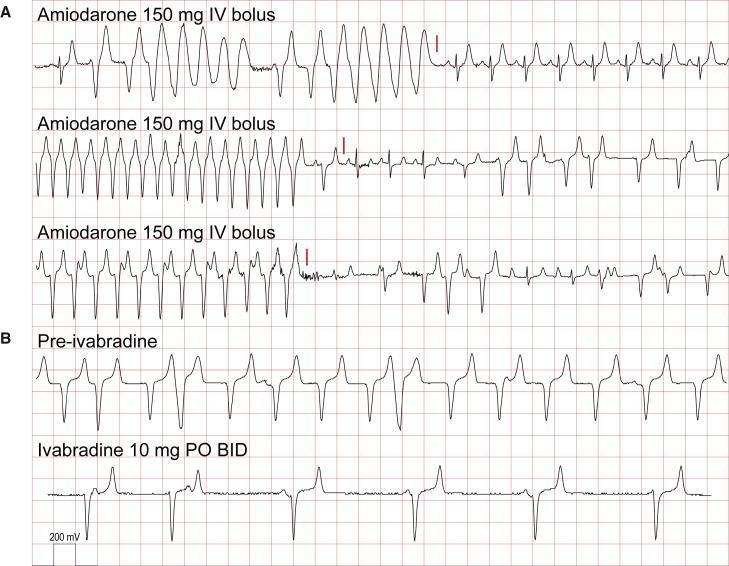
This image displays multiple electrocardiogram (ECG) tracings illustrating the acute pharmacological response of engraftment arrhythmia (EA) to antiarrhythmic agents. The tracings are divided into two sections. Section A shows three representative strips labeled 'Amiodarone 150 mg IV bolus.' Each strip exhibits high-amplitude, wide-complex polymorphic ventricular tachycardia (VT) that acutely cardioverts to a slower rhythm or normal sinus rhythm immediately following the administration of a bolus (indicated by a vertical red marker). The scaling for these strips is 200 mV vertically and 0.2 s horizontally per large box. Section B compares 'Pre-ivabradine' and 'Ivabradine 10 mg PO BID' states. The pre-ivabradine tracing shows a rapid ectopic rhythm with consistent wide QRS morphology. The post-ivabradine tracing demonstrates a significant reduction in heart rate (bradycardic effect), evidenced by a marked increase in the R-R intervals, though the ectopic morphology persists. These tracings serve as diagnostic evidence for the efficacy of combined potassium channel blockade (amiodarone) and If current inhibition (ivabradine) in managing arrhythmias following stem cell-derived cardiomyocyte transplantation.
amiodarone clinical use arrhythmia
Amiodarone in Clinical Practice
1. Overview and Classification
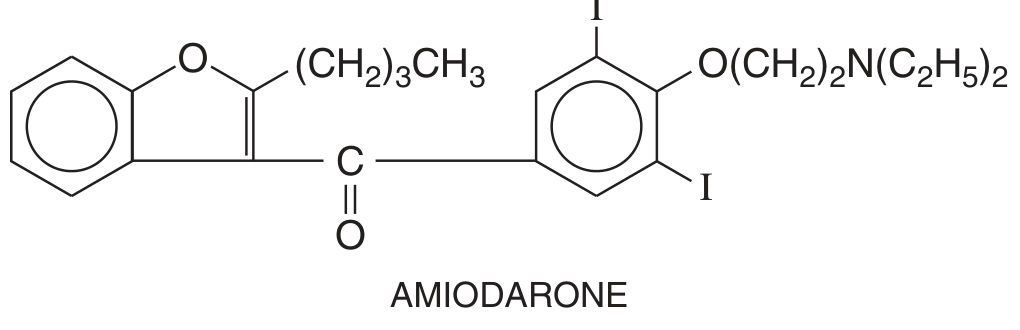
2. Mechanism of Action - "Multichannel Blocker"
| Class | Action | Effect |
|---|---|---|
| Class I (Na+ channel block) | Blocks inactivated Na+ channels, use-dependent | Slows conduction in depolarized tissue |
| Class II (antiadrenergic) | Noncompetitive alpha and beta receptor blockade | Slows sinus rate (20-30%), slows AV conduction |
| Class III (K+ channel block) | Blocks IKr, IKs, Ito (transient outward), and inward rectifier K+ currents | Prolongs APD and refractoriness |
| Class IV (Ca2+ channel block) | Blocks ICaL (L-type calcium current) | Slows AV nodal conduction further |
Key Electrophysiological Consequences:
- Prolongs the action potential duration (APD) and effective refractory period (ERP) in all cardiac tissues (atrium, ventricle, SA node, AV node, His-Purkinje)
- Does NOT demonstrate reverse use-dependence - its APD prolongation is maintained over a wide range of heart rates (unlike sotalol), which contributes to its low rate of torsades de pointes (TdP)
- Prolongs the PR, QRS, and QT intervals on ECG
- Depresses conduction velocity (especially via Na+ channel block) and inhibits cell-cell coupling - particularly important in diseased tissue
- Does not increase QT dispersion (and may actually reduce it)
- Catecholamines can partially reverse amiodarone's effects
"Amiodarone's actions approximate those of a theoretically ideal drug that exhibits use-dependent Na+ channel block with fast diastolic recovery from block and use-dependent prolongation of the APD." - Braunwald's Heart Disease
Active Metabolite - Desethylamiodarone:
3. Pharmacokinetics
| Parameter | Value |
|---|---|
| Oral bioavailability | 25-65% (highly variable, slow absorption) |
| Volume of distribution (Vd) | 66 L/kg (range: 18-148 L/kg) - extremely large due to high lipophilicity |
| Protein binding | >96% |
| Metabolism | Hepatic - CYP3A4 and CYP2C8 → active metabolite desethylamiodarone |
| Excretion | Predominantly fecal; urine <1% unchanged |
| Half-life (IV single dose) | 9-36 days |
| Half-life (oral chronic) | 40-55 days |
| Onset (oral) | 2 days-3 weeks |
| Peak effect | 1 week to 5 months |
| Duration after discontinuation | 2 weeks to several months |
Clinical Implications of Pharmacokinetics:
- Extensive tissue distribution: amiodarone concentrates in heart (10-50x plasma concentration), liver, lung, thyroid, skin, and tears
- Because of extreme lipid solubility, plasma levels fall very slowly after stopping the drug - toxicity may persist and progress even after discontinuation
- Loading dose is required to rapidly fill tissue stores; otherwise antiarrhythmic effect is severely delayed
- Drug interactions persist for months after stopping amiodarone (e.g., warfarin, digoxin, statins)
- Minimal renal elimination - can be used in renal impairment without dose adjustment
4. Dosing Regimens
IV Amiodarone (Acute/Emergency Use):
- VT/VF cardiac arrest (ACLS): 300 mg IV bolus; repeat 150 mg IV bolus if needed
- Acute hemodynamically stable VT / rate control of AF: 150 mg IV over 10 minutes, followed by 1 mg/min for 6 hours, then 0.5 mg/min for 18 hours (maintenance)
- Subsequent oral loading can follow
Oral Amiodarone (Chronic Use):
- Loading: 400-1600 mg/day in divided doses for 1-3 weeks
- Maintenance: 100-400 mg/day (lowest effective dose to minimize toxicity)
- Typical AF maintenance: 100-200 mg/day
- Typical VT maintenance: 200-400 mg/day
IV Administration Notes:
- IV amiodarone causes hypotension (~16% of cases) related to infusion rate and the vehicle polysorbate 80 (an emulsifier in older IV formulations)
- Causes peripheral thrombophlebitis when given via peripheral vein - an in-line IV filter is advisable; prefer central access for prolonged infusions
5. Clinical Indications
FDA-Approved Indications:
- Recurrent VF resistant to other agents
- Recurrent hemodynamically unstable VT resistant to other agents
- Cardiac arrest with VT/VF (IV) - first-line per ACLS
Widely Used Off-Label (Major Clinical Uses):
- Atrial fibrillation (AF): rhythm control - most effective antiarrhythmic for maintaining sinus rhythm; recommended when other agents have failed or in patients with structural heart disease (HFrEF), where other agents (flecainide, propafenone) are contraindicated
- Atrial flutter: rate and rhythm control
- Postoperative AF prevention (cardiac surgery)
- Supraventricular tachycardia (SVT) - AVNRT, AVRT in WPW (oral); note: IV amiodarone in pre-excited AF (WPW) is actually controversial - a 2026 systematic review (PMID: 41738108) found IV amiodarone may accelerate accessory pathway conduction, making it potentially harmful in pre-excited AF
- Ventricular tachycardia in ischemic and non-ischemic cardiomyopathy
- VT storm (repeated shocks) - IV amiodarone combined with deep sedation and beta-blockade
Comparative Efficacy:
- Studies show all antiarrhythmics except amiodarone have similar (lower) efficacy for AF suppression; amiodarone maintains sinus rhythm in ~65-70% at 1 year vs ~40% with other agents
- However, its toxicity profile means it is not first-line for AF in younger patients or those with normal hearts - flecainide, propafenone, or dronedarone are preferred initially - Braunwald's Heart Disease
Heart Failure:
- Oral amiodarone does not suppress LV ejection fraction, even in patients with severely reduced EF - Braunwald's Heart Disease
- A large meta-analysis (ATMA, 1997) showed modest mortality benefit in HF
- The SCD-HeFT trial (2005) found oral amiodarone did not reduce mortality vs placebo in HFrEF - ICD is now preferred for sudden death prevention in HFrEF
6. Adverse Effects and Toxicity
6a. Pulmonary Toxicity (Most Serious)
- Direct toxic effect - drug accumulates in type II pneumocytes and alveolar macrophages, causing phospholipid accumulation ("foamy macrophages" with lamellar inclusions)
- Immune/hypersensitivity mechanism - granulomatous or eosinophilic response
- Insidious onset: progressive dyspnea, nonproductive cough, low-grade fever
- Pleuritic chest pain in ~10%
- Crackles on auscultation (difficult to distinguish from CHF)
- Acute presentation (pneumonia-like) in ~20% of cases
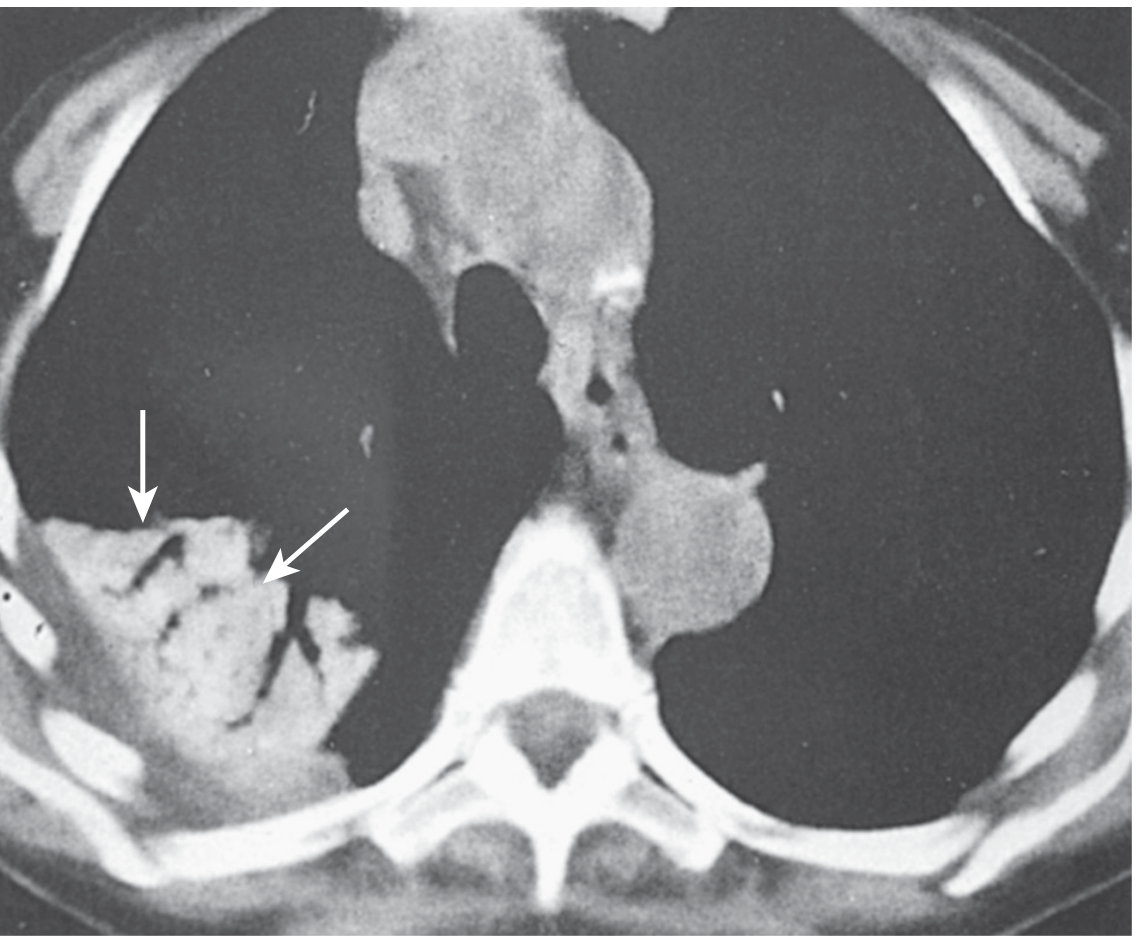
- CXR: Asymmetric or upper lobe infiltrates initially; may progress to diffuse interstitial or alveolar pattern
- CT chest: High-density confluent pulmonary masses (dense due to iodine content - radiopaque); organizing pneumonia pattern common
- PFTs: Reduced total lung capacity (TLC) and DLCO; hypoxemia
- BAL: Foamy macrophages (phospholipid-laden); also seen in all long-term users even without toxicity - not diagnostic on its own
- Lab: Normal to mildly elevated WBC, no eosinophilia, elevated ESR
- Diagnosis of exclusion - must rule out infection, HF, and other causes
6b. Thyroid Toxicity
- Direct iodine load: Each 200 mg tablet releases ~6-8 mg free iodine/day (normal intake ~0.1-0.2 mg/day), causing both hypothyroidism (Wolff-Chaikoff effect) and hyperthyroidism
- Inhibits peripheral conversion of T4 → T3 via deiodinase inhibition
- Structural similarity to T4: May directly antagonize nuclear thyroid hormone receptors
- More common in iodine-replete regions (Europe, North America)
- Mechanism: Iodine-induced inhibition of thyroid hormone synthesis (Wolff-Chaikoff effect)
- Treatment: Levothyroxine replacement (amiodarone can often be continued)
| Feature | Type 1 AIT | Type 2 AIT |
|---|---|---|
| Mechanism | Excess thyroid hormone synthesis (iodine-induced, like Graves) | Destructive thyroiditis (drug toxicity) |
| Underlying thyroid | Abnormal (nodular goiter, Graves) | Normal |
| Treatment | Thionamides (high doses) | Prednisolone |
| Vascularization on Doppler | Increased | Absent/decreased |
- Monitor TFTs at baseline and every 6 months during therapy
- AIT can be life-threatening in patients with poor cardiac reserve - amiodarone should not be abruptly stopped (arrhythmia may return); treat thyrotoxicosis aggressively
- Thyroidectomy may be required in severe/refractory AIT Type 1-2 mixed
6c. Hepatotoxicity
- Elevated liver enzymes (LFTs): Very common (15-50%); often asymptomatic
- Spectrum of disease: Mild transaminase elevation → steatohepatitis → cirrhosis (in 15-50% of those with hepatotoxicity) → rare acute liver failure (ALF)
- Drug accumulates in liver (up to 1% wet weight after weeks of therapy)
- Causes phospholipidosis - enlarged lysosomes stuffed with whorled membranous material (myeloid bodies)
- CT appearance: Liver appears hyperdense (bright) due to iodine accumulation - not clinically significant but a useful marker
- Liver histology: phospholipidosis, steatosis, focal necrosis, Mallory hyaline, neutrophilic infiltration, pericellular fibrosis
- Characteristic: AST:ALT ratio ~1:1 (unlike alcoholic hepatitis where ratio >2:1)
- Important: Liver disease may continue to progress even after amiodarone is stopped due to prolonged tissue retention
- Monitor LFTs at baseline and every 6 months
- Source: Sleisenger & Fordtran's Gastrointestinal and Liver Disease
6d. Ocular Toxicity
- Corneal microdeposits (keratopathy): Present in virtually 100% of patients after a few weeks of treatment; usually asymptomatic
- Some patients develop halos or visual blurring - drug dose reduction is recommended; rarely requires stopping
- Optic neuritis/neuropathy: Rare but serious - may progress to permanent blindness; drug should be stopped
- Baseline and regular ophthalmology review is recommended
6e. Cutaneous Toxicity
- Photosensitivity: Sun-exposed skin, especially face - erythema, edema
- Blue-gray skin discoloration (slate-gray pigmentation): In sun-exposed areas (cheeks, nose, forehead) - due to deposition of lipofuscin-like pigment in dermis and increased melanin; correlates with cumulative dose; may be irreversible
- Patients should use high-SPF sunscreen and avoid sun exposure
6f. Cardiac Toxicity
- Bradycardia and sinus node dysfunction: 5% with oral amiodarone; can be severe in patients with preexisting SA node disease
- AV block: 2nd or 3rd degree in susceptible patients
- Torsades de Pointes (TdP): <1% - paradoxically LOW despite significant QT prolongation. This is because:
- No reverse use-dependence (APD prolongation maintained at fast rates)
- Reduced QT dispersion
- Na+ channel blocking properties
- Hypotension: 16% with IV - related to infusion rate and vehicle polysorbate 80
- Risk factors for TdP: Concomitant QT-prolonging agents, hypokalemia, hypomagnesemia, female sex
- Thrombophlebitis with peripheral IV administration
6g. Neurological Toxicity
- Peripheral neuropathy: Dose-related; sensory > motor
- Paresthesias
- Dizziness, tremor, ataxia
- Proximal muscle weakness with chronic use
6h. GI Toxicity
- Nausea, vomiting, anorexia, constipation: 10-33% with oral use
- Usually responds to dose reduction or dividing doses
7. Drug Interactions
| Drug | Interaction | Management |
|---|---|---|
| Warfarin | Inhibits CYP2C9 → ↑ warfarin levels; INR increases 30-50% | Reduce warfarin dose by 30-50%; monitor INR closely |
| Digoxin | Inhibits P-glycoprotein → ↑ digoxin levels (by 70-100%) | Reduce digoxin dose by 50%; monitor levels |
| Statins (simvastatin, lovastatin) | Inhibits CYP3A4 → ↑ statin levels → myopathy risk | Limit simvastatin to 20 mg/day; prefer pravastatin |
| Direct oral anticoagulants (DOACs) | Inhibits CYP3A4/P-gp → ↑ DOAC levels | Dose reduction may be needed; a 2025 meta-analysis (PMID: 40542521) confirmed elevated bleeding risk with DOAC co-administration |
| Beta-blockers | Additive bradycardia and AV block | Monitor heart rate and rhythm |
| Calcium channel blockers | Additive AV block | Caution; avoid in sick sinus syndrome |
| QT-prolonging drugs | Additive QT prolongation → TdP risk | Monitor ECG; avoid combinations if possible |
| Cyclosporine, tacrolimus | ↑ immunosuppressant levels | Monitor drug levels |
Key point: Interactions persist for months after amiodarone is discontinued due to its extremely long half-life.
8. Monitoring Protocol
| System | Baseline | Frequency |
|---|---|---|
| Thyroid (TSH, fT4) | Yes | Every 6 months |
| Liver function tests (AST, ALT, ALP) | Yes | Every 6 months |
| Pulmonary (CXR, PFTs) | Yes | Annually (sooner if symptomatic) |
| Ophthalmology | Yes | Annually |
| ECG | Yes | Regularly (PR, QRS, QT intervals) |
| Amiodarone level | Optional | Not routinely required; therapeutic range 1.0-2.5 mg/L |
9. Contraindications and Precautions
- Sinus bradycardia / sick sinus syndrome (without pacemaker)
- 2nd or 3rd degree AV block (without pacemaker)
- Severe sinus node dysfunction (without pacemaker)
- Known iodine hypersensitivity
- Pre-excited AF / WPW with AF (IV amiodarone - see PMID: 41738108)
- Pregnancy: Category D - neonatal thyroid effects, bradycardia; use only for life-threatening arrhythmias after risk-benefit discussion (see guideline table above)
- Breastfeeding: Transfers into breast milk; life-threatening arrhythmias refractory to other treatments may justify use with close infant monitoring
- Pre-existing thyroid disease: Thyroid disease does not preclude use but requires more intensive monitoring
- Pre-existing pulmonary disease: Higher risk of pulmonary toxicity
- Pre-existing liver disease: Monitor LFTs closely
10. Comparison with Dronedarone
| Feature | Amiodarone | Dronedarone |
|---|---|---|
| Iodine content | Yes (37% by weight) | No |
| Half-life | 40-55 days | ~24 hours |
| Efficacy for AF | Higher (gold standard) | Lower |
| Thyroid toxicity | Yes | No |
| Pulmonary toxicity | Yes | No/rare |
| Approved indication | VT/VF (IV + oral); AF (off-label) | AF/flutter (not in HFrEF/permanent AF) |
| Use in HFrEF | Can be used (no suppression of EF) | Contraindicated (ANDROMEDA trial - ↑ mortality) |
11. Summary of Clinical Decision Points
- Use amiodarone first-line for: VT/VF in cardiac arrest (IV), life-threatening VT resistant to other drugs, AF with structural heart disease (HFrEF) where alternatives are contraindicated
- Reserve for later-line in: AF with normal hearts or mild structural disease (prefer flecainide, propafenone, dronedarone first)
- Always load: A loading dose strategy is mandatory; without it, onset is delayed by weeks
- Monitor relentlessly: Thyroid, liver, lungs, eyes every 6 months/annually
- Interaction warning: Reduce warfarin dose 30-50%, reduce digoxin by 50% from day 1
- Never stop abruptly if truly dependent: Risk of arrhythmia recurrence; taper or ensure alternative before stopping
- Explain persistence: Side effects and interactions can last months after stopping; this must be explained to patients and other prescribers
Key References:
- Braunwald's Heart Disease: A Textbook of Cardiovascular Medicine, 12th Ed.
- Goodman & Gilman's The Pharmacological Basis of Therapeutics, 14th Ed.
- Katzung's Basic and Clinical Pharmacology, 16th Ed.
- Tintinalli's Emergency Medicine: A Comprehensive Study Guide, 9th Ed.
- Murray & Nadel's Textbook of Respiratory Medicine
- Sleisenger & Fordtran's Gastrointestinal and Liver Disease
- Ling-Vannerus et al., Acta Anaesthesiol Scand 2025 [PMID: 39417403] - Acute amiodarone pulmonary toxicity in ICU patients
- Ali et al., Circ Arrhythm Electrophysiol 2026 [PMID: 41738108] - IV amiodarone in pre-excited AF (caution: potential harm)
- Kido et al., J Cardiovasc Pharmacol Ther 2025 [PMID: 40542521] - Amiodarone + DOACs: elevated bleeding risk (meta-analysis)