
Explain complete sound conduction through inners & middle ear
Reading File
Finding Sources
Finding Sources
Searching Images
sound conduction pathway middle ear ossicles cochlea
Reading File
Finding Sources
Loading Image
Reading File
Reading File
Reading File
Reading File
Reading File
Reading File
Reading File
Now I have comprehensive information from multiple authoritative textbooks. Let me compile a complete, well-structured answer.
Sound Conduction: Middle Ear to Inner Ear — Complete Pathway
1. External Ear (Sound Collection & Amplification)
- The pinna gathers sound from a 135° arc and increases sound pressure by ~6 dB
- The external auditory canal (EAC) acts as a closed cylinder (~2.5–3.5 cm long); its resonant frequency is ~3,500 Hz (lowered to ~2,700 Hz when the conchal component is included)
- Combined, external ear structures increase sound pressure at the tympanic membrane by 15–22 dB
— Cummings Otolaryngology, p. 299
2. Tympanic Membrane (TM) — Catenary Lever
- Sound waves strike the tympanic membrane (TM), which vibrates
- The TM is rigidly fixed at its periphery but mobile centrally — this geometry makes it act as a catenary lever, producing a ~2-fold gain in sound pressure at the malleus handle
- The thin pars flaccida has only a minor acoustic role in humans
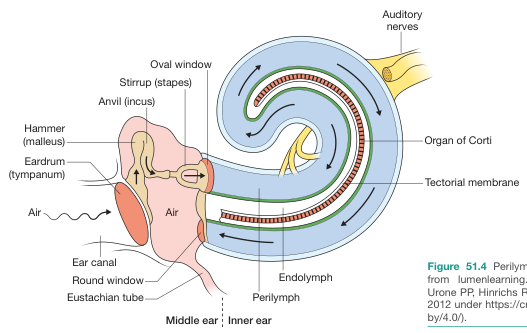
3. Ossicular Chain — Mechanical Amplification (Middle Ear)
The three ossicles — malleus → incus → stapes — form a lever system:
| Lever System | Function | Gain |
|---|---|---|
| Catenary lever (TM shape) | Pressure concentration onto malleus handle | ~2× |
| Ossicular lever (malleus-incus unit) | Rotates around axis of anterior mallear ligament + incudal ligament | Small additional advantage |
| Combined catenary + ossicular lever ratio | 2.3:1 | ~7 dB |
| Hydraulic (areal) lever | TM area (~55 mm²) >> stapes footplate area (~3.2 mm²) | ~17:1 pressure gain |
Total middle ear impedance-matching gain: ~26–35 dB (centred around resonant frequency 0.9–1.0 kHz). Above 1 kHz, pressure gain at the stapes decreases at −8.6 dB/octave.
"The mean sound-pressure gain produced by the human middle ear is 26.6 dB and is centered around its resonant frequency."
— Cummings Otolaryngology, p. 301
4. Impedance Matching — Why It's Critical
Air has low acoustic impedance; cochlear fluid has high acoustic impedance. Without the middle ear's impedance-matching system, ~99.9% of sound energy would be reflected at the air-fluid interface (~30 dB loss). The combined mechanisms of:
- The large TM area → small oval window area ratio (hydraulic lever)
- The ossicular lever system
...enable efficient energy transfer from air to fluid.
— Costanzo Physiology, p. 98
5. Oval Window — Air/Fluid Interface
- The footplate of the stapes inserts into the oval window
- Inward movement of the stapes footplate displaces the perilymph of the scala vestibuli
- Because the cochlea is enclosed in bone, when the oval window pushes in, the round window must bulge outward (pressure relief)
6. The Cochlea — Structure
The cochlea is a fluid-filled spiral divided into three scalae:
| Compartment | Fluid | Location |
|---|---|---|
| Scala vestibuli | Perilymph (like ECF: high Na⁺, low K⁺) | Above Reissner's membrane |
| Scala media (cochlear duct) | Endolymph (like ICF: high K⁺, low Na⁺) | Between Reissner's and basilar membranes |
| Scala tympani | Perilymph | Below basilar membrane → round window |
The scala vestibuli and scala tympani are connected at the apex via the helicotrema.
7. Basilar Membrane — Traveling Wave & Frequency Analysis
- Stapes movement at the oval window generates a "traveling wave" along the basilar membrane
- The wave travels from base to apex but dies at the point of maximal resonance for that frequency
Tonotopic organisation:
| Basilar Membrane Location | Properties | Frequency Detected |
|---|---|---|
| Base (near oval window) | Narrow, stiff | High frequencies (e.g., 8,000+ Hz) |
| Apex (near helicotrema) | Wide, compliant | Low frequencies (e.g., 20–200 Hz) |
"High-frequency sound waves travel only a short distance along the basilar membrane before they reach their resonant point and die; very low-frequency sound waves travel the entire distance."
— Guyton & Hall Medical Physiology, p. 658
For frequencies below ~200 Hz, the volley (frequency) principle also applies — cochlear nerve fibers fire volleys synchronized to the sound frequency.
8. Organ of Corti — Sensory Transduction
The organ of Corti sits on the basilar membrane, bathed in endolymph of the scala media. It contains two types of hair cells:
- Inner hair cells (~3,500): arranged in a single row; the primary sensory receptors
- Outer hair cells (~12,000): arranged in 3 parallel rows; amplify and fine-tune basilar membrane motion
Hair cell mechanics:
- Hair cell bodies rest on the basilar membrane
- Stereocilia (cilia) are embedded in the tectorial membrane
- Vibration of the basilar membrane causes a shearing force between the basilar membrane (more elastic) and the tectorial membrane (stiffer), bending the cilia
9. Mechanotransduction — Hair Cell Depolarization
The transduction cascade (numbered steps):
- Traveling wave deforms the basilar membrane → shearing of stereocilia against tectorial membrane
- Bending cilia toward tallest stereocilium → opens mechanically gated K⁺ channels (tip links)
- K⁺ flows into the hair cell from endolymph (high K⁺) down its concentration gradient → depolarization
- (Bending away → closes K⁺ channels → hyperpolarization)
- Depolarization opens voltage-gated Ca²⁺ channels at the presynaptic terminal
- Ca²⁺ influx → glutamate release from hair cell → excites afferent cochlear nerve fibers
- Oscillating depolarization/hyperpolarization → intermittent glutamate release → action potentials in CN VIII
The oscillating receptor potential produced is called the cochlear microphonic potential.
— Costanzo Physiology, pp. 99–100
10. Encoding of Loudness
- Louder sounds → greater basilar membrane amplitude → higher firing rate in cochlear nerves
- More hair cells recruited at the fringes of the resonating zone → spatial summation
- Outer hair cells activated only at high intensities → signal very loud sounds
- The ear compresses a ~1 trillion-fold range of sound energy into a ~10,000-fold perceived range
11. Auditory Neural Pathway (Onward from Cochlea)
Hair cells → CN VIII (cochlear nerve) → cochlear nuclei (medulla) → some fibers cross via trapezoid body to contralateral side; others remain ipsilateral → lateral lemniscus → inferior colliculus (midbrain) → medial geniculate nucleus (thalamus) → primary auditory cortex (Heschl's gyri, temporal lobe)
The tonotopic map generated at the basilar membrane is preserved at every level of the CNS up to the auditory cortex.
— Costanzo Physiology, p. 101
Summary Flowchart
Sound waves → Pinna/EAC (collect + +15–22 dB)
    ↓
Tympanic membrane (catenary lever)
    ↓
Malleus → Incus → Stapes (ossicular lever)
    ↓
Oval window (hydraulic lever: large TM → small footplate)
[Total impedance match: ~26–35 dB gain]
    ↓
Perilymph of scala vestibuli displaced
    ↓
Traveling wave along basilar membrane
(tonotopic: high freq → base; low freq → apex)
    ↓
Organ of Corti: shearing of stereocilia against tectorial membrane
    ↓
K⁺ influx → depolarization → Ca²⁺ entry → glutamate release
    ↓
Action potentials in CN VIII → CNS auditory pathway
    ↓
Round window bulges outward (pressure release)
Sources: Cummings Otolaryngology Head & Neck Surgery, p. 271–303 | Costanzo Physiology 7th Ed., pp. 97–101 | Guyton & Hall Medical Physiology, pp. 655–661
This is a shared conversation. Sign in to Orris to start your own chat.