
give an outline on mendelian disorders, autosomal dominant/recessive, x-linked dominant/recessive w.r.t. Robbins and Cotran pathology
Mendelian Disorders — Outline per Robbins, Cotran & Kumar: Pathologic Basis of Disease
I. Overview: Categories of Human Genetic Disease
- Monogenic (Mendelian) Disorders — single-gene mutations with large effects; highly penetrant; follow classic Mendelian inheritance (autosomal dominant, autosomal recessive, X-linked).
- Chromosomal Disorders — structural or numerical alterations affecting autosomes or sex chromosomes; often arise de novo in the germline.
- Complex Multigenic (Multifactorial) Disorders — multiple genetic variants + environmental factors (e.g., atherosclerosis, diabetes, hypertension).
A fourth category of somatically acquired mutations (driving clonal hematopoiesis, cancers, overgrowth syndromes) is also increasingly recognized.
II. Mutations Underlying Mendelian Disorders
| Type | Mechanism | Example |
|---|---|---|
| Point mutation | Single nucleotide substitution | Missense → altered amino acid; Nonsense → premature stop codon |
| Frameshift | Insertion or deletion of non-multiples of 3 bases | 4-bp insertion in HEXA → Tay-Sachs disease |
| Trinucleotide repeat expansions | Expansion of repetitive sequences | Fragile X, Huntington |
| Deletions/duplications | Larger DNA copy number changes | Affects gene dosage |
Functional Consequences of Mutations
- Loss-of-function: enzyme/transport protein deficiencies (usually AR)
- Gain-of-function: constitutively active or toxic protein products (usually AD)
Key Concepts
- Pleiotropism: one mutation → many end-organ effects (e.g., sickle cell anemia: hemolysis + vascular occlusion + splenic fibrosis + bone changes)
- Genetic heterogeneity: different gene loci → same phenotype (e.g., congenital deafness)
III. Transmission Patterns of Single-Gene Disorders
A. Autosomal Dominant (AD) Disorders
- Manifested in the heterozygous state
- Both males and females are equally affected and can transmit
- Affected parent → 50% chance each child is affected
- Vertical transmission through generations
| Concept | Definition |
|---|---|
| De novo mutation | No affected parent; propensity for new mutations in germ cells of older fathers (e.g., FGFR2/FGFR3 mutations → Apert syndrome, achondroplasia) |
| Incomplete penetrance | Mutant gene carried but disease not expressed (e.g., 50% penetrance = 50% carrying the gene are affected) |
| Variable expressivity | Trait present in all carriers but at differing severity |
| Anticipation | Earlier onset and increasing severity in successive generations (e.g., trinucleotide repeat disorders) |
- Loss of regulatory proteins (e.g., tumor suppressors) — one mutant allele reduces the gene product sufficiently to alter function
- Gain-of-function — mutant protein acquires new toxic activity
- Dominant-negative effect — mutant product interferes with normal allele product (common with structural proteins like collagen and fibrillin)
| System | Disorder |
|---|---|
| Neurologic | Huntington disease, neurofibromatosis, myotonic dystrophy |
| Urologic | Adult polycystic kidney disease |
| Cardiovascular | Familial hypercholesterolemia, hereditary hemorrhagic telangiectasia |
| Hematopoietic | Hereditary spherocytosis, von Willebrand disease |
| Skeletal | Marfan syndrome, Ehlers-Danlos syndrome (some variants), achondroplasia |
| Metabolic | Familial hypercholesterolemia |
- Gene: FBN1 (fibrillin-1), chromosome 15q21
- Fibrillin-1 is an extracellular glycoprotein → component of microfibrils in connective tissue
- Mutations disrupt elastin meshworks and cause excess release of TGF-β from ECM (unopposed TGF-β signaling → tissue remodeling)
- Morphology:
- Skeletal: tall stature, dolichocephaly, arachnodactyly, hypermobile joints, pectus excavatum/carinatum, kyphoscoliosis
- Ocular: bilateral ectopia lentis (upward/outward lens subluxation) — a near-pathognomonic sign
- Cardiovascular: mitral valve prolapse (40–50%), medial degeneration of aorta → aortic dilation, aortic regurgitation, aortic dissection (most common cause of death)
B. Autosomal Recessive (AR) Disorders
- Disease manifests only in the homozygous state (both alleles mutated)
- Heterozygous carriers are phenotypically normal
- Both parents are typically carriers (heterozygotes)
- 25% chance of affected offspring per pregnancy; 50% carriers; 25% normal
- Often presents in siblings, not parents ("horizontal" pedigree pattern)
- More common when parents are consanguineous
- Expression is more uniform (less variable expressivity)
- Complete penetrance is more common
- Onset often in early childhood (enzyme deficiencies manifest when both alleles are absent)
- Enzyme deficiency is the predominant mechanism — 50% residual enzyme from one functional allele is usually sufficient (hence carriers are unaffected)
| System | Disorder |
|---|---|
| Metabolic | Cystic fibrosis, phenylketonuria, galactosemia, homocystinuria, lysosomal storage diseases, α₁-antitrypsin deficiency, Wilson disease, hemochromatosis, glycogen storage diseases |
| Hematopoietic | Sickle cell anemia, thalassemias |
| Endocrine | Congenital adrenal hyperplasia |
| Skeletal | Ehlers-Danlos syndrome (some variants), alkaptonuria |
| Nervous | Spinal muscular atrophy, Friedreich ataxia, neurogenic muscular atrophies |
- Inherited deficiency of lysosomal enzymes → incomplete catabolism → accumulation of insoluble intermediates within lysosomes
- Pathogenic consequences:
- Primary accumulation — engorged lysosomes interfere with cell function
- Defective autophagy — impaired mitophagy → dysfunctional mitochondria persist → free radical generation → intrinsic apoptosis
- Secondary accumulation — aggregation-prone proteins (α-synuclein, Huntingtin) accumulate
- ~70 lysosomal storage diseases identified; frequency ~1 in 5000 live births
- Treatment approaches: (1) Enzyme replacement / gene therapy; (2) Substrate reduction therapy; (3) Molecular chaperone therapy
C. X-Linked Disorders
- Caused by mutations in genes on the X chromosome; males are hemizygous (no corresponding Y-linked locus to compensate)
- Y chromosome male-specific region encodes few genes (mostly spermatogenesis); Y-linked mutations → male infertility → cannot be transmitted
C1. X-Linked Recessive (XLR) Disorders
- Males are predominantly affected (hemizygous — one mutant X is sufficient for disease)
- Females are typically carriers (heterozygous); generally unaffected because of the normal allele
- An affected male does not transmit disorder to sons (sons inherit Y chromosome from father); all daughters of an affected male are obligate carriers
- Sons of heterozygous women: 50% affected; daughters: 50% carriers
- In females, one X chromosome is randomly inactivated in each somatic cell → females are mosaics
- In most carriers, random inactivation results in ~50% cells with the normal X active → no disease
- If X-inactivation is skewed to favor inactivation of the wild-type allele → manifesting carrier female
| System | Disorder |
|---|---|
| Musculoskeletal | Duchenne muscular dystrophy |
| Hematopoietic | Hemophilia A and B, chronic granulomatous disease, G6PD deficiency |
| Immune | Agammaglobulinemia (Bruton), Wiskott-Aldrich syndrome |
| Metabolic | Diabetes insipidus (nephrogenic), Lesch-Nyhan syndrome |
| Nervous | Fragile X syndrome |
- X-linked; enzyme deficiency → episodic hemolytic anemia triggered by infection or oxidant drugs
- Expressed principally in males; rare manifesting carrier females result from skewed X-inactivation
C2. X-Linked Dominant (XLD) Disorders
- Rare; caused by dominant mutations on X chromosome
- Heterozygous females are affected (unlike XLR where females are carriers)
- Affected males tend to be more severely affected than females, or the condition may be lethal in males (e.g., incontinentia pigmenti)
- Transmission: affected mother → 50% daughters affected, 50% sons affected; affected father → all daughters affected, no sons affected
- Fragile X syndrome (technically complex — trinucleotide expansion, discussed separately under non-classic inheritance)
- Incontinentia pigmenti (IKBKG/NEMO mutations) — lethal in males, affects females with skin, eye, neurologic, and dental abnormalities
- Rett syndrome (MECP2 mutations) — predominantly affects females
- X-linked hypophosphatemia (PHEX mutations) — rickets, affects both sexes but females less severely
IV. Comparing the Four Inheritance Patterns at a Glance
| Feature | AD | AR | XLR | XLD |
|---|---|---|---|---|
| State in which disease appears | Heterozygous | Homozygous | Hemizygous (males) | Heterozygous (females) + hemizygous (males) |
| Sex affected | Both equally | Both equally | Males >> Females | Both; females may be less severely affected |
| Carrier state | Not applicable | Heterozygotes | Heterozygous females | Not applicable (heterozygotes are affected) |
| Father → son transmission | Yes | Yes | No | No (sons get Y) |
| Risk to offspring of carrier | 50% affected | 25% affected, 50% carriers | Sons 50% affected; daughters 50% carriers | 50% children affected |
| Variable expressivity | Common | Less common | Common | Variable |
| New mutations | Common | Rare | Occasional | Occasional |
| Key molecular mechanism | Gain-of-function / dominant-negative / haploinsufficiency | Enzyme deficiency | Enzyme/protein deficiency (hemizygous) | Dominant gain- or loss-of-function on X |
V. Selected Specific Diseases Covered in Detail by Robbins & Cotran
| Disorder | Inheritance | Gene/Defect |
|---|---|---|
| Marfan syndrome | AD | FBN1 (fibrillin-1) — TGF-β excess |
| Familial hypercholesterolemia | AD | LDLR (LDL receptor) loss-of-function |
| Huntington disease | AD | HTT CAG repeat expansion |
| Neurofibromatosis type 1 | AD | NF1 (neurofibromin) |
| Cystic fibrosis | AR | CFTR — defective Cl⁻ channel |
| Phenylketonuria | AR | PAH (phenylalanine hydroxylase) deficiency |
| Sickle cell anemia | AR | HBB — Glu→Val substitution at position 6 |
| Tay-Sachs disease | AR | HEXA — 4-bp insertion → frameshift → absent hexosaminidase A |
| Gaucher disease | AR | GBA (glucocerebrosidase) deficiency |
| α₁-Antitrypsin deficiency | AR | SERPINA1 — misfolded protein accumulation in liver + uninhibited elastase in lungs |
| Duchenne muscular dystrophy | XLR | DMD (dystrophin) — frameshift deletions → absent dystrophin |
| Hemophilia A | XLR | F8 (Factor VIII) deficiency |
| G6PD deficiency | XLR | G6PD — oxidant-induced hemolysis |
| Fragile X syndrome | XLD/complex | FMR1 — CGG trinucleotide repeat expansion |
VI. Exceptions and Departures from Classic Mendelian Inheritance
- Trinucleotide repeat disorders (anticipation) — Huntington, myotonic dystrophy, Fragile X
- Genomic imprinting — Prader-Willi (paternal 15q11-q13 deletion) vs. Angelman syndrome (maternal deletion same region)
- Mitochondrial inheritance — maternally transmitted; affects organs with high energy demand
- Mosaicism — somatic or germline; explains variable expressivity
- Uniparental disomy — both copies of a chromosome derived from one parent
tutorial on microcytic and macrocytic anemia
Tutorial: Microcytic & Macrocytic Anemias
Conceptual Framework: Classifying Anemia by MCV
| MCV | Category | Key Causes |
|---|---|---|
| < 80 fL | Microcytic | Iron deficiency, thalassemia, anemia of chronic disease, sideroblastic anemia |
| 80–100 fL | Normocytic | Hemolytic anemias, aplastic anemia, acute blood loss |
| > 100 fL | Macrocytic | Megaloblastic (B12/folate deficiency), non-megaloblastic (liver disease, hypothyroidism, drugs) |
PART I — MICROCYTIC ANEMIAS (MCV < 80 fL)
1. Iron Deficiency Anemia (IDA)
Iron Metabolism (Essential Background)
- Total body iron: ~3.5 g (men) / ~2.5 g (women)
- Functional pool (80%): Hemoglobin, myoglobin, iron-containing enzymes (catalase, cytochromes)
- Storage pool (15–20%): Ferritin and hemosiderin in liver macrophages, spleen, and bone marrow
| Parameter | Normal value |
|---|---|
| Serum iron | ~120 µg/dL (men), ~100 µg/dL (women) |
| Transferrin saturation | ~33% |
| TIBC | 300–350 µg/dL |
| Dietary iron (Western diet) | 10–20 mg/day |
| Daily iron loss | 1–2 mg/day (mucosal/skin cell shedding) |
- Fe³⁺ → Fe²⁺ via duodenal cytochrome B (ferric reductase)
- Fe²⁺ enters enterocyte via DMT-1 (divalent metal transporter-1)
- Fe²⁺ exits basolateral membrane via ferroportin
- Reoxidised to Fe³⁺ by hephaestin/ceruloplasmin → binds transferrin
Causes of IDA
| Setting | Cause |
|---|---|
| High-resource countries | Chronic blood loss — GI tract (peptic ulcer, colon cancer, hemorrhoids); female genital tract (menorrhagia) |
| Low-resource countries | Inadequate intake — vegetarian diets, low bioavailability |
| Universal | Increased demand — pregnancy, infancy |
| Malabsorption | Celiac disease, gastritis, post-gastrectomy |
Stages of Iron Deficiency (in sequence)
- Depletion of iron stores → ↓ serum ferritin, absent bone marrow iron staining; no anemia yet
- Iron-limited erythropoiesis → ↓ serum iron, ↑ TIBC, ↓ transferrin saturation
- Frank IDA → microcytic hypochromic anemia, ↑ erythropoietin (marrow response blunted by iron lack)
Morphology
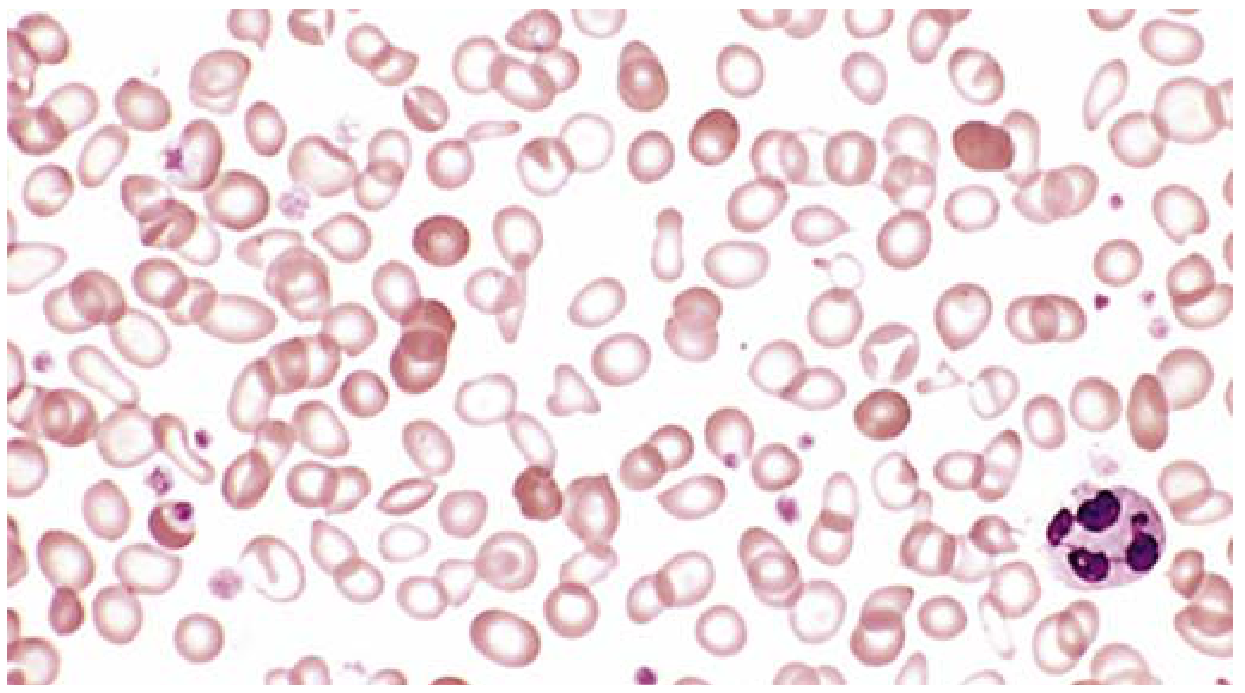
- Microcytic, hypochromic RBCs (MCV ↓, MCH ↓, MCHC ↓)
- Increased central pallor (>1/3 of cell diameter)
- Anisocytosis + poikilocytosis
- Platelets often elevated (reactive thrombocytosis)
- Reticulocyte count: normal or slightly low (response blunted)
Lab Findings Summary
| Test | IDA | ACD | Thalassemia trait |
|---|---|---|---|
| Serum iron | ↓ | ↓ | Normal |
| Ferritin | ↓ | ↑ | Normal/↑ |
| TIBC | ↑ | ↓ | Normal |
| Transferrin saturation | ↓ | ↓ | Normal |
| RBC count | ↓ | ↓ | ↑ or normal |
| RDW | ↑ | Normal | Normal/↑ |
Clinical Features
- Often mild and asymptomatic
- Weakness, listlessness, pallor in severe cases
- Long-standing: koilonychia (spoon nails), thin/flat nails
- Pica — compulsion to eat non-food items (dirt, clay, ice/pagophagia) — a neurobehavioral complication
- Angular cheilitis, glossitis (sore tongue)
- Impaired cognitive performance and reduced immunocompetence
"Persons often die with iron deficiency anemia but virtually never of it. Microcytic hypochromic anemia is not a disease but a symptom — always investigate the underlying cause." — Robbins Basic Pathology
2. Anemia of Chronic Disease (ACD) / Anemia of Inflammation
- Chronic infections: osteomyelitis, bacterial endocarditis, lung abscess
- Chronic immune disorders: rheumatoid arthritis, Crohn disease
- Cancers: Hodgkin lymphoma, lung/breast carcinoma
- Serum iron: ↓ (same as IDA)
- Ferritin: ↑ (iron sequestered, not depleted) — key differentiator
- TIBC: ↓ (unlike IDA where TIBC is ↑)
- Red cells: mildly hypochromic and microcytic or normocytic
3. Thalassemias
- β-globin gene: single gene on chromosome 11 (mutations = mainly point mutations affecting transcription, splicing, or translation of β-globin mRNA)
- α-globin genes: two tandem genes on chromosome 16 per haploid genome (4 total; mutations = mainly gene deletions)
- Autosomal codominant inheritance
β-Thalassemia
| Syndrome | Genotype | Clinical Features |
|---|---|---|
| β-Thalassemia major (Cooley anemia) | β⁰/β⁰ (no β-chain) | Severe transfusion-dependent anemia; splenomegaly; growth retardation; extramedullary hematopoiesis; facial bone changes ("chipmunk face"); iron overload |
| β-Thalassemia intermedia | β⁺/β⁰ or β⁺/β⁺ | Moderately severe; transfusions not required |
| β-Thalassemia minor (trait) | β⁺/β (one normal allele) | Asymptomatic; mild/absent anemia; ↑ HbA2; often mistaken for IDA — MCV low but RBC count high |
α-Thalassemia
| Syndrome | Gene deletions | Clinical Features |
|---|---|---|
| Silent carrier | 1 deleted (−/α, α/α) | No abnormality; asymptomatic |
| α-Thalassemia trait | 2 deleted | Asymptomatic; resembles β-thal minor |
| HbH disease | 3 deleted (−/−, −/α) | Moderate anemia (resembles β-thal intermedia); HbH (β₄ tetramers) |
| Hydrops fetalis | 4 deleted (−/−, −/−) | Lethal in utero; Hb Bart's (γ₄ tetramers); incompatible with extrauterine life |
4. Sideroblastic Anemia
| Form | Cause |
|---|---|
| Inherited (X-linked) | Mutations in ALAS2 gene (ALA synthase 2 — first step of heme synthesis) |
| Inherited (AR) | Mutations in SLC25A38 (glycine importer) |
| Acquired — MDS | Myelodysplastic syndrome (most common acquired form) |
| Acquired — drugs/toxins | Ethanol, isoniazid, pyrazinamide, linezolid |
| Acquired — nutritional | Copper deficiency (also zinc excess) |
PART II — MACROCYTIC ANEMIAS (MCV > 100 fL)
Megaloblastic Anemias
- Many progenitors trigger DNA damage response → apoptosis (ineffective erythropoiesis)
- Surviving progenitors produce fewer, larger red cells (fewer cell divisions → larger cells)
Universal Morphologic Features of Megaloblastic Anemia
- Macro-ovalocytes (large, oval RBCs without central pallor — hyperchromic appearance, but MCHC is not truly elevated)
- Marked anisocytosis and poikilocytosis
- Hypersegmented neutrophils (5+ lobes in a single neutrophil, or ≥1 neutrophil with 6+ lobes) — pathognomonic
- Low reticulocyte count
- Hypercellular bone marrow with megaloblastic changes: giant bands, giant metamyelocytes, large erythroid precursors with immature-appearing ("open") nuclei relative to mature cytoplasm
5. Folate Deficiency Anemia
| Category | Examples |
|---|---|
| Decreased intake | Poor diet, alcoholism (most common in high-resource countries), infancy |
| Impaired absorption | Malabsorption, intrinsic intestinal disease, anticonvulsants, oral contraceptives |
| Increased loss | Hemodialysis |
| Increased requirement | Pregnancy, infancy, disseminated cancer, markedly increased hematopoiesis |
| Impaired utilization | Folate antagonists (methotrexate, trimethoprim) |
- Megaloblastic anemia (identical hematology to B12 deficiency)
- GI mucosal changes: sore tongue, glossitis
- NO neurologic manifestations (key distinguishing feature from B12 deficiency)
Critical: Folate supplementation corrects the anemia of B12 deficiency but does NOT prevent — and may worsen — the neurologic damage. Always exclude B12 deficiency before starting folate therapy.
6. Vitamin B12 (Cobalamin) Deficiency Anemia
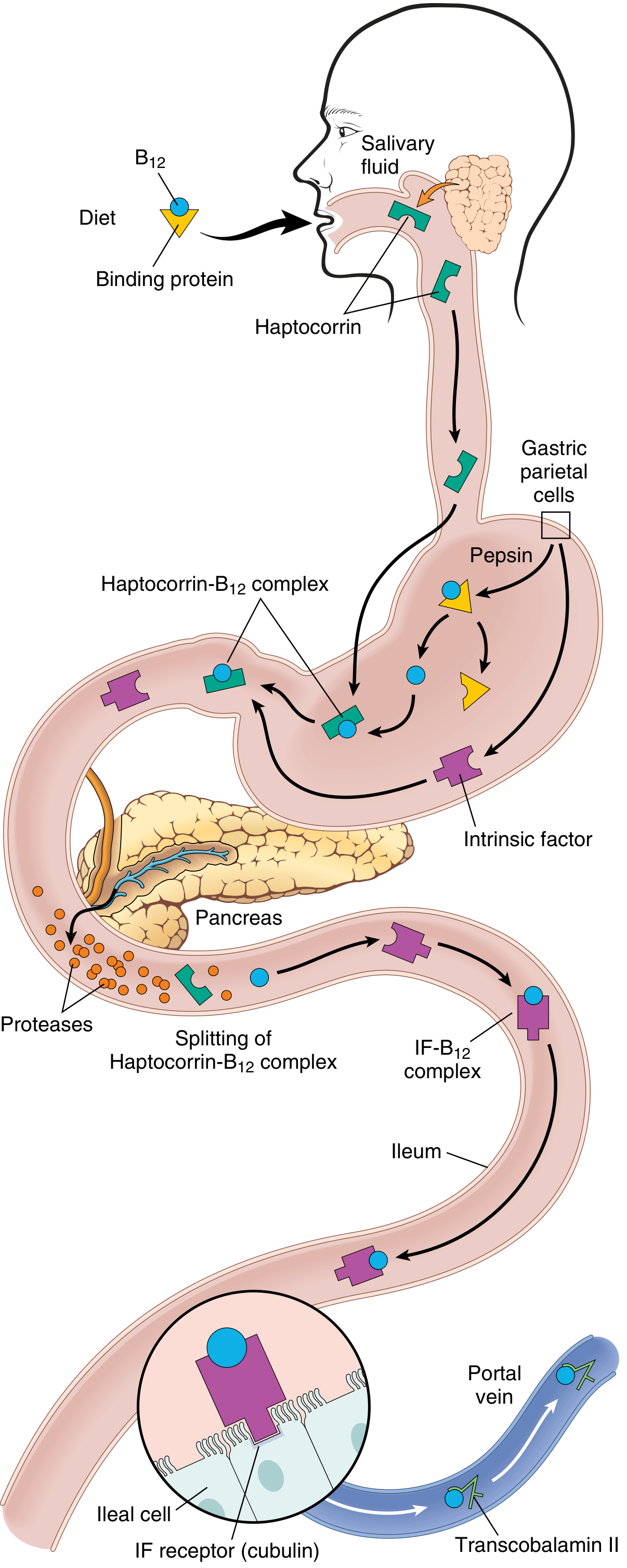
Causes of B12 Deficiency
| Cause | Mechanism |
|---|---|
| Pernicious anemia (most common) | Autoimmune atrophic gastritis → loss of parietal cells → absent intrinsic factor. Serum autoantibodies to IF (diagnostic but not primary pathogen). |
| Gastrectomy | Loss of IF-producing cells |
| Ileal resection / Crohn disease / Whipple disease | Loss of IF-B12 absorbing cells |
| Blind loop / diverticulosis | Bacterial overgrowth → competitive uptake |
| Fish tapeworm (Diphyllobothrium) | Competitive parasitic uptake |
| Gastric atrophy / achlorhydria | Cannot release B12 from food-bound form (especially elderly) |
| Strict veganism | Only cause of dietary B12 deficiency |
Why B12 Deficiency Causes Neurologic Damage (and Folate Deficiency Does Not)
- Methylation of homocysteine → methionine (requires methylcobalamin; regenerates tetrahydrofolate → thymidine synthesis)
- Isomerisation of methylmalonyl-CoA → succinyl-CoA (requires adenosylcobalamin)
- Demyelination of posterior columns (dorsal) — loss of vibration sense, proprioception
- Demyelination of lateral columns (corticospinal tracts) — spastic weakness, hyperreflexia
- Peripheral neuropathy — symmetric tingling, numbness, burning in feet/hands
- Neurologic damage may be irreversible even after B12 treatment
Clinical Features of Pernicious Anemia
| Feature | Detail |
|---|---|
| Anemia | Pallor, fatigue, dyspnea, palpitations |
| Mild jaundice | Ineffective erythropoiesis → intramedullar haemolysis |
| Glossitis | "Beefy red tongue" — megaloblastic changes in oral mucosa |
| Neurologic | SCD: symmetric paraesthesias → unsteady gait → loss of position sense |
| Gastric | Autoimmune atrophic gastritis; increased risk of gastric carcinoma |
Diagnosis of B12 Deficiency
| Finding | Result |
|---|---|
| Serum B12 | ↓ |
| Serum folate | Normal or ↑ |
| Serum homocysteine | ↑ |
| Serum methylmalonate | ↑ (unique to B12 deficiency) |
| Blood smear | Macro-ovalocytes, hypersegmented neutrophils |
| Bone marrow | Hypercellular, megaloblastic changes |
| Anti-intrinsic factor antibodies | Present in pernicious anemia (specific) |
Differentiating B12 from Folate Deficiency
| Feature | B12 Deficiency | Folate Deficiency |
|---|---|---|
| Serum B12 | ↓ | Normal |
| Serum folate | Normal or ↑ | ↓ |
| RBC folate | Normal | ↓ |
| Homocysteine | ↑ | ↑ |
| Methylmalonate | ↑ | Normal |
| Neurologic deficits | YES (SCD) | NO |
| Onset | Slow (years) | Faster (months) |
Non-Megaloblastic Macrocytosis
| Cause | Mechanism |
|---|---|
| Liver disease / alcoholism | Lipid membrane abnormalities → ↑ RBC membrane surface area → macrocytes (also folate deficiency component) |
| Hypothyroidism | Slowed RBC maturation |
| Drugs (hydroxyurea, AZT, azathioprine) | Inhibit DNA synthesis but without classic megaloblastic morphology |
| Reticulocytosis | Reticulocytes are larger → MCV rises after hemolysis/hemorrhage treatment |
| MDS | Dyserythropoiesis |
Master Summary Table
| Feature | IDA | ACD | Thalassemia Minor | Sideroblastic | Folate Def | B12 Def |
|---|---|---|---|---|---|---|
| MCV | ↓ | Normal/↓ | ↓ | ↓ (inherited); variable (acquired) | ↑ | ↑ |
| Serum iron | ↓ | ↓ | Normal | ↑ | Normal | Normal |
| TIBC | ↑ | ↓ | Normal | Normal | Normal | Normal |
| Ferritin | ↓ | ↑ | Normal/↑ | ↑ | Normal | Normal |
| Transferrin sat | ↓ | ↓ | Normal | ↑ | Normal | Normal |
| Homocysteine | — | — | — | — | ↑ | ↑ |
| Methylmalonate | — | — | — | — | Normal | ↑ |
| Smear hallmark | Microcytic, hypochromic | Mild hypo/normo | Target cells, microcytic | Dimorphic, ring sideroblasts on BM | Macro-ovalocytes, hyperseg PMN | Macro-ovalocytes, hyperseg PMN |
| Neuro deficits | No | No | No | No (unless Cu deficiency) | No | YES (SCD) |
| BM finding | ↑ cellularity, no iron stores | ↑ iron in macrophages | Hyperplastic erythropoiesis | Ringed sideroblasts | Megaloblastic | Megaloblastic |
topographic anatomy of upper limb with nomenclature, and osteology of clavicle in easy language
Topographic Anatomy of the Upper Limb + Osteology of the Clavicle
PART I — TOPOGRAPHIC ANATOMY OF THE UPPER LIMB
What is "topographic anatomy"?
1. Overview: The Upper Limb as a Whole
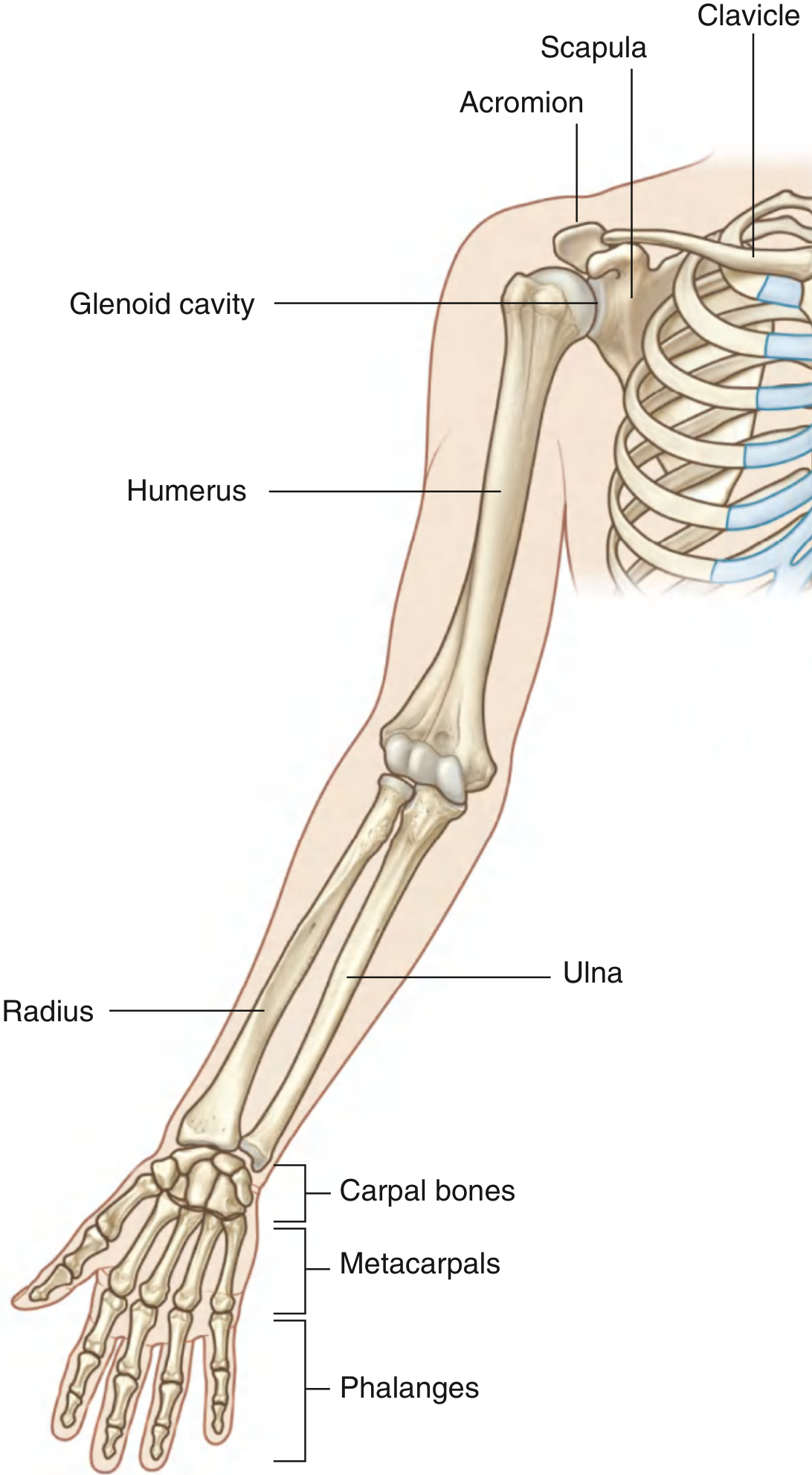
2. Nomenclature: Names of Regions
| Common name | Anatomical/Technical name |
|---|---|
| Shoulder | Regio deltoidea (deltoid region) + Regio scapularis |
| Armpit | Axilla (or axillary fossa) |
| Upper arm | Brachium (→ adjective: brachial) |
| Front of elbow | Fossa cubitalis (cubital fossa) |
| Forearm | Antebrachium (→ adjective: antebrachial) |
| Wrist | Carpus (→ adjective: carpal) |
| Palm | Palma manus |
| Back of hand | Dorsum manus |
| Fingers | Digiti manus (digits of the hand) |
| Thumb | Pollex (digit I) |
| Index finger | Index (digit II) |
| Middle finger | Digitus medius (digit III) |
| Ring finger | Digitus anularis (digit IV) |
| Little finger | Digitus minimus / minimus manus (digit V) |
| Finger bones | Phalanges (singular: phalanx) |
3. The Bones and Their Joints — Region by Region
A. Shoulder (Regio Scapularis / Deltoidea)
- Clavicle ("collar bone") — horizontal strut connecting the trunk to the upper limb
- Scapula ("shoulder blade") — flat triangular bone sitting on the back of the rib cage
- Humerus — the single bone of the upper arm; its upper end (head) sits in the socket of the scapula
| Joint | Bones involved | Movement |
|---|---|---|
| Sternoclavicular (SC) joint | Clavicle + manubrium of sternum | Only bony attachment of upper limb to trunk |
| Acromioclavicular (AC) joint | Clavicle + acromion of scapula | Gliding; transmits forces from limb to clavicle |
| Glenohumeral joint | Head of humerus + glenoid cavity of scapula | Ball-and-socket; most mobile joint in the body |
- Flexion (arm forward), Extension (arm backward)
- Abduction (arm away from body), Adduction (arm toward body)
- Medial rotation (internal rotation), Lateral rotation (external rotation)
- Circumduction (combination of all the above in a circle)
B. Axilla (Armpit)
| Wall | What forms it |
|---|---|
| Anterior wall | Pectoralis major + pectoralis minor muscles |
| Posterior wall | Subscapularis, teres major, latissimus dorsi |
| Medial wall | Serratus anterior muscle on ribs 1–4 |
| Lateral wall | Intertubercular groove of the humerus (narrowest wall) |
| Apex (inlet) | Clavicle (front) + superior border of scapula (back) + 1st rib (medial) |
| Base (floor) | Axillary fascia + skin of the armpit |
- Axillary artery (continuation of subclavian artery — divided into 3 parts by the pectoralis minor)
- Axillary vein (formed by union of basilic vein + brachial veins)
- Brachial plexus (the main nerve network of the upper limb — formed from C5 to T1)
- Axillary lymph nodes (drain the breast, arm, and thoracic wall — clinically important in breast cancer)
C. Arm (Brachium)
| Compartment | Position | Main muscles | Main action |
|---|---|---|---|
| Anterior compartment | Front of arm | Biceps brachii, brachialis, coracobrachialis | Flexion of forearm at elbow |
| Posterior compartment | Back of arm | Triceps brachii | Extension of forearm at elbow |
- Musculocutaneous nerve (C5, C6) — supplies anterior compartment; becomes the lateral cutaneous nerve of the forearm
- Radial nerve (C5–C8, T1) — runs in the spiral groove of the humerus; supplies posterior compartment
- Median nerve (C6–C8, T1) — runs in front of the arm; no branches in arm
- Ulnar nerve (C8, T1) — passes behind the medial epicondyle ("funny bone")
D. Elbow Joint + Cubital Fossa
- Flexion and extension of the forearm
- Also allows the radius to spin on the capitulum (part of humeral condyle) during pronation/supination
- Tendon of biceps
- Artery (brachial artery — divides here into radial and ulnar)
- Nerve (median nerve)
E. Forearm (Antebrachium)
- Radius — lateral bone (thumb side); head at top, wide lower end forming most of the wrist joint
- Ulna — medial bone (little finger side); large olecranon process at top ("elbow tip")
| Movement | What happens | Result |
|---|---|---|
| Supination | Radius parallel to ulna | Palm faces forward (anatomical position) |
| Pronation | Radius crosses over ulna | Palm faces backward |
| Compartment | Position | Action |
|---|---|---|
| Anterior (flexor) | Front | Flexion of wrist and fingers; pronation |
| Posterior (extensor) | Back | Extension of wrist and fingers; supination |
F. Wrist (Carpus) and Hand
Easy mnemonic: "Some Lovers Try Positions That They Can't Handle"
- Thumb: 2 phalanges (proximal + distal)
- Other 4 fingers: 3 phalanges each (proximal + middle + distal)
- Metacarpophalangeal (MCP) joints — knuckles; biaxial, allow flexion/extension + abduction/adduction
- Proximal interphalangeal (PIP) joints — hinge joints
- Distal interphalangeal (DIP) joints — hinge joints
4. Muscles: General Compartment Logic
| Region | Anterior compartment | Posterior compartment |
|---|---|---|
| Arm | Flexors (biceps, brachialis) | Extensors (triceps) |
| Forearm | Flexors of wrist + fingers; pronators | Extensors of wrist + fingers; supinator |
| Hand | Intrinsic muscles (thenar, hypothenar, lumbricals, interossei) | — |
- Rotator cuff (4 muscles — SITS): Supraspinatus, Infraspinatus, Teres minor, Subscapularis — form a cuff around the joint and stabilize the humeral head in the glenoid
5. Innervation — Brachial Plexus in Brief
| Spinal level | Test movement (Myotome) | Test area (Dermatome) |
|---|---|---|
| C5 | Arm abduction at shoulder | Upper lateral arm |
| C6 | Forearm flexion at elbow | Palmar thumb |
| C7 | Forearm extension at elbow | Pad of index finger |
| C8 | Finger flexion | Pad of little finger |
| T1 | Finger abduction/adduction | Medial elbow skin |
- Biceps reflex → tests C6
- Triceps reflex → tests C7
| Nerve | Spinal roots | Main territory |
|---|---|---|
| Musculocutaneous | C5, C6 | Anterior arm (biceps, brachialis) |
| Radial | C5–C8, T1 | All extensors; dorsal hand skin |
| Median | C6–C8, T1 | Anterior forearm most flexors; lateral palm + 3½ fingers |
| Ulnar | C8, T1 | Intrinsic hand muscles; medial 1½ fingers |
6. Blood Supply
- Subclavian artery → becomes axillary artery (at lateral border of 1st rib) → becomes brachial artery (at lower border of teres major)
- Brachial artery divides at the cubital fossa into radial artery (lateral) and ulnar artery (medial)
- Radial + ulnar arteries anastomose in the hand to form the superficial and deep palmar arches, which supply the digits
- Cephalic vein — runs on lateral (radial) side of forearm and arm; drains into axillary vein
- Basilic vein — runs on medial (ulnar) side; pierces deep fascia of arm, joins brachial vein → forms axillary vein
- Median cubital vein — connects cephalic to basilic across the cubital fossa; most common site for venepuncture
7. Relationship to the Neck
- Rib I (medially)
- Posterior surface of clavicle (anteriorly)
- Superior border of scapula (posteriorly)
- Coracoid process (laterally, forming the apex)
PART II — OSTEOLOGY OF THE CLAVICLE
What is the Clavicle?
Shape
- The medial (inner) two-thirds curves forward (convex anteriorly) — like the front of the letter "S"
- The lateral (outer) one-third curves backward (concave anteriorly)
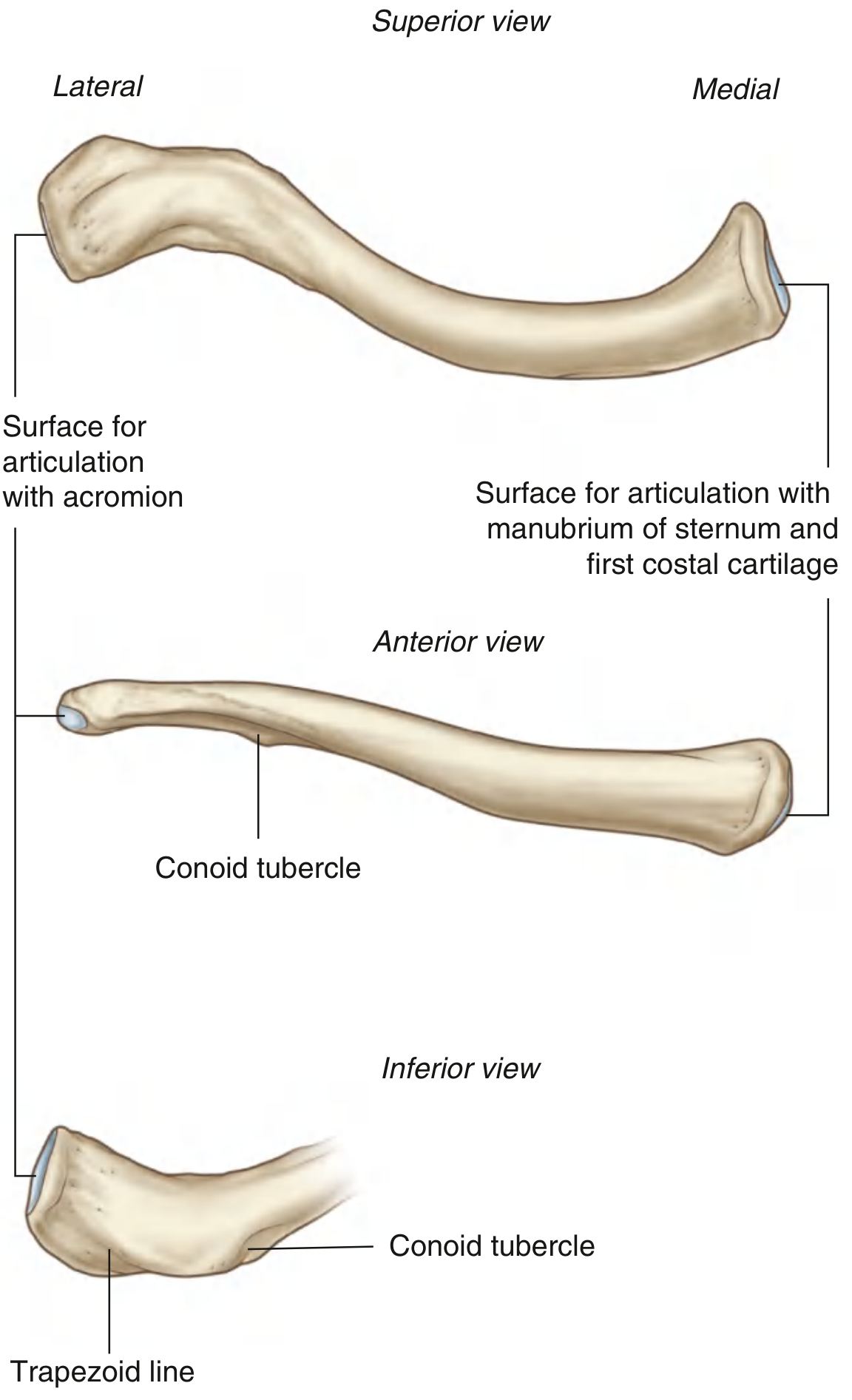
Parts of the Clavicle
1. Sternal End (Medial End)
- Shape: Rounded, quadrangular/bulky — the bigger, heavier end
- Has a large articular facet that joins the manubrium of the sternum (breastbone) and partially the 1st costal cartilage → forms the sternoclavicular (SC) joint
- This is the only true bony joint between the upper limb and the axial skeleton (trunk)
- The inferior surface here has an oval depression = impression for the costoclavicular ligament (the strong ligament anchoring the clavicle to rib 1)
2. Acromial End (Lateral End)
- Shape: Flat and broad — thinner, flattened
- Has a small oval facet on its tip that joints with a matching facet on the acromion of the scapula → forms the acromioclavicular (AC) joint
- This joint is felt as a small bump on top of the shoulder
3. Shaft (Body)
- The middle portion connecting the two ends
- The superior surface is relatively smooth — no major muscle attachments here
- The inferior surface is rougher and carries important markings (see below)
Key Bony Markings (What you find on the surface)
| Marking | Location | What attaches |
|---|---|---|
| Conoid tubercle | Inferior surface, junction of lateral 1/3 and middle 1/3 | Conoid part of coracoclavicular ligament |
| Trapezoid line | Inferior surface, lateral to conoid tubercle, running forward/laterally | Trapezoid part of coracoclavicular ligament |
| Impression for costoclavicular ligament | Inferior surface near sternal end | Costoclavicular ligament (holds clavicle down to rib 1) |
| Deltoid tubercle | Anterior surface, lateral half | Deltoid muscle (origin) |
| Trapezoid tubercle | Posterior surface, lateral half | Trapezius muscle (insertion) |
Coracoclavicular ligament = the main suspensory ligament that holds the scapula (and the whole arm) up from the clavicle. It has two parts: the conoid (medial, cone-shaped) and the trapezoid (lateral, flat).
Muscle Attachments on the Clavicle
| Region | Surface | Muscle | What it does |
|---|---|---|---|
| Medial half anterior | Anterior | Pectoralis major (clavicular head) | Flex + medially rotate arm |
| Medial half posterior | Posterior | Sternohyoid | Depresses hyoid bone |
| Medial half superior | Superior | Sternocleidomastoid | Turns head to opposite side |
| Lateral half anterior | Anterior | Deltoid | Abducts arm |
| Lateral half posterior | Posterior | Trapezius | Elevates scapula |
Ossification (How the Clavicle Develops) — Simple Explanation
-
First bone to start forming in the fetus — ossification begins around the 5th week of pregnancy, before any other bone in the body.
-
Last bone to completely fuse — the epiphysis (growth plate) at the sternal end does not fuse until 22–25 years of age — making it the last epiphysis in the entire body to close. This is clinically important: an injury to the medial end of the clavicle in a young adult may be a physeal (growth plate) injury rather than a true joint dislocation.
- Most of the clavicle ossifies by intramembranous (desmal) ossification — directly from connective tissue, without a cartilage model first (unlike most other long bones)
- The sternal end develops from a secondary ossification centre and fuses by endochondral ossification
- The acromial end ossifies by intramembranous ossification
Clinical Relevance of the Clavicle
| Clinical point | Explanation |
|---|---|
| Most commonly fractured bone in the body | Falls on outstretched hand (FOOSH) transmit force to the clavicle; it typically breaks at the junction of middle and lateral thirds (weakest point, no muscular reinforcement) |
| Fracture causes | The medial fragment is pulled up by sternocleidomastoid; the lateral fragment drops down and inward due to the weight of the arm |
| Why the shape matters | The S-curve makes the middle third weak but also ensures that a fracture here (rather than at the ends) protects the underlying subclavian vessels and brachial plexus |
| AC joint injury ("shoulder separation") | Disruption of the acromioclavicular joint + coracoclavicular ligaments; the shoulder drops away from the clavicle |
| SC joint dislocation | Much less common; a posterior dislocation is dangerous because the sternal end can compress the trachea, esophagus, or great vessels |
| Nutrient canal | An oblique nutrient canal runs in the shaft directed toward the acromial end; in ~6–10% of people there is also an accessory canal for the supraclavicular nerve |
Summary: Clavicle at a Glance
| Feature | Detail |
|---|---|
| Type | Long bone (S-shaped) |
| Classification | Part of the shoulder girdle (pectoral girdle) |
| Articulations | Medially: manubrium + 1st costal cartilage (SC joint); laterally: acromion (AC joint) |
| Function | Only bony connection between upper limb and trunk; strut to keep shoulder wide |
| First bone to ossify | 5th week of fetal life |
| Last epiphysis to fuse | Sternal end, at 22–25 years |
| Most common fracture site | Junction of middle + lateral thirds |
| Key ligaments attached | Costoclavicular, coracoclavicular (conoid + trapezoid) |
Create a visual anatomy poster of upper limb regions and landmarks
A detailed medical anatomy education poster of the upper limb showing anterior and posterior views of the right arm. The poster has a clean white background with a professional academic style. LEFT SIDE: Anterior (front) view of the entire right upper limb from shoulder to fingertips, with clear anatomical labels pointing to each region and landmark using thin leader lines: - Shoulder region (deltoid region) at the top - Clavicle labeled as "Clavicle (Collar Bone)" with arrow - Acromion of scapula - Glenohumeral joint - Axilla (armpit region) indicated - Arm / Brachium with anterior compartment labeled - Biceps brachii muscle visible - Medial and lateral epicondyles of humerus - Cubital fossa (antecubital fossa) at elbow - Forearm / Antebrachium with flexor compartment anterior - Radius (lateral) and Ulna (medial) labeled - Wrist / Carpus - Thenar eminence on palm - Hypothenar eminence on palm - Palm (Palma manus) - Digits I-V labeled (Pollex/Thumb to Digitus Minimus) - Phalanges: proximal, middle, distal labeled on one finger RIGHT SIDE: Posterior (back) view of the right upper limb: - Spine of scapula labeled - Infraspinous fossa - Posterior arm / triceps brachii visible - Olecranon process at elbow tip - Posterior forearm / extensor compartment - Dorsum manus (back of hand) - Knuckles (MCP joints) BOTTOM: A small inset panel showing cross-section of arm with anterior flexor compartment (light blue) and posterior extensor compartment (light orange), labeled with compartment names, humerus in center, and intermuscular septa shown. Color scheme: soft anatomical tones — muscles in light pink/salmon, bones in cream/beige, nerves in yellow, arteries in red, veins in blue. Bold title at top reads "TOPOGRAPHIC ANATOMY OF THE UPPER LIMB". Subtitle: "Regional Nomenclature & Surface Landmarks". Professional medical illustration style, clean sans-serif labels.
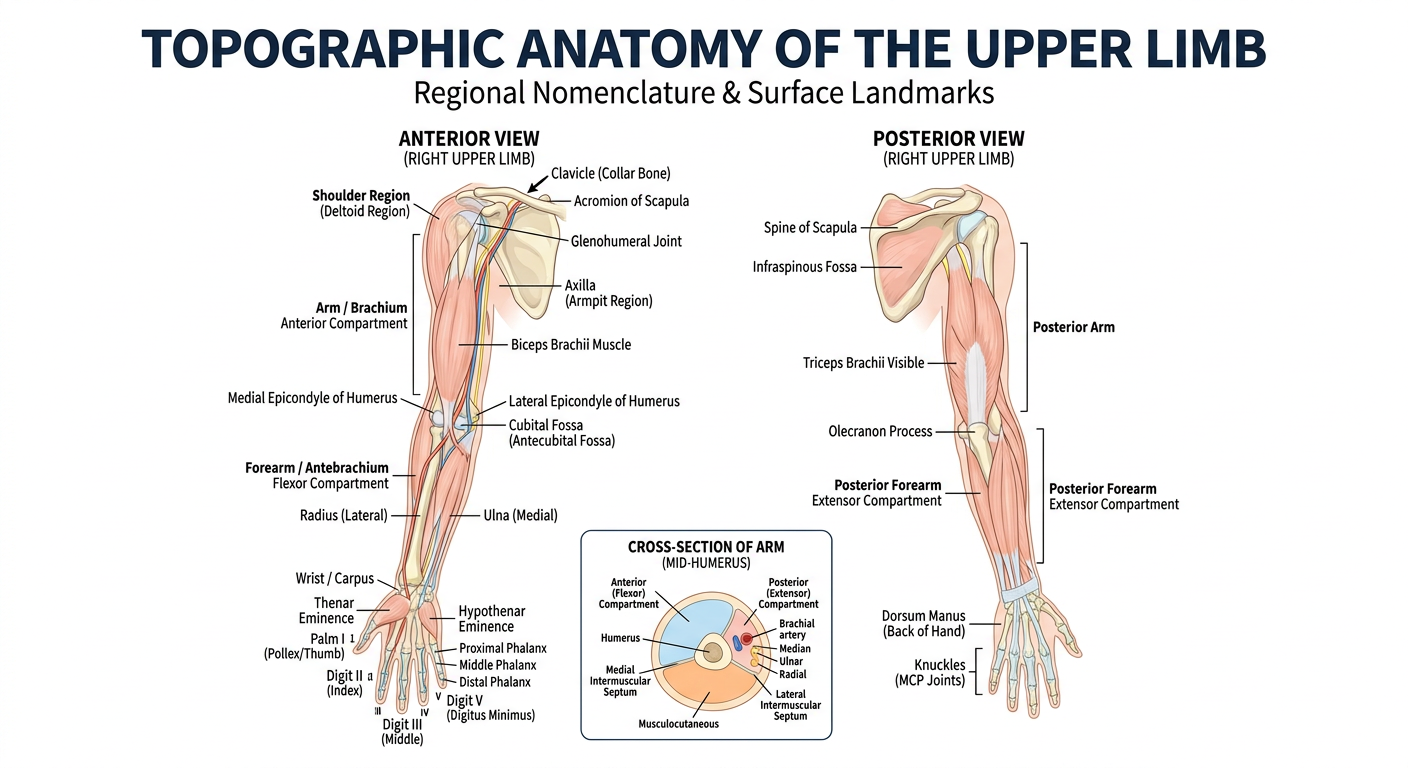
- Shoulder girdle — clavicle, acromion, glenohumeral joint
- Axilla (armpit gateway)
- Brachium — biceps brachii, medial/lateral epicondyles
- Cubital fossa (antecubital fossa)
- Antebrachium — radius (lateral) and ulna (medial)
- Carpus, thenar/hypothenar eminences, palma manus
- Digits I–V with phalangeal labeling
- Spine of scapula, infraspinous fossa
- Triceps brachii, olecranon process
- Extensor compartment of forearm
- Dorsum manus and MCP knuckles
upper limb w.r.t. KLM oriented anatomy whole, in easy language
What do you mean by 'KLM oriented anatomy'?
Note: Moore's Clinically Oriented Anatomy isn't in the library by that exact title. The closest available equivalent is Gray's Anatomy for Students, which follows the same regional, clinically oriented approach — organized region by region with clinical boxes, just like Moore. The following tutorial is fully drawn from that source and structured in the KL Moore style.
Upper Limb — Clinically Oriented Anatomy (Moore-Style)
HOW TO READ THIS TUTORIAL
- Bones — what you're building around
- Joints — how the bones connect and move
- Muscles — what moves what
- Nerves — who controls what
- Blood supply — arteries and veins
- Clinical pearls — what goes wrong and why it matters
REGION 1: THE SHOULDER GIRDLE (Pectoral Girdle)
Bones
1. Clavicle (Collar Bone)
- The only bony bridge between the arm and the trunk
- S-shaped; medial end is round and thick, lateral end is flat
- You can feel the whole length of it just below your neck
- The medial (sternal) end has a large facet → joins the sternum (SC joint)
- The lateral (acromial) end has a small oval facet → joins the scapula (AC joint)
2. Scapula (Shoulder Blade)
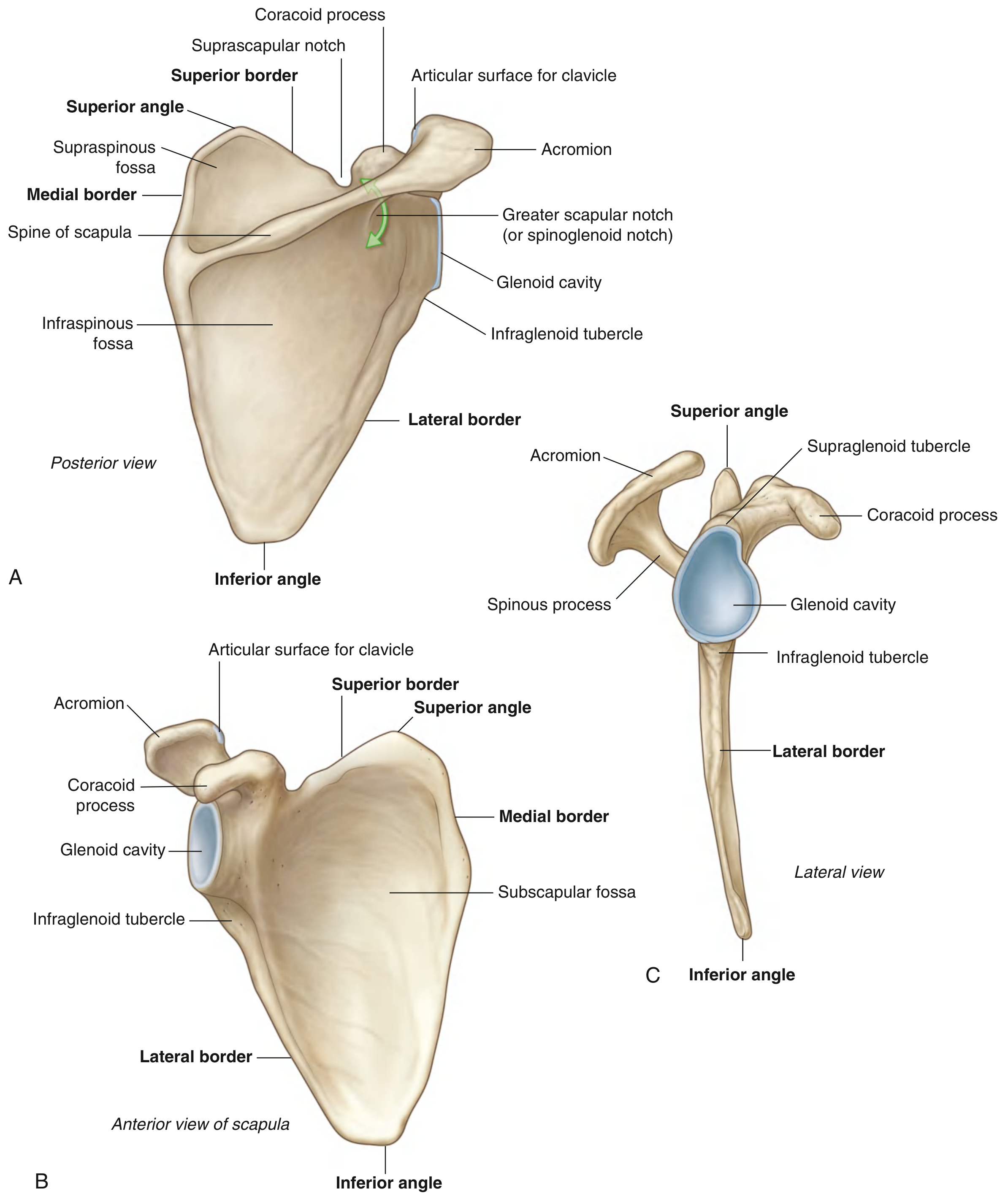
| Structure | What it is | Why it matters |
|---|---|---|
| Spine | Bony ridge across the back surface | Divides into supraspinous + infraspinous fossae; palpable landmark |
| Acromion | Anterolateral projection of the spine | Arches over glenohumeral joint; articulates with clavicle (AC joint) |
| Coracoid process | Hook-like projection from superior border | Anchor for biceps short head, coracobrachialis, pec minor; palpable under clavicle |
| Glenoid cavity | Shallow cup on lateral angle | Receives the humeral head → glenohumeral joint |
| Supraglenoid tubercle | Small projection above glenoid | Origin of long head of biceps brachii |
| Infraglenoid tubercle | Roughening below glenoid | Origin of long head of triceps brachii |
| Subscapular fossa | Concave anterior (costal) surface | Origin of subscapularis (rotator cuff) |
| Supraspinous fossa | Above the spine (posterior) | Origin of supraspinatus (rotator cuff) |
| Infraspinous fossa | Below the spine (posterior) | Origin of infraspinatus (rotator cuff) |
| Medial border | Thin, sharp inner edge | Origin of serratus anterior |
| Inferior angle | Bottom corner of triangle | Moves forward when arm is raised — palpable landmark |
3. Proximal Humerus
| Structure | Description |
|---|---|
| Head | Half-sphere; articulates with glenoid cavity |
| Anatomical neck | Constriction just below the head |
| Greater tubercle | Large projection lateral side → SITS rotator cuff attaches here (except subscapularis) |
| Lesser tubercle | Smaller projection anteriorly → subscapularis attaches here |
| Intertubercular (bicipital) groove | Sulcus between the two tubercles → long head of biceps runs here |
| Surgical neck | Narrowing below the tubercles → most common fracture site (axillary nerve is at risk here) |
Joints of the Shoulder Complex
1. Sternoclavicular (SC) Joint
- Type: Synovial saddle-shaped joint; the only bony connection between the upper limb and the trunk
- Has an articular disc that divides the joint completely into two compartments — acts like a shock absorber
- Reinforced by 4 ligaments: anterior/posterior sternoclavicular, interclavicular, and costoclavicular ligament (the strongest — pins the clavicle to rib 1)
- Movements: clavicle moves in anteroposterior and vertical planes + some rotation
Clinical: SC joint dislocations are rare (only ~3% of shoulder dislocations) but posterior dislocations are dangerous — the medial end of the clavicle can compress the trachea, esophagus, or great vessels.
2. Acromioclavicular (AC) Joint
- Small synovial joint between acromion and lateral clavicle
- Reinforced by: small acromioclavicular ligament (directly over the joint) + large coracoclavicular ligament (conoid + trapezoid parts) — this bigger ligament is the main weight-bearing support
- Allows anteroposterior gliding + axial rotation of scapula
Clinical: AC joint sprain/separation — graded I–III. Grade III: coracoclavicular ligament torn → shoulder drops, clavicle "steps up." Mechanism: fall on tip of shoulder.
Clinical: Clavicle fractures are extremely common (most fractured bone in body). Typically break at the junction of middle and lateral thirds (weakest point). Mechanism: fall on outstretched hand. After fracture: medial fragment pulled UP by sternocleidomastoid; lateral fragment drops DOWN by weight of arm.
3. Glenohumeral (Shoulder) Joint
- Type: Ball-and-socket synovial joint — most mobile joint in the body
- The socket (glenoid cavity) is shallow and only covers about 1/4 of the humeral head → unstable but mobile
- Stability is provided by:
- Glenoid labrum — fibrocartilaginous rim that deepens the socket
- Joint capsule — thin, lax capsule that allows wide movement
- Glenohumeral ligaments — superior, middle, inferior (thickenings of capsule)
- Rotator cuff muscles — the main dynamic stabilizers
- Biceps long head tendon — runs through the joint, helps prevent upward displacement
Clinical: Shoulder dislocation — most common joint dislocation overall. Usually anterior (95%): humeral head forced forward and inferior. Mechanism: forced external rotation + extension. May injure axillary nerve (test: sensation over deltoid). May cause Bankart lesion (anterior glenoid labrum tear) or Hill-Sachs lesion (posterolateral head compression fracture).
Muscles of the Shoulder
The Rotator Cuff — "SITS"
| Muscle | Origin | Insertion | Nerve | Action |
|---|---|---|---|---|
| Supraspinatus | Supraspinous fossa | Greater tubercle (top facet) | Suprascapular (C5, C6) | Initiates abduction (first 15°) |
| Infraspinatus | Infraspinous fossa | Greater tubercle (middle facet) | Suprascapular (C5, C6) | Lateral (external) rotation |
| Teres minor | Lateral border of scapula | Greater tubercle (lowest facet) | Axillary (C5, C6) | Lateral rotation |
| Subscapularis | Subscapular fossa | Lesser tubercle | Subscapular nerves (C5, C6, C7) | Medial (internal) rotation |
Clinical: Rotator cuff tears — supraspinatus is the most commonly torn (compressed between acromion and humeral head during abduction). Presents as painful arc from 60–120° of abduction. Subacromial bursa gets pinched in the same space → subacromial impingement.
Other Major Shoulder Muscles
| Muscle | Main Action | Nerve |
|---|---|---|
| Deltoid | Abduction of arm (15–90°); anterior part = flex; posterior = extend | Axillary (C5, C6) |
| Trapezius | Elevates, retracts, and rotates scapula; holds shoulder girdle up | Accessory nerve (CN XI) + C3/C4 |
| Pectoralis major | Adduction, medial rotation, flexion of arm | Medial + lateral pectoral nerves |
| Latissimus dorsi | Powerful extension, adduction, medial rotation ("swimming stroke" muscle) | Thoracodorsal (C6–C8) |
| Serratus anterior | Protracts scapula; holds medial border against ribs; rotates scapula upward | Long thoracic nerve (C5–C7) |
Clinical: Long thoracic nerve injury → paralysis of serratus anterior → winged scapula (medial border lifts off the chest wall when arm is pushed forward against resistance). Caused by: neck surgery, prolonged carrying of heavy bags, viral illness.
REGION 2: THE AXILLA
| Wall | Formed by |
|---|---|
| Anterior wall | Pectoralis major (superficial) + pectoralis minor + subclavius (deep) + clavipectoral fascia |
| Posterior wall | Subscapularis (above) + teres major + latissimus dorsi (below) |
| Medial wall | Serratus anterior muscle on ribs 1–4 |
| Lateral wall | Intertubercular groove of humerus (narrowest wall — just a slit) |
| Apex (inlet) | Triangle: clavicle (front) + 1st rib (medial) + scapula superior border (posterior) |
| Floor (base) | Axillary fascia + skin of the armpit |
"Gateways" in the Posterior Wall — Very High Yield
| Space | Boundaries | What passes through |
|---|---|---|
| Quadrangular space | Teres minor (top) + teres major (bottom) + long head triceps (medial) + surgical neck humerus (lateral) | Axillary nerve + posterior circumflex humeral artery |
| Triangular space | Teres minor (top) + teres major (bottom) + long head triceps (lateral) | Circumflex scapular artery |
| Triangular interval | Teres major (top) + long head triceps (medial) + humerus shaft (lateral) | Radial nerve + profunda brachii artery |
Clinical: Quadrangular space syndrome — compression of axillary nerve here → deltoid and teres minor weakness + "badge area" numbness (lateral arm over deltoid).
Contents of the Axilla
- Axillary artery (+ all its branches)
- Axillary vein
- Brachial plexus (cords and terminal branches)
- Axillary lymph nodes (drain breast, arm, thoracic wall — palpated in breast cancer examination)
- Proximal parts of biceps brachii and coracobrachialis muscles
Axillary Artery — 3 Parts (divided by pectoralis minor)
| Part | Branches |
|---|---|
| Part 1 (medial to pec minor) | 1. Superior thoracic artery |
| Part 2 (behind pec minor) | 2. Thoracoacromial artery; 3. Lateral thoracic artery |
| Part 3 (lateral to pec minor) | 4. Subscapular artery (→ circumflex scapular + thoracodorsal); 5. Anterior circumflex humeral; 6. Posterior circumflex humeral |
Mnemonic: "Screw The Lawyer, Save A Patient" (Superior thoracic, Thoracoacromial, Lateral thoracic, Subscapular, Anterior circumflex, Posterior circumflex)
REGION 3: THE BRACHIAL PLEXUS
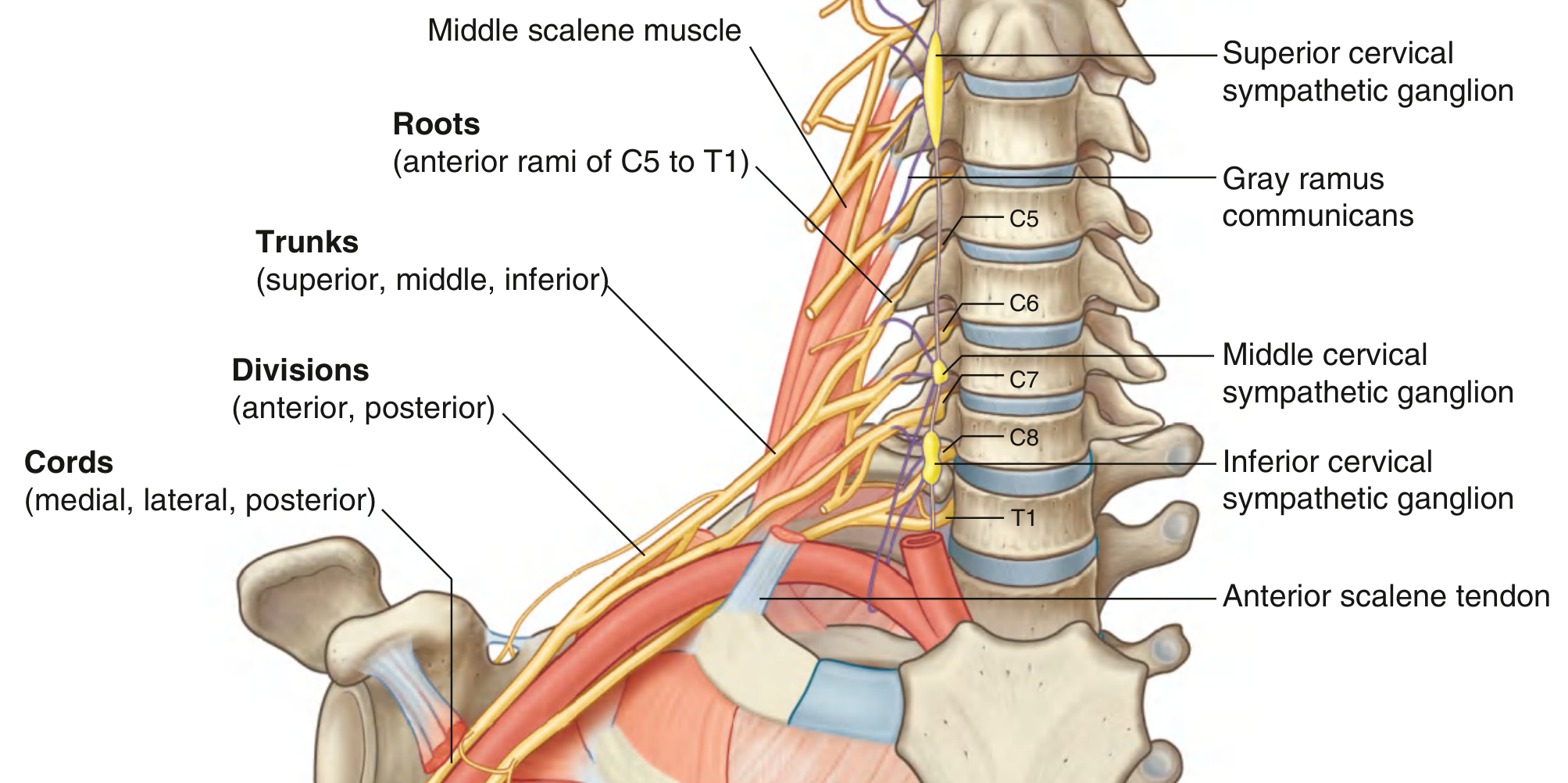
| Level | Number | How formed |
|---|---|---|
| Roots | 5 | Anterior rami C5, C6, C7, C8, T1 (pass between anterior and middle scalene muscles) |
| Trunks | 3 | Superior (C5+C6), Middle (C7), Inferior (C8+T1) |
| Divisions | 6 | Each trunk splits into anterior (→ flexors) and posterior (→ extensors) |
| Cords | 3 | Lateral, Medial, Posterior (named by position relative to axillary artery Part 2) |
| Branches | 5 terminal | Musculocutaneous, Median, Ulnar, Radial, Axillary |
| Nerve | Root | From | Motor territory | Sensory territory |
|---|---|---|---|---|
| Musculocutaneous | C5, C6 | Lateral cord | Anterior arm (biceps, brachialis, coracobrachialis) | Lateral forearm (as lateral cutaneous n. of forearm) |
| Median | C6–C8, T1 | Lateral + medial cords | Most anterior forearm flexors; thenar muscles; lateral 2 lumbricals | Lateral 3½ digits (palmar), lateral palm |
| Ulnar | C8, T1 | Medial cord | Flexor carpi ulnaris, medial FDP; most intrinsic hand muscles | Medial 1½ digits, medial palm |
| Radial | C5–C8, T1 | Posterior cord | All extensors in arm and forearm; triceps | Posterior arm, posterior forearm, dorsal lateral hand |
| Axillary | C5, C6 | Posterior cord | Deltoid + teres minor | "Badge area" — lateral arm over deltoid |
Clinical Brachial Plexus Injuries:
- Erb's palsy (upper trunk C5–C6): e.g., baby during difficult delivery, motorcycle fall on shoulder. Arm hangs in the "waiter's tip" position — adducted, medially rotated, elbow extended, forearm pronated. Loss of shoulder abduction, elbow flexion.
- Klumpke's palsy (lower trunk C8–T1): e.g., grabbing overhead to prevent a fall. Claw hand (intrinsic muscle paralysis) + Horner's syndrome if T1 rami are involved.
REGION 4: THE ARM (BRACHIUM)
Compartments of the Arm
| Compartment | Position | Muscles | Nerve | Main action |
|---|---|---|---|---|
| Anterior (flexor) | Front | Biceps brachii, Brachialis, Coracobrachialis | Musculocutaneous | Flex forearm + supinate; flex arm |
| Posterior (extensor) | Back | Triceps brachii (3 heads), Anconeus | Radial | Extend forearm |
Key Muscles in Detail
- Two origins: Long head from supraglenoid tubercle (travels inside the glenohumeral joint capsule, through the bicipital groove); Short head from coracoid process
- Insertion: Radial tuberosity in forearm + bicipital aponeurosis (into deep fascia of forearm)
- Main actions: Powerful supinator of forearm; flexor of forearm at elbow; accessory flexor of arm at shoulder
- Nerve: Musculocutaneous (C5, C6)
- Reflex: Biceps jerk tests C6
- Three heads: Long head (infraglenoid tubercle of scapula), Lateral head (posterior humerus above radial groove), Medial head (posterior humerus below radial groove)
- Insertion: Olecranon process of ulna
- Action: Extend forearm; long head stabilises glenohumeral joint inferiorly
- Nerve: Radial (C7 mainly)
- Reflex: Triceps jerk tests C7
Blood Supply of the Arm
- Brachial artery (continuation of axillary artery, begins at lower border of teres major)
- Gives off profunda brachii (deep brachial artery) → travels with radial nerve in the spiral/radial groove of the humerus → supplies posterior compartment
- Ends at the cubital fossa by dividing into radial and ulnar arteries
Clinical: Fracture of the midshaft of humerus in the spiral groove → radial nerve palsy → "wrist drop" (lost extension of wrist and fingers). Wrist drops; thumb cannot be extended; patient cannot supinate against resistance. Sensation lost over dorsal first web space (only consistent area). Radial nerve palsy is the most common nerve injury from humeral fractures.
REGION 5: THE ELBOW JOINT AND CUBITAL FOSSA
Elbow Joint
| Joint | Bones | Movement |
|---|---|---|
| Humeroulnar joint | Trochlea of humerus + trochlear notch of ulna | Flexion/extension (main hinge) |
| Humeroradial joint | Capitulum of humerus + head of radius | Flexion/extension + forearm rotation |
| Proximal radioulnar joint | Head of radius + radial notch of ulna + anular ligament | Pronation/supination |
- Ulnar (medial) collateral ligament (UCL) — from medial epicondyle → coronoid process + olecranon; stabilizes against valgus force
- Radial (lateral) collateral ligament (RCL) — from lateral epicondyle → anular ligament
- Anular ligament of radius — holds radial head in the radial notch of the ulna; allows the head to spin during pronation/supination
Clinical — Nursemaid's elbow (pulled elbow): In children < 6 years, sudden pull on the outstretched arm → radial head slips partially out of the anular ligament. The ligament is loose in children. Child holds arm pronated and slightly flexed. Treatment: supination + flexion (the head pops back in).
Clinical — Medial epicondylitis ("Golfer's elbow") vs. Lateral epicondylitis ("Tennis elbow"):
- Tennis elbow: inflammation at common extensor origin at lateral epicondyle; pain on gripping
- Golfer's elbow: inflammation at common flexor origin at medial epicondyle; pain with wrist flexion
Cubital Fossa — The "V" at the Front of Your Elbow
- Lateral boundary: Brachioradialis muscle
- Medial boundary: Pronator teres muscle
- Roof: Deep fascia + skin (bicipital aponeurosis reinforces the roof)
- Floor: Brachialis + supinator muscles
- Tendon of biceps (→ radial tuberosity)
- Artery (brachial artery → divides here into radial and ulnar)
- Nerve (median nerve)
Clinical: Brachial artery pulse is felt in the cubital fossa — used for blood pressure measurement (stethoscope bell here when inflating BP cuff).
REGION 6: THE FOREARM (ANTEBRACHIUM)
- Proximal radioulnar joint (elbow level)
- Interosseous membrane (tough fibrous sheet between the bones — transmits forces)
- Distal radioulnar joint (wrist level)
Compartments of the Forearm
Anterior Compartment (Flexors) — Innervated mainly by Median nerve (exception: FCU and medial FDP by Ulnar nerve)
| Layer | Muscles | Main action |
|---|---|---|
| Superficial (common origin: medial epicondyle) | Pronator teres, Flexor carpi radialis (FCR), Palmaris longus*, Flexor carpi ulnaris (FCU) | Flex wrist; pronate; FCU = flex + adduct wrist; FCR = flex + abduct wrist |
| Intermediate | Flexor digitorum superficialis (FDS) | Flex middle phalanges of fingers 2–5 (flexes at PIP joint) |
| Deep | Flexor digitorum profundus (FDP), Flexor pollicis longus (FPL), Pronator quadratus | FDP: flex distal phalanges; FPL: flex thumb IP joint; Pronator quadratus: pronation |
Clinical — Carpal tunnel syndrome: Median nerve compressed under the flexor retinaculum at the wrist. Presents with numbness/tingling in lateral 3½ fingers (thumb, index, middle, half ring finger), thenar wasting, night pain. Most common nerve compression in the body. Diagnosis: Tinel's sign (tap over carpal tunnel → tingling) and Phalen's test (wrist flexion for 60 sec → symptoms).
Posterior Compartment (Extensors) — Innervated by Radial nerve (deep branch = posterior interosseous nerve)
| Layer | Key muscles | Main action |
|---|---|---|
| Superficial (common origin: lateral epicondyle) | Extensor carpi radialis longus (ECRL), Extensor carpi radialis brevis (ECRB), Extensor digitorum (ED), Extensor carpi ulnaris (ECU), Extensor digiti minimi (EDM) | Extend wrist and fingers |
| Deep | Abductor pollicis longus (APL), Extensor pollicis brevis (EPB), Extensor pollicis longus (EPL), Extensor indicis | Move the thumb and index |
REGION 7: THE WRIST AND HAND
The Wrist (Carpus) — 8 Carpal Bones in 2 Rows
Clinical — Scaphoid fracture: Most common carpal fracture. From FOOSH (fall on outstretched hand). Pain in the anatomical snuffbox (see below). Up to 10% have their scaphoid blood supply entering from the distal end only — fracture across the waist cuts off blood to the proximal fragment → avascular necrosis of proximal scaphoid. Danger: X-ray can be normal initially; always treat clinically if snuffbox tenderness is present.
Clinical — Lunate dislocation: FOOSH + hyperextension. The lunate dislocates anteriorly into the carpal tunnel → compresses the median nerve → acute carpal tunnel syndrome.
The Hand
- Contents: 4 tendons of FDS + 4 tendons of FDP + 1 tendon of FPL = 9 tendons, all inside synovial sheaths, + median nerve
- NOT inside: Flexor carpi radialis, ulnar nerve, ulnar artery (these all travel outside the carpal tunnel)
| Group | Location | Muscles | Main action |
|---|---|---|---|
| Thenar group | Base of thumb (thenar eminence) | Abductor pollicis brevis, Flexor pollicis brevis, Opponens pollicis | Opposition of thumb (touching thumb to fingertips) |
| Hypothenar group | Base of little finger | Abductor digiti minimi, Flexor digiti minimi, Opponens digiti minimi | Move little finger |
| Lumbricals (4) | Palm | Originate from FDP tendons | Flex MCP joints + extend PIP/DIP joints — the "L"-shape movement |
| Interossei (4 dorsal, 3 palmar) | Between metacarpals | Dorsal = abduct fingers; Palmar = adduct fingers | DAB = Dorsal ABducts; PAD = Palmar ADducts |
| Adductor pollicis | Deep palm | Brings thumb toward palm | Adducts thumb (tested by Froment's sign) |
Nerve mnemonic for hand muscles: "LOAF" = Lumbricals 1+2, Opponens pollicis, Abductor pollicis brevis, Flexor pollicis brevis → all supplied by median nerve. Everything else intrinsic → ulnar nerve.
Palmar Arches
| Arch | Formed by | Depth |
|---|---|---|
| Superficial palmar arch | Mainly ulnar artery + small radial contribution | Superficial to flexor tendons; gives common palmar digital arteries → finger supply |
| Deep palmar arch | Mainly radial artery (after entering through 1st dorsal interosseous) + deep ulnar contribution | Deep to tendons; gives palmar metacarpal arteries |
Clinical — Allen's test: Compress both radial and ulnar arteries at wrist, then release one → check hand filling. Tests adequacy of palmar arch anastomosis. Done before radial artery catheterization to ensure the hand won't become ischemic.
Superficial Veins — Clinically Important
- Cephalic vein — originates at lateral (radial) side of dorsal venous network → crosses anatomical snuffbox → runs up lateral forearm and arm → empties into axillary vein in deltopectoral groove
- Basilic vein — originates medial (ulnar) side of dorsal network → runs up medial forearm → pierces deep fascia mid-arm → joins brachial vein → becomes axillary vein
- Median cubital vein — connects cephalic to basilic across the cubital fossa; preferred site for venipuncture (blood draws)
Anatomical Snuffbox
- Medial border: Extensor pollicis longus tendon
- Lateral borders: Extensor pollicis brevis + Abductor pollicis longus tendons
- Floor: Scaphoid + Trapezium bones; distal ends of ECRL and ECRB tendons
- Passes through: Radial artery (deep); Terminal branches of superficial radial nerve (subcutaneous); Origin of cephalic vein
Clinical: Tenderness in the snuffbox after FOOSH = scaphoid fracture until proven otherwise. The radial artery pulse can also be felt here.
MASTER SUMMARY TABLE
| Region | Key bones | Key joints | Key muscles | Key nerves | Key arteries |
|---|---|---|---|---|---|
| Shoulder girdle | Clavicle, Scapula | SC, AC | Trapezius, Serratus anterior, Pec major/minor | Accessory (XI), Long thoracic, Pectoral nerves | Subclavian → Axillary |
| Glenohumeral joint | Proximal humerus | Glenohumeral | Rotator cuff (SITS), Deltoid | Axillary, Suprascapular | Post. circumflex humeral |
| Axilla | — | — | Biceps (short head), Coracobrachialis | Brachial plexus cords + terminal branches | Axillary artery (3 parts, 6 branches) |
| Arm (Brachium) | Humerus shaft | Glenohumeral (above), Elbow (below) | Biceps, Brachialis (ant.); Triceps (post.) | Musculocutaneous (ant.), Radial (post.) | Brachial artery + Profunda brachii |
| Elbow | Distal humerus, Proximal radius, Proximal ulna | Humeroulnar, Humeroradial, Proximal RU joint | Pronator teres, Brachioradialis | Radial, Median, Ulnar all pass here | Brachial → Radial + Ulnar |
| Forearm (Antebrachium) | Radius, Ulna | Radioulnar joints + interosseous membrane | FCR, FCU, FDS, FDP (ant.); Extensors (post.) | Median (ant.), Radial deep branch (post.), Ulnar | Radial artery (lat.), Ulnar artery (med.) |
| Wrist + Hand | 8 carpals, 5 metacarpals, phalanges | Wrist, CMC, MCP, IP | Thenar, Hypothenar, Lumbricals, Interossei | Median (thenar + lateral 3½), Ulnar (rest of hand) | Superficial + deep palmar arches |
CLINICAL SUMMARY — HIGH-YIELD INJURIES BY NERVE
| Nerve injured | Mechanism | Deformity / Sign |
|---|---|---|
| Axillary (C5,C6) | Anterior shoulder dislocation or surgical neck fracture | Cannot abduct arm 15–90°; "badge area" numbness |
| Musculocutaneous (C5,C6) | Coracoid fracture, anterior dislocation | Weak elbow flexion and supination; lateral forearm numbness |
| Radial (C5–C8,T1) | Midshaft humeral fracture (spiral groove) | Wrist drop; cannot extend wrist or fingers; dorsal first web space numb |
| Median (C6–C8,T1) | Supracondylar fracture (distal) or carpal tunnel | "Ape hand" (thenar wasting); cannot oppose thumb; lateral 3½ fingers numb |
| Ulnar (C8,T1) | Medial epicondyle fracture or Guyon's canal compression | "Claw hand" (ring + little finger); cannot abduct/adduct fingers; medial 1½ fingers numb; + Froment's sign |
| Long thoracic (C5–C7) | Neck surgery, carrying heavy loads | Winged scapula (serratus anterior paralysis) |
Create a visual diagram showing brachial plexus anatomy and nerve territories
A detailed medical education poster titled "BRACHIAL PLEXUS — Complete Anatomy & Nerve Territories" on a clean white background in professional anatomical illustration style. LEFT HALF — Brachial Plexus Schematic Diagram (large, central): A clear color-coded tree diagram showing the full brachial plexus from spinal roots to terminal branches. ROOTS (far left column, vertical): C5, C6, C7, C8, T1 — each labeled in a colored circle (C5=blue, C6=green, C7=orange, C8=red, T1=purple) TRUNKS (next column): - Superior trunk (C5+C6 merge) — blue-green - Middle trunk (C7 continues) — orange - Inferior trunk (C8+T1 merge) — red-purple DIVISIONS (next column, each trunk splits into A=anterior, P=posterior): - 3 anterior divisions (solid lines going to lateral and medial cords) - 3 posterior divisions (dashed lines going to posterior cord) CORDS (next column): - Lateral cord (blue-green, positioned top) — labeled "Lateral Cord (C5-C7)" - Posterior cord (orange-brown, positioned middle) — labeled "Posterior Cord (C5-T1)" - Medial cord (red-purple, positioned bottom) — labeled "Medial Cord (C8-T1)" TERMINAL BRANCHES (far right, 5 main nerves with color coding): From lateral cord: Musculocutaneous nerve (teal) From lateral+medial cords joining in an M shape: Median nerve (dark blue) — show the two roots forming an M over the axillary artery From medial cord: Ulnar nerve (purple) From posterior cord: Radial nerve (red-orange) and Axillary nerve (brown) Also label smaller branches: - Long thoracic nerve (C5,C6,C7) from roots - Dorsal scapular nerve (C5) from roots - Suprascapular nerve from superior trunk - Medial cutaneous nerves from medial cord - Thoracodorsal, Subscapular nerves from posterior cord RIGHT HALF — Two panels stacked: TOP PANEL — Anterior view of right upper limb showing cutaneous nerve territory map: An outline of the arm, forearm, and hand from the front (anterior). Color-filled dermatome territories with a legend: - Axillary nerve = brown patch on lateral (deltoid) shoulder - Musculocutaneous nerve = teal strip on lateral forearm - Medial cutaneous of arm = small purple strip medial upper arm - Medial cutaneous of forearm = purple strip medial forearm - Radial nerve superficial branch = orange patch on dorsal lateral hand and first web space - Median nerve = dark blue area covering lateral 3.5 fingers (thumb, index, middle, half ring) on the PALM side - Ulnar nerve = purple area covering medial 1.5 fingers and medial palm BOTTOM PANEL — Table listing 5 terminal nerves: Columns: Nerve | Roots | Cord Origin | Motor Supply | Sensory Territory | Injury Sign Row 1: Musculocutaneous | C5,C6 | Lateral | Biceps, Brachialis, Coracobrachialis | Lateral forearm | Weak elbow flexion/supination Row 2: Median | C6-T1 | Lat+Med | Anterior forearm flexors, Thenar, Lumbricals 1+2 | Lateral 3.5 digits (palm) | Ape hand, carpal tunnel Row 3: Ulnar | C8,T1 | Medial | FCU, med. FDP, intrinsic hand | Medial 1.5 digits | Claw hand Row 4: Radial | C5-T1 | Posterior | All extensors arm+forearm | Dorsal lateral hand | Wrist drop Row 5: Axillary | C5,C6 | Posterior | Deltoid, Teres minor | Lateral shoulder (badge) | Cannot abduct arm Color scheme: each nerve has one consistent color throughout the diagram, table, and territory map. Bold sans-serif fonts. Professional clean medical illustration.