
Pt difficulty in speaking of 66male pt
Reading File
A 66-year-old male with difficulty speaking — this is a broad clinical scenario. The key differential is dysarthria vs. aphasia, and in an elderly male, stroke is the primary concern. Let me search the textbooks across multiple relevant dimensions simultaneously.
Finding Sources
Finding Sources
Reading File
Reading File
Reading File
Reading File
Excellent content retrieved. Now I have comprehensive information to provide a detailed clinical answer.
Difficulty Speaking in a 66-Year-Old Male — Clinical Approach
Key Distinction: Dysarthria vs. Aphasia
These are the two main categories of "difficulty speaking" and must be differentiated first.
| Feature | Aphasia | Dysarthria |
|---|---|---|
| Definition | Language disorder (comprehension/expression of words) | Motor speech disorder (articulation, phonation, prosody) |
| Mechanism | Cortical/language center damage | Neuromuscular control dysfunction |
| Speech quality | Wrong words, paraphasias, comprehension deficits | Slurred/slow/nasal speech, but correct words |
| Writing | Also affected | Usually preserved |
Aphasia
Most common cause in a 66-year-old male: Stroke
- In a UK community study, new stroke-induced aphasia cases numbered ~202/year per 250,000 population
- 38% of acute stroke patients are aphasic on admission
- Nearly half of severe aphasia cases die soon after stroke onset
- Best predictor of recovery: less severe aphasia close to stroke onset
- ~95% with mild aphasia reach best recovery at 2 weeks; severe aphasia peaks at 10 weeks
Types of Aphasia (by location):
| Type | Fluency | Comprehension | Repetition | Location |
|---|---|---|---|---|
| Broca's | Non-fluent | Intact | Impaired | Left inferior frontal |
| Wernicke's | Fluent | Impaired | Impaired | Left superior temporal |
| Global | Non-fluent | Impaired | Impaired | Large left MCA territory |
| Conduction | Fluent | Intact | Impaired | Arcuate fasciculus |
| Anomic | Fluent | Intact | Intact | Variable |
Dysarthria
Dysarthria = impaired speech from abnormal neuromuscular control, affecting articulation, respiration, prosody, resonance, and phonation.
Assessment includes 3 activities (Localization in Clinical Neurology):
- Contextual speech (reading a standard paragraph + spontaneous speech)
- Vowel prolongation ("ahhh...") — reveals laryngeal tremor, spasticity
- Diadochokinesis — rapid "puh-tuh-kuh" repetitions (tests lips, tongue, posterior tongue)
Types of Dysarthria and Localization:
| Type | Quality | Lesion Level |
|---|---|---|
| Flaccid | Breathy, hypernasal, short phrases | Lower motor neuron / multiple cranial nerve palsies |
| Spastic | Harsh, strained, strangled; slow rate; hypernasality | Bilateral upper motor neuron |
| Ataxic | Irregular breakdowns, vowel distortions, excess/equal stress | Cerebellum |
| Hypokinetic | Soft, monotone, rapid bursts (festinating speech) | Parkinsonism (basal ganglia) |
| Mixed | Combined features | ALS (flaccid+spastic), MS (spastic+ataxic), Wilson disease |
Differential Diagnosis in a 66-Year-Old Male
Neurological (Most common):
- Ischemic stroke (MCA territory) — most urgent; sudden onset
- TIA — transient episode, resolves < 24h
- Hemorrhagic stroke
- Brain tumor — progressive, may have headache, seizures
- Parkinson's disease — hypokinetic dysarthria + other features
- ALS — mixed flaccid-spastic dysarthria, progressive
Other causes to consider:
- Myasthenia gravis — fluctuating, worsens with fatigue
- Hypothyroidism — slow, hoarse speech
- Drug toxicity (e.g., phenytoin → ataxic dysarthria; sedatives)
- Hypoglycemia — reversible with glucose
- Oral/laryngeal pathology — consider if no neurological signs
Urgent Red Flags — STROKE Protocol
In a 66-year-old male, sudden-onset difficulty speaking = stroke until proven otherwise.
FAST criteria: Face drooping | Arm weakness | Speech difficulty | Time to call emergency
Immediate workup:
- Non-contrast CT head (rule out hemorrhage)
- Blood glucose (rule out hypoglycemia)
- ECG (AF → cardioembolic stroke)
- CBC, coagulation, metabolic panel
- MRI + DWI if CT negative but high suspicion
Time-sensitive intervention:
- IV tPA within 4.5 hours of onset (if ischemic, no contraindications)
- Mechanical thrombectomy within 24 hours (large vessel occlusion)
Management
Aphasia/Dysarthric rehabilitation:
- Speech therapy is the cornerstone — retrains contralateral areas to compensate
- Dysarthric patients learn to slow delivery and emphasize words to improve clarity
- For aphasia: stimulation-facilitation techniques (picture matching, sentence completion, phoneme-based training)
- Melodic intonation therapy (MIT) — particularly effective in non-fluent (Broca's) aphasia
- Constraint-induced language therapy with intensive phonemic cues
Sources: Bradley and Daroff's Neurology in Clinical Practice | Localization in Clinical Neurology, 8e
Face tilted o. One side
Reading File
The combination of difficulty speaking + face tilted/drooping to one side in a 66-year-old male is highly suspicious for facial nerve palsy (CN VII) in the context of stroke, or Bell's palsy. Let me search across both.
Finding Sources
Finding Sources
Reading File
Reading File
Reading File
Reading File
Now let me fetch the facial nerve anatomy image for visual clarity.
Loading Image
Excellent. Here is a comprehensive clinical answer integrating the new symptom:
Updated Clinical Picture: 66M — Difficulty Speaking + Face Tilted/Drooping to One Side
This combination strongly points to unilateral facial palsy (CN VII), which in this context must be urgently classified as central (UMN) vs. peripheral (LMN) — the most critical clinical distinction.
The Critical Distinction: UMN vs. LMN Facial Palsy
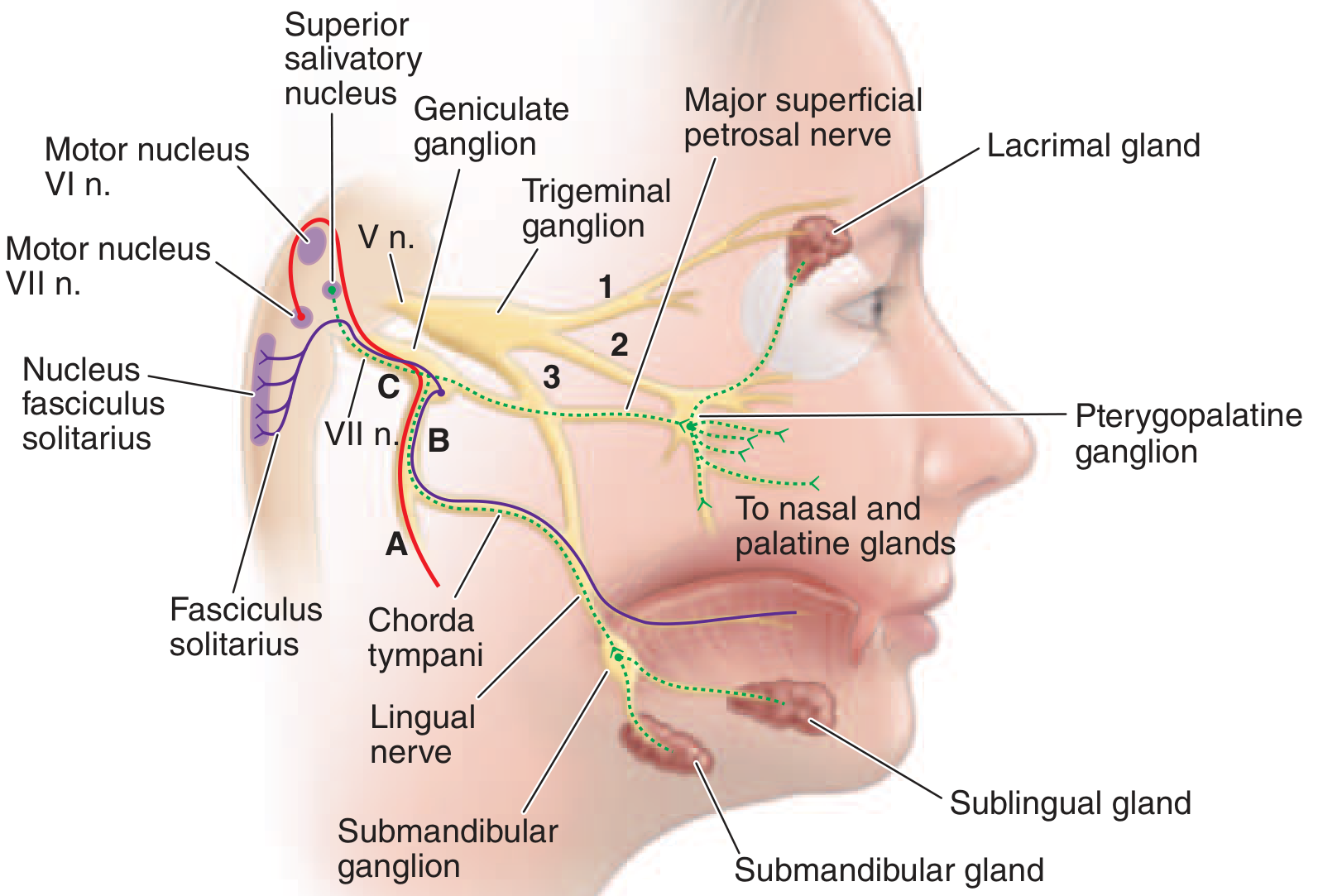
| Feature | Central (UMN) — STROKE | Peripheral (LMN) — Bell's Palsy |
|---|---|---|
| Forehead sparing? | Yes — forehead spared (bilateral cortical input) | No — entire face including forehead affected |
| Eye closure | Preserved | Lost — eye won't close (Bell's phenomenon) |
| Which face affected? | Contralateral lower face | Ipsilateral whole face |
| Cause in 66M | Stroke (MCA territory), tumor | Bell's palsy (HSV-1), Ramsay Hunt, parotid tumor |
| Urgency | EMERGENCY | Urgent but less acute |
Key rule: If the upper face (forehead wrinkling, eye closure) is spared → stroke until proven otherwise. If the upper face is involved → likely Bell's palsy or peripheral CN VII lesion.
Anatomy of CN VII — Lesion Localization
The facial nerve (CN VII) supplies all muscles of facial expression, stapedius, stylohyoid, and posterior digastric. Its parasympathetic fibers control lacrimation and salivation; sensory fibers carry taste from anterior 2/3 of the tongue.
Lesion site determines what additional features are present:
| Site | Motor Loss | Additional Features |
|---|---|---|
| Above nucleus (cortex/subcortex) | Contralateral lower face only | + Arm/leg weakness (stroke) |
| Pons (nucleus) | Ipsilateral whole face | + Ipsilateral CN VI palsy (abducens) + contralateral limb weakness |
| Geniculate ganglion | Ipsilateral whole face | + Loss of taste (ant. 2/3 tongue) + reduced lacrimation + hyperacusis |
| Stylomastoid foramen | Ipsilateral whole face | Motor only; taste and lacrimation intact |
| Parotid | Partial (individual branches) | Parotid mass/swelling |
Clinical Features of Complete Peripheral Facial Palsy
(Harrison's, 22nd Ed.)
- Corner of the mouth droops
- Creases and skin folds effaced
- Forehead unfurrowed
- Eyelids will not close → eye rolls upward on attempted closure (Bell's phenomenon)
- Lower lid sags → tears spill over cheek
- Food collects between teeth and lips
- Saliva dribbles from corner of mouth
- Patient feels heaviness/numbness in face
Bell's Palsy (Most Common Peripheral Cause)
- Incidence: ~25/100,000/year (~1 in 60 over a lifetime)
- Onset: abrupt — maximal weakness within 48 hours
- May be preceded by pain behind the ear for 1–2 days
- Cause: HSV-1 reactivation in geniculate ganglion (most common); VZV in up to 1/3
- 80% recover within weeks to months
- Incomplete paralysis in first week = most favorable prognostic sign
- MRI: swelling and enhancement of geniculate ganglion and facial nerve in temporal bone
Ramsay Hunt syndrome (VZV): Severe facial palsy + vesicles in external auditory canal ± CN VIII involvement (deafness, tinnitus, vertigo)
In This 66-Year-Old Male — Priority Assessment
Given difficulty speaking + unilateral facial drooping together:
Step 1: Is this a STROKE?
- Sudden onset + facial droop + dysarthria/aphasia = activate stroke protocol immediately
- Check FAST: Face drooping ✓ | Speech difficulty ✓
- Also assess: arm/leg weakness, gait, vision
Step 2: Emergency workup
| Test | Purpose |
|---|---|
| Non-contrast CT head | Rule out hemorrhagic stroke |
| Blood glucose | Rule out hypoglycemia |
| ECG | Detect atrial fibrillation |
| CBC, metabolic panel, coagulation | Baseline + tPA eligibility |
| MRI + DWI | Gold standard for ischemic stroke (if CT negative) |
Step 3: Examine forehead
- Forehead spared → Likely stroke → IV tPA within 4.5 hours if eligible
- Forehead involved (whole face) → Likely Bell's palsy or peripheral lesion → steroids ± antivirals
Treatment of Bell's Palsy (if confirmed)
- Prednisolone 25 mg twice daily × 10 days (started within 72 hours of onset)
- Acyclovir/Valacyclovir if Ramsay Hunt suspected (vesicles present)
- Eye protection: lubricating drops, eye patch at night (prevent corneal exposure)
Bottom line: In a 66-year-old male, facial drooping + speech difficulty = stroke must be ruled out first. The presence or absence of forehead involvement is the fastest bedside clue to localize the lesion.
Sources: Harrison's Principles of Internal Medicine 22E | Gray's Anatomy for Students | Rosen's Emergency Medicine
This is a shared conversation. Sign in to Orris to start your own chat.