
Fluticasone propionate uses as a topical cream
fluticasone propionate topical cream uses indications dermatology
fluticasone propionate topical cream dermatitis
fluticasone propionate topical corticosteroid cream dermatitis psoriasis
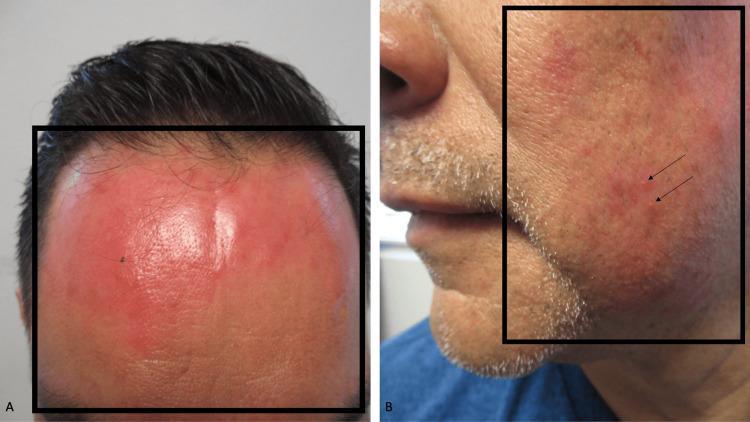
Clinical photograph of a male patient in his late 50s presenting with topical corticosteroid-induced dermatitis. The image is divided into two panels. Panel A (frontal view) shows the forehead with a large, confluent, erythematous macular patch within a black outlined area. The skin appears bright red and inflamed, resembling the clinical presentation of a superficial or first-degree thermal burn. Panel B (lateral view) displays the left cheek featuring macular erythema and small, randomly distributed pustules, as indicated by black arrows within the highlighted region. These features are characteristic of steroid-induced rosacea-like dermatitis following the repetitive application of high-potency corticosteroids (betamethasone 0.05% cream) to facial skin. The educational focus is on the adverse cutaneous effects of potent topical steroids and their ability to mimic acute inflammatory conditions or burns.
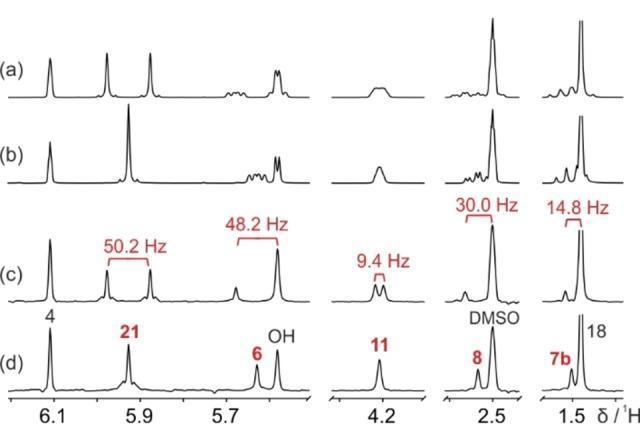
This diagnostic image displays four comparative 500 MHz 1H NMR spectra (a-d) of fluticasone propionate, a corticosteroid used for treating asthma and allergic rhinitis. The series demonstrates the evolution of spectral resolution through various decoupling techniques. Spectrum (a) shows conventional 1H NMR with significant peak overlap due to homonuclear and heteronuclear couplings. Spectrum (b) utilizes 1H{19F} NMR, showing partial simplification via heteronuclear decoupling. Spectrum (c) displays a 'pure shift PSYCHE' method, which suppresses homonuclear coupling but retains heteronuclear (JHF) splitting, evidenced by labeled coupling constants (e.g., 50.2 Hz, 14.8 Hz). Spectrum (d), 'fully decoupled pure shift PSYCHE,' achieves maximum resolution, where both coupling types are suppressed to yield sharp, single peaks for chemical site assignment (labeled 4, 21, 6, 11, 8, and 7b). The comparison illustrates how advanced NMR methodology clarifies complex molecular environments in pharmacology by resolving obscured signals at specific chemical shifts, such as 5.9, 4.2, and 1.5 ppm.
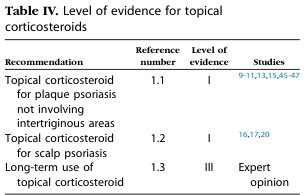
Table IV. Level of evidence for topical corticosteroids <table><thead><tr><th>Recommendation</th><th>Reference number</th><th>Level of evidence</th><th>Studies</th></tr></thead><tbody><tr><td>Topical corticosteroid for plaque psoriasis not involving intertriginous areas</td><td>1.1</td><td>I</td><td>9-11,13,15,45-47</td></tr><tr><td>Topical corticosteroid for scalp psoriasis</td><td>1.2</td><td>I</td><td>16,17,20</td></tr><tr><td>Long-term use of topical corticosteroid</td><td>1.3</td><td>III</td><td>Expert opinion</td></tr></tbody></table>
Fluticasone Propionate Topical Cream - Uses & Clinical Overview
Drug Overview
Primary Indications
1. Atopic Dermatitis (Eczema)
- Adults and children ≥3 months of age
- Apply a thin film to affected areas once or twice daily
- Reassess the diagnosis if no improvement within 2 weeks
- Safety and efficacy have not been established beyond 4 weeks in pediatric patients
- Once symptoms are controlled, reduce to a less potent topical agent
2. Corticosteroid-Responsive Dermatoses
- Psoriasis - provides sustained response, usually within about 1 week of application; once- and twice-daily regimens have similar efficacy (though twice daily may have slightly faster onset)
- Contact dermatitis (allergic and irritant)
- Seborrheic dermatitis
- Nummular eczema
- Lichen simplex chronicus
- Dyshidrosis
- Other inflammatory, pruritic skin conditions
Mechanism of Action
- Reduces synthesis of pro-inflammatory mediators (cytokines, prostaglandins, leukotrienes)
- Inhibits phospholipase A2 via lipocortin induction
- Causes vasoconstriction (basis of the vasoconstrictor assay used for potency classification)
- Suppresses immune cell trafficking to inflamed skin
Formulations & How to Use
| Formulation | Concentration | Application | Indication |
|---|---|---|---|
| Cream | 0.05% | Once or twice daily | Atopic dermatitis, moist/weeping lesions |
| Ointment | 0.005% | Twice daily | Dry/lichenified lesions (more occlusive) |
| Lotion | 0.05% | Once daily | Atopic dermatitis, hair-bearing areas |
- Apply a thin film only - do not over-apply
- Do not use under occlusive dressings unless directed (increases absorption and risk of side effects)
- Do not apply to the face, groin, axillae, or diaper area unless specifically directed
Special Populations
- Children ≥3 months: Cream and lotion are approved; ointment is not recommended in children
- Children <3 months: Safety and efficacy not established
- Pregnancy: Use the minimum effective amount; systemic absorption is low with topical use
- No dose adjustment is required for renal impairment (minimal systemic absorption)
Contraindications
- Rosacea and perioral dermatitis (can worsen these conditions)
- Pre-existing skin atrophy
- Sites of active skin infection
- Not for ophthalmic use
Adverse Effects
- Skin atrophy, striae, telangiectasia (with prolonged use)
- Pruritus, burning, stinging at application site
- Folliculitis, acneiform eruptions
- Hypopigmentation
- HPA axis suppression (risk is much lower than with equally potent corticosteroids due to rapid hepatic metabolism)
- Cushing syndrome (especially if used with CYP3A4 inhibitors like ritonavir - monitor closely)
Key Pharmacological Advantages
- Low systemic bioavailability despite high receptor affinity
- Rapid first-pass metabolism in the liver
- Demonstrates greater vasoconstrictor activity than other corticosteroids of similar potency class, meaning better anti-inflammatory effect with less systemic risk
- Suitable for intermittent/proactive dosing in atopic dermatitis to reduce relapse risk (weekend therapy or twice-weekly maintenance)
Comparison: Cream vs. Ointment
- Cream is preferred for moist, weeping, or acute lesions and for use in intertriginous areas; it is less occlusive
- Ointment is more potent for the same molecule because it increases percutaneous absorption through hydration of the stratum corneum; preferred for dry, chronic, or lichenified plaques - Dermatology 2-Volume Set 5e, Topical Therapy