
Describe structure of nail with its functions 5 mark question
Reading File
Finding Sources
Finding Sources
Reading File
Reading File
Reading File
Reading File
Loading Image
Reading File
Loading Image
I now have comprehensive content from authoritative dermatology textbooks. Here is a complete 5-mark answer:
Structure of the Nail and Its Functions
Introduction
The nail is a skin appendage — a hard, keratinized plate located on the dorsal surface of the distal phalanx of each finger and toe. The entire nail apparatus (nail unit) comprises four distinct epithelial structures.
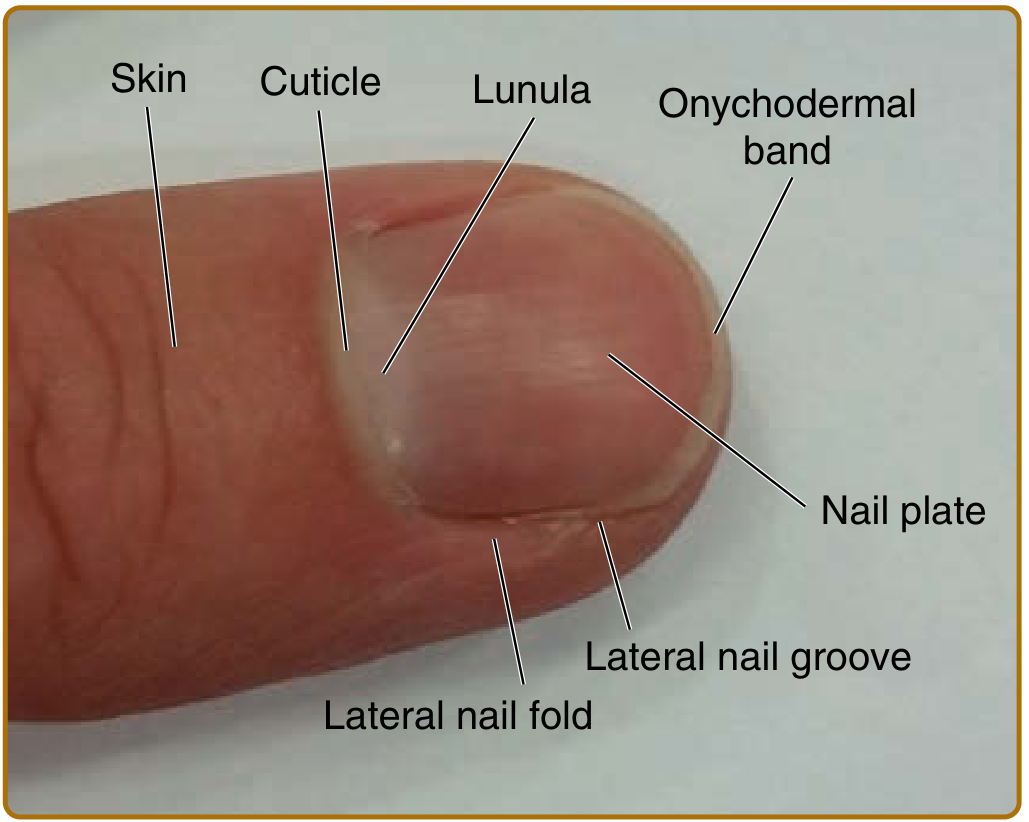
Components of the Nail Unit
1. Nail Plate
- The visible hard portion, composed of desiccated, keratinized squamous cells (onychocytes) arranged in three layers: dorsal, intermediate, and ventral.
- Produced continuously from the 15th week of embryonic life until death.
- Growth rate: fingernails ~3 mm/month; toenails ~1 mm/month.
- Grows distally along the nail bed, guided by the lateral nail folds.
- Function: Protects the fingertip from trauma; acts as a rigid counter-pressure surface that enhances tactile sensation; used as a tool for picking up small objects (fine manipulation).
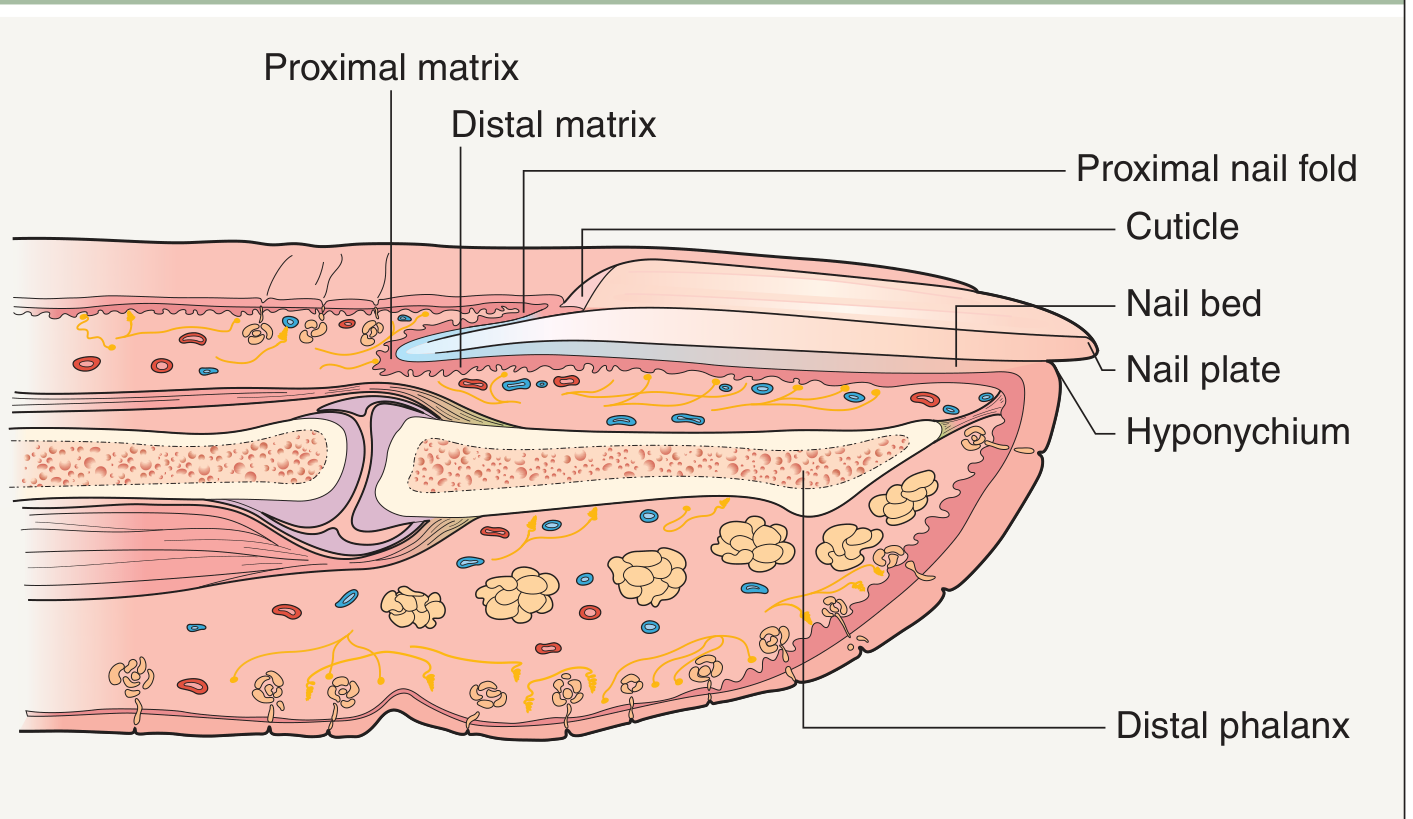
2. Nail Matrix (Germinal Matrix)
- Located beneath the proximal nail fold, extends distally to the distal border of the lunula.
- Composed of actively proliferating cells that differentiate and keratinize without forming a granular layer.
- Proximal matrix → produces the dorsal nail plate.
- Distal matrix (lunula) → produces the ventral nail plate.
- Contains melanocytes that are normally quiescent.
- Function: Sole source of nail plate production; most critical component of the nail unit.
3. Nail Bed (Sterile Matrix)
- Lies beneath the nail plate, extending from the distal margin of the lunula to the onychodermal band.
- Highly vascular (gives the nail its pink appearance).
- Contains longitudinal rugose rete ridges that interlock with corresponding ridges on the ventral nail plate.
- Function: Supports and adheres the nail plate; enhances leverage without pain; adds squamous cells to thicken the nail.
4. Nail Folds
- Proximal nail fold (PNF): A dorsal flap of skin overlying the nail matrix. Its ventral surface is continuous with the nail matrix. Protects the matrix from external trauma.
- Lateral nail folds: Skin folds that border the nail laterally, guide longitudinal growth, and seal the lateral margins.
- Function: Provide a protective seal around the nail unit; maintain the shape and direction of nail growth.
5. Cuticle (Eponychium)
- A thin, translucent membrane extending from the nail wall onto the dorsal surface of the nail plate where it emerges from the proximal fold.
- Function: Acts as a physical barrier, sealing the space between the proximal nail fold and the nail plate; prevents entry of microorganisms and irritants.
6. Lunula
- The white, crescent-shaped opacity at the proximal nail, most visible on the thumb.
- Represents the visible, distal part of the nail matrix.
- Appears white because the underlying matrix is thicker here and obscures the vasculature of the nail bed.
7. Hyponychium
- The area where the nail plate separates from the nail bed at the fingertip (distal junction).
- Function: Provides a barrier against subungual infection; allows the free edge of the nail to detach distally.
Cross-Sectional Anatomy (Longitudinal Section)
Summary of Functions
| Structure | Primary Function |
|---|---|
| Nail plate | Protection, fine manipulation, tactile counter-pressure |
| Nail matrix | Nail plate production |
| Nail bed | Plate adhesion, levering tool support |
| Proximal nail fold | Matrix protection |
| Cuticle | Barrier against infection |
| Hyponychium | Distal seal, barrier against subungual infection |
| Lateral nail folds | Guide growth direction, lateral sealing |
Clinical Relevance: Damage to the nail matrix produces permanent nail plate deformity (e.g., ridges, splitting), while nail bed disorders typically cause onycholysis (plate detachment). The nail also serves as a diagnostic window — changes in color, texture, and shape reflect systemic diseases (clubbing in hypoxia, koilonychia in iron deficiency, Beau's lines after systemic illness).
— Fitzpatrick's Dermatology, Vol. 1–2; Dermatology 2-Volume Set 5e; Pfenninger and Fowler's Procedures for Primary Care, 3rd ed.
This is a shared conversation. Sign in to Orris to start your own chat.