
Low level of serum PTH
Reading File
Now let me search the medical library for content on low serum PTH (hypoparathyroidism).
Finding Sources
Finding Sources
Excellent results. Let me now read the most relevant sections from Harrison's and Frameworks for Internal Medicine, as well as Robbins for pathology.
Reading File
Reading File
Reading File
Now let me fetch the flowchart image and read more from Harrison's on causes and treatment, plus read more from the Frameworks book.
Loading Image
Reading File
Reading File
I now have comprehensive information. Let me also fetch the second flowchart image and continue reading Harrison's for clinical features and management.
Reading File
Loading Image
I now have a thorough picture. Let me compile the complete answer.
Low Serum PTH (Hypoparathyroidism)
A low or inappropriately low serum PTH in the setting of hypocalcemia defines hypoparathyroidism - the parathyroid glands fail to secrete adequate PTH despite falling calcium levels. This is the key diagnostic distinction: PTH should be elevated (secondary hyperparathyroidism) when calcium is low, so a "normal" or low PTH in that context is always pathological.
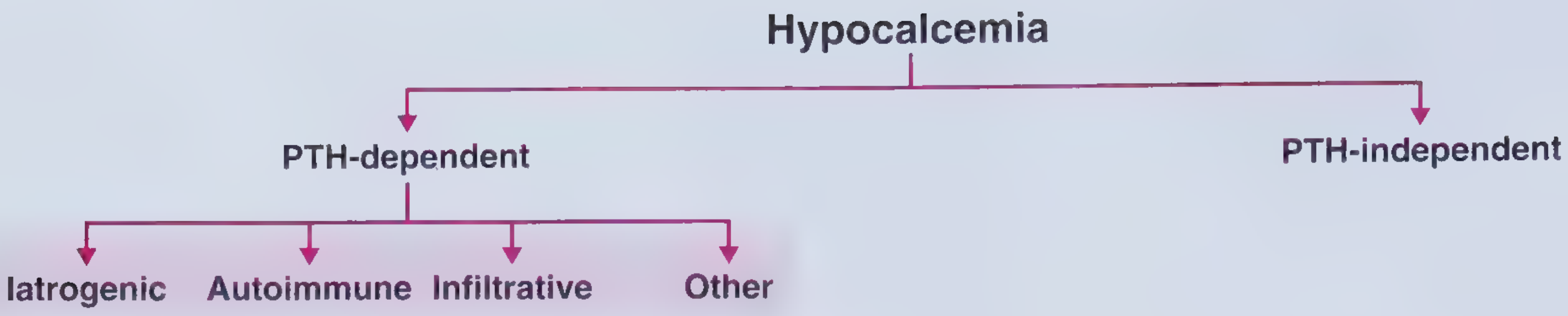
Classification of Hypocalcemia by PTH Level
| PTH Low/Normal | PTH High (compensatory) |
|---|---|
| Hypoparathyroidism | Vitamin D deficiency/resistance |
| Chronic kidney disease | |
| Intestinal malabsorption |
Causes of Low PTH (Hypoparathyroidism)
The causes fall into four broad categories (Frameworks for Internal Medicine, p.130):
1. Iatrogenic (Most Common in Adults)
- Surgery - inadvertent removal of or damage to the parathyroid glands or their blood supply during thyroidectomy, parathyroidectomy, or radical neck dissection. Most post-surgical cases are transient ("stunning"); persistent hypoparathyroidism >6 months is relatively rare.
- Radiation - external beam radiation for head and neck cancers, or rarely radioactive iodine therapy for hyperthyroidism.
- Medications - cinacalcet (a calcimimetic) activates calcium-sensing receptors (CaSR) on parathyroid cells, suppressing PTH secretion.
2. Autoimmune (Second Most Common in Adults)
- Immune-mediated parathyroid destruction - can be isolated or part of Autoimmune Polyglandular Syndrome type 1 (APS-1), caused by mutations in the AIRE gene. APS-1 features hypoparathyroidism, chronic mucocutaneous candidiasis, and adrenal insufficiency.
- Activating antibodies to CaSR - these mimic high calcium, persistently suppressing PTH secretion.
- Even late-onset idiopathic adult hypoparathyroidism frequently involves anti-CaSR and anti-NALP5 antibodies.
3. Infiltrative Disease
- Sarcoidosis, IgG4-related disease
- Iron overload (hemochromatosis, transfusion-dependent thalassemia)
- Copper overload (Wilson's disease)
4. Other / Genetic
- DiGeorge syndrome (chromosome 22q11.2 deletion) - congenital absence of parathyroids with thymic aplasia and cardiac defects.
- Inactivating mutations in GCM2, GATA3, or the PTH gene itself.
- Activating mutations in CaSR or GNA11 (autosomal dominant hypocalcemia).
- Hypomagnesemia - impairs intracellular PTH synthesis and release. Causes include alcohol abuse, cisplatin, anti-EGFR antibodies, proton pump inhibitors.
- Severe hypermagnesemia (e.g., obstetric Mg infusions) - can suppress PTH via CaSR activation.
- COVID-19 infection caused transient hypoparathyroidism by unknown mechanism.
Lab Pattern
| Serum Calcium | Serum PTH | Serum Phosphorus | Urinary Calcium |
|---|---|---|---|
| Low | Low or low-normal | High (PTH normally promotes phosphaturia) | Low |
The phosphorus is elevated because PTH normally promotes phosphate excretion in the kidneys; without PTH, phosphate is retained.
- Tietz Textbook of Laboratory Medicine, p.986; Frameworks for Internal Medicine, p.130
Clinical Manifestations (Due to Hypocalcemia)
Acute:
- Paresthesias (fingers, toes, perioral)
- Chvostek's sign - facial twitch on tapping facial nerve (also present in ~10% of normals)
- Trousseau's sign - carpal spasm on BP cuff inflation 20 mmHg above systolic for 3 min
- Tetany, carpopedal spasm
- Bronchospasm, laryngospasm
- Seizures
- QTc prolongation → ventricular tachyarrhythmia (Torsade de Pointes), sudden death
Chronic:
- Cataracts
- Calcification of basal ganglia
- Dental abnormalities
- Harrison's Principles of Internal Medicine 22e, p.409; Robbins & Kumar Basic Pathology, p.742
Diagnosis
A suppressed or inappropriately low PTH in the setting of hypocalcemia establishes hypoparathyroidism. Work-up should also include:
- Serum albumin (to calculate corrected calcium)
- Serum phosphorus, magnesium
- 25(OH)D levels
- 24-hour urinary calcium
- History of neck surgery, radiation, family history
- Harrison's Principles of Internal Medicine 22e, p.409
Treatment
Acute symptomatic hypocalcemia:
- IV calcium gluconate - 10 mL of 10% solution (90 mg elemental Ca) diluted in 50 mL dextrose/saline, given over 5-10 min with telemetry, repeated as needed.
- May require continuous IV calcium infusion (~1 mg/min elemental calcium) titrated to symptoms, ECG, and blood levels.
- Correct hypomagnesemia first if present - PTH cannot be secreted adequately with low Mg.
Chronic hypoparathyroidism:
- Oral calcium supplements + active vitamin D (calcitriol) - since PTH is absent, 1α-hydroxylation of 25(OH)D in the kidney is impaired, so the active form must be supplemented directly.
- Monitor urinary calcium to avoid hypercalciuria (without PTH, kidneys don't retain calcium normally).
- Recombinant PTH 1-84 (natpara) - approved for chronic hypoparathyroidism uncontrolled by supplements.
- Harrison's Principles of Internal Medicine 22e, p.409-410; Katzung's Basic and Clinical Pharmacology 16e
This is a shared conversation. Sign in to Orris to start your own chat.