
Heart marmar with mnemonic
Reading File
Heart murmurs (marmar = Arabic/colloquial for murmur) with mnemonics. Let me search the medical library for this.
Searching sources...
Finding Sources
Searching the Web
heart murmur mnemonic PASS RILE SPASM cardiology
Reading File
Reading Web Page
https://shop.latrinawaldenexamsolutions.com/blogs/news/heart…
Reading File
Loading Image
Reading File
Here is a complete, high-yield guide to heart murmurs (marmur/marmar) with all key mnemonics:
Heart Murmurs (Marmar) - Complete Guide with Mnemonics
1. Auscultation Locations - "APE To Man"
| Letter | Area | Location |
|---|---|---|
| A | Aortic | Right 2nd ICS, sternal edge |
| P | Pulmonic | Left 2nd ICS, sternal edge |
| E | Erb's Point | Left 3rd ICS |
| T | Tricuspid | Left 4th-5th ICS, sternal border |
| M | Mitral (Apex) | Left 5th ICS, midclavicular line |
Think of the stethoscope path going top-right to bottom-left across the chest.
2. Systolic Murmurs - "MR PASS MVP"
| Letter | Meaning |
|---|---|
| M | Mitral |
| R | Regurgitation |
| P | Physiologic (flow murmur) |
| A | Aortic |
| S | Stenosis |
| S | Systolic |
| MVP | Mitral Valve Prolapse (bonus - also systolic!) |
All systolic murmurs occur between S1 and S2 (lub - murmur - dub)
Key Systolic Murmurs at a Glance
| Murmur | Timing | Character | Best Heard | Radiation |
|---|---|---|---|---|
| Aortic Stenosis (AS) | Mid-systolic | Crescendo-decrescendo, harsh | Right 2nd ICS | Carotids |
| Mitral Regurgitation (MR) | Holosystolic | Blowing, plateau | Apex | Left axilla |
| Tricuspid Regurgitation (TR) | Holosystolic | Blowing | Lower left sternal border | Louder with inspiration |
| Pulmonary Stenosis (PS) | Mid-systolic | Crescendo-decrescendo | Left 2nd ICS | - |
| VSD | Holosystolic | Harsh | Left sternal border | - |
| MVP | Late-systolic with click | "Honking" | Apex | - |
| HOCM | Mid-systolic | Decreases with squatting | Left sternal border | - |
Aortic Stenosis symptoms - "SAD"
- S - Syncope
- A - Angina
- D - Dyspnea (heart failure)
3. Diastolic Murmurs - "MS ARD"
| Letter | Meaning |
|---|---|
| M | Mitral |
| S | Stenosis |
| A | Aortic |
| R | Regurgitation |
| D | Diastolic |
All diastolic murmurs occur between S2 and the next S1 (lub - dub - murmur)
4 Types - "Aunt Polly Makes Tea"
| Letter | Murmur |
|---|---|
| A | Aortic regurgitation |
| P | Pulmonary regurgitation |
| M | Mitral valve rumble (stenosis) |
| T | Tricuspid valve rumble (stenosis) |
Key Diastolic Murmurs at a Glance
| Murmur | Timing | Character | Best Heard | Special Feature |
|---|---|---|---|---|
| Aortic Regurgitation (AR) | Early diastolic | High-pitched, blowing, decrescendo | Left sternal border | Leaning forward at end-expiration |
| Mitral Stenosis (MS) | Mid-late diastolic | Low-pitched rumble | Apex, with bell | Opening snap; presystolic accentuation |
| Pulmonary Regurgitation | Early diastolic | Blowing | Left 2nd ICS | Graham Steell murmur (with pulm. HTN) |
4. Continuous Murmur
- PDA (Patent Ductus Arteriosus) - "Machinery murmur" - crescendos to S2 then continues into diastole
- Mnemonic: "PDA = Persistent Dull Audience" - it never stops
Key distinction: A continuous murmur crosses S2; a to-and-fro murmur (e.g., AS + AR) has a gap at S2.
5. Effects of Bedside Maneuvers - "HISS STAND"
| Maneuver | Effect | Murmur affected |
|---|---|---|
| Valsalva / Standing | Decreases preload | Decreases most murmurs; increases HOCM & MVP |
| Squatting / Leg raise | Increases preload | Increases most murmurs; decreases HOCM & MVP |
| Inspiration | Increases right heart filling | Increases right-sided murmurs (TR, PS, TS) - Carvallo's sign |
| Hand grip | Increases afterload | Increases MR, AR, VSD; decreases AS, HOCM |
HOCM & MVP memory trick:
"HOCM and MVP are drama queens - they get louder when there's less blood (Valsalva/standing) and quieter when there's more (squatting)."
6. Murmur Grading - "1 to 6"
| Grade | Description |
|---|---|
| 1 | Barely audible, only in quiet room |
| 2 | Soft but easily heard |
| 3 | Moderately loud, no thrill |
| 4 | Loud + palpable thrill |
| 5 | Very loud, heard with stethoscope edge |
| 6 | Heard without stethoscope |
Mnemonic: "1-2 = soft, 3-4 = loud + thrill starts at 4, 5-6 = very loud" Murmurs grade 3+ are almost always pathological.
Visual Reference - Heart Murmur Timing Diagram
(From Harrison's Principles of Internal Medicine, 22E)
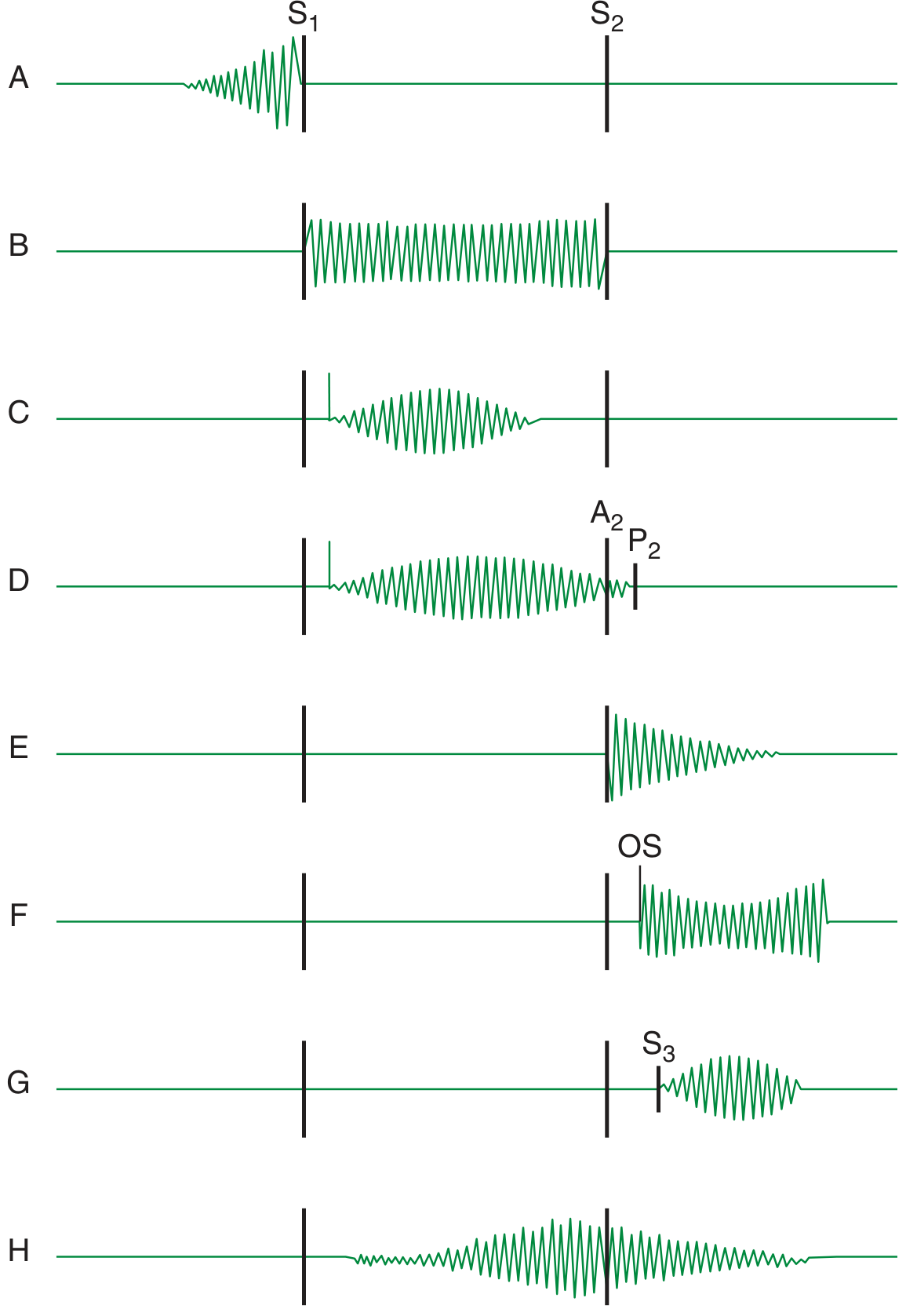
- A = Presystolic (MS/TS in sinus rhythm)
- B = Holosystolic (MR, TR, VSD)
- C = Aortic ejection murmur (AS) - ends before S2
- D = Pulmonary stenosis - spills through A2
- E = Early diastolic decrescendo (AR, PR)
- F = Long diastolic rumble of MS (with opening snap OS)
- G = Short mid-diastolic after S3
- H = Continuous murmur (PDA)
Quick Summary Cheat-Sheet
| Systolic (S1→S2) | Diastolic (S2→S1) | Continuous | |
|---|---|---|---|
| Mnemonic | MR PASS MVP | MS ARD | PDA machinery |
| Key examples | AS, MR, TR, PS, VSD, MVP | AR, MS | PDA |
| Increases with inspiration | TR, PS (right-sided) | TS | - |
| Increases with Valsalva | HOCM, MVP | - | - |
Sources: Harrison's Principles of Internal Medicine 22E (2025), p. 326-331; Latrina Walden Exam Solutions; Fitzgerald Health Education Associates
For an excellent audio walkthrough with actual murmur sounds, see this video:
This is a shared conversation. Sign in to Orris to start your own chat.