
Detailed description regarding acid peptic disorders along with pharmacology
Reading File
Finding Sources
Finding Sources
Searching PubMed
"peptic ulcer disease"[MeSH Terms] AND "drug therapy"[MeSH Terms]
Finding Sources
Finding Sources
Finding Sources
Now let me read the key textbook sections in parallel:
Reading File
Reading File
Reading File
Reading File
Reading File
Reading File
Reading File
Reading File
Finding Sources
Searching Images
peptic ulcer disease gastric mucosal barrier pathophysiology
Finding Sources
Reading File
Reading File
Finding Sources
Reading File
Finding Sources
Reading File
Reading File
I now have comprehensive information to write a detailed answer. Let me mark the research todos complete and compile the final synthesis.# Acid Peptic Disorders — Detailed Description & Pharmacology
1. DEFINITION & SPECTRUM
Acid peptic disorders (APD) encompass a group of conditions caused by the damaging interaction of gastric acid and pepsin on the gastrointestinal mucosa. The spectrum includes:
| Condition | Primary Site |
|---|---|
| Peptic Ulcer Disease (PUD) | Gastric antrum, duodenal bulb |
| Gastroesophageal Reflux Disease (GERD) | Esophageal mucosa |
| Stress-related mucosal disease | Stomach/duodenum |
| Zollinger-Ellison Syndrome | Stomach, duodenum, jejunum |
| Non-ulcer dyspepsia | Functional |
2. NORMAL MUCOSAL DEFENSE vs. AGGRESSIVE FACTORS
The gastroduodenal mucosa maintains a balance between aggressive and defensive forces:
Aggressive factors:
- Hydrochloric acid (HCl) and pepsin
- Helicobacter pylori infection
- NSAIDs and aspirin (COX inhibition → ↓ prostaglandin → ↓ mucus, ↓ bicarbonate, ↓ mucosal blood flow)
- Bile reflux, alcohol, cigarette smoking
Defensive factors:
- Mucus-bicarbonate barrier (pH gradient 7 at surface → 1–2 at lumen)
- Tight junctions between epithelial cells
- Mucosal blood flow (delivers O₂, bicarbonate, removes acid)
- Prostaglandins (PGE₂, PGI₂) → stimulate mucus and bicarbonate secretion
- Rapid epithelial restitution after injury
A peptic ulcer forms when either excess acid/pepsin production overwhelms normal defenses, or mucosal defenses are impaired — or both. — Guyton & Hall Medical Physiology
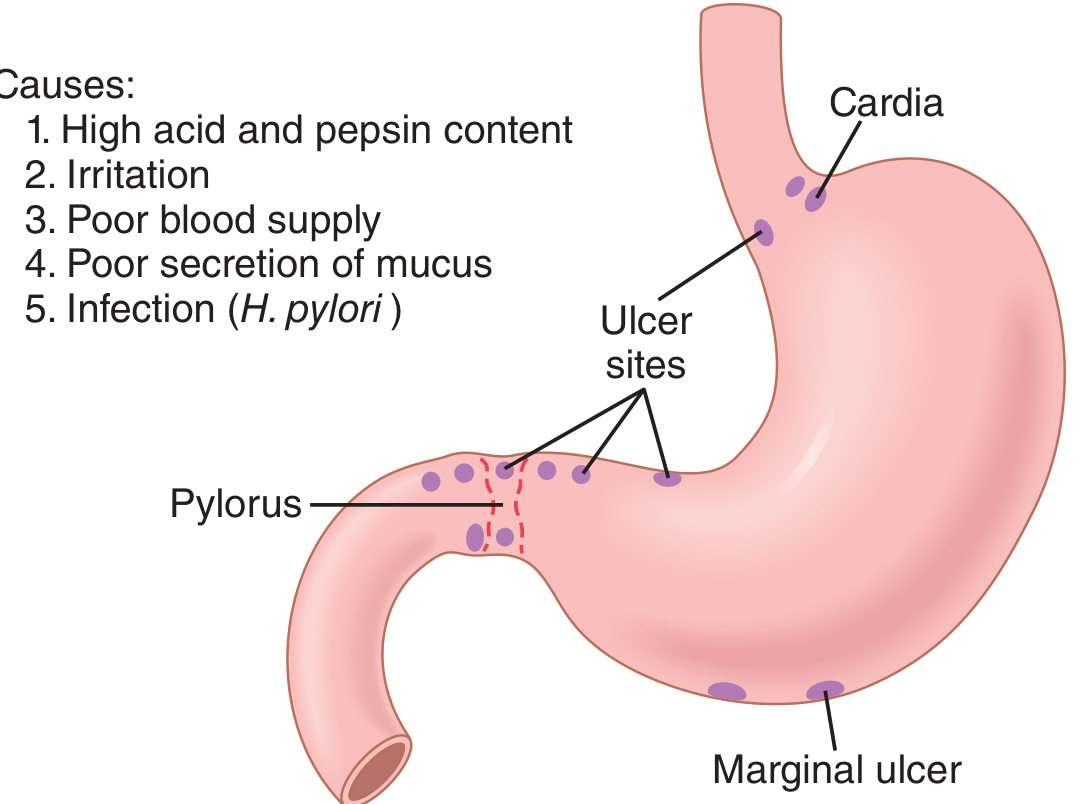
3. PEPTIC ULCER DISEASE (PUD)
Epidemiology
- Affects >4 million individuals/year in the United States
- Lifetime risk: ~10% in males, ~4% in females
- Most common sites: gastric antrum and first portion of the duodenum
Pathogenesis
1. H. pylori infection (most common)
- Found in >75% of PUD cases; >70% of all PUD associated with it
- H. pylori physically burrows through the mucous barrier, releases urease (producing ammonium → liquefies mucus), stimulates gastric acid secretion, triggers chronic inflammation
- Only 5–10% of infected individuals develop ulcers — host factors and strain virulence (CagA, VacA) matter
2. NSAID/Aspirin use
- Inhibit COX-1 → suppress prostaglandin synthesis → ↓ mucus, ↓ bicarbonate, ↓ mucosal blood flow
- Becoming the leading cause of gastric ulcers in the US as H. pylori rates fall
- Risk amplified by: concurrent anticoagulant use, age >65, prior ulcer history
3. Hyperacidity states
- Zollinger-Ellison syndrome: gastrin-secreting tumors → massive acid → multiple ulcers in stomach, duodenum, and jejunum
- Parietal cell hyperplasia, excessive secretory responses
4. Cofactors
- Cigarette smoking (↓ mucosal blood flow, ↓ healing)
- High-dose corticosteroids (suppress prostaglandin synthesis)
- Alcohol-related cirrhosis, chronic renal failure, hyperparathyroidism (↑ Ca²⁺ → ↑ gastrin → ↑ acid)
— Robbins & Kumar Basic Pathology
Clinical Features of PUD
| Feature | Duodenal Ulcer | Gastric Ulcer |
|---|---|---|
| Pain | Epigastric, burns/gnaws | Epigastric, burning |
| Timing | 2–3 hrs after meals; worsens when stomach empties | During or shortly after meals |
| Food effect | Relieved by food/antacids | May worsen with food |
| Nocturnal pain | Common (1–3 AM) | Less common |
| Nausea/vomiting | Less common | More common |
| Weight loss | Less common | Common (fear of eating) |
Complications
| Complication | Features |
|---|---|
| Hemorrhage | Melena, hematemesis; most common complication |
| Perforation | Sudden severe "board-like" abdominal rigidity |
| Penetration | Into pancreas (back pain), liver, biliary tree |
| Gastric outlet obstruction | Vomiting, succussion splash |
| Malignant transformation | Gastric ulcers only (not duodenal) |
Diagnosis
- Endoscopy (EGD): gold standard; biopsy for H. pylori and malignancy
- Urea breath test: non-invasive H. pylori detection (urease-based)
- Stool antigen test: H. pylori detection, also useful for post-treatment confirmation
- Serology: detects anti-H. pylori IgG (less useful — cannot distinguish active vs past infection)
- Barium upper GI series: "crater" or niche sign

4. GASTROESOPHAGEAL REFLUX DISEASE (GERD)
- Retrograde passage of gastric contents → esophageal mucosal damage
- Core mechanism: transient lower esophageal sphincter (LES) relaxations; exacerbated by ↑ intra-abdominal pressure, hiatus hernia, ↓ esophageal clearance
- Symptoms: heartburn, regurgitation, dysphagia, atypical features (hoarseness, chronic cough, asthma)
- Complications: erosive esophagitis, Barrett's esophagus, esophageal adenocarcinoma
- Management: lifestyle modification → step-up to H2 blockers → PPIs → antireflux surgery (Nissen fundoplication)
5. PHARMACOLOGY OF ACID PEPTIC DISORDERS
5A. ANTACIDS
Mechanism: Weak bases that directly neutralize HCl → form a salt + water. Reduce intragastric acidity; a single dose of 156 mEq neutralizes gastric acid for up to 2 hours.
| Agent | Reaction | Key Properties | Adverse Effects |
|---|---|---|---|
| Sodium bicarbonate | NaHCO₃ + HCl → NaCl + H₂O + CO₂ | Rapid onset | Belching, metabolic alkalosis, Na⁺ load; milk-alkali syndrome |
| Calcium carbonate (Tums) | CaCO₃ + HCl → CaCl₂ + H₂O + CO₂ | Slower; antacid + Ca supplement | Belching, hypercalcemia, rebound acid secretion |
| Magnesium hydroxide | Mg(OH)₂ + HCl → MgCl₂ + H₂O | No CO₂ generation | Osmotic diarrhea |
| Aluminum hydroxide | Al(OH)₃ + HCl → AlCl₃ + H₂O | No CO₂ generation | Constipation |
| Combination (Maalox, Mylanta) | Mg + Al | Balanced GI effects | Avoid in renal failure |
Drug interactions: Antacids bind tetracyclines, fluoroquinolones, itraconazole, iron — space 2 hours apart.
— Katzung's Basic & Clinical Pharmacology, 16th ed
5B. H₂-RECEPTOR ANTAGONISTS (H2RAs)
Available agents: Cimetidine, Famotidine, Nizatidine
(Ranitidine was withdrawn due to NDMA carcinogen contamination)
(Ranitidine was withdrawn due to NDMA carcinogen contamination)
Mechanism: Competitive and reversible blockade of parietal cell H₂ receptors → dose-dependent suppression of basal and meal-stimulated acid secretion. Also reduce volume of gastric secretion and pepsin concentration. Particularly effective against nocturnal acid secretion.
| Drug | Relative Potency | Dose (Duodenal Ulcer) | Dose (GERD) |
|---|---|---|---|
| Cimetidine | 1× | 800 mg HS or 400 mg bid | 800 mg bid |
| Nizatidine | 4–10× | 300 mg HS or 150 mg bid | 150 mg bid |
| Famotidine | 20–50× | 40 mg HS or 20 mg bid | 20 mg bid |
Pharmacokinetics:
- Well-absorbed orally; cimetidine & famotidine ~50% bioavailability (first-pass)
- Cleared by hepatic metabolism + renal excretion; dose reduce in renal failure
- Half-lives: 1.1–4 hours; duration of action dose-dependent
Clinical Uses:
- Mild-moderate GERD (infrequent heartburn)
- Acute peptic ulcer (largely superseded by PPIs)
- Non-ulcer dyspepsia
- Prevention of stress-related gastritis in ICU patients
- Prophylaxis before procedures, OTC heartburn relief
Adverse Effects:
- Very safe overall (<3% adverse events): diarrhea, headache, fatigue, myalgias
- Cimetidine-specific: gynecomastia, impotence, galactorrhea (anti-androgenic; inhibits androgen receptors and estradiol metabolism); mental confusion in elderly/ICU; inhibits CYP1A2, 2C9, 2D6, 3A4 — many drug interactions
- Rapid IV infusion → bradycardia, hypotension (cardiac H₂ blockade) — infuse over 30 min
- Cross placenta, secreted in breast milk
Drug Interactions (cimetidine-specific): Prolongs half-lives of warfarin, theophylline, phenytoin, lidocaine, carbamazepine, metoprolol. Famotidine and nizatidine have negligible CYP interactions.
5C. PROTON PUMP INHIBITORS (PPIs)
"Since their introduction in the late 1980s, these efficacious acid inhibitory agents have assumed the major role for the treatment of acid-peptic disorders. PPIs are now among the most widely prescribed drugs worldwide." — Katzung's, 16th ed
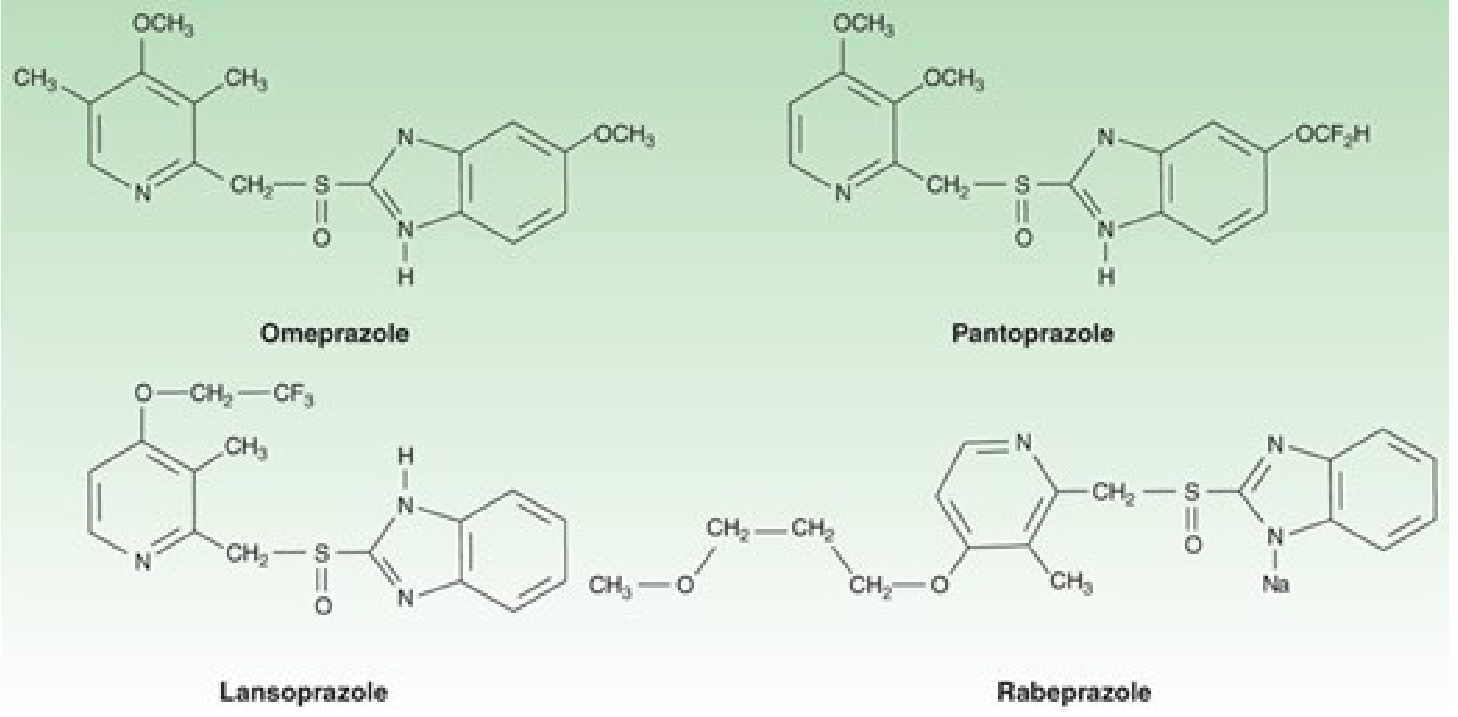
Available agents: Omeprazole, Esomeprazole, Lansoprazole, Dexlansoprazole, Rabeprazole, Pantoprazole
Mechanism:
- PPIs are inactive prodrugs — substituted benzimidazoles
- Acid-resistant enteric-coated formulations absorbed in the small intestine
- After absorption, as lipophilic weak bases (pKa 4–5), they diffuse across membranes and accumulate in the acidic parietal cell canaliculus (>1000-fold concentration by Henderson-Hasselbalch trapping)
- Protonation → rapid conversion to sulfenamide cation (active form)
- Covalent disulfide bond with H⁺/K⁺-ATPase (proton pump) → irreversible inhibition
- Acid secretion resumes only when new pump molecules are synthesized (t½ ~18 h)
Key pharmacokinetic rule: Must be taken 30–60 minutes before the first meal — the drug works only on actively secreting pumps; eating stimulates pumps into the active state.
| PPI | Bioavailability | t½ (h) | Standard Dose |
|---|---|---|---|
| Omeprazole | 40–65% | 0.5–1.0 | 20–40 mg qd |
| Esomeprazole | >80% | 1.5 | 20–40 mg qd |
| Lansoprazole | >80% | 1.0–2.0 | 30 mg qd |
| Pantoprazole | 77% | 1.0–1.9 | 40 mg qd |
| Rabeprazole | 52% | 1.0–2.0 | 20 mg qd |
| Dexlansoprazole | NA | 1.0–2.0 | 30–60 mg qd |
Clinical Uses:
- GERD (first-line for erosive esophagitis, superior to H2RAs)
- PUD — 4–8 weeks; superior ulcer healing vs H2RAs
- H. pylori eradication (component of triple/quadruple therapy)
- Zollinger-Ellison syndrome (high-dose, long-term)
- NSAID-induced ulcer prevention (when NSAID cannot be discontinued)
- Stress ulcer prophylaxis in critically ill patients
Adverse Effects:
- Generally very safe short-term
- Long-term concerns:
- ↑ Serum gastrin (1.5–2× normal; ECL hyperplasia; rebound acid secretion on abrupt discontinuation)
- Hypomagnesemia (with >1 year use)
- ↓ Bone density → ↑ hip/spine fracture risk
- Clostridium difficile infection (↑ with acid suppression)
- Community-acquired pneumonia (slightly ↑ risk)
- Vitamin B12 and iron malabsorption (requires gastric acid for absorption)
- Benign gastric fundic-gland polyps
Drug Interactions:
- Clopidogrel + PPIs (especially omeprazole/esomeprazole): PPIs inhibit CYP2C19 → ↓ clopidogrel activation → ↓ antiplatelet effect. Use pantoprazole or rabeprazole if needed.
- ↓ Absorption of ketoconazole, itraconazole, atazanavir (need acidic environment)
- Omeprazole: inhibits warfarin, diazepam, phenytoin metabolism
- All food reduces bioavailability ~50% — take on empty stomach
5D. MUCOSAL PROTECTIVE AGENTS
Sucralfate
- Mechanism: Sucrose complexed to sulfated aluminum hydroxide; in acidic conditions forms a viscous paste that binds selectively to ulcer bases (positively charged proteins in ulcer base), forming a physical protective barrier for up to 6 hours. Also stimulates mucosal prostaglandin and bicarbonate secretion.
- Dose: 1 g four times daily on empty stomach
- Use: Stress ulcer prophylaxis in ICU; useful when avoiding acid-inhibitory therapy
- Adverse effects: Constipation (2%); avoid in renal failure (aluminum accumulation)
- Interactions: Can bind and reduce absorption of other drugs — space administration
Misoprostol (PGE₁ analog)
- Mechanism: Binds mucosal prostaglandin receptors → ↑ mucus, ↑ bicarbonate, ↑ mucosal blood flow + inhibits acid secretion (↓ cAMP in parietal cells)
- Use: Prevention of NSAID-induced gastric ulcers (indicated when NSAIDs cannot be stopped in high-risk patients)
- Dose: 200 µg four times daily
- Adverse effects: Dose-dependent diarrhea and cramping (limits use); contraindicated in pregnancy (uterotonic — induces contractions)
- Half-life: <30 minutes; must dose 3–4 times daily
Bismuth subsalicylate
- Mechanism: Coating agent; forms a protective layer; has direct anti-H. pylori bactericidal activity (disrupts bacterial cell wall)
- Use: Component of bismuth quadruple therapy for H. pylori; traveler's diarrhea
- Adverse effects: Black discoloration of stool and tongue (bismuth sulfide), tinnitus (salicylate toxicity in high doses)
5E. H. PYLORI ERADICATION THERAPY
Eradication is curative in the majority of H. pylori-positive PUD patients and dramatically reduces recurrence.
First-line regimens (14 days preferred over 7):
| Regimen | Drugs | Eradication Rate |
|---|---|---|
| Standard Triple Therapy | PPI + Clarithromycin + Amoxicillin (or Metronidazole) bid | 70–85% |
| Bismuth Quadruple Therapy | PPI + Bismuth + Tetracycline + Metronidazole | ~90% |
| Concomitant Quadruple | PPI + Clarithromycin + Amoxicillin + Metronidazole | ~85–90% |
First-line choice guidance:
- In areas of clarithromycin resistance >15% or unknown: use bismuth quadruple therapy
- Avoid clarithromycin in patients with prior macrolide exposure
Second-line / salvage therapy (if first-line fails):
- Levofloxacin-based triple: PPI + Levofloxacin + Amoxicillin × 10 days
- Rifabutin-based: PPI + Rifabutin + Amoxicillin × 10 days (~86% cure in resistant strains)
- Culture & sensitivity testing if two courses fail
Most common causes of eradication failure:
- Antibiotic-resistant strains (clarithromycin resistance ~13–16% in US)
- Inadequate acid suppression
- Non-adherence
— Harrison's Principles of Internal Medicine 22E; Yamada's Textbook of Gastroenterology, 7th ed
5F. POTASSIUM-COMPETITIVE ACID BLOCKERS (P-CABs)
Vonoprazan (recently approved):
- Binds to the potassium-binding site of H⁺/K⁺-ATPase competitively and reversibly
- Does not require acid activation (unlike PPIs) → faster, more consistent acid suppression
- Not pH-dependent for activation → can be taken with or without food
- Used in H. pylori eradication regimens and PUD
6. SUMMARY COMPARISON TABLE
| Drug Class | Mechanism | Onset | Duration | Best Use |
|---|---|---|---|---|
| Antacids | Neutralize HCl | Minutes | 1–2 h | Symptomatic relief |
| H2RAs | Block H₂ receptor on parietal cell | 30–60 min | 6–10 h | Mild GERD, OTC use |
| PPIs | Irreversible H⁺/K⁺-ATPase blockade | 1–4 days (full effect) | 24+ h | PUD, GERD, ZE syndrome |
| Sucralfate | Mucosal coating/barrier | Minutes | 6 h | Stress ulcer prophylaxis |
| Misoprostol | PGE₁ analog; ↑ defense, ↓ acid | 30 min | 3–4 h | NSAID-ulcer prevention |
| P-CABs | Competitive K⁺-site pump blockade | Rapid | 24 h | H. pylori, PUD |
Sources:
- Katzung's Basic and Clinical Pharmacology, 16th Edition — Chapter 62
- Guyton and Hall Textbook of Medical Physiology, 14th Edition — Chapter 67
- Robbins & Kumar Basic Pathology — Chapter 13
- Harrison's Principles of Internal Medicine, 22nd Edition — Chapter 335
- Yamada's Textbook of Gastroenterology, 7th Edition — Chapters 49, 50
- Sleisenger and Fordtran's Gastrointestinal and Liver DiseaseThe above is a comprehensive, textbook-sourced reference on acid peptic disorders. Here's a quick orientation to the sections:
What's covered:
- Spectrum of APD — PUD, GERD, stress ulcers, Zollinger-Ellison, dyspepsia
- Pathophysiology — the offensive vs. defensive balance, how H. pylori destroys the mucosal barrier, how NSAIDs inhibit prostaglandin protection
- Clinical features — classic symptom patterns of duodenal vs. gastric ulcers, plus complications (hemorrhage, perforation, obstruction, malignancy)
- Diagnosis — endoscopy, urea breath test, stool antigen, barium studies
Pharmacology (full detail):
- Antacids — types (NaHCO₃, CaCO₃, Mg/Al hydroxides), mechanisms, adverse effects, interactions
- H2-receptor antagonists — cimetidine, famotidine, nizatidine; mechanism, dosing table, CYP interactions, cimetidine-specific effects (gynecomastia, multiple drug interactions)
- PPIs — all 6 agents; irreversible H⁺/K⁺-ATPase blockade mechanism; pharmacokinetics table; clinical uses; long-term risks (hypomagnesemia, fractures, C. diff, B12 deficiency); clopidogrel interaction warning
- Mucosal protective agents — sucralfate (physical barrier + prostaglandin stimulation), misoprostol (PGE₁ analog), bismuth
- H. pylori eradication — triple therapy, bismuth quadruple, clarithromycin resistance guidance, salvage regimens
- P-CABs (Vonoprazan) — newer class with advantages over PPIs
This is a shared conversation. Sign in to Orris to start your own chat.