
Guidelines for Rational use of antibiotics in surgical prophylaxis
Reading File
Now let me search the medical library and PubMed in parallel for surgical antibiotic prophylaxis guidelines.
Finding Sources
Finding Sources
Searching PubMed
"surgical site infection" AND "antibiotic prophylaxis" AND guidelines
Good results. Now let me read the key sections from Fischer's Surgery (which has a dedicated "Perioperative Antimicrobial Prophylaxis" section), Katzung's pharmacology, Jawetz Microbiology, and the Barash anesthesia text in parallel.
Reading File
Reading File
Reading File
Reading File
Excellent content retrieved. Let me get the Fischer's Surgery section on timing and duration, and also the wound classification table, plus the Barash table for procedure-specific recommendations.
Reading File
Reading File
Searching the Web
WHO surgical site infection prevention guidelines 2024 2025 antibiotic prophylaxis recommendations
Now let me get the Fischer's Surgery section on wound classification and key prophylaxis principles (before line 550), and also fetch the Barash table:
Reading File
Reading File
Now let me get the wound classification table and the Fischer's section on the actual prophylaxis principles (around line 620-700):
Reading File
I now have very comprehensive information from multiple authoritative sources. Let me compile the complete, detailed response.
Loading Image
Excellent - all sources compiled. Here is the comprehensive, structured answer:
Guidelines for Rational Use of Antibiotics in Surgical Prophylaxis
Surgical antibiotic prophylaxis (SAP) aims to reduce the incidence of surgical site infections (SSIs) - the most common healthcare-associated infection in surgical patients, complicating 2-4% of all procedures. These guidelines are based on the ASHP/IDSA/SIS/SHEA Clinical Practice Guidelines, WHO SSI prevention guidelines, CDC recommendations, and authoritative surgical and pharmacology textbooks.
1. The CDC Wound Classification System
This is the foundation for determining whether prophylaxis is needed:
| Class | Definition | SSI Risk | Prophylaxis |
|---|---|---|---|
| I - Clean | No hollow viscus entered; no break in aseptic technique; elective | <2% | Generally not needed (except high-risk patients or implant surgery) |
| II - Clean-Contaminated | Controlled entry into respiratory, GI, or GU tract; no spillage | 5-15% | Recommended |
| III - Contaminated | Open, fresh traumatic wound; gross spillage from GI tract; acute non-purulent inflammation | 15-20% | Recommended |
| IV - Dirty/Infected | Old traumatic wound; frank infection; perforated viscus | >30% | Therapeutic antibiotics, not prophylaxis |
2. When to Use Surgical Prophylaxis - Indications
Prophylaxis is indicated in:
- All clean-contaminated operations (GI, biliary, gynecologic, urologic)
- Selected clean procedures where postoperative infection would be catastrophic - open-heart surgery, neurosurgical craniotomy
- Clean procedures involving prosthetic material - joint replacements, vascular grafts, mesh repairs
- Any procedure in an immunocompromised host
- Clean procedures with SENIC risk factors (>1 discharge diagnosis, abdominal surgery, operation >2 hours, contaminated/dirty wound class)
Prophylaxis is generally not required for truly clean, short procedures without implants (e.g., simple inguinal hernia without mesh, breast biopsy without implant, laparoscopic cholecystectomy in low-risk patients).
- Fischer's Mastery of Surgery, 8th ed.
- Katzung's Basic and Clinical Pharmacology, 16th ed.
3. Six Core Principles of Rational Antibiotic Selection
- Target the likely pathogens - the antibiotic must cover common wound pathogens for that procedure; unnecessarily broad coverage must be avoided
- Proven clinical efficacy - use agents with established evidence in clinical trials
- Adequate tissue concentrations - concentrations must exceed the MIC of suspected pathogens and must be present at the time of incision throughout the procedure
- Shortest effective course - ideally a single dose; avoid postoperative continuation beyond 24 hours
- Preserve newer agents - broad-spectrum antibiotics should be reserved for treating resistant infections, not prophylaxis
- Cost-effectiveness - when other factors are equal, use the least expensive effective agent
- Katzung's Basic and Clinical Pharmacology, 16th ed., p. 1424
4. Timing of Administration
This is the single most important determinant of prophylaxis efficacy.
The standard rule: administer prophylactic antibiotic within 60 minutes before incision (within 30 minutes is ideal for most agents). For vancomycin and fluoroquinolones, infusion may begin up to 120 minutes before incision due to their slow infusion requirements.
The landmark Classen et al. study (NEJM 1992) demonstrated the dose-response relationship:
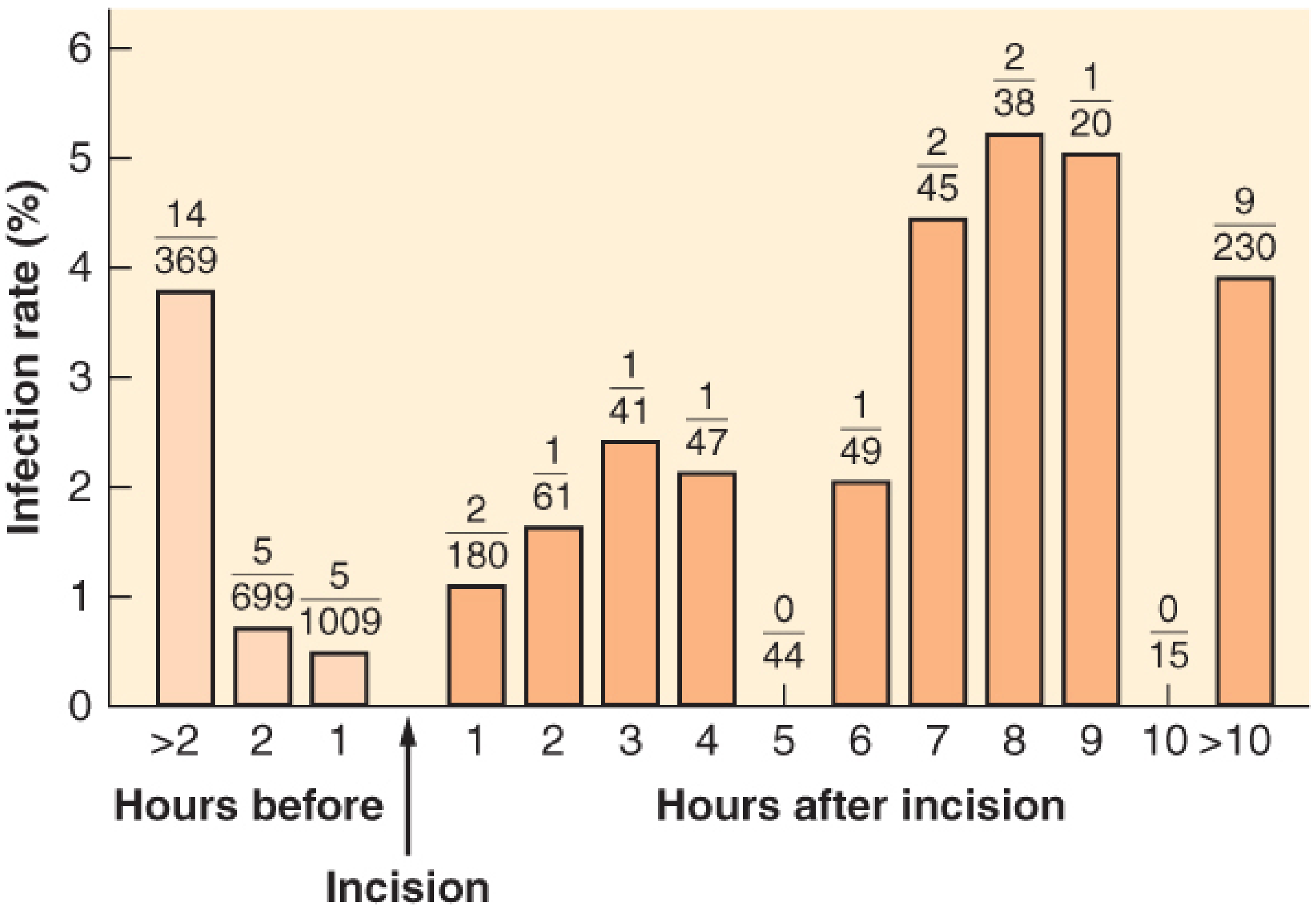
Figure: Rates of surgical wound infection by timing of antibiotic administration. Lowest infection rates occur when the drug is given 0-2 hours before incision. Risk rises significantly when antibiotics are given after incision. - Barash Clinical Anesthesia, 9th ed., p. 569
Key timing rules:
- Give within 60 min before incision for most agents
- Give within 120 min before incision for vancomycin and fluoroquinolones
- For cesarean section: administer after umbilical cord clamping (traditional) - though current evidence supports pre-incision dosing
- When a tourniquet is used: complete the infusion at least 5 minutes before tourniquet inflation
- Do not give too early - if incision is more than 60 minutes after the dose, tissue levels may be subtherapeutic
5. Agent of Choice by Procedure
Cefazolin (1st-generation cephalosporin) is the prophylactic agent of choice for the vast majority of surgical procedures. It has proven efficacy, an excellent safety profile, desirable duration of action, and covers the organisms most commonly encountered in SSIs (gram-positive cocci from skin, and gram-negative rods in clean-contaminated procedures).
| Type of Surgery | Common Pathogens | First-Line Prophylaxis | Alternative (Penicillin Allergy) |
|---|---|---|---|
| Cardiac (sternotomy) | Staphylococci, gram-negative rods | Cefazolin | Vancomycin |
| Thoracic (non-cardiac) | Staphylococci, streptococci, gram-negatives | Cefazolin | Clindamycin + aztreonam |
| Vascular (abdominal/lower extremity) | Staphylococci, gram-negatives | Cefazolin | Clindamycin + aztreonam |
| Neurosurgical (craniotomy) | Staphylococci | Cefazolin | Vancomycin |
| Orthopedic (hardware insertion) | Staphylococci | Cefazolin | Vancomycin |
| Head and neck (oropharyngeal entry) | S. aureus, oral flora | Cefazolin + metronidazole | Clindamycin |
| Gastroduodenal | S. aureus, gram-negatives, streptococci | Cefazolin | Clindamycin + aztreonam |
| Biliary tract | E. coli, Klebsiella, enterococci | Cefazolin | Clindamycin + aztreonam |
| Colorectal | Enterobacteriaceae, anaerobes, enterococci | Cefazolin + metronidazole (or cefoxitin) | Clindamycin + aztreonam |
| Gynecologic | Enterobacteriaceae, anaerobes, group B strep | Cefazolin | Clindamycin + aztreonam |
| Urologic | E. coli, Klebsiella, Proteus | Cefazolin or fluoroquinolone | Aztreonam |
Katzung's Basic and Clinical Pharmacology, 16th ed., p. 1424; Jawetz Medical Microbiology, 28th ed.
6. Dosing and Redosing
Standard Adult Doses
| Agent | Adult Dose | Redosing Interval |
|---|---|---|
| Cefazolin | 2 g IV (3 g if ≥120 kg) | Every 4 hours intraoperatively |
| Cefuroxime | 1.5 g IV | Every 4 hours |
| Cefoxitin | 2 g IV | Every 2 hours |
| Cefotetan | 2 g IV | Every 6 hours |
| Ampicillin-sulbactam | 3 g IV | Every 2 hours |
| Clindamycin | 900 mg IV | Every 6 hours |
| Metronidazole | 500 mg IV | Every 6-8 hours |
| Vancomycin | 15 mg/kg IV | No redosing recommendation (long half-life) |
| Gentamicin | 5 mg/kg (dosing weight) | NA |
Intraoperative Redosing Rules
-
Redose when procedure duration exceeds 2x the half-life of the drug (e.g., redose cefazolin every 4 hours intraoperatively)
-
Redose with significant blood loss (~0.5 to 1 blood volume)
-
Redosing intervals may be extended in renal insufficiency
-
Fischer's Mastery of Surgery, 8th ed., Table 9.10
7. Duration of Prophylaxis
This is a critical principle for antibiotic stewardship:
-
Single-dose prophylaxis is effective for most procedures and is the ideal
-
If postoperative dosing is chosen, discontinue within 24 hours of the operative end time (48 hours for cardiac surgery in some guidelines)
-
Prolonging antibiotics beyond 24 hours does NOT reduce SSI risk but significantly increases:
- Antibiotic resistance
- Clostridioides difficile infection
- Drug toxicity and adverse effects
- Cost
-
Antibiotics should not be continued solely because a wound drain is in place (WHO strong recommendation)
-
Barash Clinical Anesthesia, 9th ed., p. 570
-
Jawetz Medical Microbiology, 28th ed.
8. Special Situations
Penicillin/Beta-Lactam Allergy
- A reported penicillin allergy is almost never a true contraindication to cefazolin - cross-reactivity between penicillin and cephalosporins is much lower (~1%) than previously believed
- A documented history of anaphylaxis, angioedema, urticaria, bronchospasm, SJS, or TEN is the exception where cefazolin should be avoided
- Always assess the severity and nature of the allergic reaction before choosing an alternative - choosing an inferior alternative when none is needed increases risk and cost
- Barash Clinical Anesthesia, 9th ed.
MRSA Colonization
- Pre-surgical nares surveillance screening for MRSA using culture or NAAT (nucleic acid amplification) is recommended
- MRSA-positive patients: treat with mupirocin nasal ointment (3-5 days) + chlorhexidine bathing before surgery
- Consider adding vancomycin to cefazolin for intraoperative prophylaxis in known MRSA carriers
- Vancomycin alone is not recommended for routine surgical prophylaxis even in hospitals with high MRSA rates, but may substitute cefazolin when MRSA rates are very high
- Jawetz Medical Microbiology, 28th ed.
Obesity
- Standard doses may be inadequate - weight-based dosing is preferred
- Cefazolin: 3 g for patients ≥120 kg
- Cefotaxime: 2 g for obese patients
Immunocompromised Patients
- Any procedure in an immunocompromised host warrants prophylaxis regardless of wound class
- Patients with neutropenia (<1000/μL) undergoing surgery may need extended empiric coverage targeting gram-negative organisms
When Therapeutic Antibiotics Are Already Given
- If therapeutic antibiotics are being administered preoperatively for an active infection (e.g., acute appendicitis), separate prophylactic antibiotics are not required
- Coverage of skin flora at incision may still be added in some cases
9. Additional Measures to Prevent SSI (Non-Antibiotic)
Antibiotic prophylaxis works alongside non-pharmacologic strategies:
| Measure | Recommendation |
|---|---|
| Skin preparation | Chlorhexidine-alcohol preferred; povidone-iodine with alcohol for CHG-allergic patients |
| Hair removal | Clipping (not shaving) if hair must be removed; shaving increases SSI risk |
| Glycemic control | Target blood glucose <150 mg/dL perioperatively in all patients (not just diabetics) |
| Normothermia | Maintain intraoperative body temperature; warming devices should be used |
| Nutritional support | Oral/enteral nutritional formulas for underweight patients undergoing major surgery |
| Wound drains | Do NOT continue antibiotics solely because a drain is present |
- WHO Global Guidelines for SSI Prevention
10. Antimicrobial Stewardship Principles in Surgical Prophylaxis
The rational use framework emphasizes:
- Right drug - narrowest spectrum active against likely pathogens
- Right dose - weight-adjusted, pharmacokinetically appropriate
- Right time - within 60 min before incision
- Right duration - single dose or maximum 24 hours
- Use of a pharmacist-led or multidisciplinary perioperative stewardship program significantly improves adherence to guidelines and reduces SSI rates (systematic review evidence: Naseralallah et al., 2024, PMID 39153871)
- Local antibiogram data should guide agent selection - if institutional MRSA rates are high, adjust prophylaxis accordingly
- Hospital committees should determine protocols based on national guidelines + local resistance patterns
Key Takeaway Summary
| Principle | Recommendation |
|---|---|
| Drug of choice | Cefazolin for most procedures |
| Timing | Within 60 min before incision (120 min for vancomycin) |
| Duration | Single dose preferred; max 24 hours |
| Redosing | Every 4 hours for cefazolin; if procedure >2x drug half-life or major blood loss |
| MRSA screen | Decolonize preoperatively; consider adding vancomycin |
| Beta-lactam allergy | Reassess; true allergy to cefazolin is rare |
| Drains | Not a reason to continue antibiotics |
| Postoperative extension | Does NOT reduce SSI risk; increases resistance |
Sources: Fischer's Mastery of Surgery 8th ed. | Katzung's Basic and Clinical Pharmacology 16th ed. | Jawetz Medical Microbiology 28th ed. | Barash Clinical Anesthesia 9th ed. | ASHP/IDSA/SIS/SHEA Guidelines (2013) | WHO SSI Prevention Guidelines | CDC 2017 SSI Guidelines
This is a shared conversation. Sign in to Orris to start your own chat.