
Macrophages of skin
Reading File
Finding Sources
Finding Sources
Searching Images
macrophages skin Langerhans cells histiocyte
Reading File
Reading File
Reading File
Reading File
Reading File
Here is a comprehensive overview of macrophages of the skin, synthesized from authoritative textbooks:
Macrophages of the Skin — Langerhans Cells
Identity & Classification
Langerhans cells (LCs) are the resident macrophages/dendritic cells of the skin epidermis. They belong to the mononuclear phagocyte system (MPS) — the network of phagocytic cells (monocytes, macrophages, and dendritic cells) that mediate phagocytosis, antigen processing, and presentation.
LCs are classified as a type of non-lymphoid tissue-resident macrophage with dendritic morphology that resides in the epidermis. — Janeway's Immunobiology 10e
Location
- Found scattered among keratinocytes of the stratum spinosum
- Constitute 3–5% of cells in the stratum spinosum
- Like melanocytes, LCs are not connected to adjacent keratinocytes by desmosomes
- In oral mucosa: highest density in the vestibular region, lowest in the sublingual region (a relatively immunologically "privileged" site) — Andrews' Diseases of the Skin
Embryological Origin
LCs are yolk sac–derived, arising from erythro-myeloid progenitor cells in the early (primitive) hematopoietic wave at 3–4 weeks of gestation — independently of blood monocytes. They migrate to the skin and acquire tissue-specific macrophage phenotypes during organ development.
Key point: Unlike most macrophages, Langerhans cells cannot be replenished by bone marrow–derived monocytes — they are maintained entirely by local self-renewal (similar to microglia in the brain).
— Histology: A Text and Atlas, Pawlina
Morphology & Identification
| Feature | Detail |
|---|---|
| Light microscopy (H&E) | Difficult to detect |
| Gold chloride stain | Appears as dendritic cell (LC-specific stain) |
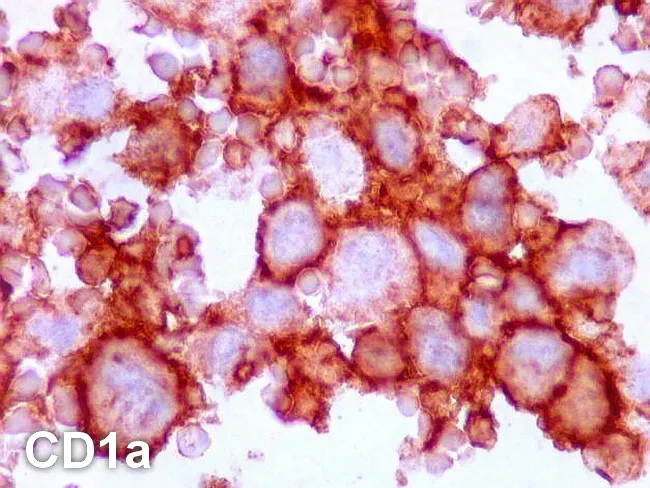
| Immunohistochemistry | CD1a+, S-100+, CD39+, Langerin (CD207)+ |
| Ultrastructure | Folded nucleus + Birbeck granules (rod-shaped intracytoplasmic organelles; fully developed form resembles a tennis racquet) |
— Andrews' Diseases of the Skin
Function
LCs operate primarily in the afferent limb of the immune response:
- Antigen recognition, uptake, and processing — via pattern recognition receptors (PRRs), complement receptors, and Fc receptors
- Antigen presentation to T lymphocytes — critical for induction of delayed-type hypersensitivity and humoral immunity
- Migration to lymph nodes after antigen capture — directed by hyaluronan (hyaluronic acid), which plays a critical role in LC maturation and migration
- CD4 T-cell priming — particularly TH17 responses; LCs produce IL-12
- Antigen transfer to resident cDC1 cells in lymph nodes for CD8 T-cell cross-priming
"The epidermis of the skin normally lacks both cDC1 and cDC2 cells. Here, the initiation of CD8 T-cell responses is dependent on a specialized tissue-resident macrophage, the Langerhans cell, for initial uptake and transport of antigen to draining lymph nodes." — Janeway's Immunobiology 10e
Molecular Markers
| Marker | LC | Dermal Dendritic Cells (CD104+) |
|---|---|---|
| Langerin (CD207) | ✓ | — |
| CD1a | ✓ | — |
| S-100 | ✓ | ✓ |
| CD39 / membrane ATPase | ✓ | — |
| CCR6 | ✓ | — |
| Macrophage mannose receptor | — | ✓ |
| CD36 | — | ✓ |
| Factor XIIIa | — | ✓ |
| Chemokine receptor 5 | — | ✓ |
UV Radiation Effects
- UV radiation depletes LCs from the epidermis → skin loses the ability to be sensitized until LC population is replenished
- Macrophages that present antigen in LC-depleted skin induce immune tolerance rather than immunity
- Macrophages appearing in the epidermis 72 hours after UVB irradiation produce different cytokines than LCs (which make IL-12)
Clinical Relevance — Langerhans Cell Histiocytosis (LCH)
In LCH, pathological LCs proliferate and infiltrate tissues, including skin:
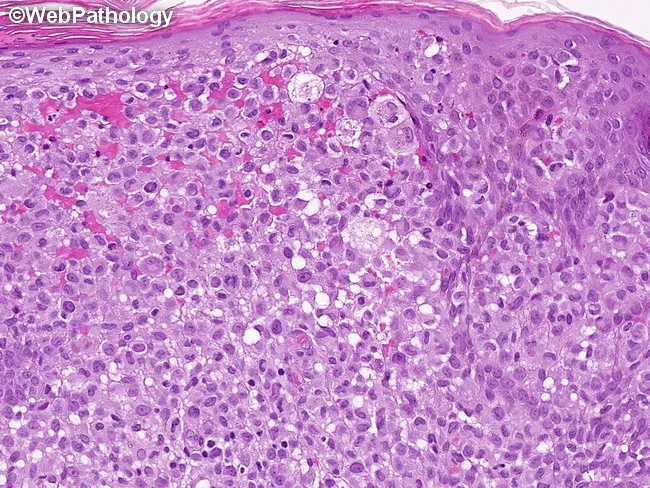
- Histology: epidermotropism of cells with grooved ("coffee-bean") nuclei, mixed inflammatory background with eosinophils, intraepidermal microabscesses
- IHC: CD1a+, Langerin (CD207)+, S-100+, CD68+ (macrophage lineage marker)
Sources:
- Histology: A Text and Atlas with Correlated Cell and Molecular Biology (Pawlina) — Mononuclear Phagocyte System
- Andrews' Diseases of the Skin — Langerhans Cells
- Janeway's Immunobiology 10e — Section 9-7
- Junqueira's Basic Histology 17e — Table 5-2
This is a shared conversation. Sign in to Orris to start your own chat.