
Antioxidant
Reading File
Finding Sources
Finding Sources
Reading File
Reading File
Here is a comprehensive overview of antioxidants drawn from authoritative medical biochemistry textbooks.
Antioxidants
What Are Antioxidants?
Antioxidants are substances that protect cells against reactive oxygen species (ROS) — highly reactive molecules with unpaired electrons (free radicals) such as:
- Superoxide (O₂⁻)
- Hydroxyl radical (OH•)
- Perhydroxyl radical (O₂H•)
- Hydrogen peroxide (H₂O₂)
Free radicals are self-perpetuating chain reactions: each radical attacks a nearby molecule, generating another radical. Antioxidants interrupt these chains. — Harper's Illustrated Biochemistry, 32nd Ed.
Why Antioxidants Matter
Radical damage targets three major classes of biomolecules:
| Target | Consequence |
|---|---|
| DNA | Base modifications → mutations, cancer |
| Lipids (cell membranes, LDL) | Lipid peroxidation → dialdehydes → further protein/DNA damage, atherosclerosis |
| Proteins | Tyrosine oxidation → dihydroxyphenylalanine → more radical generation |
Clinical conditions linked to oxidative damage include cancer, atherosclerosis/coronary artery disease, and autoimmune diseases. — Harper's, p. 561
Enzymatic Antioxidant Defenses
The body's primary enzymatic defenses against ROS:
1. Superoxide Dismutase (SOD)
Converts superoxide → H₂O₂ + O₂ (dismutation). Exists in three isoforms:
- Cu²⁺/Zn²⁺ SOD — cytosol (encoded by SOD1 gene; mutations cause ~5–10% of familial ALS)
- Mn²⁺ SOD — mitochondria
- Cu²⁺/Zn²⁺ SOD — extracellular
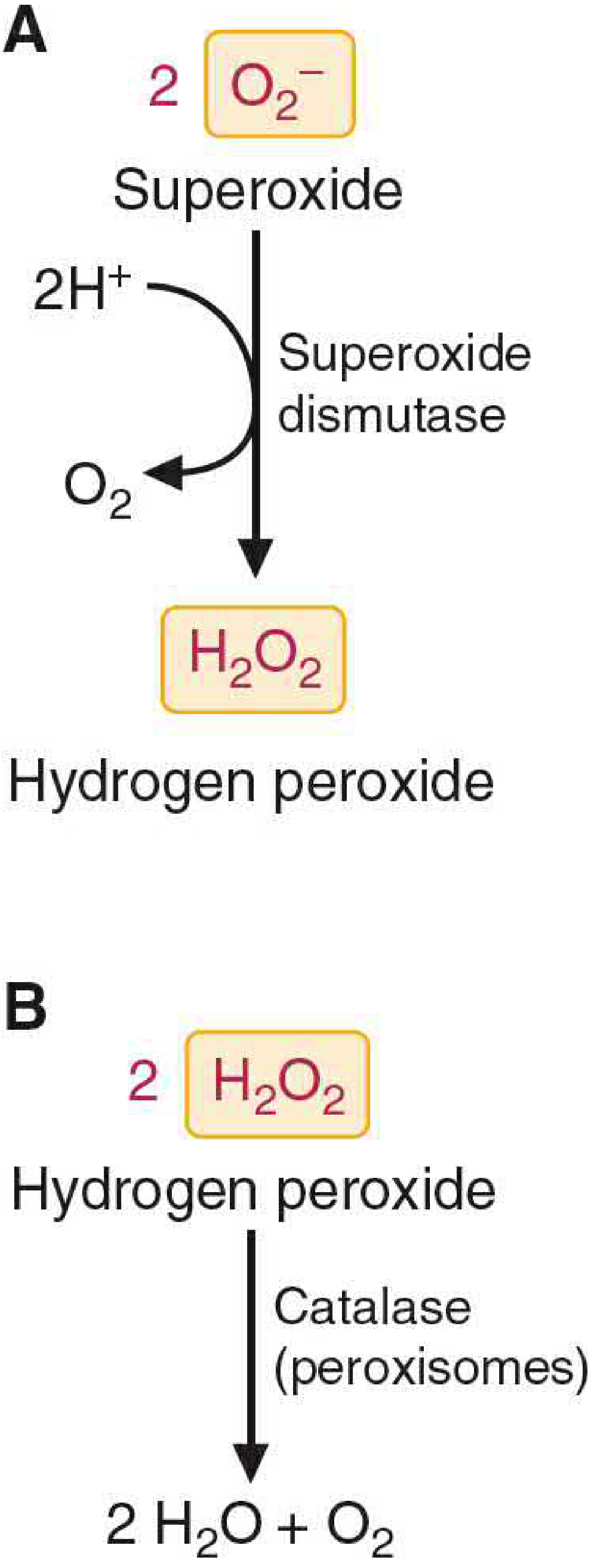
2. Catalase
Converts 2 H₂O₂ → 2 H₂O + O₂. Found mainly in peroxisomes (highest in kidney and liver). Protects immune cells against their own respiratory burst.
3. Glutathione Peroxidase / Glutathione Reductase
Glutathione (γ-glutamyl-cysteinyl-glycine, a tripeptide) is oxidized to glutathione disulfide (GSSG) while reducing:
- H₂O₂ → H₂O
- Lipid peroxides → nontoxic alcohols
— Basic Medical Biochemistry, 6th Ed., p. 917–918
Non-Enzymatic (Dietary) Antioxidants
Key nutrients with antioxidant activity:
| Nutrient | Mechanism |
|---|---|
| Vitamin E (α-tocopherol) | Lipid-soluble; principal protector against lipid peroxidation in membranes |
| Vitamin C (ascorbic acid) | Water-soluble radical scavenger; regenerates vitamin E |
| β-Carotene & carotenoids | Quench singlet oxygen; precursor to vitamin A |
| Selenium | Essential cofactor for glutathione peroxidase |
| Polyphenols (green tea, flavonoids) | Scavenge radicals; some have anti-inflammatory effects independent of antioxidant activity |
— Harper's Illustrated Biochemistry, 32nd Ed.; Basic Medical Biochemistry, 6th Ed.
Measuring Oxidative Stress
- FOX assay (ferrous oxidation in xylenol orange): measures lipid peroxides
- TBARS (thiobarbituric acid reactive substances): measures dialdehydes from lipid peroxidation
- Global antioxidant capacity assays: total antioxidant capacity (TAC) in plasma, since measuring every individual antioxidant is impractical — Tietz Textbook of Laboratory Medicine, 7th Ed.
The Antioxidant Paradox
Despite strong epidemiological associations between antioxidant-rich diets and reduced disease risk, intervention trials with supplements have largely been disappointing:
- Little benefit from supplements except in those who were initially deficient
- Trials of β-carotene and vitamin E have shown increased mortality in some populations
- This is partly explained by the fact that antioxidants can act as pro-oxidants at high doses — e.g., vitamin C can reduce Fe³⁺ → Fe²⁺, promoting the Fenton reaction and generating hydroxyl radicals
The practical message: antioxidant protection is best obtained through a diet rich in fruits, vegetables, and whole grains, not through high-dose supplementation. — Harper's Illustrated Biochemistry, 32nd Ed., "The Antioxidant Paradox"
Clinical Applications
| Context | Role of Antioxidants |
|---|---|
| Chronic pancreatitis / RAP | Selenium, ascorbic acid, α-tocopherol levels should be measured and repleted — Yamada's Gastroenterology |
| Cardiovascular disease | Antioxidant supplements not shown to reduce CV events (Women's Antioxidant and Cardiovascular Study) |
| Ophthalmology (AMD) | AREDS formulation with antioxidants (vitamins C, E, zinc) slows progression — Kanski's Clinical Ophthalmology |
| Pulmonary disease | Oxidant–antioxidant imbalance central to COPD and lung injury pathogenesis — Fishman's Pulmonary Diseases |
| Dermatology | Topical antioxidants (argan oil, green tea) used to reduce UV-induced pigmentation and inflammation — Fitzpatrick's Dermatology |
Key takeaway: Antioxidants operate through both enzymatic (SOD, catalase, glutathione peroxidase) and non-enzymatic (vitamins C/E, carotenoids, polyphenols, selenium) mechanisms to neutralize ROS. Dietary sources are superior to supplements for most people, and high-dose supplementation carries risks.
This is a shared conversation. Sign in to Orris to start your own chat.