
Rheumatic heart disease
Reading File
Now let me search the medical library and PubMed in parallel for comprehensive coverage.
Finding Sources
Searching PubMed
"rheumatic heart disease"[MeSH Terms]
Good results. Now let me read the most relevant textbook sections in parallel.
Reading File
Reading File
Reading File
Good data. Let me get more detail on pathology, clinical features, diagnosis, and management from the Sabiston Surgery and Fuster Heart textbooks.
Reading File
Reading File
Finding Sources
Excellent. Let me now read the Braunwald's Heart Disease section for Jones Criteria and clinical features, plus the Rheumatology textbook.
Reading File
Reading File
Reading File
Let me get the Jones Criteria table and management sections from Braunwald's, plus the Aschoff body image.
Reading File
Loading Image
I have rich content now. Let me get the Jones Criteria table and management details from Braunwald's.
Reading File
Reading File
I now have comprehensive data from multiple authoritative textbooks. Let me compile the full answer.
Rheumatic Heart Disease (RHD)
The famous French aphorism by Lasegue (1884) perfectly captures the essence: "Rheumatic fever licks the joints but bites the heart." RHD is the chronic cardiac sequela of acute rheumatic fever (ARF), caused by an abnormal immune response to Group A beta-hemolytic streptococcal (GAS) pharyngitis, resulting in progressive valvular damage.
Epidemiology
- Global burden: RHD affects over 40.5 million people worldwide and caused approximately 305,651 deaths in 2019, resulting in 10.7 million DALYs lost annually - almost entirely in endemic countries.
- Incidence of ARF: ~19/100,000 globally; lowest in North America/Western Europe (<10/100,000), highest in Eastern Europe, Middle East, Asia, Africa, and Oceania.
- Age: Most common between ages 5-30; peak onset of ARF is 5-15 years.
- Sex: Women are ~1.8 times more susceptible to developing RHD, and disease is more severe in females than males.
- High-burden regions: Central sub-Saharan Africa, South Asia, and Oceania (particularly indigenous populations).
- India: Prevalence of 5-7 per 1000 in the 5-15 age group; RHD constitutes 20-30% of hospital admissions for cardiovascular disease.
- Declining in affluent nations: But persists in pockets of poverty even in high-income countries.
(Fuster and Hurst's The Heart, 15th Edition; Park's Textbook of Preventive and Social Medicine)
Pathophysiology
Molecular Mimicry - The Core Mechanism
RHD is an autoimmune disease triggered by molecular mimicry between streptococcal antigens and cardiac proteins:
- GAS pharyngitis triggers antibody production against streptococcal M-protein and N-acetyl-glucosamine (streptococcal carbohydrate).
- These antibodies cross-react with cardiac myosin, tropomyosin, and laminin in valve tissue - a phenomenon called molecular mimicry.
- Cross-reactive antibodies bind to valvular endothelium and basement membrane, upregulating adhesion molecules including VCAM-1 (vascular cell adhesion molecule-1).
- VCAM-1 interacts with VLA-4 (very late activation antigen-4) on CD4+ T lymphocytes, facilitating their infiltration into heart tissue.
- Chemokines including CCL1/I-309 and CXCL9/Mig are highly expressed in valvular tissue, mediating both CD4+ and CD8+ T cell infiltration.
- Cardiac myosin is the major autoantigen; ~63% of intralesional T cell clones in valve tissue recognize light meromyosin (LMM) peptides.
Pathological Hallmark: The Aschoff Body
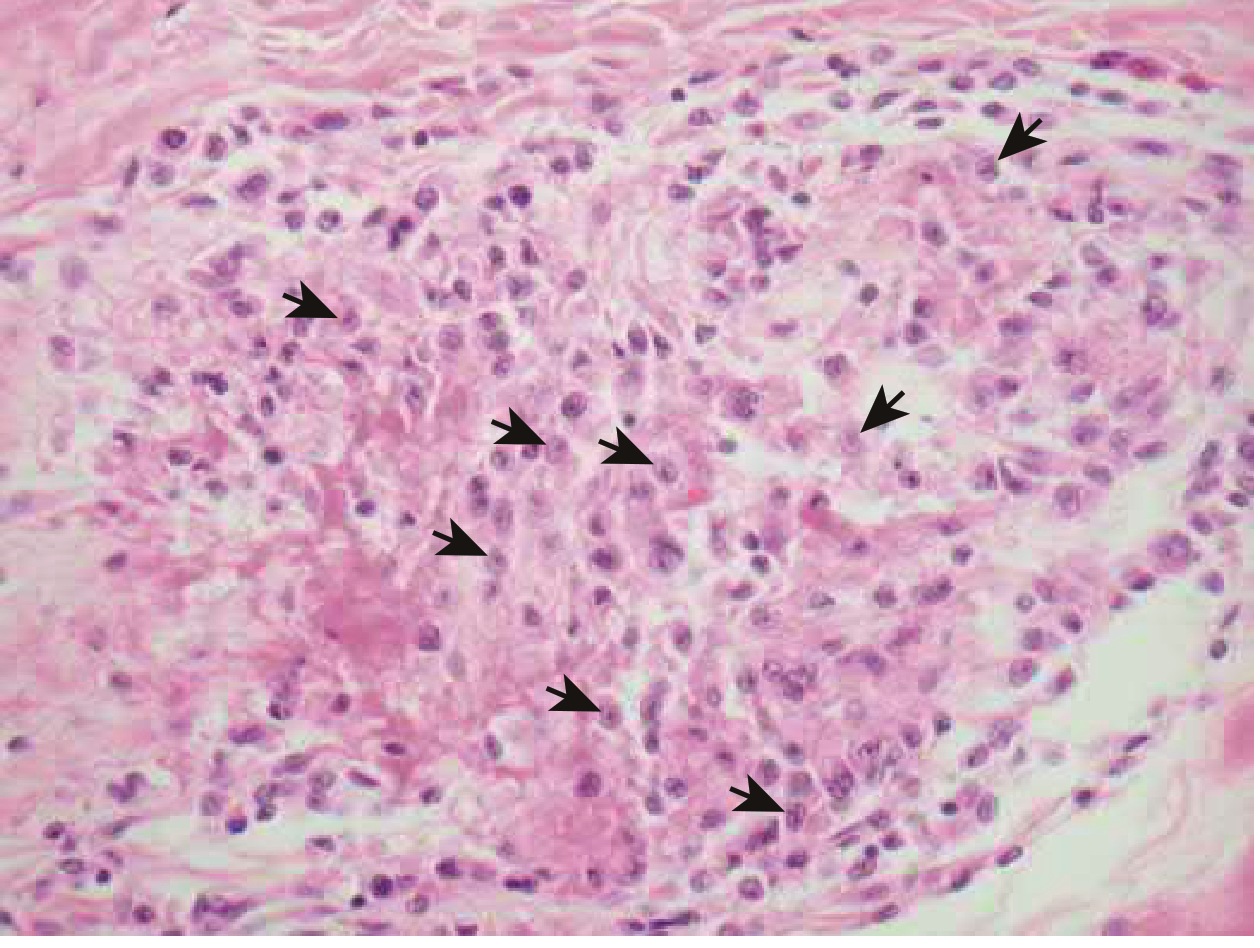
Aschoff nodule (arrows): Composed of Anitschkow cells with clear nuclei and a central chromatin bar resembling a caterpillar. Central fibrinoid necrosis is surrounded by mononuclear cell infiltrate. Myocardial fibers adjacent to the nodule undergo destruction. - Braunwald's Heart Disease
The Aschoff body is the pathognomonic granulomatous lesion of rheumatic carditis, found in the myocardium. It consists of:
- A central zone of fibrinoid necrosis
- Anitschkow (caterpillar) cells - modified macrophages with characteristic nuclei
- Surrounding mononuclear infiltrate (lymphocytes, plasma cells)
Valve Involvement
| Valve | Frequency |
|---|---|
| Mitral | ~100% |
| Aortic | 20-30% |
| Tricuspid | 15-40% (histologic only, rarely clinical) |
| Pulmonic | Rare |
- Mitral regurgitation is the most common early lesion.
- Mitral stenosis develops from progressive scarring - RHD is the most common cause of MS worldwide.
- Aortic involvement: regurgitation more common than stenosis.
(Firestein & Kelley's Textbook of Rheumatology; Goldman-Cecil Medicine)
Acute Rheumatic Fever (ARF) - Clinical Features
ARF precedes RHD. It occurs 2-4 weeks after GAS pharyngitis. The major manifestations (in order of frequency):
1. Arthritis (Most Common - 65-75%)
- Migratory polyarthritis - large joints (ankles, knees, elbows, wrists)
- Begins asymmetrically in lower limbs before spreading to upper limbs
- Pain is disproportionate to physical signs (opposite to Lyme arthritis)
- Resolves completely within 4 weeks; if persistent, consider JIA or SLE
- In high-risk populations (India, Australia, Fiji): monoarthritis occurs in 17-25%
- Jaccoud arthropathy: rare chronic post-RF arthropathy with swan neck deformity, ulnar deviation - no erosions on X-ray
2. Carditis (35-72% clinical; 18% subclinical on echo)
- Pancarditis: affects endocardium, myocardium, and pericardium
- Presents as: new murmur, tachycardia out of proportion to fever, pericardial friction rub, cardiomegaly, or heart failure
- Subclinical carditis detectable by echocardiography (important addition in 2015 Jones Criteria revision)
- Most likely to resolve in the first year after acute episode
3. Sydenham's Chorea (10-30%)
- Involuntary, purposeless movements of face, trunk, and extremities
- Emotional lability, muscle weakness
- Appears late (up to 6 months after GAS infection - "pure chorea")
- Can occur in isolation without other manifestations
4. Erythema Marginatum (<5%)
- Fleeting, non-pruritic, macular rash with pale centers and red margins
- Spreads centrifugally on trunk and proximal limbs (not face)
- Evanescent - may come and go within hours
5. Subcutaneous Nodules (<5%)
- Firm, painless nodules over bony prominences (elbows, wrists, knees, ankles, spinous processes)
- Associated with severe carditis
- Resolve spontaneously within weeks
Diagnosis: Revised Jones Criteria (2015 AHA)
Requirement: Evidence of preceding GAS infection (positive throat culture, rapid strep test, elevated/rising ASO or anti-DNase B titers) PLUS:
| Initial ARF | Recurrent ARF | |
|---|---|---|
| Criteria needed | 2 major OR 1 major + 2 minor | 2 major OR 1 major + 2 minor OR 3 minor |
Major Criteria
| Low-Risk Populations | Moderate/High-Risk Populations |
|---|---|
| Carditis (clinical and/or subclinical echo) | Carditis (clinical and/or subclinical echo) |
| Polyarthritis only | Monoarthritis or polyarthritis; polyarthralgia (added) |
| Chorea | Chorea |
| Erythema marginatum | Erythema marginatum |
| Subcutaneous nodules | Subcutaneous nodules |
Minor Criteria
| Low-Risk | Moderate/High-Risk |
|---|---|
| Polyarthralgia | Monoarthralgia |
| Fever ≥38.5°C | Fever ≥38°C |
| ESR ≥60 mm/hr and/or CRP ≥3.0 mg/dL | ESR ≥30 mm/hr and/or CRP ≥3.0 mg/dL |
| Prolonged PR interval | Prolonged PR interval |
Low-risk populations: ARF incidence <2/100,000 school-aged children/year OR all-age RHD prevalence ≤1/1000/year.
(Adapted from 2015 AHA Scientific Statement; Braunwald's Heart Disease; Goldman-Cecil Medicine)
Echocardiographic Criteria for Rheumatic Valvulitis (WHO/WHF)
Pathologic mitral regurgitation requires all four:
- Seen in at least 2 views
- Jet length ≥2 cm in at least one view
- Peak velocity >3 m/sec
- Pansystolic jet in at least one envelope
Acute mitral valve changes: annular dilatation, chordal elongation/rupture, anterior leaflet tip prolapse, beading/nodularity.
Management
Acute Phase
| Intervention | Details |
|---|---|
| Hospitalization | All ARF patients |
| Eradication of GAS | Benzathine penicillin G 1.2 million units IM (single dose) OR oral penicillin V 10 days |
| Arthritis | Aspirin 80-100 mg/kg/day (max 4-8 g/day) OR naproxen 10-20 mg/kg/day; continue 1-2 weeks after all symptoms resolve |
| Carditis/Heart failure | Diuretics, ACE inhibitors/ARBs, fluid restriction, bed rest; severe cases: corticosteroids (limited evidence) |
| Chorea | Usually self-limiting; carbamazepine or sodium valproate if severe |
| Valve surgery | Rarely needed acutely; indicated for acute leaflet rupture |
Secondary Prophylaxis (Critical for preventing RHD progression)
| Drug | Dose | Route |
|---|---|---|
| Benzathine penicillin G (preferred) | 1.2 million units every 4 weeks (every 3 weeks in high-risk) | IM |
| Oral penicillin V | 250 mg twice daily | Oral |
| Oral amoxicillin | 250 mg twice daily | Oral |
| Azithromycin (penicillin allergy) | 250 mg daily | Oral |
Duration of secondary prophylaxis (AHA guidelines):
| Condition | Duration |
|---|---|
| ARF without carditis | 5 years or until age 21 |
| ARF with mild carditis (resolved) | 10 years or until age 21 |
| ARF with persistent valvular disease | 10 years or until age 40, sometimes lifelong |
2024 Cochrane Review (PMID: 39312290): Confirmed that long-term benzathine penicillin G prophylaxis reduces ARF recurrence and prevents progression to RHD. Adherence remains a major challenge globally (meta-analysis PMID: 39542478 found suboptimal adherence in many settings). A 2025 meta-analysis (PMID: 40333929) found severe adverse reactions to benzathine penicillin G are rare (0.2-2.1/1000 injections), supporting its continued use.
Chronic RHD - Natural History and Complications
- Progressive valvular scarring leads to severe disease in the 3rd-4th decade of life in untreated patients
- Premature death by age 35 or earlier without treatment
- Major complications:
- Mitral stenosis - breathlessness, hemoptysis, pulmonary hypertension, right heart failure
- Atrial fibrillation - from left atrial enlargement (major cause of stroke)
- Infective endocarditis - RHD is a leading risk factor in developing countries
- Heart failure - systolic and/or diastolic
- Pulmonary hypertension
- Thromboembolism/stroke - especially with AF and MS
- Variables predicting severity: number of previous ARF attacks, delay before starting therapy, female sex
- 60-80% of mitral insufficiency resolves with adherent prophylaxis
Surgical/Interventional Options for Chronic RHD
| Lesion | Intervention |
|---|---|
| Mitral stenosis | Percutaneous balloon mitral commissurotomy (PBMC) - preferred if anatomy suitable; Closed/open mitral commissurotomy; Mitral valve replacement |
| Mitral regurgitation | Mitral valve repair (preferred) or replacement |
| Aortic valve disease | Aortic valve repair or replacement |
Prevention
- Primordial: Address social determinants - overcrowding, poverty, poor sanitation
- Primary: Treat GAS pharyngitis with antibiotics within 9 days of onset (prevents first episode of ARF)
- Secondary: Long-term benzathine penicillin G after established ARF/RHD
- Echocardiographic screening: Population-based screening in endemic regions detects subclinical RHD and guides prophylaxis to reduce disease progression (prevalence 0.3-5.7 per 1000 by echo vs. lower by auscultation alone)
Key Points Summary
- RHD = autoimmune sequela of GAS pharyngitis via molecular mimicry
- Pathognomonic lesion = Aschoff body (Anitschkow cells)
- Mitral valve affected in virtually 100%; MR most common early, MS most common late
- Diagnosis by 2015 revised Jones Criteria (requires preceding GAS evidence + major/minor manifestations)
- Treatment: eradicate GAS + anti-inflammatory (aspirin) + manage carditis
- Secondary prophylaxis with benzathine penicillin G is the most important intervention to prevent progression
- RHD remains a leading preventable cause of cardiovascular mortality in low-income countries, affecting >40 million people globally
Sources: Braunwald's Heart Disease (15th ed.); Goldman-Cecil Medicine; Firestein & Kelley's Textbook of Rheumatology; Fuster and Hurst's The Heart (15th ed.); Park's Textbook of Preventive and Social Medicine; Sabiston Textbook of Surgery; Cochrane Database 2024 (PMID: 39312290); BMJ Open 2024 (PMID: 39542478); PLoS One 2025 (PMID: 40333929)
This is a shared conversation. Sign in to Orris to start your own chat.