
Give me a 10 marks answer for the topic trans oral endoscopic thyroidectomy
Reading File
Finding Sources
Finding Sources
Reading File
Reading File
Reading File
Reading File
Reading File
Reading File
Now I have enough material from authoritative sources. Let me also fetch the TOETVA operative approach image mentioned in the text.
Loading Image
Reading File
I now have comprehensive material to write a thorough 10-mark answer. Let me compile it.
Transoral Endoscopic Thyroidectomy (TOET / TOETVA)
Introduction
Transoral endoscopic thyroidectomy is a "remote access" approach to thyroid surgery designed to eliminate visible cervical scars by placing port incisions entirely within the oral vestibule. The most widely adopted technique is the Transoral Endoscopic Thyroidectomy Vestibular Approach (TOETVA), popularized in Thailand, which uses laparoscopic instruments and CO₂ gas insufflation. A robotic variant — Transoral Robotic Thyroidectomy (TORT) — also exists.
Historical Background
Among all remote access thyroidectomy approaches (axillary, breast/anterior, retroauricular "facelift", transoral), only the transoral route offers the potential to avoid any skin incision altogether. The transaxillary approach was first described in Japan (2000) and gained traction with robotic assistance thereafter. The first robotic thyroidectomy was reported in 2009. TOETVA was subsequently developed and popularized as a scarless alternative to the transaxillary route, avoiding the need for a robot and thus reducing cost and operative time. — Sabiston Textbook of Surgery, 21st ed.
Surgical Anatomy & Concept
The oral vestibule (the sulcus between the inner lip and the lower gum) serves as the natural orifice for port placement. From here, instruments dissect inferiorly through a subplatysmal plane in the neck to reach the thyroid gland. CO₂ insufflation creates the working space in this closed subcutaneous tunnel.
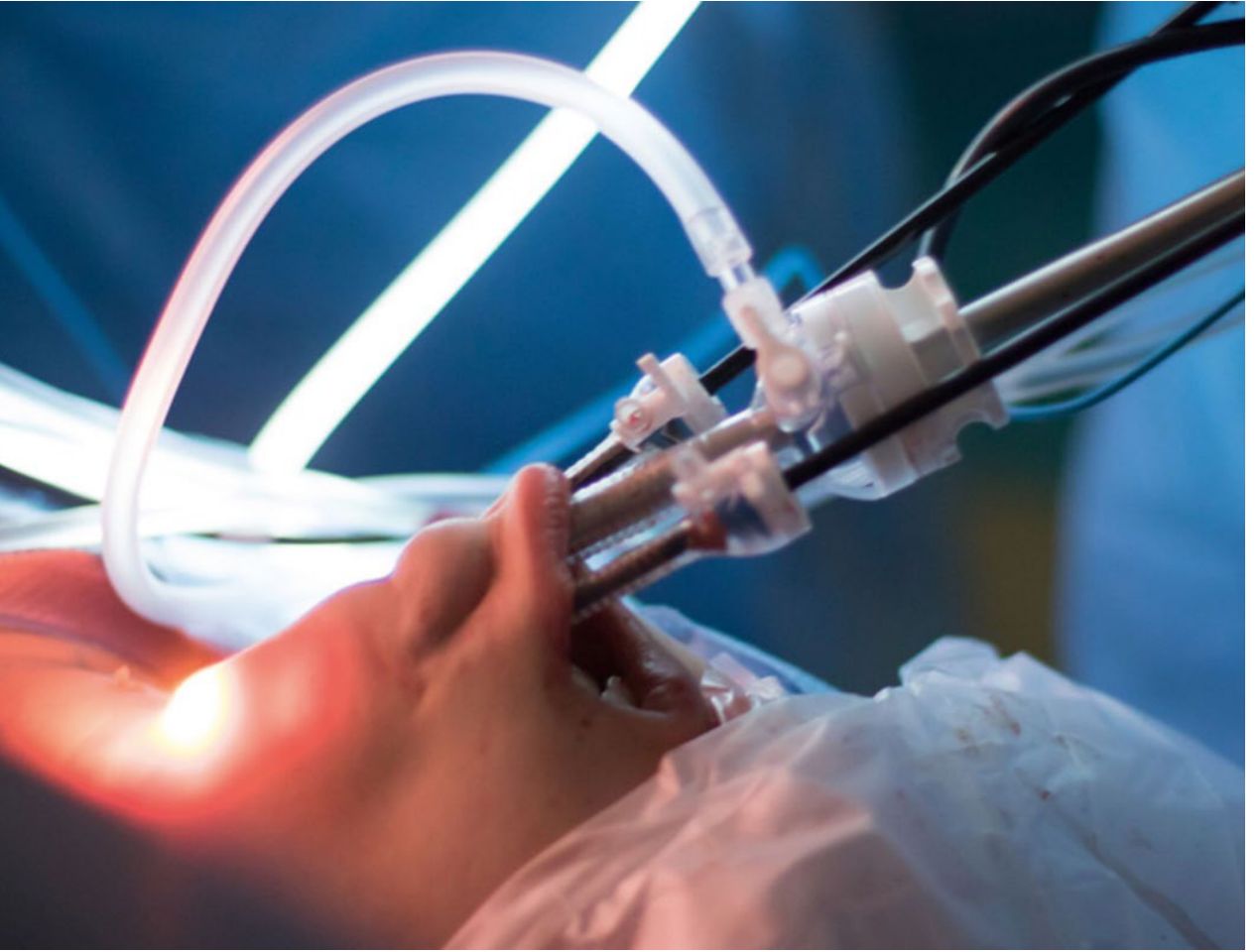
Three laparoscopic ports are placed in the oral vestibule and dissection is carried down to the subplatysmal plane in the neck.
Port Placement & Technique
Three small port incisions are made in the oral vestibule:
- One central port (midline) — for the 5 mm laparoscope
- Two lateral ports — for two handheld laparoscopic instruments
CO₂ insufflation (6–8 mmHg) creates and maintains the working space in the subplatysmal/sub-strap muscle plane. Dissection proceeds caudally to expose the thyroid, with identification of the recurrent laryngeal nerve (RLN) and parathyroid glands as in conventional thyroidectomy. — Sabiston Textbook of Surgery, 21st ed.
Variants
| Approach | Instruments | Key Feature |
|---|---|---|
| TOETVA | Laparoscope + 2 laparoscopic instruments | Shorter, less expensive |
| TORT (Single-port) | Robotic single-port system | Improved visualization & retraction |
| TORT (Multi-port) | Robotic multi-port system | Maximum dexterity |
The robot (TORT) provides improved visualization and retraction but at greater cost and operative time. Both TOETVA and TORT are considered safe options compared to conventional open thyroidectomy. Large-scale RCTs are needed to determine whether TORT's improved optics justify the added cost. — Sabiston Textbook of Surgery, 21st ed.
Indications (Selection Criteria)
Selection criteria have been kept deliberately conservative, especially during the early adoption phase, to protect patient safety:
- Benign thyroid nodules — symptomatic or cosmetically significant
- Well-differentiated (low-risk) thyroid cancer without extrathyroidal extension or lymph node metastasis
- Thyroid volume not excessively enlarged (generally < 10 cm in widest dimension)
- Patients who strongly prefer scar-free surgery (particularly Asian patients, among whom cosmetic neck scarring carries greater social significance)
- No prior neck surgery or radiation (relative contraindication)
Adoption is primarily occurring at larger, high-volume institutions with appropriate training, credentialing, and outcomes-tracking in place. — Sabiston Textbook of Surgery, 21st ed.; Current Surgical Therapy, 14th ed.
Advantages
- No visible cutaneous scar — the only remote access approach with true scarlessness
- Equivalent oncologic outcomes to open thyroidectomy in appropriately selected patients
- Less expensive and shorter operative time than robotic variants
- High patient satisfaction, particularly in young women and Asian patients
- Good visualization of the central neck via a direct inferior approach (unlike axillary approaches)
Complications
General thyroidectomy complications (same as open):
- RLN injury — transient or permanent; the largest series (425 patients, Thailand) reported zero permanent RLN injuries
- Hypoparathyroidism/hypocalcemia — zero permanent cases in the largest series
- Hematoma — 1 case requiring conversion to open thyroidectomy (0.24%)
- 3 intraoperative conversions to open thyroidectomy (0.7%) in the largest series
TOETVA-specific complications:
- Mental nerve palsy — the mental nerve (branch of the inferior alveolar nerve) runs in the dissection field near the chin; transient palsy occurred in 3/425 patients (0.7%) in the largest series. Manifests as paresthesia/numbness of the lower lip and chin.
- Oral/wound infection — theoretically higher due to oral flora contamination; in practice, infection rates have been very low with appropriate antibiotic prophylaxis and oral preparation
- CO₂ subcutaneous emphysema/CO₂ embolism — rare but described
- Skin perforation at the chin (if dissection is too superficial)
Comparison with Conventional Open Thyroidectomy
| Parameter | TOETVA | Open Thyroidectomy |
|---|---|---|
| Scar | None (scarless) | Visible cervical scar |
| Operative time | Longer | Shorter |
| RLN injury rate | Comparable | Comparable |
| Hypoparathyroidism | Comparable | Comparable |
| Approach-specific risk | Mental nerve palsy, infection | None |
| Cost | Higher than open, lower than robotic | Lowest |
| Patient satisfaction (cosmesis) | High | Moderate |
Training, Credentialing & Safe Adoption
With lessons learned from the turbulent rollout of robotic transaxillary thyroidectomy in the US (which led to brachial plexus injuries, FDA warnings in 2013, and withdrawal of manufacturer support), the introduction of TOETVA has been more structured:
- Emphasis on formal cadaveric and simulation training before clinical practice
- Proctored cases with experienced mentors
- Institutional credentialing requirements
- Centralised outcomes tracking (complication rates, conversion rates)
- Adoption restricted to high-volume thyroid surgery centres in the initial phase
— Sabiston Textbook of Surgery, 21st ed.; Current Surgical Therapy, 14th ed.
Current Status & Future Directions
TOETVA is increasingly adopted worldwide, especially in Asia (Thailand, South Korea, China) where cosmetic concerns around neck scars are culturally significant, and is establishing a growing niche in the US and Europe. The robotic TORT approach uses a single-port robotic system entering through the same oral vestibule, and while it offers superior optics and ergonomics, prospective RCTs comparing TOETVA to TORT are still awaited to clarify whether the added expense of robotics translates to measurably better clinical outcomes.
Remote access thyroidectomy (including TOETVA) has been shown to be safe and oncologically equivalent to conventional open thyroidectomy in appropriately selected patients with thyroid cancer. — Sabiston Textbook of Surgery, 21st ed.
Key Points for Exam:
- TOETVA = 3 ports in oral vestibule, laparoscopic, CO₂ insufflation, subplatysmal dissection
- Only remote access approach with no skin incision
- Approach-specific complication: mental nerve palsy
- Largest published series (425 patients, Thailand) — zero permanent RLN or parathyroid injury
- Robotic variant = TORT; same access, better optics, higher cost
- Selection criteria remain conservative; high-volume centres only
Sources: Sabiston Textbook of Surgery (21st ed.) — Chapters 10 & 73; Current Surgical Therapy (14th ed.) — Chapter on Technical Considerations of Thyroidectomy
This is a shared conversation. Sign in to Orris to start your own chat.