
Gallstones
Reading File
Finding Sources
Searching Images
gallstones cholelithiasis types pathology
Reading File
Reading File
Reading File
Reading File
Reading File
Reading File
Here is a comprehensive overview of gallstones (cholelithiasis):
Gallstones (Cholelithiasis)
More than 95% of biliary tract disease is attributable to gallstones. They affect 10–20% of adults in the US, Canada, and Europe — an estimated 20 million Americans — leading to over 700,000 cholecystectomies annually at a cost of ~$6 billion. — Robbins, Cotran & Kumar Pathologic Basis of Disease
Types of Gallstones
There are two main types:
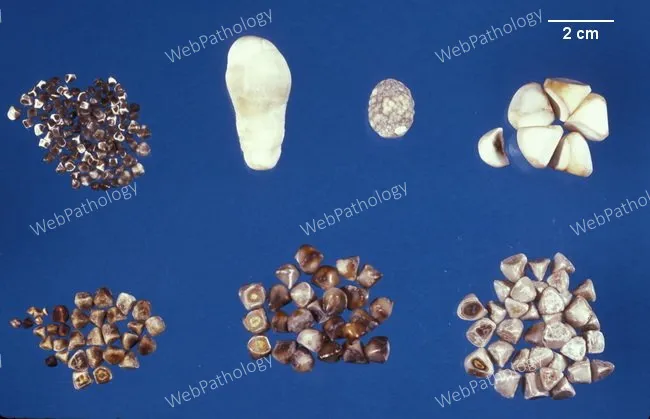
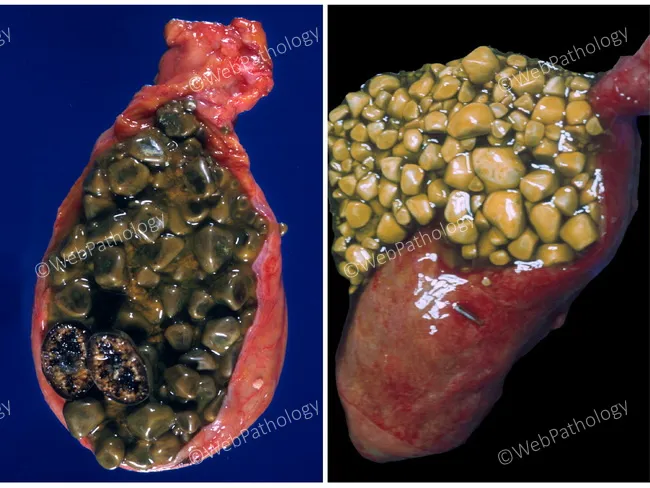
1. Cholesterol Stones (80–90% in Western populations)
- Contain >50% crystalline cholesterol monohydrate
- Appearance: Pale yellow, ovoid, firm; with increasing calcium carbonate/bilirubin content, become gray-white to black; often multiple with faceted surfaces
- Radiolucent in most cases; ~10–20% are radiopaque (due to calcium carbonate)
- Arise exclusively in the gallbladder
2. Pigment Stones
- Made of insoluble calcium bilirubinate salts
- Black stones: Found in sterile gallbladder bile; small, numerous, friable; 50–75% radiopaque
- Brown stones: Found in infected bile ducts; soft, greasy/soaplike; radiolucent; contain calcium soaps from bacterial phospholipase activity
Pathogenesis
Cholesterol Stones — 4 key mechanisms:
- Supersaturation of bile with cholesterol — bile's solubilizing capacity (via bile salts + lecithin micelles) is overwhelmed
- Gallbladder hypomotility (stasis) — promotes crystal nucleation
- Accelerated cholesterol crystal nucleation
- Mucus hypersecretion — traps nucleated crystals, promoting stone growth
Pigment Stones:
- Chronic hemolytic anemia → increased conjugated bilirubin secretion → ~1% deconjugated in biliary tree → calcium bilirubinate precipitates
- Biliary infection (E. coli, Ascaris lumbricoides, liver fluke C. sinensis) → bacterial β-glucuronidases hydrolyze bilirubin glucuronides → free unconjugated bilirubin precipitates
- Ileal dysfunction/Crohn's disease → altered enterohepatic cycling of bilirubin
- Cirrhosis → reduced bile salt synthesis impairs bilirubin solubilization
Risk Factors
| Cholesterol Stones | Pigment Stones |
|---|---|
| Advancing age | Chronic hemolytic anemia (sickle cell, hereditary spherocytosis) |
| Female sex | Biliary infection |
| Oral contraceptives / pregnancy | Ileal disease (Crohn's), ileal resection |
| Obesity, metabolic syndrome | Cystic fibrosis with pancreatic insufficiency |
| Rapid weight loss | Liver flukes, E. coli |
| Gallbladder stasis | |
| Dyslipidemia | |
| Inborn bile acid metabolism disorders | |
| ABCG8 gene variants |
Genetics: ~25% of cholelithiasis risk is genetically determined. A common variant of the ABCG8 sterol transporter gene is strongly associated with cholesterol gallstones.
Clinical Features
- 70–80% are asymptomatic for decades
- Biliary colic: Right upper quadrant or epigastric pain, often severe and constant (>6 hours); triggered by fatty meals that induce gallbladder contraction against an obstructing stone
- Larger stones are paradoxically less likely to cause cystic or common duct obstruction; smaller stones pass and can obstruct
Complications:
- Acute cholecystitis — 90% precipitated by cystic duct obstruction by a stone; chemical irritation → mucosal injury (lysolecithins, detergent bile salts, prostaglandins) → may progress to bacterial superinfection
- Empyema of the gallbladder
- Gangrenous/emphysematous cholecystitis
- Perforation and fistula formation
- Cholangitis (ascending biliary infection)
- Cholestasis and obstructive jaundice (stone in common bile duct = choledocholithiasis)
- Gallstone pancreatitis (ampullary obstruction)
- Gallstone ileus (fistula → bowel obstruction by large stone)
Diagnosis
- Ultrasound — first-line investigation; highly sensitive for gallbladder stones
- LFTs/bilirubin — elevated if common duct obstruction
- ALP — modestly elevated in cholecystitis
- Leukocytosis — in acute cholecystitis
Management
- Asymptomatic: Conservative/watchful waiting (70–80% never develop symptoms)
- Symptomatic / acute cholecystitis: Laparoscopic cholecystectomy — the definitive treatment; second most common non-obstetric surgery overall
- Pregnancy: Laparoscopic cholecystectomy preferred in the 1st–2nd trimester for symptomatic disease; associated with lower fetal/maternal complications than open surgery
- ERCP: For common bile duct stones (choledocholithiasis)
Sources: Robbins, Cotran & Kumar Pathologic Basis of Disease; Robbins & Kumar Basic Pathology; Sabiston Textbook of Surgery
This is a shared conversation. Sign in to Orris to start your own chat.