
Explain me 10 common heart diseases with ECG changes And ECG images of those diseases
Reading File
Finding Sources
Searching Images
ECG changes myocardial infarction ST elevation
Finding Sources
Searching Images
atrial fibrillation ECG irregularly irregular rhythm
Searching Images
complete heart block third degree AV block ECG
Searching Images
left ventricular hypertrophy ECG voltage criteria
Searching Images
ventricular tachycardia wide complex tachycardia ECG
Searching Images
Wolff-Parkinson-White syndrome delta wave short PR ECG
Searching Images
pericarditis saddle-shaped ST elevation ECG diffuse
Searching Images
right bundle branch block RBBB ECG RSR pattern V1
Searching Images
pulmonary embolism ECG S1Q3T3 right heart strain sinus tachycardia
Searching Images
hypertrophic cardiomyopathy ECG deep Q waves lateral leads
I now have excellent ECG images for all 10 conditions. Let me compile the comprehensive answer.Here is a comprehensive guide to 10 common heart diseases with their ECG changes and real ECG images:
10 Common Heart Diseases: ECG Changes & Images
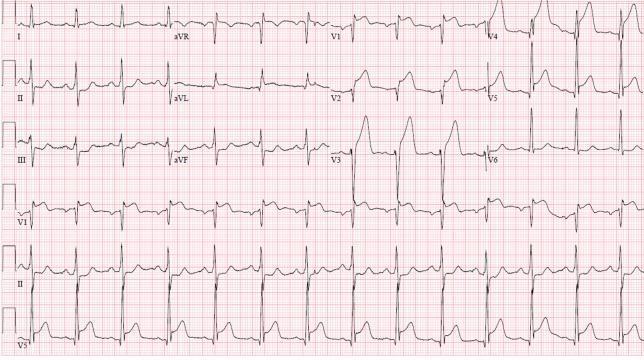
1. 🫀 ST-Elevation Myocardial Infarction (STEMI)
Disease Overview: Complete occlusion of a coronary artery causing transmural myocardial infarction.
ECG Changes:
- Hyperacute T waves — tall, peaked T waves (earliest sign)
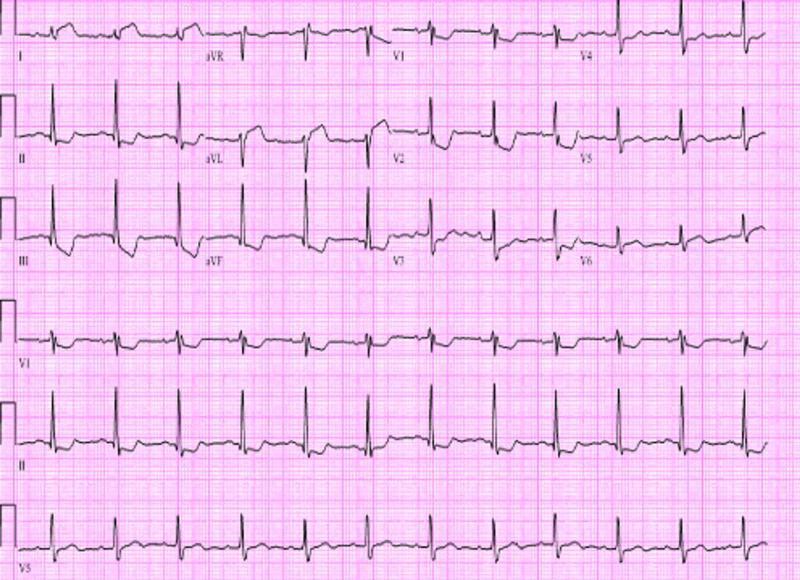
- ST-segment elevation ≥1 mm (limb leads) or ≥2 mm (precordial leads), convex/tombstone shape
- Reciprocal ST depression in mirror-opposite leads
- Pathological Q waves (≥40 ms wide, ≥25% of R wave height) — develop within hours
- T-wave inversion — evolves after the acute phase
- Lead distribution identifies the territory:
- V1–V4: Anterior (LAD occlusion)
- II, III, aVF: Inferior (RCA/LCx occlusion)
- I, aVL, V5–V6: Lateral (LCx occlusion)
ECG Image — Anterolateral STEMI (LAD occlusion):
ECG Image — Inferior STEMI (RCA/LCx occlusion):
2. 🌀 Atrial Fibrillation (AF)
Disease Overview: Chaotic, disorganized atrial electrical activity leading to irregular ventricular response. Most common sustained arrhythmia.
ECG Changes:
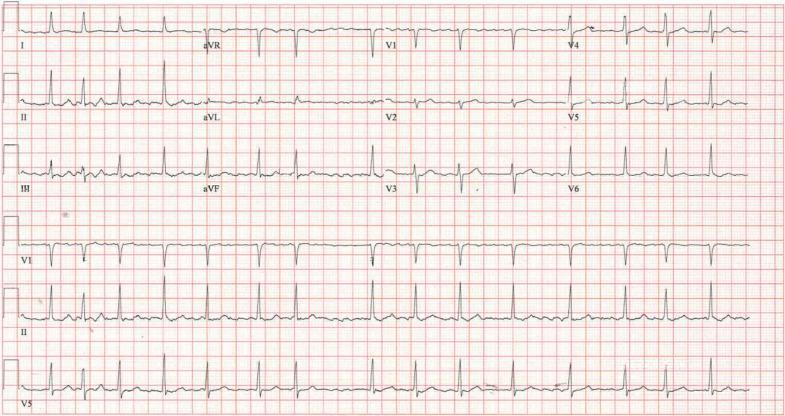
- Absent P waves — replaced by irregular fibrillatory (f) waves, best seen in V1 and II
- Irregularly irregular R-R intervals — the hallmark finding
- Narrow QRS (unless aberrant conduction or bundle branch block coexists)
- Ventricular rate variable: 60–170+ bpm depending on AV nodal conduction
- No organized atrial activity
ECG Image:
3. 💔 Complete (Third-Degree) AV Block
Disease Overview: Total failure of conduction from atria to ventricles through the AV node. Atria and ventricles beat completely independently.
ECG Changes:
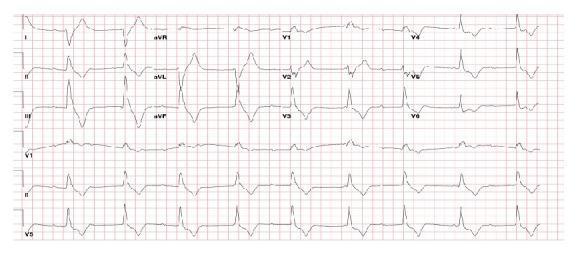
- Complete AV dissociation — P waves and QRS complexes march independently
- Regular P-P intervals (atrial rate 60–100 bpm)
- Regular but slow R-R intervals — ventricular escape rhythm
- Narrow QRS (40–60 bpm) if junctional escape; wide QRS (<40 bpm) if ventricular escape
- P waves "march through" QRS complexes and T waves
- No fixed PR interval
ECG Image:
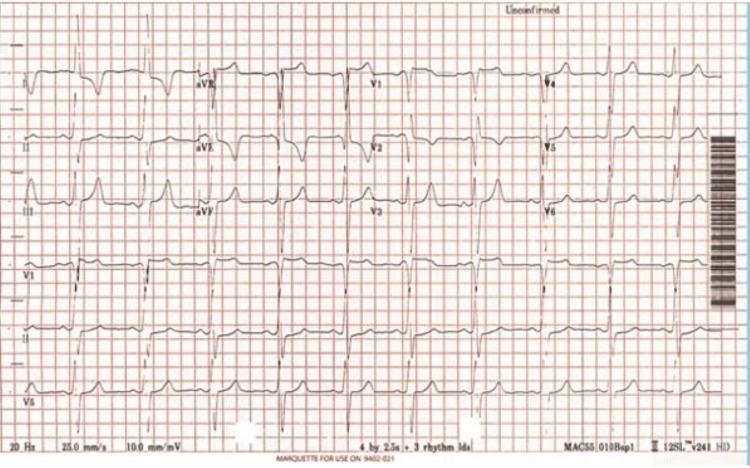
4. 🏋️ Left Ventricular Hypertrophy (LVH)
Disease Overview: Increased LV wall mass from chronic pressure/volume overload, most commonly due to hypertension or aortic stenosis.
ECG Changes:
- Sokolow-Lyon criteria: S in V1 + R in V5 or V6 ≥35 mm
- Cornell criteria: R in aVL + S in V3 >28 mm (men) or >20 mm (women)
- R in aVL ≥12 mm
- LV strain pattern: ST depression + T-wave inversion in lateral leads (I, aVL, V5–V6)
- Left axis deviation
- Prolonged QRS, P-wave changes (left atrial enlargement)
ECG Image:
5. ⚡ Ventricular Tachycardia (VT)
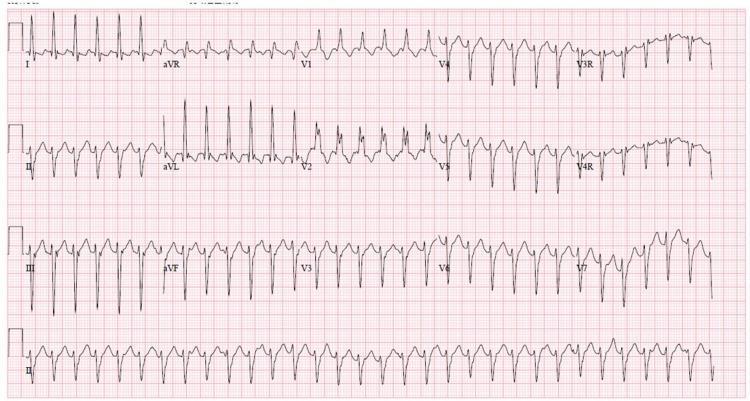
Disease Overview: Life-threatening arrhythmia originating from the ventricles. Rate >100 bpm (usually 150–250 bpm). Can degenerate into ventricular fibrillation.
ECG Changes:
- Wide QRS complexes (>120 ms), usually >140 ms — bizarre morphology
- Regular rapid rate — typically 150–250 bpm
- AV dissociation — P waves independent of QRS (when visible)
- Fusion beats and capture beats (pathognomonic when present)
- Concordance — all precordial leads positive or all negative
- Northwest axis (extreme left axis deviation, negative in I and aVF)
- No preceding P waves
ECG Image:
6. 🔌 Wolff-Parkinson-White (WPW) Syndrome
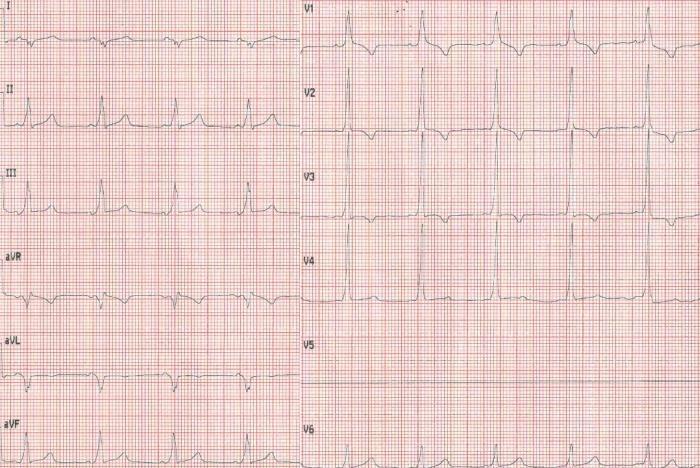
Disease Overview: Accessory conduction pathway (Bundle of Kent) bypasses the AV node, causing ventricular pre-excitation. Risk of sudden cardiac death from rapid conduction in AF.
ECG Changes:
- Short PR interval (<120 ms) — bypasses AV nodal delay
- Delta wave — slurred slow upstroke at the start of QRS
- Wide QRS complex (>110 ms) due to fusion of delta wave and normal conduction
- Secondary ST-T changes — discordant repolarization
- Pseudoinfarction Q waves in some leads (from negative delta waves)
- Accessory pathway location can be determined by delta wave polarity
ECG Image:
7. 🫁 Acute Pericarditis
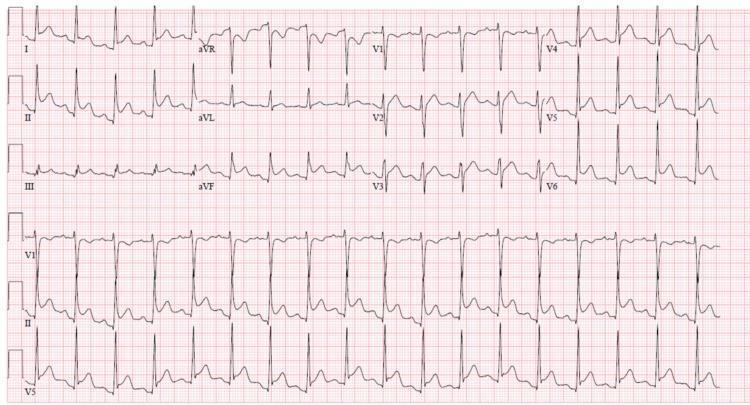
Disease Overview: Inflammation of the pericardium, commonly from viral infection. Presents with sharp pleuritic chest pain relieved by sitting forward.
ECG Changes (4 stages):
- Stage 1 (acute): Diffuse concave "saddle-shaped" ST elevation in all leads except aVR and V1; PR depression in most leads (highly specific); reciprocal ST depression + PR elevation in aVR
- Stage 2: ST normalizes, T waves flatten
- Stage 3: Diffuse T-wave inversion
- Stage 4: Resolution
- Spodick's sign — downsloping TP segment (subtle but specific)
- Unlike STEMI: involves multiple territories, no reciprocal ST depression (except aVR), no Q waves
ECG Image:
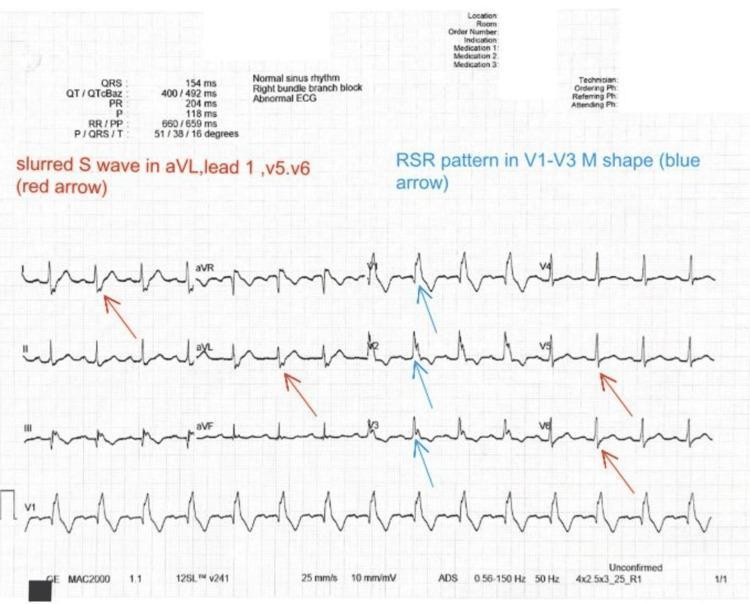
8. 🫀 Right Bundle Branch Block (RBBB)
Disease Overview: Conduction delay/block in the right bundle branch. Can be normal variant or indicate right heart disease, pulmonary hypertension, ASD, or ischemia.
ECG Changes:
- Wide QRS ≥120 ms (complete RBBB); 100–119 ms = incomplete RBBB
- RSR' pattern ("rabbit ears") in V1–V3 — classic finding
- Wide, slurred S waves in I, aVL, V5–V6 — delayed terminal depolarization
- T-wave inversion in V1–V3 — secondary repolarization change (not ischemia)
- Normal or right axis deviation
- Septal Q waves preserved in lateral leads
ECG Image:
9. 🩸 Pulmonary Embolism (PE)
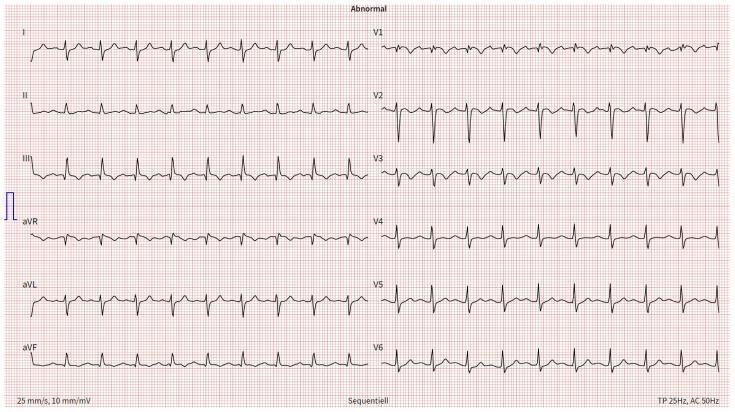
Disease Overview: Acute obstruction of the pulmonary arterial tree causing acute right heart strain. ECG changes reflect acute RV pressure overload.
ECG Changes:
- Sinus tachycardia — most common finding (>70% of cases)
- S1Q3T3 pattern — S wave in lead I, Q wave in lead III, T-wave inversion in lead III (classic but present only ~20%)
- Incomplete or complete RBBB — from RV strain
- T-wave inversions in V1–V4 — right ventricular strain pattern
- Right axis deviation
- P pulmonale — tall peaked P wave in II (>2.5 mm) from right atrial overload
- Sinus tachycardia is the most sensitive finding; S1Q3T3 is specific but insensitive
ECG Image:
10. 🧬 Hypertrophic Cardiomyopathy (HCM)
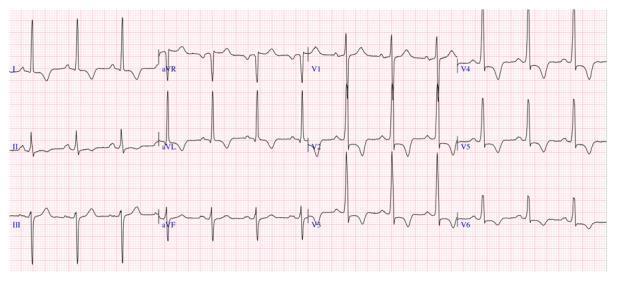
Disease Overview: Genetic sarcomeric protein mutation causing asymmetric LV hypertrophy (particularly the septum). Leading cause of sudden cardiac death in young athletes.
ECG Changes:
- LVH voltage criteria (Sokolow-Lyon, Cornell) — most common finding
- Deep T-wave inversions in lateral leads (I, aVL, V4–V6) — "giant" negative T waves in apical HCM (Yamaguchi variant, >10 mm)
- Pathological Q waves in lateral or inferior leads — from septal hypertrophy (not infarction)
- Left axis deviation
- ST depression with strain pattern
- Absent normal septal Q waves in V5–V6 (paradoxical)
- Resting ECG is abnormal in >90% of HCM patients
ECG Image:
Quick Reference Summary Table
| # | Disease | Key ECG Finding | Hallmark |
|---|---|---|---|
| 1 | STEMI | ST elevation + Q waves | Convex ST elevation, territory-specific |
| 2 | Atrial Fibrillation | Absent P waves + irregular rhythm | Irregularly irregular RR |
| 3 | Complete AV Block | AV dissociation | P waves independent of QRS |
| 4 | LVH | High voltage + strain | S(V1) + R(V5) ≥35 mm |
| 5 | Ventricular Tachycardia | Wide QRS tachycardia | AV dissociation, concordance |
| 6 | WPW Syndrome | Short PR + delta wave | Slurred QRS onset |
| 7 | Acute Pericarditis | Diffuse ST elevation | PR depression + saddle shape |
| 8 | RBBB | RSR' in V1 | Wide S waves in I, V5–V6 |
| 9 | Pulmonary Embolism | S1Q3T3 + sinus tach | Right heart strain pattern |
| 10 | HCM | LVH + giant T inversions | Deep T-wave inversions ± Q waves |
Clinical Pearl: Always interpret ECGs in clinical context. Many patterns overlap — for example, STEMI vs. pericarditis both show ST elevation, but pericarditis is diffuse with saddle-shape and PR depression, while STEMI is territory-specific and convex.Each section above includes a real 12-lead ECG from the medical literature with annotated findings. Here's a brief orientation to use this guide effectively:
How to read each ECG image: Every image is drawn from peer-reviewed clinical/educational sources and is described in detail — look for the specific features called out in the ECG changes section above each image (e.g., the slurred delta wave in WPW, the saddle-shaped ST in pericarditis, the RSR' pattern in RBBB).
Key differentials to keep in mind:
- Wide QRS tachycardia → always assume VT until proven otherwise
- Diffuse ST elevation → pericarditis (saddle shape + PR depression) vs. STEMI (convex, territory-specific)
- Short PR + wide QRS → WPW vs. LBBB (no delta wave in LBBB)
- Irregular rhythm → AF (no P waves) vs. multiple PACs/PVCs (P waves present but abnormal)
This is a shared conversation. Sign in to Orris to start your own chat.