
Drugs for diabetic mellitus
I'll start by reading the medical library skill, then search for comprehensive information on diabetes mellitus drugs.
Searching sources...
Reading File
Now I'll run parallel searches across the medical library and PubMed simultaneously.
Finding Sources
Searching PubMed
"diabetes mellitus" AND "antidiabetic drugs" AND management
Finding Sources
Finding Sources
I found good sources. Let me read the key pharmacology sections from Goodman & Gilman and Lippincott in parallel.
Reading File
Reading File
Excellent content found. Let me read more from Goodman & Gilman (the main pharmacology sections on GLP-1, SGLT2, DPP-4, TZDs, etc.) and also from Lippincott Pharmacology.
Reading File
Finding Sources
I now have very comprehensive data from Goodman & Gilman. The truncated output contains most of the key drug classes. Let me fetch a bit more to capture insulin preparations and the overview chart, and also the Lippincott content.
Reading File
Reading File
I now have very comprehensive content. Let me fetch a diagram image from Lippincott and also read the insulin section from Goodman & Gilman.
Reading File
Reading File
I now have comprehensive information from authoritative sources. Let me fetch the key diagram images to include visuals in my answer.
Loading Image
I now have all the information needed for a comprehensive, well-organized answer. Let me compile it.
Drugs for Diabetes Mellitus
Antidiabetic drugs are broadly divided into insulin and non-insulin agents (oral + injectable). The choice depends on diabetes type, degree of hyperglycemia, comorbidities (especially CV disease, HF, CKD), and individual patient factors.
1. INSULIN
Insulin is the primary treatment for Type 1 DM and is also used in Type 2 DM when oral agents fail or in hospitalized/critically ill patients.
Insulin Preparations by Duration of Action
| Type | Examples | Onset | Peak | Duration |
|---|---|---|---|---|
| Rapid-acting | Lispro, Aspart, Glulisine | 5-15 min | 30-90 min | 3-5 h |
| Short-acting (Regular) | Regular insulin | 30-45 min | 2-4 h | 5-8 h |
| Intermediate-acting | NPH (Isophane) | 2-4 h | 4-10 h | 10-16 h |
| Long-acting | Glargine, Detemir, Degludec | 1-2 h | Peakless | 20-24 h |
Key points:
- Rapid-acting analogues (lispro, aspart, glulisine): Inject 15 min before a meal. Lower postprandial hypoglycemia risk vs. regular insulin. They dissociate into monomers rapidly, enabling fast absorption. - Goodman & Gilman's Pharmacological Basis of Therapeutics, p. 1050
- Regular insulin: Must be injected 30-45 min before meals. The only form suitable for IV infusion (100 units/mL). - Goodman & Gilman, p. 1050
- NPH insulin: Cloudy suspension with zinc and protamine; usually given once or twice daily with short-acting insulin.
- Insulin glargine: Clear solution (pH 4.0), forms a precipitate at subcutaneous neutral pH giving prolonged "peakless" action. Cannot be mixed with other insulins. - Goodman & Gilman, p. 1051
- Insulin detemir: Binds albumin at injection site, contributing to its prolonged action.
Hospitalized patients: Insulin is the cornerstone; target glucose 140-180 mg/dL for most, 110-140 mg/dL for some critically ill patients. Sliding-scale-only regimens are less effective than scheduled basal-bolus regimens. - Goodman & Gilman, p. 1053
2. INSULIN SECRETAGOGUES
A. Sulfonylureas (2nd Generation preferred)
Drugs: Glimepiride, Glipizide, Glyburide (glibenclamide)
Mechanism: Block ATP-sensitive K⁺ (KATP) channels on beta-cell membrane → depolarization → Ca²⁺ influx → exocytosis of insulin. - Lippincott Illustrated Reviews: Pharmacology, p. 813
Pharmacokinetics:
- Oral, 90-99% protein bound, hepatically metabolized, renally excreted
- Duration 12-24 hours (can dose once daily)
- Half-life is short (3-5 h) but hypoglycemic effect lasts 12-24 h
Uses: Type 2 DM; 50-80% of patients respond. May fail over time (secondary failure due to progressive beta-cell loss).
Adverse effects: Hypoglycemia (most important), weight gain (1-3 kg)
Contraindications: Type 1 DM, pregnancy, hepatic/renal insufficiency. Glyburide is generally avoided due to higher hypoglycemia risk. Glipizide and glimepiride are safer in renal impairment and elderly. - Lippincott, p. 813
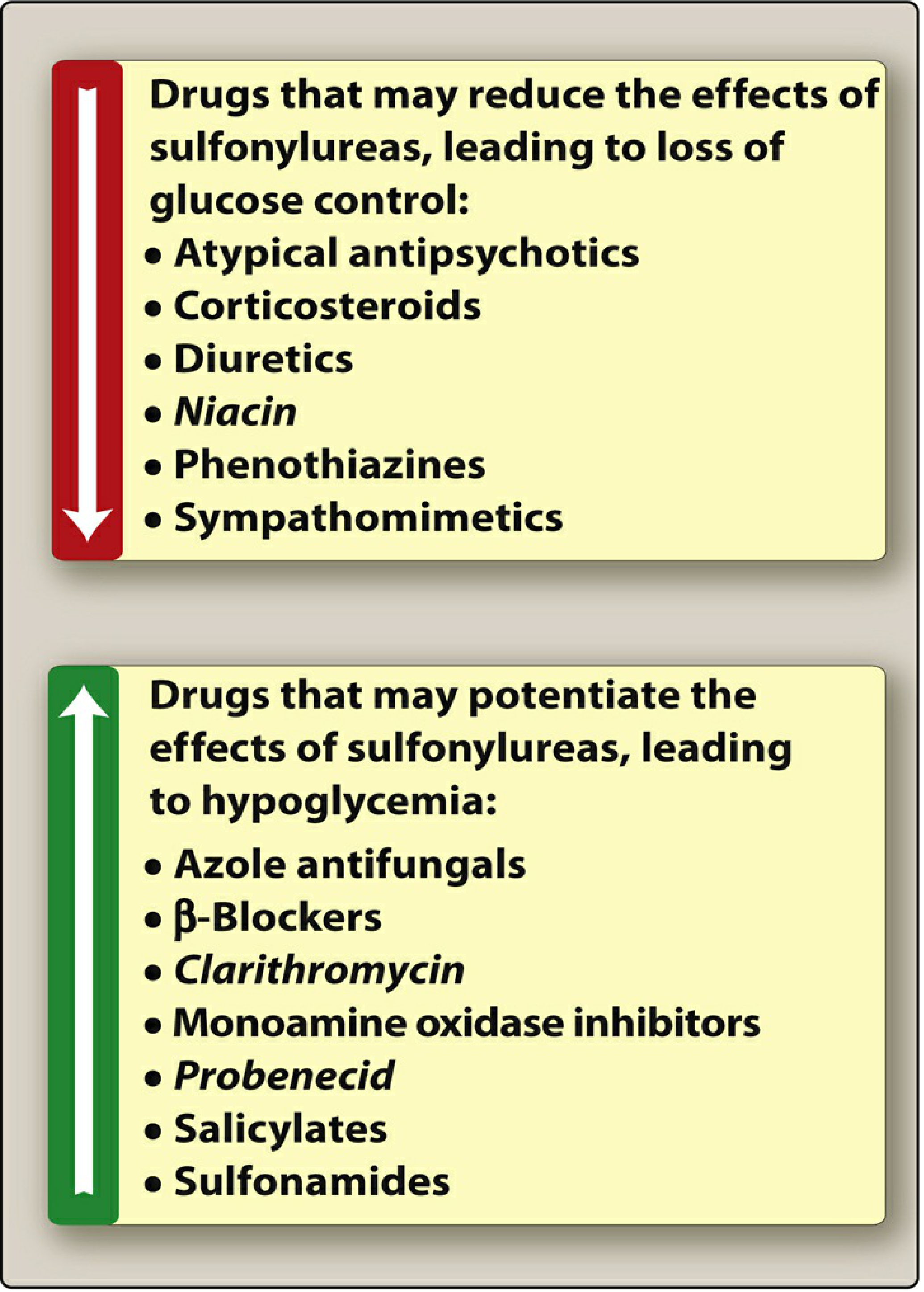
Drug interactions (see diagram below):
B. Meglitinides (Non-sulfonylurea secretagogues)
Drugs: Repaglinide, Nateglinide
Mechanism: Also close KATP channels on beta cells, but with rapid onset and shorter duration - classified as postprandial glucose regulators.
PK: Taken just before meals. Metabolized by CYP2C8/3A4 (repaglinide) and CYP2C9/3A4 (nateglinide).
Adverse effects: Hypoglycemia (less than sulfonylureas), weight gain.
Note: Do NOT combine with sulfonylureas (overlapping mechanism, increased hypoglycemia risk). - Lippincott, p. 815
3. BIGUANIDES
Drug: Metformin (first-line for Type 2 DM)
Mechanism: Primarily reduces hepatic gluconeogenesis (decreases hepatic glucose output). Also improves peripheral insulin sensitivity. Does NOT stimulate insulin secretion. - Ganong's Review of Medical Physiology, p. ~2065
Advantages:
- No hypoglycemia (does not raise insulin)
- Weight neutral or modest weight loss
- Cardiovascular benefit (UKPDS data)
- Low cost
Adverse effects:
- GI side effects (nausea, diarrhea) - take with food
- Lactic acidosis (rare but serious)
- Vitamin B12 deficiency with long-term use
Contraindications: eGFR <30 mL/min (hold if eGFR 30-45), hepatic disease, severe heart failure, IV contrast procedures (hold temporarily), alcohol abuse. - Goodman & Gilman, p. 1054
4. THIAZOLIDINEDIONES (TZDs / Glitazones)
Drugs: Pioglitazone, Rosiglitazone
Mechanism: Agonist at PPAR-γ (peroxisome proliferator-activated receptor gamma) → enhances insulin sensitivity in liver, adipose tissue, and skeletal muscle. Require endogenous insulin to work. - Goodman & Gilman, p. 1056
Uses: Type 2 DM; reduce A1c by 0.5-1.4%. Effective as monotherapy or in combination with metformin, sulfonylureas, or insulin.
Lipid effects:
- Pioglitazone: Reduces triglycerides by 10-15%, raises HDL. PPAR-α partial agonism.
- Rosiglitazone: Minimal effect on TG; may raise LDL.
Adverse effects:
- Weight gain (2-4 kg in first year) and edema
- Fluid retention → risk of heart failure (up to 2-fold increase)
- Increased risk of osteoporotic fractures
- Macular edema
Contraindications: Symptomatic/moderate-to-severe heart failure, active hepatic disease. - Lippincott, p. 820
5. GLP-1 RECEPTOR AGONISTS (Incretin Mimetics)
Drugs: Semaglutide, Liraglutide, Dulaglutide, Exenatide, Lixisenatide, Albiglutide
Mechanism: Mimic endogenous GLP-1 hormone:
- Stimulate glucose-dependent insulin secretion from beta cells
- Suppress glucagon secretion (postprandial)
- Slow gastric emptying
- Reduce food intake (enhance satiety)
- Promote beta-cell proliferation
Route: All are injectable (subcutaneous); semaglutide is also available orally (Rybelsus).
Dosing frequency:
- Daily: Exenatide (twice daily), Liraglutide, Lixisenatide
- Weekly: Semaglutide, Dulaglutide, Exenatide extended release
Advantages:
- Weight loss (significant with semaglutide and liraglutide)
- No hypoglycemia as monotherapy
- Cardiovascular and renal benefits (liraglutide: LEADER trial; semaglutide: SUSTAIN-6) - especially in patients with established ASCVD or high CV risk
Adverse effects: Nausea, vomiting, constipation (most common); risk of pancreatitis; contraindicated in personal/family history of medullary thyroid carcinoma or MEN-2. - Lippincott, p. 820-821
6. DPP-4 INHIBITORS (Gliptins)
Drugs: Sitagliptin, Saxagliptin, Alogliptin, Linagliptin
Mechanism: Inhibit dipeptidyl peptidase-4, the enzyme that degrades endogenous incretins (GLP-1 and GIP) → prolongs their action → glucose-dependent insulin release and reduced glucagon secretion. - Goodman & Gilman, p. 1058
Key features:
- Oral, once daily
- Weight neutral
- Low hypoglycemia risk
- Well tolerated
Adverse effects: Nasopharyngitis, possible increased risk of heart failure (saxagliptin - SAVOR-TIMI trial caution), possible pancreatitis (rare).
Renal dosing: Most require dose adjustment in CKD, except linagliptin (excreted mainly via bile/feces).
7. SGLT2 INHIBITORS (Gliflozins)
Drugs: Empagliflozin, Canagliflozin, Dapagliflozin, Ertugliflozin
Mechanism: Inhibit sodium-glucose cotransporter 2 (SGLT2) in the proximal tubule of the kidney → prevents renal glucose reabsorption → increases urinary glucose excretion (glucosuria). Insulin-independent mechanism. - Lippincott, p. 822
Advantages (beyond glucose lowering):
- Weight loss (caloric loss via glycosuria)
- Blood pressure reduction (osmotic diuresis)
- Cardiovascular benefit: Empagliflozin (EMPA-REG OUTCOME), canagliflozin (CANVAS) - reduce CV mortality and HF hospitalization
- Renal protection: Delay progression of diabetic kidney disease
- Heart failure with reduced EF (HFrEF): Dapagliflozin (DAPA-HF), empagliflozin (EMPEROR-Reduced) - benefit even without diabetes
Adverse effects:
- Genital mycotic infections (candidiasis - most common)
- Urinary tract infections
- Urinary frequency/polyuria
- Euglycemic DKA (rare but serious, especially in type 1 off-label use)
- Canagliflozin: increased risk of lower limb amputations and bone fractures
Contraindications: eGFR <20-30 mL/min (glucose-lowering effect requires adequate GFR); Type 1 DM (risk of DKA). - Lippincott, p. 822
8. ALPHA-GLUCOSIDASE INHIBITORS
Drugs: Acarbose, Miglitol
Mechanism: Inhibit intestinal alpha-glucosidase enzymes → delay digestion and absorption of complex carbohydrates and sucrose → blunt postprandial glucose rise.
Adverse effects: GI - flatulence, bloating, diarrhea (common, limits use). Do not cause hypoglycemia as monotherapy.
9. OTHER AGENTS
- Colesevelam (bile acid sequestrant): Reduces A1c by ~0.5% as adjunct to metformin; also lowers LDL.
- Bromocriptine (dopamine agonist): Approved for Type 2 DM; modest A1c reduction.
- Pramlintide (amylin analogue): Injectable; used with insulin (both Type 1 and 2); suppresses glucagon, slows gastric emptying, reduces postprandial glucose. - Goodman & Gilman, p. 1060
10. TREATMENT APPROACH SUMMARY
| Clinical Situation | Preferred Drug(s) |
|---|---|
| Type 1 DM | Insulin (mandatory) |
| Type 2 DM - First line | Metformin |
| T2DM + Established CVD/high CV risk | Add GLP-1 agonist or SGLT2 inhibitor |
| T2DM + Heart failure | Add SGLT2 inhibitor (especially dapagliflozin, empagliflozin) |
| T2DM + CKD | Add SGLT2 inhibitor (renal protection) |
| T2DM + Obesity | GLP-1 agonist (semaglutide, liraglutide) |
| Postprandial hyperglycemia | Meglitinides, acarbose, rapid-acting insulin |
| Hospitalized patients | Insulin (IV or subcutaneous basal-bolus) |
Sources:
- Goodman & Gilman's The Pharmacological Basis of Therapeutics, 16th Ed., Chapter 51 (Insulin, Sulfonylureas, GLP-1 agonists, TZDs, SGLT2i)
- Lippincott Illustrated Reviews: Pharmacology, Chapter 24 (Antidiabetic drugs, pp. 813-824)
- Ganong's Review of Medical Physiology, 26th Ed., Chapter 24 (Oral hypoglycemic agents)
- Costanzo Physiology, 7th Ed., Chapter 4 (Pathophysiology of insulin)
This is a shared conversation. Sign in to Orris to start your own chat.