
Compartment syndrome
Reading File
Compartment syndrome is a condition where pressure within a closed muscle compartment rises to a level that impairs tissue perfusion, leading to ischemia and potential necrosis if untreated. It can be acute (surgical emergency) or chronic (exertional). Key causes include fractures, crush injuries, burns, and tight casts.
Searching sources...
Finding Sources
Searching PubMed
"compartment syndrome" AND management
Good. Now let me read the two most comprehensive sources - Bailey & Love (surgical) and Current Surgical Therapy.
Reading File
Reading File
Now let me read the Rosen's Emergency Medicine section and fetch the compartment anatomy diagram.
Reading File
Loading Image
Now let me read the dedicated Rosen's compartment syndrome chapter and the Roberts & Hedges clinical procedures section.
Reading File
Reading File
Let me now read the continuation of the Rosen's pathophysiology and management section, and the Bailey & Love section for the fasciotomy technique.
Reading File
Reading File
Let me now read the clinical presentation continuation and the management/fasciotomy details from Rosen's.
Reading File
Reading File
I now have comprehensive information from multiple authoritative sources. Let me compile the full answer.
Compartment Syndrome
Definition
Compartment syndrome is raised pressure within a closed osseofascial compartment to a level that compromises tissue perfusion, causing ischemia and, if untreated, irreversible nerve and muscle necrosis. - Bailey and Love's Short Practice of Surgery, 28th Ed.
Anatomy
The leg has four compartments and is the most commonly affected site. The forearm also has three compartments.
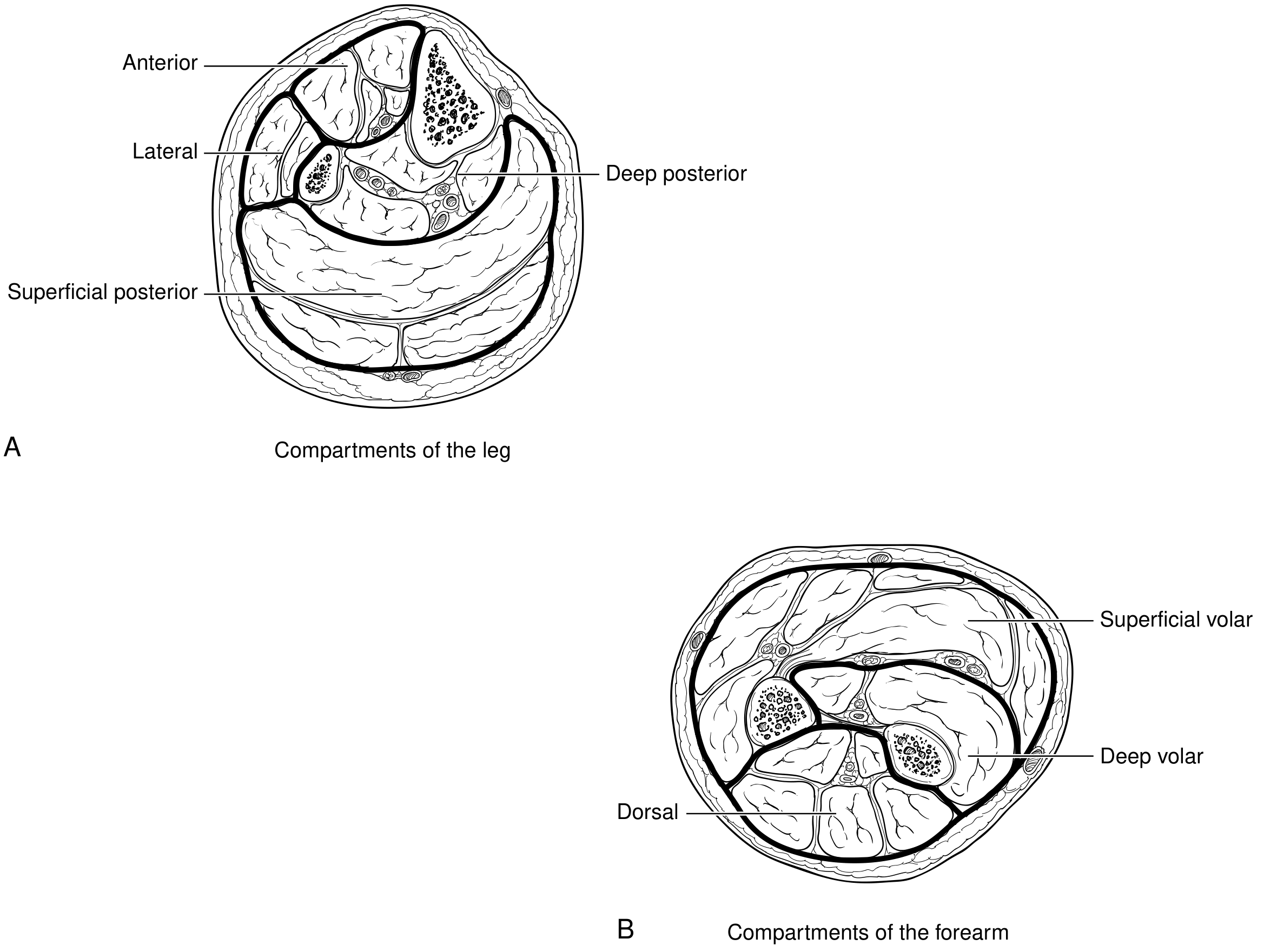
Leg compartments: Anterior, Lateral, Deep posterior, Superficial posterior
Forearm compartments: Superficial volar, Deep volar, Dorsal
Other reported sites include the thigh (quadriceps), buttock (gluteal), arm (biceps, deltoid), and hand (interosseous). - Rosen's Emergency Medicine, 9th Ed.
Causes
Compartment syndrome arises from one of three mechanisms:
Increased Compartment Contents
| Category | Examples |
|---|---|
| Fracture | Tibial shaft (most common, ~70% of cases), other long bone fractures |
| Soft tissue trauma | Crush injury, contusions (~23%) |
| Bleeding | Major vascular injury, coagulation disorders, anticoagulation therapy |
| Increased capillary filtration | Reperfusion after ischemia, arterial bypass grafting, embolectomy |
| Burns | Thermal, electrical (especially circumferential third-degree) |
| Muscle overuse | Exercise, seizures, eclampsia, tetany |
| Intravenous extravasation | Contrast under pressure, IV infiltration |
| Intraarterial drug injection | |
| Orthopedic surgery | Tibial osteotomy, ORIF of fractures |
Decreased Compartment Volume
- Closure of fascial defects
- Excessive traction on fractured limbs
External Pressure
-
Tight casts, dressings, or air splints
-
Prolonged lying on a limb (e.g., coma, lithotomy position, tuck position in lumbar surgery)
-
Rosen's Emergency Medicine, Box 41.3
Pathophysiology
Elevated compartment pressure increases local venous pressure, which reduces the arteriovenous gradient and compromises capillary perfusion. In response, histamine is released in an attempt to vasodilate - but this also increases capillary permeability, causing protein and fluid leak into the tissue, further raising compartment pressure in a vicious cycle.
As pressure rises further, venous outflow is impaired, then arterial capillary inflow ceases, resulting in ischemic necrosis of muscles and nerves.
Key pressure thresholds:
- Normal compartment pressure: 0 mmHg
- Microcirculation impairment begins at: ≥ 30 mmHg absolute pressure
- Critical threshold (delta pressure, ΔP): diastolic BP minus compartment pressure ≤ 30 mmHg - this is the more clinically relevant trigger for fasciotomy
- When compartment pressure equals diastolic BP: tissue perfusion effectively ceases
Important: Elevating the limb is counterproductive - it reduces local arterial pressure (~0.8 mmHg per 1 cm elevation) without meaningfully improving venous outflow, and worsens the arteriovenous gradient. - Rosen's Emergency Medicine
Clinical Features
Compartment syndrome is primarily a clinical diagnosis.
Early Signs (Reliable)
| Sign | Detail |
|---|---|
| Pain out of proportion | Hallmark - deep, burning, unrelenting, difficult to localize |
| Pain on passive stretch | Stretching muscles within the affected compartment worsens pain |
| Increasing pain | Escalating analgesic requirements should raise suspicion |
| Tense/tight compartment | Palpable firmness |
| Paraesthesia / hypoesthesia | In the distribution of nerves traversing the compartment |
Late Signs (Ominous - indicate irreversible damage)
| Sign | Significance |
|---|---|
| Paralysis | Late finding - irreversible muscle/nerve ischemia likely |
| Numbness | Late |
| Pallor | Late, unreliable - arterial pressure not yet exceeded |
| Pulselessness | Extremely late and ominous sign |
The classic "5 Ps" (pain, pallor, pulselessness, paresthesias, paralysis) actually describe acute arterial occlusion, not early compartment syndrome. Distal pulses may be entirely preserved even in severe compartment syndrome, since the compartment pressure required rarely reaches systemic arterial pressure. Do not be falsely reassured by the presence of pulses. - Rosen's Emergency Medicine
Special Situations
- Altered consciousness (head injury, intubation, sedation, coma): Clinical signs are unreliable. Pressure monitoring is mandatory.
- Open fractures: Do NOT assume an open wound prevents compartment syndrome. Higher energy of injury means open fractures actually have higher rates.
- High- and low-energy injuries: The incidence is nearly equal. Maintain suspicion regardless of injury mechanism.
Diagnostic Pressure Measurement
Indicated in:
- Diagnostic uncertainty
- Altered level of consciousness
- Intubated or uncooperative patients
Method: The Stryker Intra-Compartmental Pressure Monitor is the standard hand-held device. Zero the monitor at the same plane as the insertion site to account for gravity. Measure all compartments of the affected limb, at multiple sites near (but not in) the fracture zone.
Thresholds for fasciotomy:
- Absolute compartment pressure ≥ 30 mmHg
- ΔP (diastolic BP - compartment pressure) ≤ 30 mmHg (Bailey & Love) or ΔP < 10 mmHg (Current Surgical Therapy - in the context of post-vascular repair)
- High clinical suspicion even with normal pressures
Serial or continuous monitoring is superior to a single measurement. A hand-held Doppler is not useful - arterial flow may be detected even in severe compartment syndrome. CPK and myoglobinuria are late markers of tissue destruction and should not be used to establish the diagnosis. - Rosen's; Current Surgical Therapy 14e
Management
Immediate (Emergency) Measures
- Remove all circumferential constrictions - split casts, cut dressings down to skin
- Do NOT elevate the limb - keep at heart level or slightly dependent (reverse Trendelenburg) to maximize arterial inflow
- Urgent senior/surgical input
- IV access and analgesics
Definitive Treatment: Fasciotomy
Complete fasciotomy is the only reliable treatment. Fasciotomy should be performed without delay - delay causes irreversible myonecrosis and nerve damage.
Lower leg: Four-compartment fasciotomy via medial and lateral incisions.
Forearm: Release of volar (superficial + deep) and dorsal compartments. If swelling extends to the hand, carpal tunnel release and hand fasciotomies may be needed (hand surgery consultation).
Prophylactic fasciotomy is recommended after vascular revascularization in patients with:
- Prolonged ischemia (>6 hours)
- Limb edema after reperfusion
Fasciotomy wounds are left open. Vacuum-assisted closure (VAC) devices are applied postoperatively to reduce edema. Early closure must be avoided - it can cause muscle necrosis. - Current Surgical Therapy 14e
Complications of Delayed/Missed Diagnosis
| Complication | Notes |
|---|---|
| Irreversible myonecrosis | Occurs within hours |
| Nerve damage | Permanent sensory/motor loss |
| Volkmann's contracture | Ischemic contracture of forearm/hand muscles |
| Rhabdomyolysis | Elevated CK, hyperkalemia, myoglobinuria |
| Acute tubular necrosis / renal failure | From myoglobinuria - treat with IV fluids targeting urine output >100 mL/hr until CK < 5,000 U/L; consider urine alkalinization with bicarbonate |
| Infection / gangrene | Secondary to necrotic tissue |
| Amputation | May be required |
| Death |
A 2017 national closed-claims study found the mean malpractice indemnity for traumatic compartment syndrome was $987,716 USD, with delay in diagnosis alleged in 88% of cases. - Rosen's Emergency Medicine
Chronic Exertional Compartment Syndrome
A distinct entity, typically seen in athletes. Symptoms (pain, tightness, paresthesias) appear with exercise and resolve with rest. Diagnosis requires pressure measurement during and after exercise. Management is elective fasciotomy after conservative measures fail.
Key Takeaways
- Compartment syndrome is a clinical diagnosis - act on clinical suspicion, do not wait for pressure measurement
- Pain out of proportion + pain on passive stretch are the early, actionable signs
- Absent pulses and pallor are late, unreliable signs
- ΔP ≤ 30 mmHg (diastolic BP minus compartment pressure) is the pressure threshold that triggers fasciotomy
- Do not elevate the limb
- Fasciotomy without delay is the only definitive treatment
- Open fractures, altered consciousness, and anticoagulation are high-risk situations requiring extra vigilance
This is a shared conversation. Sign in to Orris to start your own chat.