
What is alt ast test for liver
ALT (Alanine Aminotransferase) and AST (Aspartate Aminotransferase) are enzymes found primarily in liver cells. When the liver is damaged, these enzymes leak into the bloodstream, causing elevated blood levels. They are measured together as part of a liver function panel to detect liver injury, inflammation, or disease. Normal ALT is roughly 7-56 U/L and AST 10-40 U/L, though ranges vary by lab.
Searching sources...
Reading File
Searching the Web
ALT AST liver function test interpretation
Finding Sources
Finding Sources
Reading File
Reading File
Reading File
I now have excellent textbook information to give a thorough answer. Let me also fetch the diagnostic decision tree image that appeared in the Tietz results.
Loading Image
Here is a complete, textbook-based explanation of ALT and AST liver tests:
ALT and AST - Liver Enzyme Tests
What They Are
ALT (Alanine Aminotransferase) and AST (Aspartate Aminotransferase) are enzymes normally found inside liver cells (hepatocytes). When liver cells are damaged, their plasma membranes break down and these enzymes leak into the bloodstream, causing measurable elevations in blood levels. They are the primary markers of hepatocyte integrity (cellular health).
- Robbins & Kumar Basic Pathology, Lab Tests section
Normal Reference Ranges
| Enzyme | Males | Females |
|---|---|---|
| ALT | 7-55 U/L | 7-45 U/L |
| AST | 8-48 U/L | 8-43 U/L |
- Robbins & Kumar Basic Pathology
Key Difference Between ALT and AST
| Feature | ALT | AST |
|---|---|---|
| Primary location | Liver only | Liver, heart, skeletal muscle, kidney, brain, red blood cells |
| Specificity for liver | More specific | Less specific |
| Duration elevated | Stays elevated longer | Returns to normal faster |
Because ALT is concentrated almost exclusively in the liver, it is the more liver-specific marker. AST can also rise from muscle damage (e.g., heart attack, intense exercise, myositis).
What the Ratio Tells You (AST:ALT Ratio)
This ratio is one of the most clinically useful aspects of these tests:
-
ALT >= AST (ratio < 1): Typical of viral hepatitis (hepatitis A, B, C) and most inflammatory liver diseases
-
AST > ALT (ratio > 2:1): Strongly suggests alcoholic liver disease - alcohol causes mitochondrial damage, and AST is also present in mitochondria, so it rises disproportionately
-
End-stage cirrhosis: Both enzymes may actually be LOW due to loss of hepatocytes (fewer cells left to release enzymes)
-
Goldman-Cecil Medicine, Laboratory Studies
What Elevated ALT/AST Can Mean
Hepatocellular causes (ALT/AST primarily elevated):
- Viral hepatitis (A, B, C, D, E)
- Alcoholic hepatitis
- Non-alcoholic fatty liver disease (NAFLD)
- Drug-induced liver injury (e.g., acetaminophen, statins, antibiotics)
- Autoimmune hepatitis
- Ischemic hepatitis ("shock liver")
- Wilson's disease, hemochromatosis
Non-hepatic causes of elevated AST:
- Heart attack (myocardial infarction)
- Skeletal muscle disease or trauma
- Intense exercise
- Hemolysis (red blood cell breakdown)
The Full Liver Panel - Context Matters
ALT and AST are always interpreted alongside other tests:
| Test | What It Assesses |
|---|---|
| ALT, AST | Hepatocyte integrity (cell damage) |
| Alkaline phosphatase (ALP) | Cholestasis (bile duct obstruction) |
| Gamma-GT (GGT) | Confirms liver origin when ALP is elevated |
| Bilirubin (conjugated) | Cholestasis, hepatocyte injury |
| Serum albumin | Liver synthetic capacity |
| Prothrombin time (PT/INR) | Liver synthetic capacity (most sensitive) |
- Symptom to Diagnosis, 4th Ed., Table 26-1
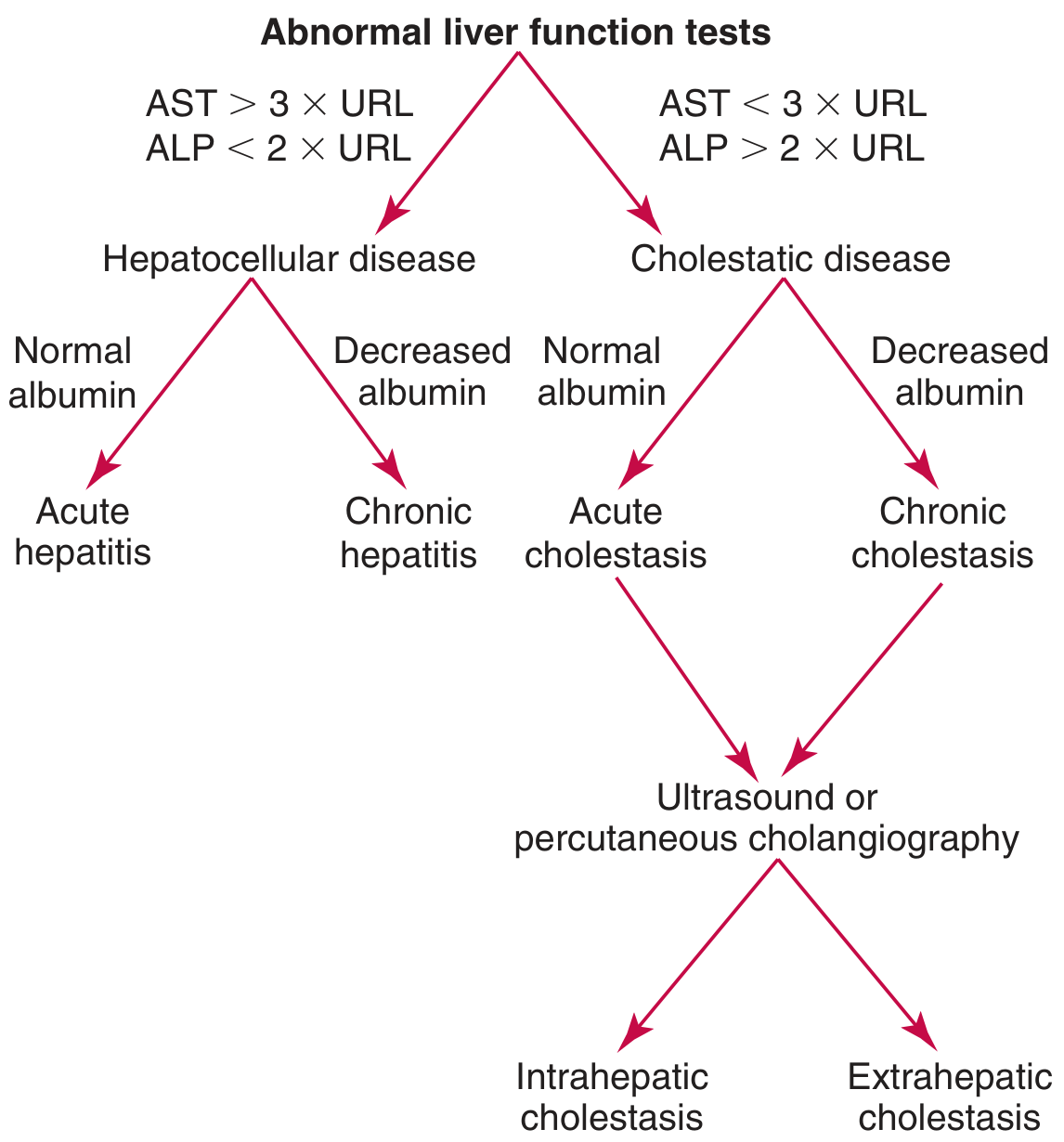
Diagnostic Decision Tree
When liver tests are abnormal, this framework helps identify the type of disease:
-
AST > 3x upper limit + ALP < 2x upper limit → Hepatocellular disease (hepatitis, alcoholic liver disease)
-
AST < 3x upper limit + ALP > 2x upper limit → Cholestatic disease (bile duct obstruction)
-
Then albumin helps distinguish acute vs. chronic forms
-
Tietz Textbook of Laboratory Medicine, 7th Ed.
Degree of Elevation - Clinical Significance
| Elevation Level | Likely Cause |
|---|---|
| Mild (< 3x normal) | Fatty liver, drug effect, thyroid disease |
| Moderate (3-10x) | Chronic hepatitis, alcoholic hepatitis |
| Marked (> 10x) | Acute viral hepatitis, ischemic hepatitis, drug toxicity |
| Massive (> 1000 U/L) | Acute acetaminophen toxicity, ischemic hepatitis, acute viral hepatitis |
Important Caveats
- Normal ALT/AST does not rule out liver disease - chronic hepatitis and cirrhosis can have normal or near-normal levels
- AST and ALT values have a skewed distribution in the population, so the "normal range" is not a perfect bell curve - some healthy individuals have mildly elevated levels
- In patients on renal dialysis, normal values are about half those in the general population, so elevations may be underestimated
- Both enzymes can be normal in burned-out cirrhosis when few hepatocytes remain
In summary, ALT and AST are the cornerstone blood tests for detecting liver cell damage. ALT is more liver-specific, while the AST:ALT ratio and the overall pattern of all liver tests together give the most diagnostic information about what kind of liver disease is present.
This is a shared conversation. Sign in to Orris to start your own chat.