
Tell me the detail of jantamycin. Its class of drug, its introduction, the mode of action, its pharmacol- pharmacological action, its pharmacokinetics, its therapeutic uses, side effects and contraindications.
Reading File
Now let me search the library for gentamicin (jantamycin is a brand/alternate spelling of gentamicin):
Finding Sources
Searching the Web
jantamycin gentamicin drug pharmacology mode of action pharmacokinetics uses side effects
Good. Now let me read the dedicated gentamicin sections from the pharmacology textbooks:
Finding Sources
Reading File
Reading File
Reading File
Reading File
Reading File
I now have comprehensive information. Let me compile the complete answer on Jantamycin (Gentamicin).
Jantamycin (Gentamicin) - Complete Pharmacological Profile
"Jantamycin" is a brand/trade name for Gentamicin, an aminoglycoside antibiotic widely used in clinical practice. Below is a detailed account of all its pharmacological aspects.
1. Drug Class
Gentamicin belongs to the aminoglycoside antibiotic class. Other members of this class include streptomycin, neomycin, kanamycin, tobramycin, amikacin, netilmicin, sisomicin, and arbekacin. All aminoglycosides share chemical, antimicrobial, pharmacologic, and toxic characteristics.
- Katzung's Basic and Clinical Pharmacology, 16th Ed.
2. Introduction
Gentamicin is a naturally occurring aminoglycoside antibiotic isolated from the bacterium Micromonospora purpurea (note: unlike most aminoglycosides derived from Streptomyces, gentamicin comes from Micromonospora, which is why its name ends in "-micin" rather than "-mycin"). It was patented in 1962 and approved for medical use in 1964. It is on the World Health Organization's List of Essential Medicines and remains one of the most clinically important aminoglycosides for treating serious gram-negative infections.
In concentrations of 0.5-5 mcg/mL, gentamicin is bactericidal for many gram-positive and gram-negative bacteria, including many strains of Proteus, Serratia, and Pseudomonas. It is ineffective against streptococci and Bacteroides species.
- Jawetz, Melnick & Adelberg's Medical Microbiology, 28th Ed.
3. Mode of Action (Mechanism of Action)
Gentamicin is an irreversible inhibitor of bacterial protein synthesis. The mechanism proceeds in steps:
Step 1 - Entry into the cell:
The drug initially undergoes passive diffusion via porin channels across the outer bacterial membrane. It is then actively transported across the cell membrane into the cytoplasm by an oxygen-dependent process. The transmembrane electrochemical gradient supplies the energy for this transport, which is coupled to a proton pump. This is why:
- Low extracellular pH and anaerobic conditions inhibit transport (reducing the gradient)
- Anaerobic bacteria are thus often resistant
- Cell wall-active drugs like penicillin or vancomycin enhance transport - the basis of synergy
Step 2 - Ribosomal binding and protein synthesis inhibition:
Inside the cell, aminoglycosides bind irreversibly to 30S ribosomal subunit proteins. Protein synthesis is inhibited by at least three mechanisms simultaneously:
- Interference with the initiation complex of peptide formation
- Misreading of mRNA, causing incorporation of incorrect amino acids into the peptide, resulting in nonfunctional proteins
- Breakup of polysomes into nonfunctional monosomes
The overall effect is irreversible and leads to cell death (bactericidal action).
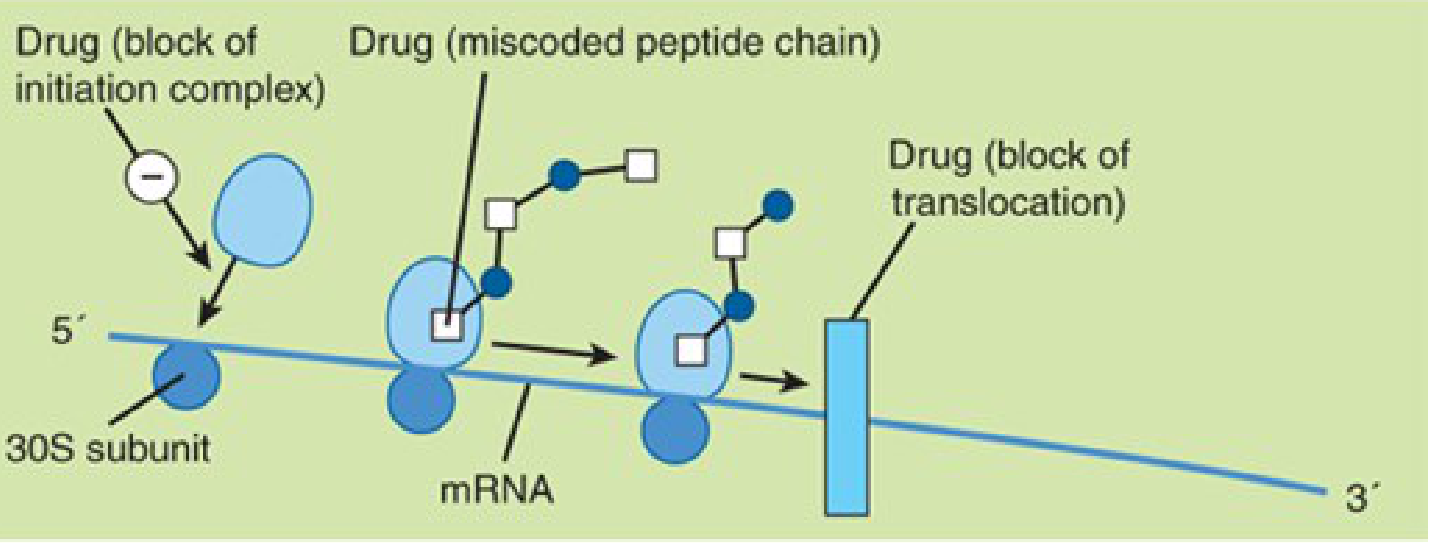
- Katzung's Basic and Clinical Pharmacology, 16th Ed.
4. Pharmacological Action
- Bactericidal action (not bacteriostatic) - kills bacteria rather than merely inhibiting growth
- Concentration-dependent killing: Higher peak concentrations produce greater bactericidal effect. This is the rationale for once-daily high-dose dosing.
- Postantibiotic effect (PAE): Significant PAE against gram-negative bacilli, meaning bacterial growth continues to be suppressed even after drug concentrations fall below the MIC
- Spectrum of activity: Primarily gram-negative aerobic bacteria - E. coli, Klebsiella, Proteus, Serratia, Pseudomonas aeruginosa, Enterobacter
- When combined with a penicillin or vancomycin, gentamicin can achieve synergistic bactericidal activity against gram-positive organisms (enterococci, viridans streptococci) - used in endocarditis treatment
- Inactive against anaerobes and most streptococci as monotherapy
5. Pharmacokinetics
| Parameter | Detail |
|---|---|
| Absorption (oral) | Very poorly absorbed from intact GI tract; almost entire oral dose excreted in feces. Can be absorbed if GI ulcerations are present. |
| Route of administration | IV (30-60 min infusion) or IM |
| IM absorption | Well absorbed; peak serum level in 30-90 minutes |
| Half-life | 2-3 hours (normal renal function); increases to 24-48 hours in significant renal impairment |
| Distribution | Highly polar - does not enter cells readily. Largely excluded from CNS and the eye. In active inflammation, CSF levels reach ~20% of plasma (higher in neonatal meningitis). |
| Tissue concentration | Not high in most tissues, except the renal cortex (where it accumulates - basis of nephrotoxicity). Bile levels: ~30% of blood. Pleural/synovial fluid with prolonged therapy: 50-90% of plasma. |
| Protein binding | Minimal |
| Metabolism | Not metabolized |
| Elimination | Primarily by glomerular filtration (unchanged); dosage must be reduced in renal failure |
| Hemodialysis removal | Partial and irregular (40-60% removed for gentamicin) |
| Dosing | Traditional: divided doses q8h; now often once-daily dosing preferred (takes advantage of concentration-dependent killing and PAE, with less toxicity) |
- Katzung's Basic and Clinical Pharmacology, 16th Ed.
6. Mechanisms of Resistance
Three principal mechanisms exist:
- Enzymatic inactivation - transferase enzymes inactivate gentamicin by adenylation, acetylation, or phosphorylation (most common clinically; plasmid-mediated)
- Impaired entry - mutation or deletion of porin proteins involved in transport, or absence of the oxygen-dependent electrochemical gradient
- Receptor alteration - mutation leading to deletion or modification of the receptor protein on the 30S ribosomal subunit
7. Therapeutic Uses
A. Primary Gram-Negative Infections:
- Serious infections caused by Pseudomonas aeruginosa, Proteus, Serratia, Klebsiella, E. coli, Enterobacter (especially resistant strains)
- Bacterial septicemia / sepsis
- Urinary tract infections (severe/complicated)
- Pneumonia in critically ill patients
- Intra-abdominal infections (combined with agents for anaerobes)
- Gastrointestinal and soft tissue infections
- Meningitis (requires intrathecal/intraventricular injection for adequate CSF levels)
B. Combination therapy:
- Enterococcal endocarditis: Gentamicin + ampicillin (or penicillin) - for synergistic bactericidal killing. Note: ampicillin + ceftriaxone is now preferred to reduce nephrotoxicity risk.
- Viridans streptococcal endocarditis: Gentamicin + penicillin for shortened therapy duration
C. Topical:
- Gentamicin sulfate 0.1% cream or solution for infected burns and skin lesions
- Eye drops/ointment for external ocular infections
D. Almost always used in combination with a beta-lactam antibiotic to broaden empiric coverage and exploit synergy, particularly in critically ill patients.
- Katzung's Basic and Clinical Pharmacology, 16th Ed.; Jawetz, Melnick & Adelberg's Medical Microbiology, 28th Ed.
8. Side Effects (Adverse Reactions)
A. Nephrotoxicity (most common serious toxicity)
- Accumulates in the renal cortex - causes tubular cell damage
- Presents as non-oliguric renal failure, rising serum creatinine, proteinuria, hematuria
- Usually reversible on discontinuation
- Risk increased by: pre-existing renal disease, prolonged therapy, high doses, concomitant nephrotoxic drugs (NSAIDs, vancomycin, cyclosporine, amphotericin B), volume depletion
B. Ototoxicity
- Vestibulotoxicity: Vertigo, loss of balance, nystagmus (more common with gentamicin)
- Cochleotoxicity / Auditory damage: Hearing loss (tinnitus, high-frequency hearing loss progressing to total deafness) - can be permanent
- Due to accumulation in the endolymph and perilymph of the inner ear; hair cell destruction
- Risk increased by: renal failure (drug accumulation), prolonged therapy, prior hearing loss, loop diuretics (furosemide - synergistic ototoxicity)
C. Neuromuscular Blockade
- Rarely: acute neuromuscular blockade leading to respiratory paralysis
- Can occur after rapid IV infusion or in patients with myasthenia gravis or hypomagnesemia
- Reversed by calcium gluconate or neostigmine
D. Hypersensitivity
- Uncommon with gentamicin (unlike streptomycin)
- Skin rashes, drug fever
E. Other
- Topical creams may select for gentamicin-resistant bacterial strains
9. Contraindications
| Contraindication | Reason |
|---|---|
| Known hypersensitivity to gentamicin or any aminoglycoside | Allergic reactions (cross-sensitivity within the class) |
| Pre-existing significant renal impairment (without dose adjustment and monitoring) | Nephrotoxicity risk and drug accumulation |
| Pre-existing auditory or vestibular damage | Worsening of ototoxicity |
| Myasthenia gravis | Risk of neuromuscular blockade and respiratory paralysis |
| Concurrent use of other nephrotoxic or ototoxic drugs | Additive toxicity (e.g., furosemide, amphotericin B, cisplatin, vancomycin without monitoring) |
| Pregnancy | Aminoglycosides cross the placenta; can cause irreversible bilateral congenital deafness in the fetus (teratogenic - Category D) |
| Oral use in patients with GI ulcerations | Systemic absorption occurs, leading to toxicity |
Precautions (dose adjustment required):
- Renal failure - reduce dose and/or extend interval; monitor drug levels
- Elderly patients - reduced renal clearance
- Neonates and infants - altered volume of distribution
Quick Summary
| Property | Detail |
|---|---|
| Class | Aminoglycoside antibiotic |
| Source | Micromonospora purpurea |
| Action | Bactericidal; inhibits 30S ribosomal protein synthesis |
| Spectrum | Gram-negative aerobes; synergy against gram-positive with beta-lactams |
| Route | IV, IM, topical (not oral for systemic use) |
| Key toxicities | Nephrotoxicity, ototoxicity, neuromuscular blockade |
| Monitoring | Serum drug levels, renal function, hearing |
| Key uses | Gram-negative sepsis, endocarditis (combination), UTI, Pseudomonas infections |
Sources: Katzung's Basic and Clinical Pharmacology, 16th Ed. | Jawetz, Melnick & Adelberg's Medical Microbiology, 28th Ed. | Wikipedia (Gentamicin)
What are contraindications of lignocaine?
Lignocaine (lidocaine) is contraindicated in hypersensitivity to amide-type local anesthetics, severe sinoatrial/AV block (without pacemaker), Adams-Stokes syndrome, and Wolff-Parkinson-White syndrome. It should be avoided in patients with severe hepatic impairment, hypovolemia, and known epilepsy. Use with caution in heart failure and bradycardia.
Searching sources...
Finding Sources
Finding Sources
Reading File
Reading File
Reading File
Reading File
Finding Sources
Reading File
Finding Sources
Reading File
Reading File
I now have comprehensive information from multiple authoritative textbooks. Here is the full answer:
Contraindications of Lignocaine (Lidocaine)
Lignocaine is a Class IB antiarrhythmic and amide-type local anesthetic. Its contraindications span both its cardiac and anesthetic uses.
Absolute Contraindications
1. Stokes-Adams Syndrome (Cardiovascular Syncope)
Complete heart block causing sudden loss of consciousness. Lignocaine further depresses conduction and can worsen or precipitate asystole in these patients.
- Harriet Lane Handbook, 23rd Ed.; Barash's Clinical Anesthesia, 9th Ed.
2. Wolff-Parkinson-White (WPW) Syndrome
In WPW, lignocaine can potentially facilitate conduction through the accessory pathway, causing life-threatening tachyarrhythmias.
- Harriet Lane Handbook, 23rd Ed.
3. SA (Sinoatrial) Block
Lignocaine suppresses SA node automaticity, worsening sinoatrial block and risking cardiac arrest.
4. AV (Atrioventricular) Heart Block (second or third degree) without a pacemaker
Lignocaine's sodium channel blockade slows conduction further through the AV node and His-Purkinje system, risking complete block and asystole. If a pacemaker is in situ, it may be used cautiously.
- Harriet Lane Handbook, 23rd Ed.; Goodman & Gilman's Pharmacological Basis of Therapeutics
5. Intraventricular Heart Block without a pacemaker
Same mechanism - slowing of ventricular conduction can precipitate asystole.
- Harriet Lane Handbook, 23rd Ed.
6. Known Hypersensitivity to Amide-Type Local Anesthetics
True allergy to amide-type anesthetics (lignocaine, mepivacaine, bupivacaine) is exceedingly rare but constitutes a contraindication. Note: there is no cross-reactivity between amide and ester-type (procaine, tetracaine) local anesthetics, so patients allergic to esters can safely receive amides.
- Pfenninger and Fowler's Procedures for Primary Care, 3rd Ed.
Contraindications Specific to IV Lignocaine Infusion (Antiarrhythmic Use)
7. Arrhythmia with pre-existing significant structural abnormality
IV lignocaine infusion is contraindicated in patients with arrhythmia, heart failure, coronary artery disease, or heart block. When lidocaine was given routinely to all suspected MI patients, survival to discharge actually decreased - likely due to exacerbated heart block or worsening congestive heart failure.
- Goodman & Gilman's; Barash's Clinical Anesthesia, 9th Ed.
8. Concurrent use of other local anesthetics
IV lignocaine must not be infused concurrently with other local anesthetics (e.g., peripheral nerve blocks, topical lignocaine patches) due to additive effects and greatly increased risk of Local Anesthetic Systemic Toxicity (LAST).
- Barash's Clinical Anesthesia, 9th Ed.
Conditions Requiring Extreme Caution (Relative Contraindications)
| Condition | Reason |
|---|---|
| Severe hepatic failure / liver disease | Lignocaine is almost entirely metabolized by the liver (CYP2D6 and CYP3A4). In hepatic failure, toxic accumulation occurs, risking seizures and cardiac arrest. Dose must be halved or avoided. |
| Reduced cardiac output / cardiogenic shock | Reduced hepatic blood flow impairs metabolism, causing drug accumulation |
| Severe renal disease | Active metabolites may accumulate |
| Epilepsy / seizure disorders | Lignocaine at toxic levels is pro-convulsant; risk of lowering seizure threshold |
| Elderly patients (>70 years) | Reduced hepatic clearance; same bolus dose but infusion rate should be reduced by 50% |
| Hypovolemia | Enhanced toxicity due to altered distribution |
| Myasthenia gravis | Risk of neuromuscular blockade (relevant for high systemic doses) |
| Allergy to corn/corn products | Dextrose-containing lignocaine solutions are contraindicated |
| Medications inhibiting CYP3A4 | These reduce hepatic metabolism of lignocaine, leading to toxic drug levels |
- Harriet Lane Handbook, 23rd Ed.; Tintinalli's Emergency Medicine; Fischer's Mastery of Surgery, 8th Ed.
Special Populations
- Pregnancy: Lignocaine (Class B) crosses the placenta. Use cautiously; not absolutely contraindicated but fetal bradycardia can occur.
- Neonates and infants: Prolonged IV infusion risks toxic accumulation; toxicity can occur at lower serum levels (>5 mg/L in neonates vs. >7 mg/L in adults) due to reduced protein binding.
- Topical use: EMLA cream (lignocaine + prilocaine) must not be used on mucous membranes, broken skin, or infants under 1 month of age.
- Harriet Lane Handbook, 23rd Ed.; Morgan and Mikhail's Clinical Anesthesiology, 7th Ed.
Quick Summary Table
| Contraindication | Absolute / Relative |
|---|---|
| Stokes-Adams syndrome | Absolute |
| Wolff-Parkinson-White syndrome | Absolute |
| SA, AV, or intraventricular heart block (without pacemaker) | Absolute |
| Known hypersensitivity to amide local anesthetics | Absolute |
| Concurrent other local anesthetics (IV use) | Absolute |
| Severe hepatic failure | Relative (dose reduction/avoid) |
| Significant heart failure or low cardiac output | Relative |
| Coronary artery disease (IV infusion) | Relative |
| Epilepsy | Relative |
| Renal failure | Relative (monitor levels) |
| Elderly / neonates | Relative (dose adjustment) |
This is a shared conversation. Sign in to Orris to start your own chat.