
BERA waves
Reading File
BERA (Brainstem Evoked Response Audiometry) waves are a series of 5-7 electrical potentials recorded from scalp electrodes in response to auditory stimuli. Each wave corresponds to a specific neural generator along the auditory pathway.
Searching sources...
Finding Sources
Finding Sources
Finding Sources
Finding Sources
Reading File
Reading File
Finding Sources
Finding Sources
Reading File
Reading File
Reading File
I now have comprehensive data from multiple textbooks. Let me also fetch the waveform diagram.
Loading Image
Here is a complete, textbook-based overview of BERA waves:
BERA (Brainstem Evoked Response Audiometry) Waves
BERA is also called the Auditory Brainstem Response (ABR). It records far-field electrical potentials generated by synchronized neural activity along the auditory pathway in response to an acoustic stimulus (usually a 100 µs click delivered at ~75-85 dB nHL). Between 1000-3000 sweeps are averaged to extract the signal from background noise. The normal ABR contains 5-7 peaks occurring within 10 ms of stimulus onset.
Normal two-channel ABR (ipsilateral channel shows Wave I clearly; contralateral channel separates Waves IV and V):
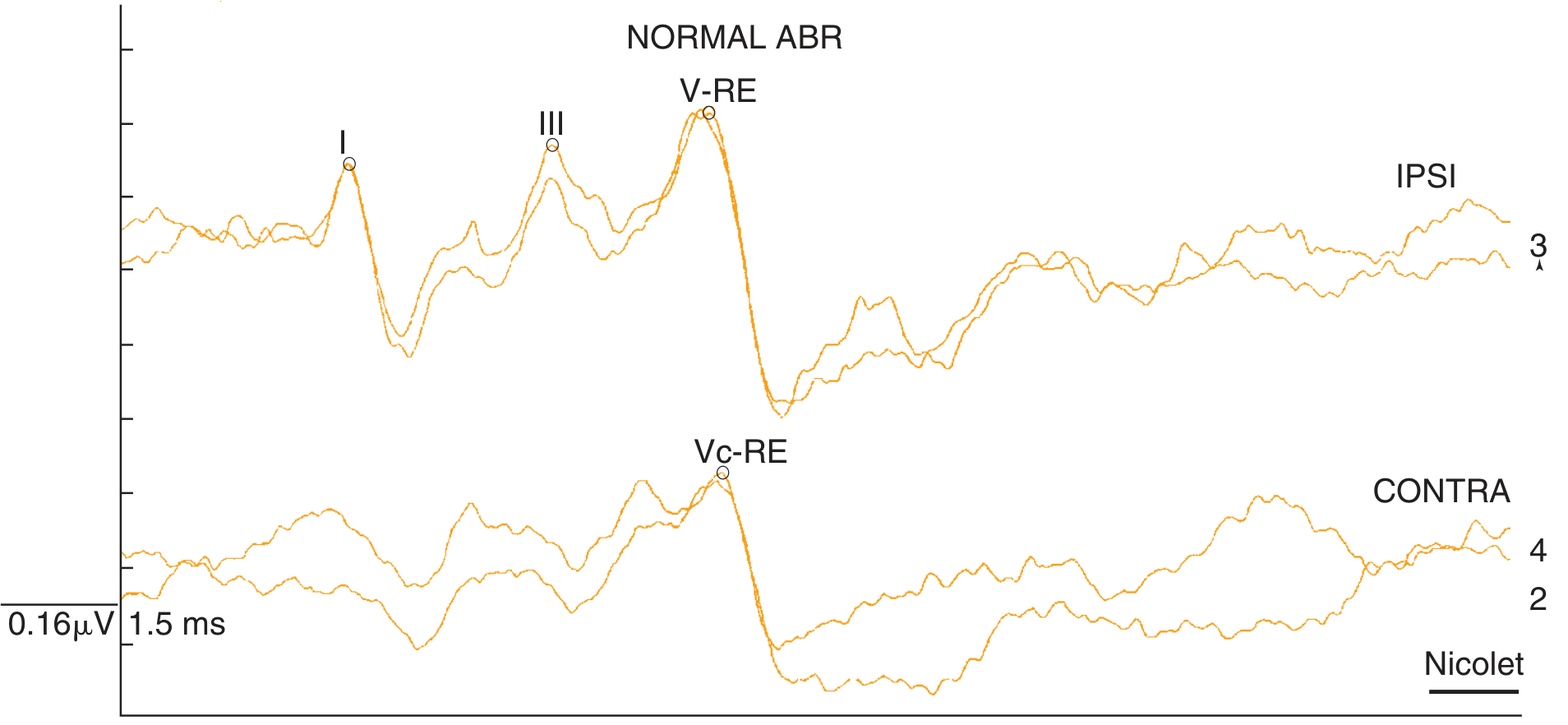
Wave Generators - Mnemonic: "EECOL"
| Wave | Generator Site | Approx. Latency |
|---|---|---|
| I | Distal eighth nerve (cochlear end) | ~1.7 ms |
| II | Proximal eighth nerve (near porus acusticus) | ~2.8 ms |
| III | Cochlear nucleus complex / trapezoid body | ~3.9 ms |
| IV | Superior olivary complex | ~5.0 ms |
| V | Lateral lemniscus (as it enters the inferior colliculus) | ~5.7 ms |
| VI | Inferior colliculus | >6 ms |
| VII | Inferior colliculus | >7 ms |
Note: The shift from Schwann cell (peripheral) to neuroglial cover (central) near the porus acusticus explains the distinct wave I vs wave II latency difference. Wave V is NOT generated by the inferior colliculus (as was previously thought) - it arises from the lateral lemniscus, per Moller and Jannetta's landmark study.
Waves IV and V often fuse into an IV-V complex in clinical recordings.
Normal Interpeak Latencies (IPL)
| Interval | Normal Value | Pathway Assessed |
|---|---|---|
| I - III | 2.3 ms | Cochlear nerve to cochlear nucleus (lower brainstem) |
| III - V | 2.1 ms | Cochlear nucleus to lateral lemniscus (upper brainstem) |
| I - V | 4.4 ms | Total brainstem conduction time |
Recording Technique
- Electrodes: Non-inverting at vertex/high forehead; inverting at ipsilateral earlobe; ground at mid-forehead
- Two-channel montage: Ipsilateral channel emphasizes Wave I; contralateral channel separates Waves IV and V
- Filters: High-pass 100 Hz, low-pass 1000-3000 Hz
- Stimulus: Clicks (100 µs) or tone pips at constant or alternating polarity
Wave V - The Most Important Wave
Wave V is the most robust component - it persists even with significant hearing loss and is used to:
- Estimate hearing thresholds (particularly in infants/neonates)
- Detect retrocochlear pathology
- Monitor auditory pathway integrity intraoperatively
Wave I is difficult to resolve when hearing loss exceeds 40-45 dB at high frequencies. An absent wave V in the presence of a replicated wave I or III is a definitive indicator of retrocochlear involvement.
Indicators of Retrocochlear Pathology
- Interpeak latency I-V > 4.4 ms
- Interaural latency difference of wave V > 0.2 ms (comparing left vs right ear)
- Wave V-V latency difference > 2.1 ms
- Absent or poorly formed wave V with preserved wave I/III
Key Clinical Applications
- Newborn hearing screening (UNHS programs) - ABR matures with brain development; waves I, III, V appear at ~28 weeks gestation; full maturity at ~18 months postnatal
- Acoustic neuroma/CPA tumor detection - delayed IPL or absent waves
- Neural demyelination (e.g., multiple sclerosis) - prolonged IPLs
- Intraoperative monitoring during posterior fossa or CPA surgeries
- Threshold estimation in uncooperative patients (infants, malingerers)
- Brain death evaluation - ABR unaffected by sedatives/anesthetics
Why ABR is Ideal for Objective Testing
The brainstem is relatively impervious to sedatives, anesthetics, and CNS depressants, making ABR an objective, non-volitional test. It does not require patient cooperation.
Sources: K.J. Lee's Essential Otolaryngology, p. 1211; Cummings Otolaryngology Head and Neck Surgery (Block 30); Scott-Brown's Otorhinolaryngology Head & Neck Surgery Vol. 2, p. 689
This is a shared conversation. Sign in to Orris to start your own chat.