
Select an appropriate orthosis for a given clinical condition based on the patient's functional and biomechanical requirements.
Reading File
Now let me search the medical library for orthosis content in parallel.
Finding Sources
Finding Sources
Excellent - found rich content. Let me read all the key sections in parallel.
Reading File
Reading File
Reading File
Great content. Let me now read the spine, elbow, pediatric orthoses, and rheumatology sections in parallel.
Reading File
Reading File
Reading File
Excellent. Now let me fetch the relevant images and grab additional upper limb / thoracolumbar orthosis content.
Loading Image
Finding Sources
Searching Images
ankle foot orthosis AFO footdrop
I now have sufficient content to deliver a comprehensive, well-structured answer. Let me compile it.
Orthosis Selection: Functional and Biomechanical Framework
Selecting an orthosis requires matching the device's mechanical properties to the patient's pathology, joint stability, sensory status, activity level, and functional goals. Below is a systematic guide by body region and condition.
Core Classification Principles
Orthoses are classified by:
- Stabilization type: immobilization (rigid), stabilization (semirigid), or support (flexible/soft)
- Material: thermoplastics, neoprene, fabric, foam, metal
- Fabrication: custom-made vs. off-the-shelf
The fundamental principle is: rigid orthoses = immobilize/rest inflamed joints; flexible/semirigid orthoses = support while preserving function during activity - Firestein & Kelley's Textbook of Rheumatology
I. Foot Orthoses
| Type | Biomechanical Property | Clinical Indication |
|---|---|---|
| Rigid | Limits joint motion; stabilizes | Flexible deformities (pes planus, posterior tibial tendon dysfunction) |
| Semirigid | Support + shock absorption | Active patients; mild-to-moderate malalignment; plantar fasciitis |
| Soft/Accommodative | Maximum shock absorption; offloads pressure | Rigid/fixed deformities; neuropathic/diabetic foot; dysvascular or ulcerative conditions; RA/JIA foot pain |
Functional orthotics (rigid/semirigid thermoplastic shells with built-in corrections) control abnormal foot motion and are used for flexible deformities - correction is the goal.
Accommodative orthotics (soft foam, cork, silicone) protect painful plantar lesions and bony prominences; used when the deformity is fixed and cannot be corrected - accommodation is the goal.
Specific indications for custom rigid orthotics include plantar fasciitis (with or without heel spur), pes cavus, hallux valgus, metatarsalgia, sesamoiditis, and rearfoot pain from RA. Most patients (70%) are heel strikers; orthotics redistribute this load across the first and fifth MTP joints. - Pfenninger & Fowler's Procedures for Primary Care
II. Ankle-Foot Orthosis (AFO)
The most commonly prescribed lower limb orthosis. Extends from below knee to foot.
| Clinical Scenario | AFO Selection |
|---|---|
| Foot drop (peroneal nerve palsy, stroke) | Posterior leaf spring AFO or solid AFO; spring-assisted dorsiflexion assist |
| Plantar spasticity (stroke, CP, TBI) | Solid/rigid AFO; controls equinus posture |
| Spinal cord injury | Rigid AFO; mediolateral stability with TPE trimlines |
| Hindfoot fusion | AFO to absorb ground reaction force (GRF), protect fusion sites and midfoot |
| Active ankle motion preserved | Articulating AFO with mechanical ankle joint; allows ROM while providing mediolateral control |
Trimline selection for thermoplastic elastomer (TPE) AFOs:
- Full/anterior trimline = maximum mediolateral control
- Posterior trimline = less control, more flexibility
- Choice depends on intended function, level of control needed, limb sensation, and swelling
Key factor: the AFO's biomechanical effect on the knee joint must be considered. A rigid AFO can create a knee-extension moment (useful in quadriceps weakness) or a knee-flexion moment depending on the ankle angle set. - Miller's Review of Orthopaedics 9th Ed.
III. Knee-Ankle-Foot Orthosis (KAFO)
Used to control an unstable knee joint (mediolateral instability, quadriceps weakness, post-polio, muscular dystrophy).
- Provides mediolateral stability with prescribed flexion or extension control
- Knee locks of various types (drop lock, bail lock, offset knee joint) tailor the degree of stability
- Knee orthoses (subset): used for knee OA (unloader braces to offload medial/lateral compartment), patellofemoral syndrome (patellar tracking braces), or ACL-deficient knee (functional hinged brace)
- ACR guidelines conditionally recommend orthoses for both tibiofemoral and patellofemoral knee OA
IV. Hip-Knee-Ankle-Foot Orthosis (HKAFO)
- Provides hip and pelvic stability
- Rarely used by adult paraplegics due to high energy cost and cumbersome nature
- Primary current use: children with upper lumbar myelomeningocele (L1-L2); reciprocating gait orthosis (RGO) designs allow ambulation using the hip-hip linkage mechanism
V. Upper Limb Orthoses
Wrist-Hand Orthosis (WHO)
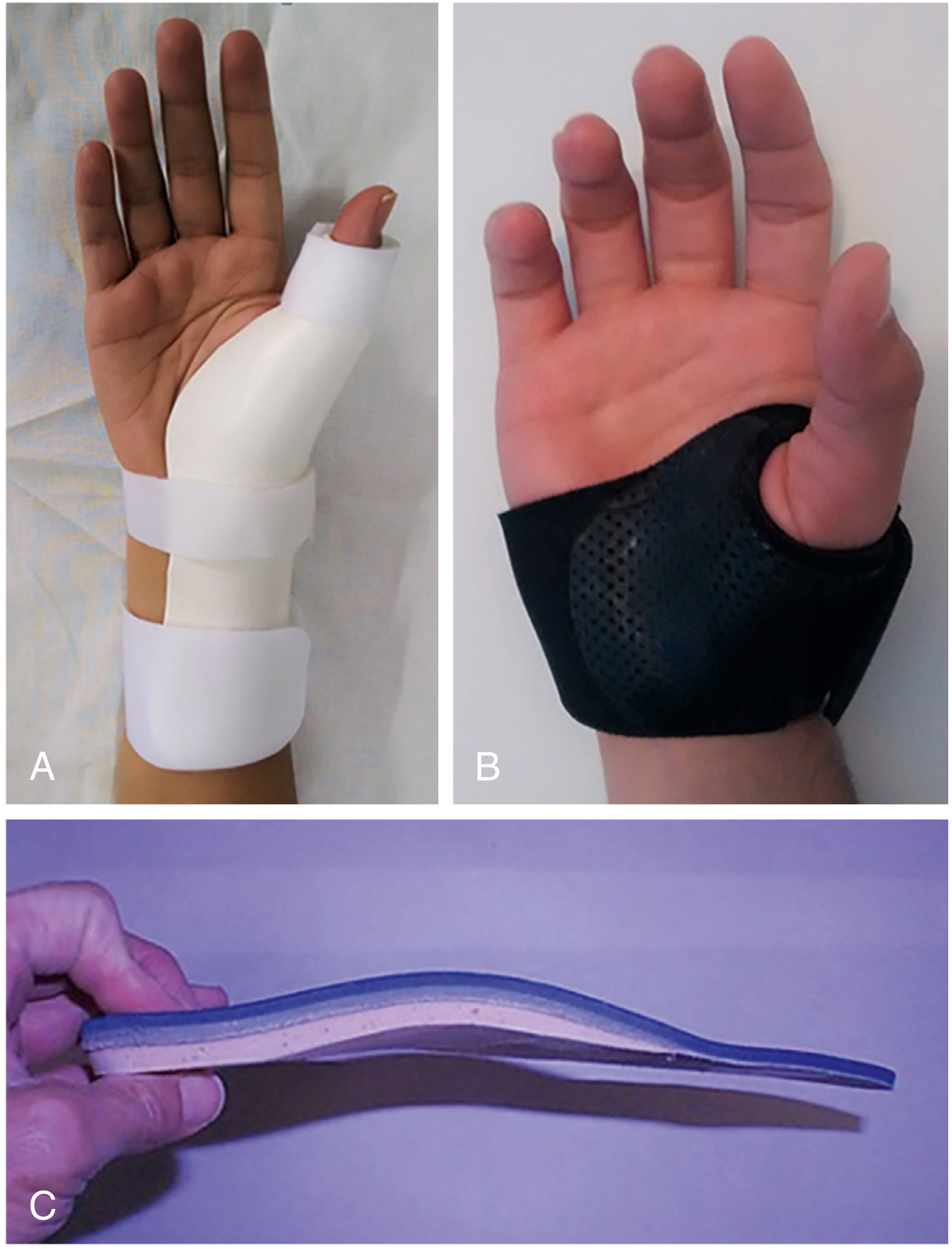
| Condition | Orthosis Type |
|---|---|
| RA with active inflammation | Rigid immobilization wrist/hand orthosis; promotes optimal alignment during flares |
| Thumb CMC OA | Rigid or hybrid CMC orthosis (ACR/EULAR recommended); longer forearm-based design for acute phase; shorter hand-based design for functional tasks |
| Carpal tunnel syndrome | Neutral wrist splint at 0-10° extension at night (caution: standard 30° extension splints may worsen RA patients if active wrist synovitis is present) |
| Cervical quadriplegia (C6-C7) | Wrist-driven hand orthosis (tenodesis splint); uses tenodesis action for grasp/release; may be motor-driven |
| Postoperative/reconstructive | Static, static-progressive, or dynamic WHO depending on phase |
Elbow Orthoses
| Condition | Orthosis |
|---|---|
| Ligament instability | Hinged-elbow orthosis (minimum stability) |
| Flexion/extension contracture | Dynamic spring-loaded orthosis |
| Lateral epicondylitis (tennis elbow) | Counterforce elbow strap (applied ~3 cm distal to lateral epicondyle) |
| Cubital tunnel syndrome | Long arm splint with elbow at 45° flexion |
The opponens splint prepositions the thumb for pinch/grasp but impairs tactile sensation - important consideration in sensory-dependent tasks. - Miller's Review of Orthopaedics 9th Ed.
VI. Spine Orthoses
Cervical Spine
| Orthosis | Immobilization Level | Indication |
|---|---|---|
| Soft collar | Minimal | Sprains, strains, transient process fractures; activity reminder; transitional weaning |
| Philadelphia collar (foam) | Moderate | Stable fractures; good for hygiene |
| Miami J collar (rigid plastic) | Moderate-high | Stable cervical fractures; popular due to comfort and demonstrated rigidity |
| Cervicothoracic orthosis (CTO) (Minerva, Yale, SOMI) | High | Fractures at cervicothoracic junction; restricts ~79-87% sagittal motion, 75-77% axial rotation |
| Halo-vest | Maximum | Unstable cervical fractures (e.g., odontoid type II, C1 ring fracture) |
Cervical orthoses use three-point pressure (occiput/mandible proximally; clavicle/sternal notch anteroinferiorly; upper thoracic spinous processes posteriorly). They decrease - but do not eliminate - motion. Complications with prolonged collar use include pressure ulcers (up to 38% in severe TBI), dysphagia, aspiration risk, and raised intracranial pressure. - Rockwood & Green's Fractures in Adults 10th Ed.
Thoracolumbar Spine
- Orthoses achieve control through three-point pressure mechanisms and by increasing intra-abdominal/body cavity pressure
- Lever arm length determines the extent of motion limitation
- TLSO (thoracolumbar sacral orthosis): used for thoracolumbar fractures, scoliosis (Milwaukee brace, Boston brace), and postsurgical stabilization
- LSO (lumbar sacral orthosis): used for mechanical back pain, lumbar fractures, and post-discectomy support
VII. Pediatric Orthoses
| Condition | Orthosis | Mechanism |
|---|---|---|
| Developmental dysplasia of the hip (DDH) | Pavlik harness | Maintains hip in flexion-abduction; allows dynamic motion; mainstay treatment in infants |
| Perthes disease | Dynamic containment orthoses (Scottish Rite, Atlanta brace) | Maintains femoral head within acetabulum during revascularization |
| Scoliosis (10-45°, skeletally immature) | Boston/Milwaukee TLSO | Three-point correction; worn 16-23 hrs/day; reduces curve progression |
| Myelomeningocele (L1-L2) | HKAFO with reciprocating gait mechanism | Enables upright ambulation using hip extension-flexion coupling |
VIII. Fracture Braces
| Situation | Device |
|---|---|
| Isolated tibia-fibula fractures | Fracture brace (functional bracing - Sarmiento principle) |
| Simple foot/ankle fractures, ankle sprains | Prefabricated fracture orthosis / walking boot |
| Simple hand injuries | Prefabricated hand orthosis |
Decision Framework Summary
Step 1: What is the primary goal?
  ├─ REST / immobilize inflamed joint → Rigid orthosis
  ├─ SUPPORT unstable joint during function → Semirigid/hinged orthosis
  ├─ ACCOMMODATE fixed deformity / protect tissue → Soft/accommodative orthosis
  ├─ CORRECT flexible deformity → Functional orthosis (rigid/semirigid with posting)
  └─ ASSIST weak muscle / substitute movement → Dynamic/tenodesis orthosis

Step 2: Check patient-specific factors
  - Sensory status (neuropathy → soft/accommodative)
  - Vascular status (SSc, PVD → avoid compressive rigid devices)
  - Active inflammation vs. mechanical instability
  - Comorbidities (swelling, skin integrity)
  - Functional demands (ADLs vs. ambulation vs. sport)

Step 3: Select material
  - Rigid thermoplastic → maximum correction/immobilization
  - Semirigid TPE → moderate control + comfort
  - Neoprene/fabric → light support, proprioception, warmth
  - Soft foam/silicone → accommodative, offloading
Key Evidence Points
- Moderate-to-strong evidence supports orthoses for hand/thumb and knee OA (ACR guidelines conditionally recommend CMC orthoses for thumb OA and unloader braces for knee OA) - Firestein & Kelley's Rheumatology
- Conditional evidence for rigid/compressive orthoses in RA (wrist, finger, knee, ankle, foot) - EULAR/ACR guidelines
- Contraindicated in SSc: devices aimed at reducing finger contractures may impair peripheral vascular perfusion
- In RA, standard carpal tunnel splints (30° wrist extension) may worsen median nerve compression if active wrist synovitis is present - prescribe at neutral (0°) instead
Sources:
- Miller's Review of Orthopaedics, 9th Edition (Foot Orthoses, AFO, KAFO, HKAFO, Spine/Elbow/Wrist Orthoses)
- Firestein & Kelley's Textbook of Rheumatology, 2-Volume Set (Rheumatic conditions, OA/RA/inflammatory orthoses)
- Rockwood and Green's Fractures in Adults, 10th Ed. 2025 (Cervical/cervicothoracic orthoses)
- Pfenninger & Fowler's Procedures for Primary Care, 3rd Ed. (Functional vs. accommodative foot orthotics)
This is a shared conversation. Sign in to Orris to start your own chat.