
Femoral canal and femoral sheath anatomy
Reading File
This is a visual anatomy topic. I'll search the medical library using headings and paragraphs FTS in parallel, along with a web search for images.
Finding Sources
Finding Sources
Searching the Web
femoral canal femoral sheath anatomy diagram
Now let me read the three most relevant textbook sections in parallel - Gray's Anatomy for Students, Mulholland's Surgery, and Fischer's Surgery.
Reading File
Reading File
Reading File
Loading Image
Loading Image
Now let me fetch the textbook images embedded in the content:
Loading Image
Loading Image
I now have rich content from three authoritative textbooks. Here is the complete, synthesized answer:
Femoral Sheath and Femoral Canal - Anatomy
Femoral Sheath
The femoral sheath is a funnel-shaped sleeve of fascia that surrounds the upper ~4 cm (about 1.5 inches) of the femoral vessels as they pass beneath the inguinal ligament into the anterior thigh.
Formation
The sheath has two walls:
- Anterior wall - downward prolongation of the transversalis fascia of the anterior abdominal wall
- Posterior wall - downward prolongation of the iliac (iliopsoas) fascia
At the inguinal ligament level, the iliopsoas fascia forms the iliopectineal arch, which divides the space inferior to the inguinal ligament into two regions:
- Lacuna vasorum (medial) - for the femoral vessels, enclosed within the sheath
- Lacuna musculorum (lateral) - for the iliopsoas muscle, femoral nerve, and lateral femoral cutaneous nerve
The femoral nerve lies lateral to the femoral sheath and is NOT enclosed within it.
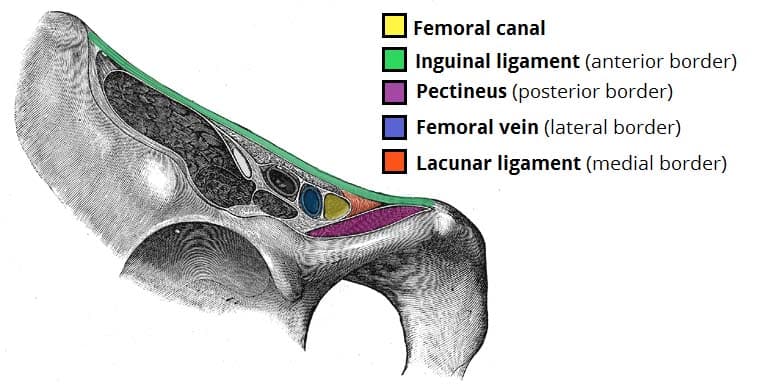
The Three Compartments
Two anteroposterior septa divide the sheath into three compartments (lateral to medial):
| Compartment | Contents |
|---|---|
| Lateral (arterial) | Femoral artery + femoral branch of genitofemoral nerve |
| Intermediate (venous) | Femoral vein |
| Medial (lymphatic) | Lymphatic vessels + deep inguinal lymph node = Femoral canal |
A useful mnemonic - from lateral to medial: NAVEL (Nerve, Artery, Vein, Empty space [canal], Lacunar ligament)
Femoral Canal
The femoral canal is the smallest and most medial compartment of the femoral sheath. It is cone-shaped (wide above, narrow below).
- Length: approximately 1.25 cm (about 0.5 inches)
- Shape: conical, wider proximally
- Contents: loose areolar connective tissue, lymphatic vessels, and the Cloquet node (a large deep inguinal lymph node at its upper end)
Femoral Ring (Superior Opening)
The femoral ring is the upper (proximal) opening of the femoral canal - its inlet from the abdominal side. It is covered by a plug of extraperitoneal fat (the femoral septum).
Boundaries of the femoral ring:
| Border | Structure |
|---|---|
| Anterior | Inguinal ligament (+ iliopubic tract) |
| Posterior | Pectineal (Cooper's) ligament + superior pubic ramus |
| Medial | Lacunar (Gimbernat's) ligament - the curved medial edge of the inguinal ligament |
| Lateral | Femoral vein (periadventitial connective tissue septum) |
Note: Mulholland and Greenfield's Surgery clarifies that the medial border is more precisely the aponeurosis of transversus abdominis (not the lacunar ligament, which inserts more medially). This is an important surgical distinction.
Saphenous Opening (Inferior Opening)
Inferiorly, the canal opens at the saphenous opening (fossa ovalis) in the deep fascia of the thigh, where the great saphenous vein pierces the fascia to enter the femoral vein.
Clinical Significance
Femoral Hernia
The femoral ring is a natural weak point in the abdominal wall. Increased intra-abdominal pressure can force peritoneum (and sometimes bowel or omentum) through the ring into the canal, creating a femoral hernia.
Key clinical points:
- More common in females because the pelvis is wider, leaving a larger femoral ring
- The hernia exits below and lateral to the pubic tubercle (distinguishing it from inguinal hernias, which exit above and medial to the pubic tubercle)
- The rigid boundaries of the ring (especially the sharp lacunar ligament medially) make femoral hernias prone to incarceration and strangulation
- The canal is relatively rigid and difficult to obliterate with sutures from below, so a prosthetic plug is often used after reducing the hernia
Anomalous Obturator Artery (Corona Mortis)
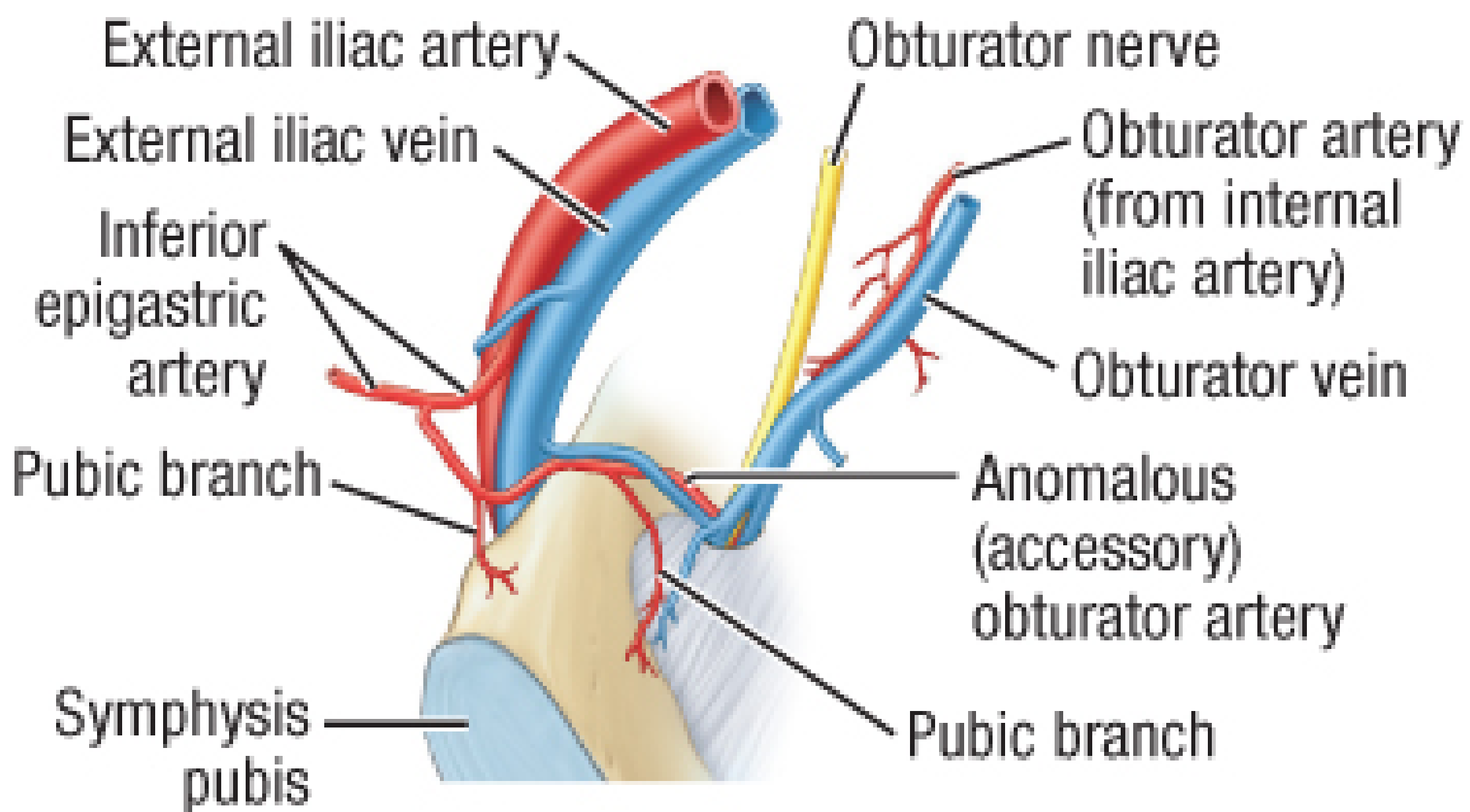
An accessory obturator artery (a branch of the inferior epigastric artery replacing the normal obturator origin from the internal iliac) passes close to the femoral ring in up to 30% of individuals. It can be injured during femoral hernia repair attempts to enlarge the ring - earning the name "corona mortis" (crown of death) due to the risk of severe hemorrhage.
Vascular Access
The femoral artery and vein are accessible just inferior to the inguinal ligament at the midpoint between the ASIS and pubic symphysis. This is a common access point for:
- Cardiac catheterization / coronary angiography
- Peripheral vascular interventions
- Central venous access (femoral vein)
Summary Relationships
Inguinal ligament
        |
   [Femoral Sheath - funnel of fascia]
   ┌──────────────────────────────┐
   │ Lateral  │ Middle  │ Medial  │
   │ Femoral  │ Femoral │ Femoral │
   │  artery  │  vein   │  canal  │
   └──────────────────────────────┘
              ↓ (narrows distally)
       Saphenous opening
Sources:
- Gray's Anatomy for Students, p. 676
- Mulholland and Greenfield's Surgery: Scientific Principles and Practice, 7e, p. 3652
- Fischer's Mastery of Surgery, 8e, p. 6051-6052
This is a shared conversation. Sign in to Orris to start your own chat.