
Write a notes on neural integration of vomiting for My MD Anaesthesiology exam
Reading File
Now let me search the medical library for content on neural integration of vomiting, while also running parallel searches.
Finding Sources
Finding Sources
Finding Sources
Excellent! I found several great sources. Let me read the most relevant ones - Guyton and Hall (physiology), Katzung (pharmacology), Morgan & Mikhail (anaesthesia), and Lippincott (mechanisms) - all in parallel.
Reading File
Reading File
Reading File
Reading File
Excellent content. Let me now read the continuation of the Katzung pathophysiology section (it got truncated), plus the Guyton image, the Costanzo section, and fetch the diagram image for the notes.
Reading File
Reading File
Reading File
Loading Image
I now have rich content from Guyton & Hall, Katzung, Lippincott, Costanzo, and Morgan & Mikhail. Let me also fetch the Guyton neural connections diagram, and search for the PONV chapter in Morgan & Mikhail which is specifically relevant for an anaesthesiology exam.
Loading Image
Finding Sources
Finding Sources
Now let me get the Morgan & Mikhail PONV chapter content and the Guyton section on the CTZ to round out the notes.
Reading File
Reading File
I now have comprehensive material from multiple authoritative textbooks. Let me compile the detailed exam notes.
Neural Integration of Vomiting
Notes for MD Anaesthesiology Examination
1. Overview
Vomiting (emesis) is a protective reflex that expels noxious contents from the upper GI tract. It is a highly coordinated act involving the respiratory, GI, and somatic musculature, all orchestrated by brainstem circuits. Understanding the neural integration is fundamental to anaesthesia practice because multiple anaesthetic agents, opioids, and surgical stimuli trigger this reflex, and antiemetics target specific nodes in these pathways.
2. The "Vomiting Centre" - Anatomical Basis
The so-called vomiting centre (VC) is not a single discrete nucleus but a loosely organised network of sensory, motor, and control nuclei located primarily in the lateral medullary reticular formation, extending into the pontine reticular formation and down into the spinal cord.
Key nuclei within this network include:
- Nucleus tractus solitarius (NTS) - the primary integrating relay; receives all visceral afferent signals; coordinates salivatory, vasomotor, and respiratory centres
- Dorsal motor nucleus of the vagus - supplies parasympathetic efferents to the gut
- Area postrema - the chemoreceptor trigger zone (CTZ); sits on the floor/lateral walls of the 4th ventricle
The VC interacts closely with cranial nerves VIII (vestibulocochlear) and X (vagus) and with the NTS network that governs respiratory, salivatory, and vasomotor responses. This explains why vomiting is always accompanied by salivation, pallor, sweating, and bradycardia.
(Katzung's Basic and Clinical Pharmacology, 16e; Guyton & Hall Medical Physiology, 14e)
3. Afferent Inputs to the Vomiting Centre
There are four major afferent pathways that activate the vomiting centre:
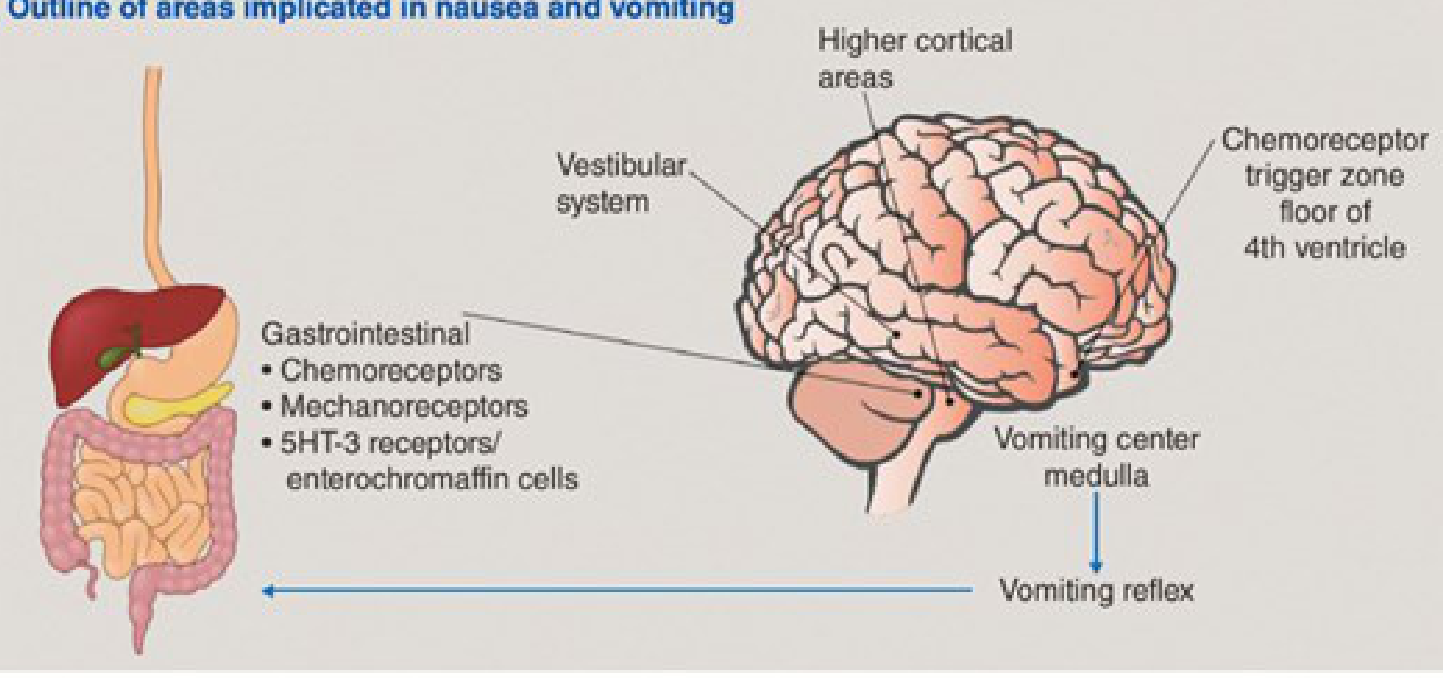
3.1 Gastrointestinal Tract (Vagal & Sympathetic Afferents)
- Sensory signals originate from pharynx, oesophagus, stomach, and proximal small intestine (especially duodenum, which is the most potent trigger)
- Transmitted via vagal (CN X) afferents and splanchnic sympathetic afferents to the NTS and VC
- GI mucosal irritation, distension, chemotherapy, radiation, or acute gastroenteritis causes enterochromaffin cells to release serotonin (5-HT)
- Serotonin activates 5-HT3 receptors on vagal/splanchnic afferent nerve terminals → sensory signals to the NTS/VC and CTZ → emesis
- GI tract afferents also carry input from mechanoreceptors (stretch) and chemoreceptors
3.2 Chemoreceptor Trigger Zone (CTZ / Area Postrema)
- Located in the area postrema on the lateral walls of the 4th ventricle (floor in some descriptions)
- Critically, it lies outside the blood-brain barrier (a circumventricular organ), making it directly accessible to blood-borne and CSF-borne emetogenic substances
- Receptor-rich zone:
- Dopamine D2 receptors (major target of metoclopramide, droperidol, haloperidol, phenothiazines)
- Opioid receptors (mu > delta) - why morphine, opioids cause PONV
- Serotonin 5-HT3 receptors (target of ondansetron, granisetron, etc.)
- NK1 receptors (substance P) (target of aprepitant, fosaprepitant)
- Drugs that directly stimulate the CTZ: apomorphine, morphine, digitalis, dopamine agonists, cancer chemotherapy agents
- The CTZ signals the NTS/VC to trigger the efferent vomiting response
- Destruction of the area postrema abolishes drug-induced vomiting but NOT vomiting from direct GI irritation
(Guyton & Hall; Katzung; Morgan & Mikhail's Clinical Anaesthesiology, 7e)
3.3 Vestibular System (Motion Sickness Pathway)
- Motion stimulates receptors in the vestibular labyrinth of the inner ear
- Impulses travel via CN VIII → brainstem vestibular nuclei → cerebellum → CTZ → VC
- The vestibular system is rich in muscarinic M1/M2 and histamine H1 receptors
- This is the dominant pathway in motion sickness and accounts for post-operative vestibular emesis from head movements
- Drugs acting here: scopolamine (M1 antagonist), promethazine (H1 antagonist), meclizine, dimenhydrinate, cyclizine
- These drugs are effective for motion sickness but are ineffective against substances acting directly on the CTZ
3.4 Higher CNS (Cortical) Inputs
- The cerebral cortex and limbic system provide afferent input to the VC
- Responsible for:
- Psychogenic vomiting (anxiety, fear, unpleasant sights/smells)
- Anticipatory nausea and vomiting (conditioned response before chemotherapy)
- Vomiting from increased intracranial pressure
- Vomiting triggered by pain
- The role of higher centres explains why anxiolytic premedication (benzodiazepines) can reduce PONV
4. Efferent Pathways - The Vomiting Act
Once the VC is sufficiently activated, it orchestrates the vomiting act through a precise temporal sequence of efferent signals:
| Cranial/Spinal Nerve | Target | Effect |
|---|---|---|
| CN V (trigeminal) | Facial muscles, jaw | Preparatory mouth movements |
| CN VII (facial) | Salivary glands | Hypersalivation (dilutes acid) |
| CN IX (glossopharyngeal) | Pharyngeal muscles | Pharyngeal coordination |
| CN X (vagus) | GI tract (oesophagus, stomach, small bowel) | Lower oesophageal sphincter relaxation, GI retroperistalsis |
| CN XII (hypoglossal) | Tongue | Tongue positioning |
| Phrenic nerve (C3-C5) | Diaphragm | Forced diaphragmatic contraction |
| Spinal somatic nerves | Abdominal wall muscles | Forceful abdominal compression |
Sequential Events of the Vomiting Act:
- Deep inspiration (to increase intrathoracic and intra-abdominal pressure)
- Raising of hyoid bone + larynx → opens the upper oesophageal sphincter
- Closure of the glottis (prevents aspiration into lungs)
- Elevation of soft palate → closes posterior nares (prevents nasal regurgitation)
- Retroperistalsis begins in the small intestine (antiperistaltic wave at 2-3 cm/sec travelling upward, sweeping contents back to the duodenum/stomach within 3-5 minutes)
- Relaxation of lower oesophageal sphincter (LOS)
- Simultaneous powerful contraction of diaphragm + abdominal muscles → squeezes stomach → raises intragastric pressure → forceful expulsion of gastric contents
(Guyton & Hall; Costanzo Physiology, 7e)
Retching vs Vomiting: In retching, the upper oesophageal sphincter remains closed, so despite LOS opening and gastric contraction, contents return to the stomach. Actual vomiting requires upper oesophageal sphincter opening.
5. Prodrome - Nausea
- Nausea = conscious recognition of subconscious excitation of the medullary area closely associated with or part of the VC
- Produced by: (1) irritative GI impulses, (2) lower brainstem signals (motion sickness), (3) cerebrocortical signals
- Accompanied by increased vagal tone: hypersalivation, pallor, sweating, tachycardia or bradycardia
- Note: Vomiting can occur without nausea if only certain sub-portions of the VC are stimulated (explains projectile vomiting in raised ICP)
- In anaesthesia: sudden nausea at the onset of hypotension (particularly after spinal/epidural) is a classic warning sign of cardiovascular compromise
6. Neurotransmitters and Receptor Map
This is the pharmacological heart of the topic for anaesthesiology:
| Receptor | Location | Endogenous Ligand | Emetogenic Role | Drug Target |
|---|---|---|---|---|
| 5-HT3 | Vagal afferents (GI), CTZ, NTS | Serotonin (from enterochromaffin cells) | Major role in CINV and PONV | Ondansetron, granisetron, palonosetron |
| D2 (Dopamine) | CTZ (area postrema) | Dopamine | Blood-borne drugs, opioids | Metoclopramide, droperidol, haloperidol, phenothiazines |
| NK1 (Neurokinin-1) | VC, CTZ, NTS | Substance P | Delayed chemotherapy emesis, PONV | Aprepitant, fosaprepitant, rolapitant |
| M1 (Muscarinic) | VC, vestibular nuclei | Acetylcholine | Motion sickness, GI motility | Scopolamine, hyoscine |
| H1 (Histamine) | Vestibular apparatus, CTZ | Histamine | Motion sickness | Promethazine, cyclizine, dimenhydrinate |
| Opioid (mu) | CTZ, GI tract | Endorphins | Opioid-induced emesis | Opioid antagonists (naloxone) |
| CB1 (Cannabinoid) | CTZ, NTS, GI tract | Endocannabinoids | Inhibitory (anti-emetic) | Dronabinol, nabilone |
| GLP-1 receptor | Area postrema | GLP-1 | GLP-1 agonist-induced nausea | (Relevant to semaglutide prescribing) |
(Katzung; Morgan & Mikhail; Lippincott Pharmacology)
7. Anaesthetic Relevance - PONV Pathways
Key triggers in anaesthesia activating these pathways:
| Agent/Factor | Pathway Activated | Receptor |
|---|---|---|
| Opioids | CTZ (blood-borne), GI slowing | D2, opioid-mu, 5-HT3 |
| Nitrous oxide | CTZ activation, vestibular disturbance | D2, H1 |
| Volatile anaesthetics | CTZ, direct GI mucosal effect | 5-HT3, D2 |
| Propofol | Inhibitory on VC | - (reduces PONV) |
| Intraperitoneal/laparoscopic surgery | Vagal afferents from peritoneum | 5-HT3, NK1 |
| Strabismus surgery | Oculocardiac reflex → vagal hypertonia | Vagal/5-HT3 |
| Hypotension (spinal/epidural) | Cerebral ischaemia → cortical input | Higher centres |
| Pharyngeal blood/secretions | Direct GI afferents | 5-HT3, vagal |
Apfel Score (PONV Risk Stratification):
- Female sex
- Non-smoker
- History of PONV / motion sickness
- Postoperative opioid use
Score 0-1: low risk (~10-20%) | 2: moderate (~40%) | 3-4: high risk (~60-80%)
8. Antiemetic Classification by Neural Target
| Drug Class | Example | Neural Target | Pathway Blocked |
|---|---|---|---|
| 5-HT3 antagonists | Ondansetron 4-8mg IV | Vagal afferents, CTZ, NTS | Vagal/serotonin pathway |
| D2 antagonists | Droperidol 0.625-1.25mg IV, Metoclopramide 10mg IV | CTZ (D2) | Dopamine/CTZ pathway |
| NK1 antagonists | Aprepitant 40mg PO, Fosaprepitant 150mg IV | VC, NTS (substance P) | Substance P pathway |
| Corticosteroids | Dexamethasone 4-8mg IV | Multiple (possibly PG inhibition) | Broad/unknown |
| Anticholinergics | Scopolamine patch (1.5mg TD) | Vestibular nuclei, VC (M1) | Vestibular/ACh pathway |
| H1 antagonists | Promethazine 25mg IV/IM | Vestibular nuclei, CTZ (H1) | Histamine/vestibular pathway |
| Cannabinoids | Dronabinol 5-10mg PO | CB1 (CTZ, NTS) | Cannabinoid pathway |
| Propofol | 10-20mg IV sub-anaesthetic | VC (direct depression?) | Broad CNS depression |
Combination antiemesis (e.g. ondansetron + dexamethasone + droperidol) works by targeting multiple independent receptor pathways simultaneously - the cornerstone of PONV management in high-risk patients.
9. Clinical Pearls for the Exam
-
The CTZ lies outside the BBB - hence it can be activated by blood-borne toxins, drugs, and uraemic/hepatic metabolites without breaching the BBB. This is why renal or hepatic failure causes nausea/vomiting.
-
Vagotomy or high spinal anaesthesia abolishes GI afferent input but does not abolish vomiting from blood-borne stimuli (CTZ is intact).
-
Destruction of area postrema = abolishes drug-induced and uraemic vomiting, but NOT direct GI irritation-induced vomiting.
-
Projectile vomiting without nausea = raised ICP stimulating the VC directly via cortical pathways, bypassing the "nausea" sub-portions of the VC.
-
Increased vagal tone (bradycardia) commonly precedes or accompanies emesis in the PACU - always check BP and oxygenation before attributing it solely to PONV.
-
5-HT3 antagonists are ineffective for motion sickness because motion sickness is mediated via the vestibular (H1/M1) pathway, not the vagal/serotonin pathway.
-
NK1 antagonists (aprepitant) are particularly effective for delayed CINV (>24h post-chemotherapy) because substance P drives the delayed phase.
-
Scopolamine anticholinergics are ineffective against CTZ-mediated vomiting (they act on M1 in the VC and vestibular nuclei, not on D2 or 5-HT3 in the CTZ).
-
Droperidol black box warning (QT prolongation) applies to high doses (5-15mg); antiemetic doses (0.625-1.25mg) are generally safe but require baseline ECG in at-risk patients.
10. Summary Diagram
(From Guyton & Hall, Fig. 67.2 - Neural connections of the vomiting centre)
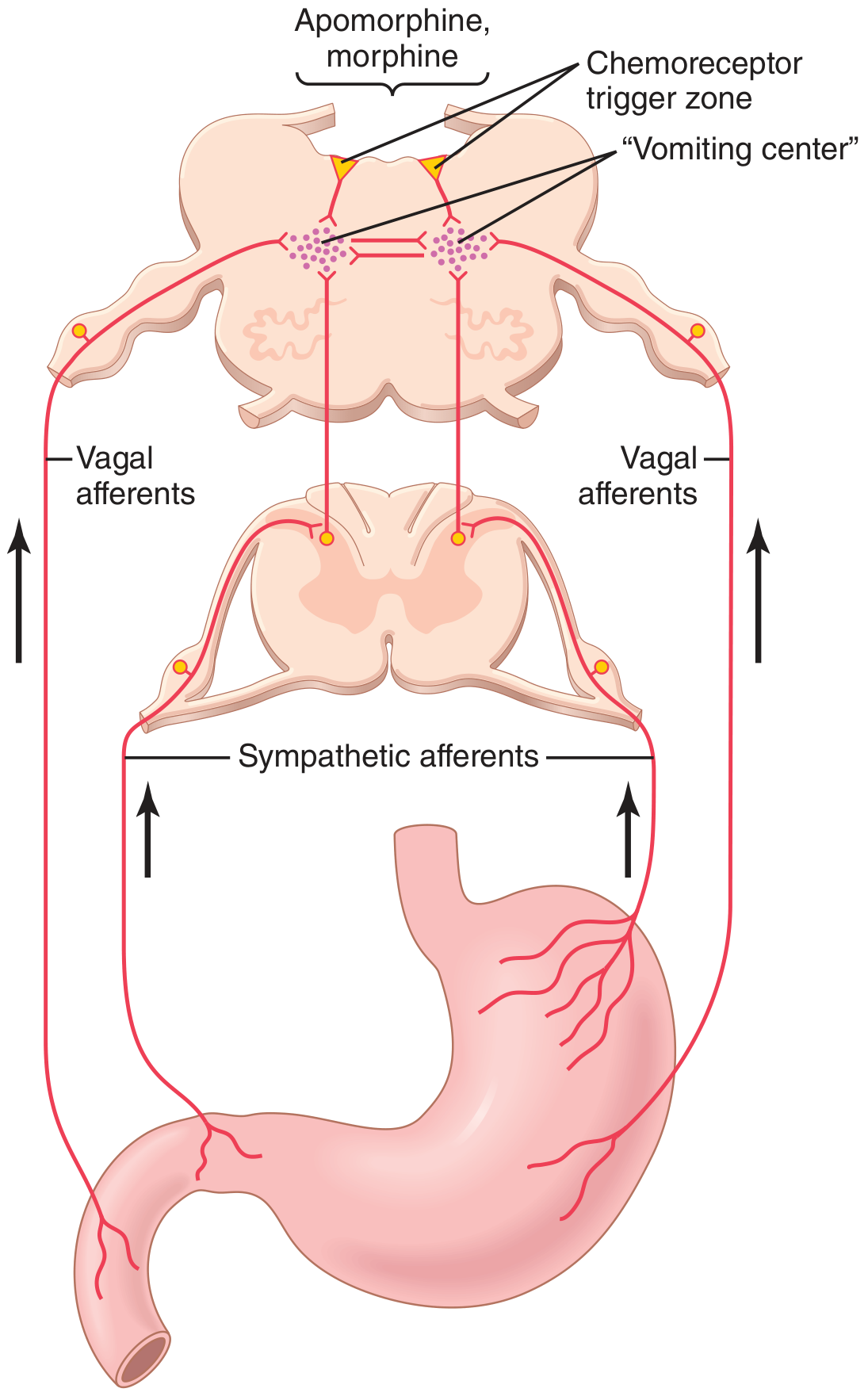
Key takeaway from the diagram: The vomiting centre (medullary reticular formation) receives vagal and sympathetic afferents from the GI tract. The CTZ (area postrema) sits separately, accessible to blood-borne emetogenic substances (e.g. apomorphine, morphine). Both converge on the VC, which then sends efferent signals via CN V, VII, IX, X, XII and spinal phrenic/abdominal nerves to execute the vomiting act.
Sources:
- Guyton & Hall Textbook of Medical Physiology, 14e - Chapter 67
- Katzung's Basic and Clinical Pharmacology, 16e - Chapter 62 (Antiemetic Agents)
- Morgan & Mikhail's Clinical Anaesthesiology, 7e - Chapter 17 (PONV)
- Lippincott Illustrated Reviews Pharmacology - Chapter 42
- Costanzo Physiology, 7e - Chapter 8 (GI Physiology)
This is a shared conversation. Sign in to Orris to start your own chat.