
Endometriosis
Reading File
Finding Sources
Searching Images
endometriosis pathology laparoscopy
Now let me read the most authoritative source — Robbins Pathology, which has a dedicated section on endometriosis with multiple paragraphs:
Reading File
Reading File
Reading File
Finding Sources
Reading File
Reading File
Reading File
Reading File
I now have comprehensive information. Let me also fetch the key pathogenesis diagram from Robbins.
Loading Image
Loading Image
Here is a comprehensive overview of endometriosis, synthesized from authoritative textbooks.
Endometriosis
Definition
Endometriosis is defined by the presence of endometrial glands and stroma outside the uterus. It affects up to 10% of women in their reproductive years and nearly half of women with infertility. — Robbins & Kumar Basic Pathology
Classification (Three Types)
| Type | Description |
|---|---|
| Superficial peritoneal | Implants on peritoneal surfaces |
| Ovarian endometriosis | "Chocolate cysts" (endometriomas) |
| Deep infiltrating endometriosis (DIE) | Penetrates >5 mm below peritoneum; highest malignant transformation risk |
Pathogenesis
The exact mechanism remains elusive. Four leading theories exist:
- Regurgitation (Sampson's theory) — Retrograde flow of menstrual endometrium through the fallopian tube implants at ectopic sites (the dominant theory)
- Benign metastasis theory — Endometrial tissue spreads hematogenously or via lymphatics to distant sites (lung, bone, brain)
- Metaplastic theory — Coelomic (peritoneal) epithelium undergoes metaplasia into endometrial tissue, arising from the same müllerian duct precursors
- Extrauterine stem/progenitor cell theory — Bone marrow-derived stem cells differentiate into ectopic endometrial tissue
Once implanted, endometriotic tissue is not merely misplaced endometrium — it actively perpetuates itself through a cycle of inflammation:
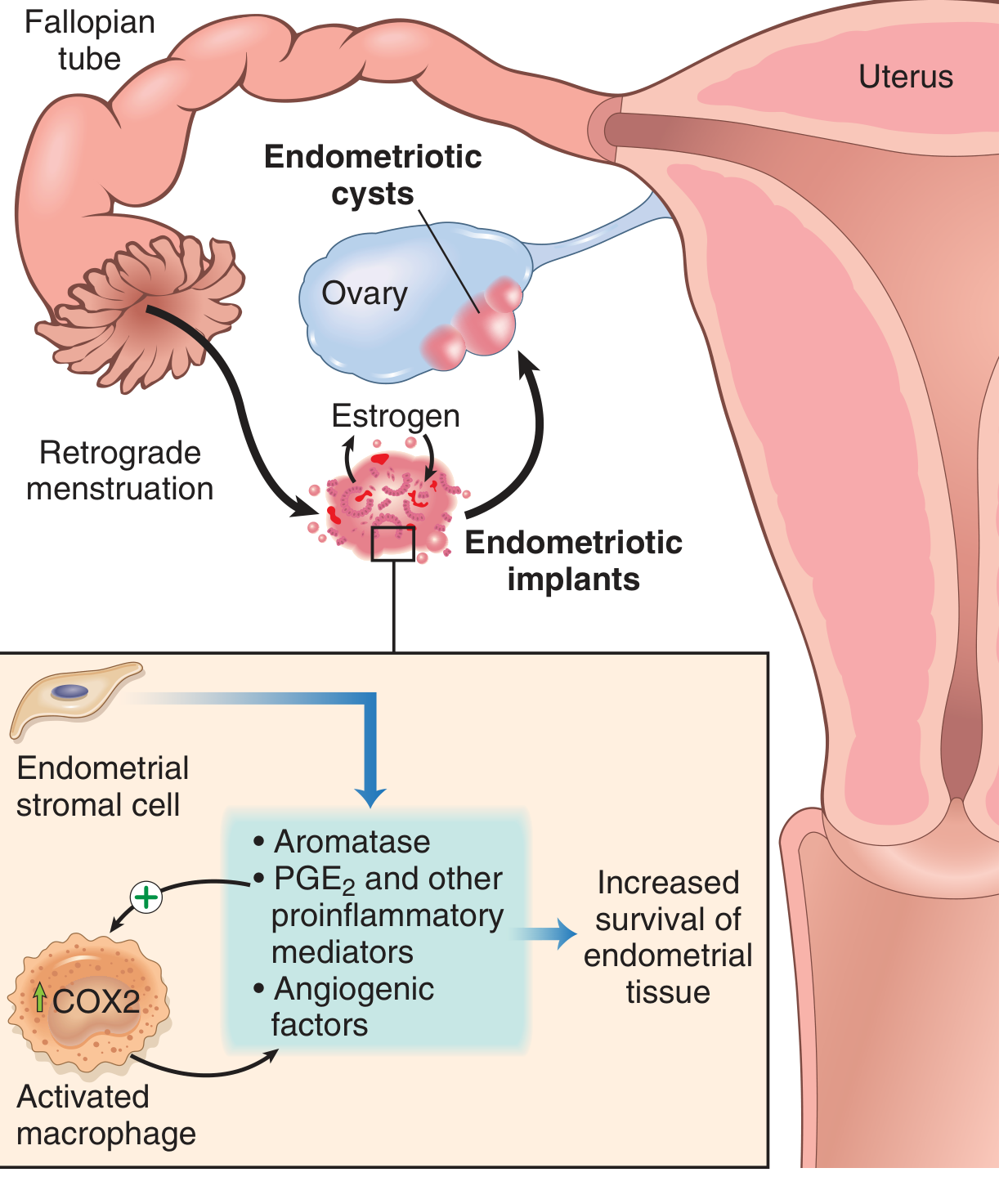
Key molecular drivers:
- Aromatase — elevated in endometriotic stromal cells → increased local estrogen production from androgens
- PGE2 (prostaglandin E2) — proinflammatory, promotes implant survival
- VEGF — drives angiogenesis to feed the implants
- MMPs — facilitate tissue invasion
- Recruited macrophages (COX2↑) amplify the inflammatory cycle
Morphology
Implants appear as red-brown nodules (microscopic to 1–2 cm) on serosal surfaces, caused by cyclic hemorrhage. In widespread disease:
- Organizing hemorrhage leads to fibrous adhesions between fallopian tubes, ovaries, and pelvic structures
- The pouch of Douglas may be obliterated
- Ovarian chocolate cysts (endometriomas) form — cystic masses 3–5 cm filled with old brown blood
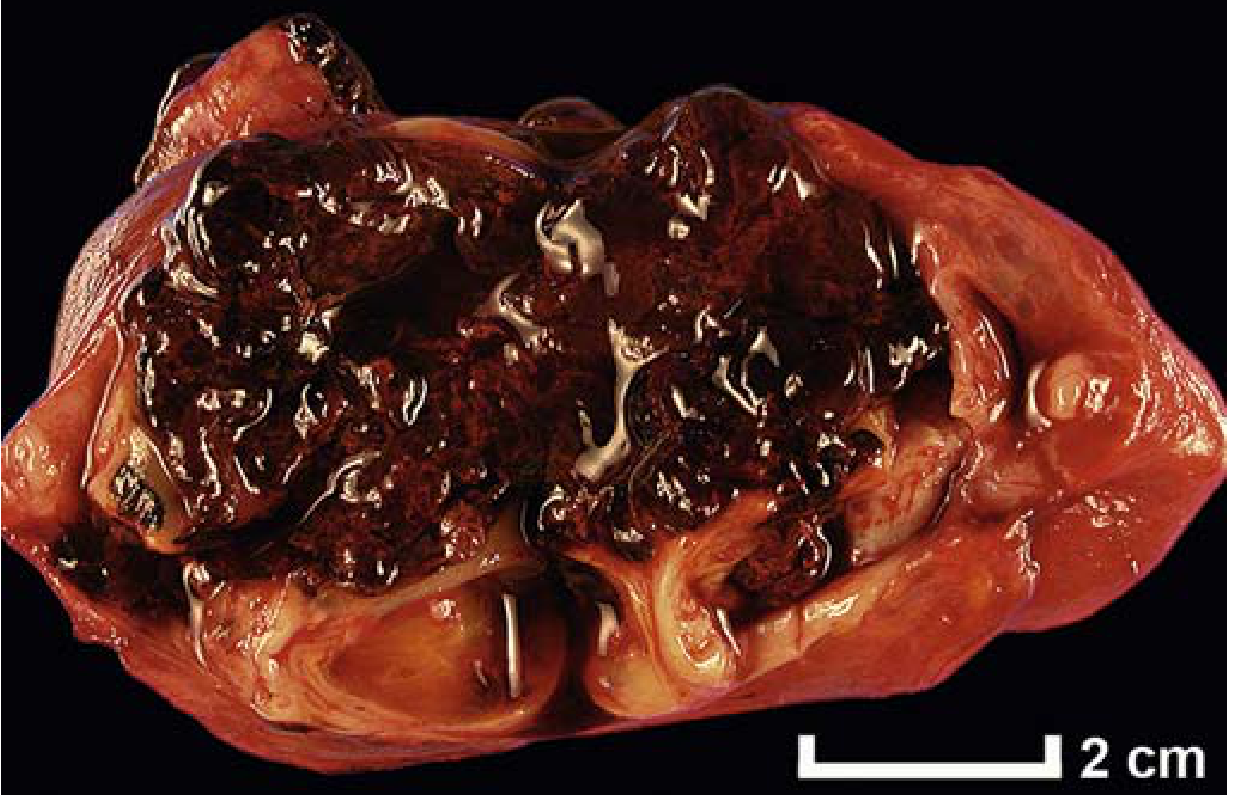
Histologic diagnosis requires identifying both endometrial glands AND stroma at the ectopic site.
Clinical Features
- Dysmenorrhea (most common symptom)
- Dyspareunia (painful intercourse)
- Chronic pelvic pain
- Infertility (~50% of infertile women)
- Rectal bleeding (bowel involvement — sigmoid most common, 12–37% of cases)
- Laparoscopic findings: "powder-burn" lesions, peritoneal implants, dense adhesions, chocolate cysts
Staging (r-ASRM)
Classified I–IV (minimal to severe) based on implant size, adhesions, and involvement of pelvic structures. The Endometriosis Fertility Index (EFI) is a validated tool for predicting post-surgical fertility outcomes.
Treatment
Treatment must be individualized, considering symptom profile, desire for fertility, and disease severity. Endometriosis is a chronic disease with high recurrence after both medical and surgical treatment. — Berek & Novak's Gynecology
1. Analgesics
- NSAIDs (ibuprofen, naproxen, mefenamic acid) — first-line for dysmenorrhea; inhibit prostaglandin synthase
- Started at onset of bleeding, continued up to 3 days
2. Hormonal (Medical) Therapy
Goal: suppress ovulation and reduce estrogen-driven implant growth
| Agent | Mechanism |
|---|---|
| Combined oral contraceptives | Suppress ovulation; continuous use preferred |
| Progestins (norethindrone 5 mg/day) | Decidualization and atrophy of implants |
| GnRH agonists (e.g., leuprolide) | Pituitary downregulation → hypoestrogenic state; often combined with "add-back" HRT to prevent bone loss |
| Danazol | Androgen/anti-gonadotropin; suppresses implants but androgenic side effects limit use |
Medical therapy provides temporary relief — implants recur after treatment cessation.
3. Surgical Treatment
- Laparoscopy is preferred over laparotomy (equivalent efficacy, faster recovery, less morbidity, fewer adhesions)
- Laparotomy only for advanced-stage disease where laparoscopy is impossible
- Goal: excise all visible lesions, lyse adhesions, restore normal anatomy
Peritoneal endometriosis: ablation (coagulation, laser) or excision — both equivalent; excision preferred to allow histologic confirmation
Ovarian endometriomas (≥3 cm): Cystectomy (excision of cyst wall) is preferred over drainage + ablation — lower recurrence of pain, lower endometrioma recurrence, higher spontaneous pregnancy rates (ESHRE guideline)
Deep infiltrating endometriosis: Complete excision in a single procedure at a specialized center with multidisciplinary expertise; asymptomatic patients should NOT undergo surgery unless complete ureteral obstruction with silent renal loss is present
4. Assisted Reproduction
For infertility-associated endometriosis when medical/surgical options are insufficient.
Extrapelvic Manifestations
- GI tract (12–37%): sigmoid colon most common; serosal implants invade muscularis propria → fibrosis, bowel wall contraction, rectal bleeding; MRI demonstrates low-signal fibrotic plaques obliterating the pouch of Douglas
- Diaphragm: upper abdominal extrapelvic endometriosis (requires thorough exploration during surgery)
- Pleura/Lung (rare): catamenial pneumothorax, hemoptysis
- Surgical scars, umbilicus
Prognosis
- Disease progresses in 30–60% of patients within a year of diagnosis
- Recurrence is high after both medical and surgical treatment
- Risk of malignant transformation is mainly confined to deep infiltrating endometriosis (particularly clear cell and endometrioid carcinoma arising in endometriomas)
- Referral to a specialized center is strongly recommended for severe or deep endometriosis
Sources: Robbins & Kumar Basic Pathology; Berek & Novak's Gynecology; Goldman-Cecil Medicine; Grainger & Allison's Diagnostic Radiology
This is a shared conversation. Sign in to Orris to start your own chat.