
Leopard manuer in OBG
Reading File
Finding Sources
Searching the Web
Leopold maneuver obstetrics OBG steps technique
Finding Sources
Reading File
Reading File
Loading Image
Loading Image
Reading File
Leopold's Maneuvers in Obstetrics
Leopold's maneuvers (note the correct spelling - named after Christian Gerhard Leopold, a German obstetrician) are a systematic set of 4 abdominal palpation techniques used from 30 weeks gestation onward to assess fetal lie, presentation, position, and engagement.
Purpose
- Determine fetal lie (longitudinal / transverse / oblique)
- Identify fetal presentation (cephalic / breech)
- Locate the fetal back (for auscultation of fetal heart tones)
- Assess engagement and degree of descent into the pelvis
- Determine attitude (flexion/deflexion of the head)
The 4 Maneuvers
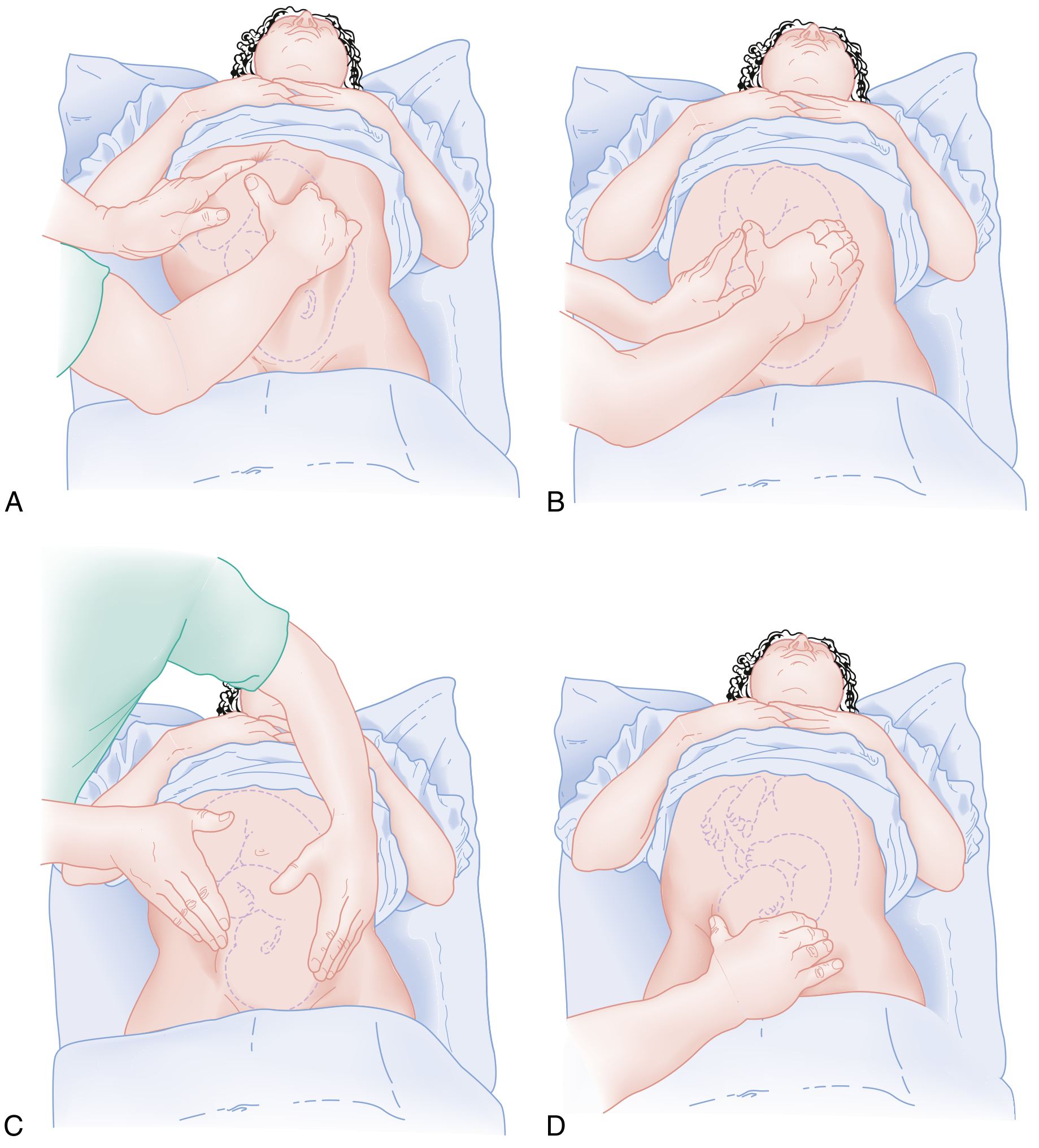
Maneuver 1 - Fundal Grip (Examiner faces the patient's head)
Technique: Both hands are placed on the uterine fundus and palpate the fetal part occupying it.
Findings:
- Breech in the fundus: soft, irregular, non-ballottable mass = fetal buttocks
- Head in the fundus: hard, round, ballottable mass = cephalic presentation (baby in breech lie)
Maneuver 2 - Lateral/Umbilical Grip (Examiner faces the patient's head)
Technique: Both hands glide down laterally along the sides of the uterus with firm pressure.
Findings:
- Fetal back: firm, smooth, continuous resistance on one side
- Fetal limbs (small parts): irregular, knobby, harder to pin down on the other side
Fetal heart tones are best heard through the fetal back - in the lower left uterus for LOA/LOP/LOT positions, and in the lower right uterus for right occiput positions.
Maneuver 3 - Pawlik's Grip (Examiner faces the patient's head)
Technique: One hand grasps the lower pole of the uterus just above the symphysis pubis between the thumb and fingers.
Findings:
- Head (cephalic presentation): hard, round, ballottable
- Breech: soft, broader, less defined
- Determines the presenting part and whether it is engaged (fixed/not ballottable = engaged; mobile/ballottable = not engaged)
Maneuver 4 - Pelvic Grip (Examiner turns 180° to face the patient's feet)
Technique: Both hands are placed on the lower abdomen, pressing downward and inward toward the pelvic inlet. The fingers glide toward the pelvis.
Findings:
- Determines the degree of flexion (attitude) of the presenting part
- The cephalic prominence is the part of the head that is felt first:
- If cephalic prominence is on the same side as small parts - head is well-flexed (vertex presentation - normal)
- If cephalic prominence is on the same side as the back - head is extended (face presentation)
Quick Memory Aid
| Maneuver | Position | Examiner Faces | Determines |
|---|---|---|---|
| 1st | Fundus | Patient's head | What's in the fundus (pole) |
| 2nd | Lateral | Patient's head | Location of fetal back |
| 3rd | Lower pole (Pawlik's) | Patient's head | Presenting part + engagement |
| 4th | Lower abdomen | Patient's feet | Attitude (flexion) of head |
Clinical Notes
- Performed at ≥30 weeks gestation when the fetus is large enough to palpate
- Done with the patient in dorsal recumbent position with knees slightly flexed
- Bladder should be emptied before examination
- By end of pregnancy, both the practitioner and the patient should know the fetal presentation - to avoid emergency management if a non-vertex presentation appears during labor
- Internal digital cervical exam can confirm presentation when palpation is uncertain
(Sources: Rosen's Emergency Medicine, Textbook of Family Medicine 9e)
This is a shared conversation. Sign in to Orris to start your own chat.