
Ultrasound guided ischiogluteal bursa and hamstring injection s
Reading File
Now let me search the medical library and web simultaneously for comprehensive information on ultrasound-guided ischiogluteal bursa and hamstring injections.
Finding Sources
Finding Sources
Searching the Web
ultrasound guided ischiogluteal bursa hamstring injection technique anatomy
Finding Sources
Finding Sources
Reading Web Page
https://mskultrasound.co.nz/wp-content/uploads/2023/01/Payne…
Finding Sources
Searching PubMed
ischiogluteal bursa injection ultrasound guided technique
Reading Web Page
https://pubs.rsna.org/doi/abs/10.1148/rg.2020190094
Finding Sources
Searching PubMed
proximal hamstring tendinopathy injection PRP corticosteroid
Reading File
Searching PubMed
hamstring tendinopathy injection platelet rich plasma
Let me fetch the ultrasound-guided injection image and read a bit more context from the textbook.
Loading Image
Finding Sources
I now have comprehensive material to provide a thorough, well-structured answer. Here it is:
Ultrasound-Guided Ischiogluteal Bursa & Hamstring Injection
Anatomy Overview
The ischiogluteal (ischial) bursa sits between the gluteus maximus muscle and the ischial tuberosity. The hamstring complex - semimembranosus, biceps femoris (long head), and semitendinosus - all originate at the ischial tuberosity. Key relationships:
- Semimembranosus: originates on the superolateral ischial tuberosity; has the largest proximal tendon of the three
- Conjoint tendon (biceps femoris long head + semitendinosus): originates medially at the ischial tuberosity
- Sciatic nerve: travels superficial to the quadratus femoris, lateral to the ischial tuberosity - the most critical structure to identify and protect
- The bursa sits deep to gluteus maximus and superficial to the hamstring tendons
Indications
| Condition | Target |
|---|---|
| Ischiogluteal bursitis | Bursa injection (corticosteroid ± LA) |
| Proximal hamstring tendinopathy | Peritendinous / intratendinous injection |
| High hamstring tendinopathy (insertional) | PRP or corticosteroid |
| Hamstring tendon partial tear | PRP |
| Prolonged sitting pain ("weaver's bottom") | Bursa injection |
Patient Positioning
Two options, with important implications for sciatic nerve proximity:
- Prone position - standard, easy access; sciatic nerve sits closer to the ischial tuberosity
- Lateral decubitus, hip flexed 90° (preferred by many) - the sciatic nerve migrates significantly laterally away from the ischial tuberosity compared to prone, reducing the risk of inadvertent nerve injection (Wisniewski et al., PM&R 2014)
Transducer Selection
- Linear-array (medium frequency): preferred for lean patients; better resolution
- Curvilinear (low frequency): needed in larger body habitus; provides wider field of view to see the ischial tuberosity, hamstring tendons, and sciatic nerve simultaneously
Scanning Protocol (Step-by-Step)
- Place the transducer in the anatomic axial (transverse) plane over the posterior superior iliac spine (PSIS)
- Slide inferiorly until the lateral sacrum is seen medially
- Continue inferiorly; the ischial tuberosity becomes visible as a prominent bony hyperechoic surface
- Move the transducer laterally to identify the sciatic nerve - it appears oval/round, superficial to the quadratus femoris muscle
- Optimize position so all four structures are visible simultaneously in one image:
- Gluteus maximus (superficial)
- Hamstring tendon origins (deep to gluteus maximus)
- Ischial tuberosity (bony backstop)
- Sciatic nerve (lateral, superficial to quadratus femoris)
Injection Technique
Needle Approach
- In-plane technique: lateral to medial
- Needle: 22-gauge, 64-89 mm (2.5-3.5 inch) spinal needle
- Mark the skin at the lateral edge of the transducer, prep in standard sterile fashion
- Infiltrate superficial local anesthetic down to the plane of the bursa
Needle Trajectory
- Advance the needle in-plane, lateral to medial under real-time ultrasound visualization
- Target: deep to gluteus maximus, superficial to hamstring tendons (for bursa injection)
- For hamstring tendon injection: advance to the peritendinous space adjacent to the tendon origin at the ischial tuberosity
- The ischial tuberosity serves as a firm bony backstop - needle should not advance past it
Critical Safety Step
- Confirm sciatic nerve position before advancing - trace it clearly and ensure the needle trajectory is lateral to it
- Dynamic real-time guidance is mandatory; do not advance blindly
Injectate
| Indication | Agent | Volume |
|---|---|---|
| Ischiogluteal bursitis | Triamcinolone acetonide (Kenalog) 40 mg + 1% lidocaine 3 mL | 3-4 mL total |
| Corticosteroid (bursa/tendon) | Methylprednisolone or betamethasone + LA | 2-4 mL |
| Proximal hamstring tendinopathy (PRP) | PRP (autologous, centrifuged) | ~3-5 mL |
For PRP protocols: blood is drawn 1 hour before the procedure, centrifuged (~15 minutes), then prepared. Typically no corticosteroid is mixed with PRP.
Image: US-Guided Proximal Hamstring Injection Technique
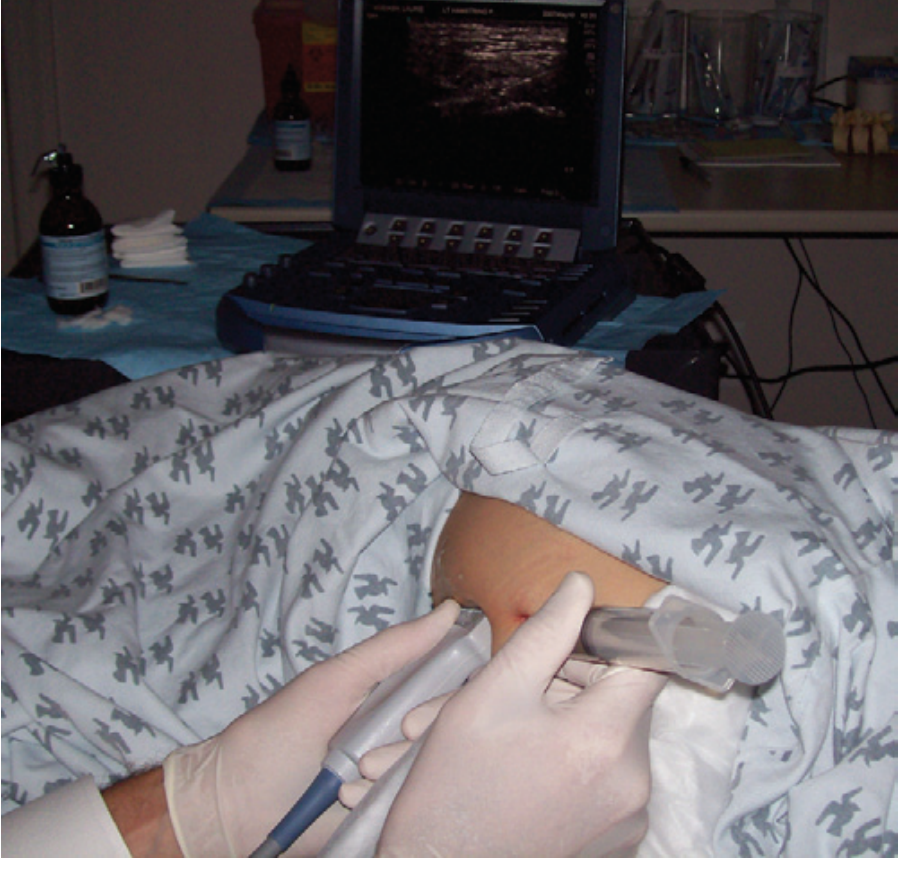
Probe in longitudinal axis; needle advanced parallel (in-plane) for continuous visualization. (Pfenninger & Fowler's Procedures for Primary Care)
Complications to Counsel
- Sciatic nerve injury - most feared; avoidable with careful nerve identification before injection
- Post-injection pain flare (especially corticosteroid, first 24-48 h)
- Tendon weakening/rupture with repeated corticosteroid injections (particularly intratendinous injection - avoid)
- Infection/hematoma
- Fat atrophy/skin depigmentation if superficial injection
- Hypopigmentation in darker skin types
Practical Tips
- Lateral decubitus with hip at 90° flexion is preferred to maximize sciatic nerve distance from needle path
- Always identify the sciatic nerve first before advancing the needle
- For bursitis: deliver corticosteroid into the bursal space, not into the tendon substance
- For tendinopathy: peritendinous injection (not intratendinous) for corticosteroid; for PRP, some advocate fenestration/needling of the tendon
- US guidance produces accurate ischial bursograms without overflow to adjacent structures compared to landmark-guided technique (cadaveric studies confirm accuracy)
- Feasibility studies (Wisniewski et al., PM&R 2014) confirm US-guided ischial bursa injections can be performed safely without damage to adjacent neurovascular structures
Recent Evidence
A 2025 systematic review (de Sire et al., PMID 39804336) found PRP injections provide effective pain relief in injured athletes, supporting their use in hamstring tendinopathy refractory to conservative care. Ongoing debate exists about corticosteroid vs. PRP for proximal hamstring tendinopathy - corticosteroid offers faster short-term pain relief but PRP may offer superior longer-term tendon healing.
Sources: Payne, Ultrasound-Guided Hip Procedures, Phys Med Rehabil Clin N Am 2016; Wisniewski et al., PM&R 2014;6:58; Pfenninger & Fowler's Procedures for Primary Care, 3rd Ed.; de Sire et al., J Sports Med Phys Fitness 2025 (PMID 39804336).
This is a shared conversation. Sign in to Orris to start your own chat.