
Jak Stat parhway
Reading File
The JAK-STAT pathway is a major intracellular signaling cascade used by cytokines and growth factors to regulate gene expression. In brief: ligand binding activates receptor-associated Janus kinases (JAKs), which phosphorylate Signal Transducers and Activators of Transcription (STATs), allowing them to dimerize, translocate to the nucleus, and drive transcription.
Searching sources...
Finding Sources
Searching PubMed
"JAK-STAT" signaling pathway
Good - several strong textbook sources found. Let me read the most comprehensive ones in parallel.
Reading File
Reading File
Reading File
Excellent content. Now let me fetch the key diagram and read the remaining Rheumatology content for clinical relevance and inhibitors.
Loading Image
Loading Image
Reading File
I now have comprehensive, well-sourced content to deliver a complete answer. Here is the full explanation:
JAK-STAT Pathway
Overview
The JAK-STAT pathway is a direct intracellular signaling system used by over 30 cytokines, growth hormones, and interferons to rapidly translate extracellular signals into changes in gene transcription -- without the need for second messengers like cAMP.
Key Components
JAK Family (Janus Kinases)
There are 4 mammalian JAKs:
- JAK1 - broad roles in growth, development, hematopoiesis, inflammation
- JAK2 - broad roles in growth, development, hematopoiesis, inflammation
- JAK3 - primarily immune response
- TYK2 - primarily immune response
Each JAK has a conserved kinase domain and a related pseudokinase regulatory domain. Crucially, JAKs are not intrinsic to the receptor -- they are cytoplasmic kinases that associate constitutively with cytokine receptor cytoplasmic tails.
STAT Family (Signal Transducers and Activators of Transcription)
There are 7 mammalian STATs: STAT1, STAT2, STAT3, STAT4, STAT5A, STAT5B, STAT6. Each shares:
- An SH2 domain (for docking to phosphorylated receptors)
- A DNA-binding domain
- A transactivation domain
Step-by-Step Mechanism
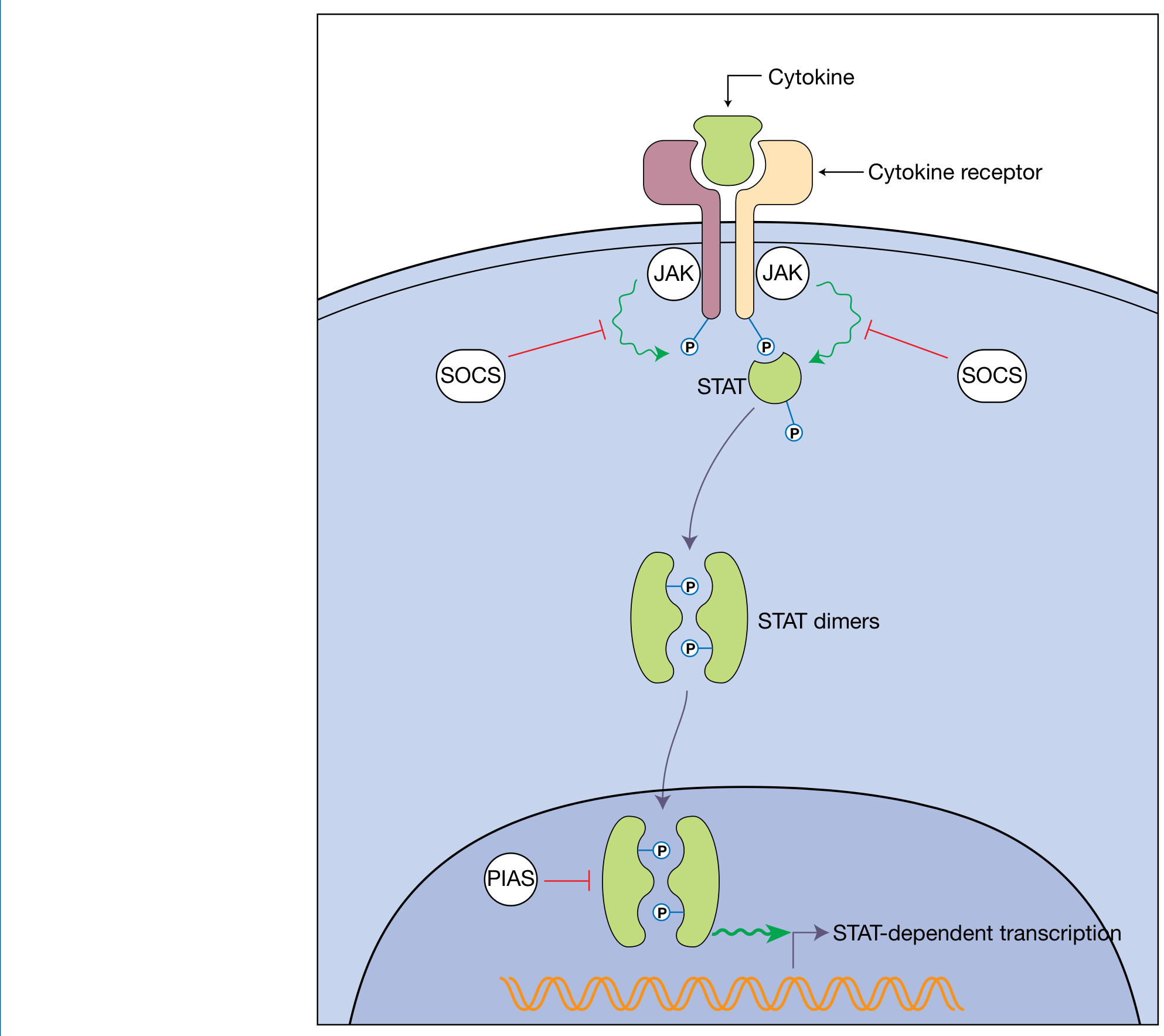
- Ligand binding - A cytokine (or growth hormone/interferon) binds its receptor on the cell surface.
- Receptor dimerization/oligomerization - This brings two receptor chains together, drawing the constitutively associated JAKs into close proximity.
- JAK trans-phosphorylation - The two JAKs reciprocally phosphorylate each other, activating their kinase activity.
- Receptor tail phosphorylation - Activated JAKs phosphorylate specific tyrosine residues on the receptor's cytoplasmic tail, creating docking sites.
- STAT recruitment - Cytoplasmic STAT proteins (inactive) are recruited to these phosphotyrosine docking sites via their SH2 domains.
- STAT phosphorylation - Receptor-docked STATs are phosphorylated by JAKs on a key tyrosine residue.
- STAT dimerization - Phosphorylated STATs detach from the receptor and dimerize (homo- or heterodimers) via mutual SH2-phosphotyrosine interactions.
- Nuclear translocation - STAT dimers translocate to the nucleus.
- Gene transcription - STAT dimers bind specific promoter motifs and activate transcription of target genes.
Cytokine-JAK-STAT Pairings
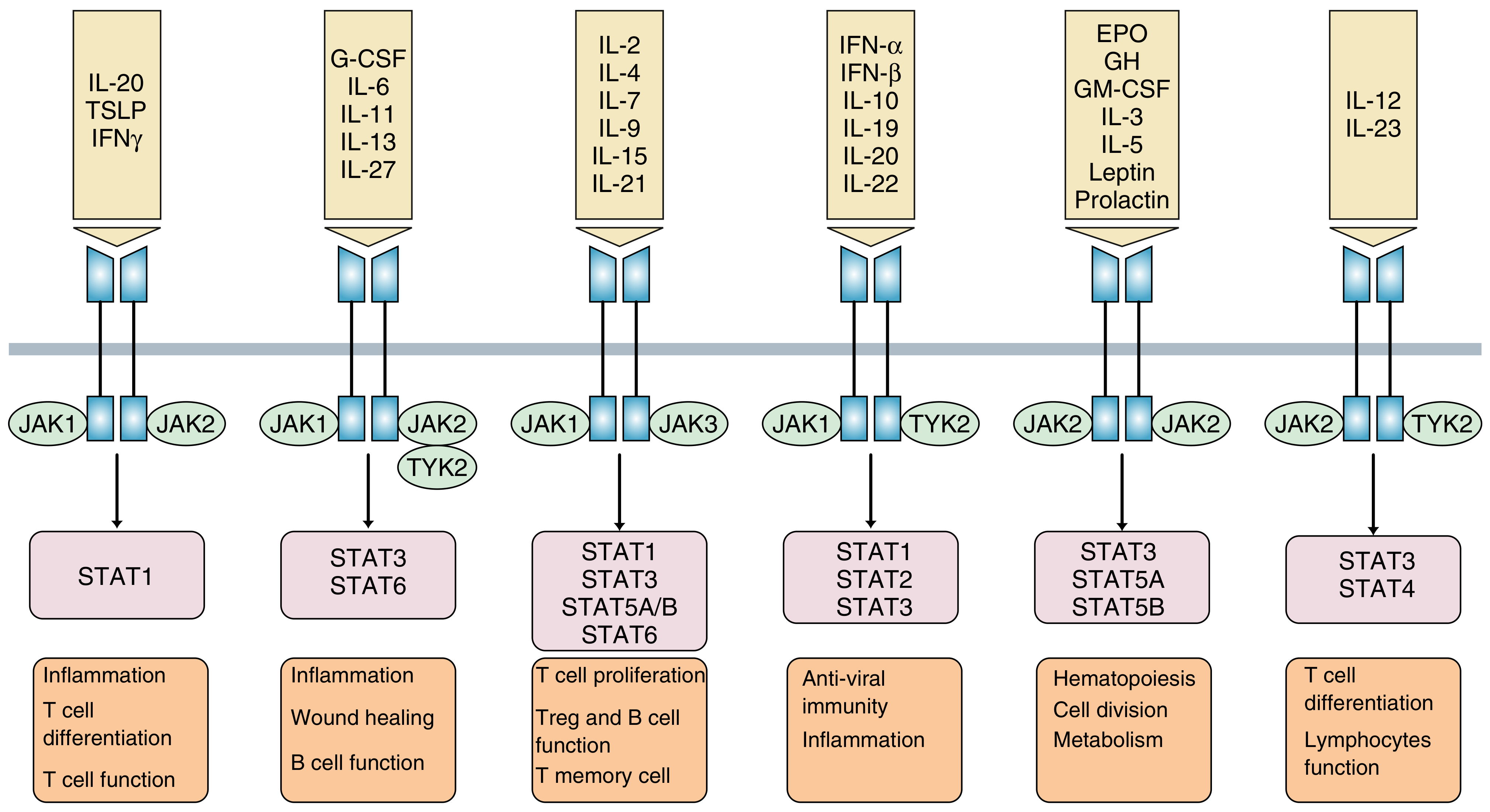
| Cytokines | JAK pair | STATs activated | Effect |
|---|---|---|---|
| IL-20, TSLP, IFN-γ | JAK1 + JAK2 | STAT1 | Inflammation, T cell differentiation |
| IL-6, IL-11, IL-13, IL-27, G-CSF | JAK1 + JAK2 (+ TYK2) | STAT3, STAT6 | Inflammation, wound healing, B cell function |
| IL-2, IL-4, IL-7, IL-9, IL-15, IL-21 | JAK1 + JAK3 | STAT1, 3, 5A/B, 6 | T cell proliferation, Treg/B cell function |
| IFN-α, IFN-β, IL-10, IL-22 | JAK1 + TYK2 | STAT1, STAT2, STAT3 | Antiviral immunity, inflammation |
| EPO, GH, GM-CSF, IL-3, IL-5, Leptin, Prolactin | JAK2 + JAK2 | STAT3, STAT5A, STAT5B | Hematopoiesis, cell division, metabolism |
| IL-12, IL-23 | JAK2 + TYK2 | STAT3, STAT4 | T cell differentiation, lymphocyte function |
Negative Regulation (How the Signal Switches Off)
Three major mechanisms downregulate JAK-STAT signaling:
-
SOCS proteins (Suppressors of Cytokine Signaling) - 8 members (CIS, SOCS1-7). Induced by STAT activation itself (classical negative feedback). SOCS proteins inhibit JAK kinase activity directly or promote ubiquitin-proteasome degradation of JAKs and receptors. SOCS3 binds both JAK and the cytokine receptor to block STAT3 activation.
-
PIAS proteins (Protein Inhibitors of Activated STATs) - Form complexes with phosphorylated STAT dimers in the nucleus, either blocking their DNA binding or recruiting histone deacetylases to silence transcription.
-
Phosphotyrosine phosphatases (PTPs) - Including SHP1, SHP2, CD45, and T cell PTP -- these dephosphorylate JAKs, STATs, and receptor tails to terminate signaling.
Additional Crosstalk
JAK activation is not exclusively coupled to STATs. Active JAKs also recruit:
- SHP2 and Shc/Grb2/Sos → activates Ras/MAPK cascade
- p85 (PI3K regulatory subunit) → activates PI3K/AKT pathway
- PLCγ → generates IP3/DAG second messengers
Clinical Relevance: JAK Inhibitors ("Jakinibs")
Because JAK-STAT signaling drives inflammation and immune cell proliferation, JAK inhibitors are a major therapeutic class:
| Drug | JAK selectivity | Indications |
|---|---|---|
| Tofacitinib | JAK1/JAK3 | Rheumatoid arthritis, UC, psoriatic arthritis |
| Baricitinib | JAK1/JAK2 | RA, atopic dermatitis, COVID-19 |
| Upadacitinib | JAK1-selective | RA, UC, Crohn's, atopic dermatitis |
| Ruxolitinib | JAK1/JAK2 | Myelofibrosis, polycythemia vera |
| Filgotinib | JAK1-selective | RA, UC |
Pathological JAK-STAT activation (via gain-of-function mutations, e.g., JAK2 V617F in myeloproliferative neoplasms) drives malignant hematopoiesis.
Sources: Firestein & Kelley's Textbook of Rheumatology, pp. 380-381 | Roitt's Essential Immunology, p. 256 | Harper's Illustrated Biochemistry, 32nd Ed, p. 528
This is a shared conversation. Sign in to Orris to start your own chat.