
Lungs anatomy
Reading File
Finding Sources
Reading File
Searching Images
lung lobes fissures mediastinal surface anatomy
Reading File
Reading File
Reading File
Reading File
I now have enough from Gray's Anatomy for Students to give a comprehensive overview. Here's the anatomy of the lungs:
Lungs — Anatomy Overview
The two lungs are the organs of respiration, sitting on either side of the mediastinum, each enclosed within its own pleural cavity. Air reaches them via the main bronchi (branches of the trachea), while the pulmonary arteries bring deoxygenated blood from the right ventricle and the pulmonary veins return oxygenated blood to the left atrium. The right lung is normally slightly larger than the left because the heart and mediastinum bulge more into the left side of the chest.
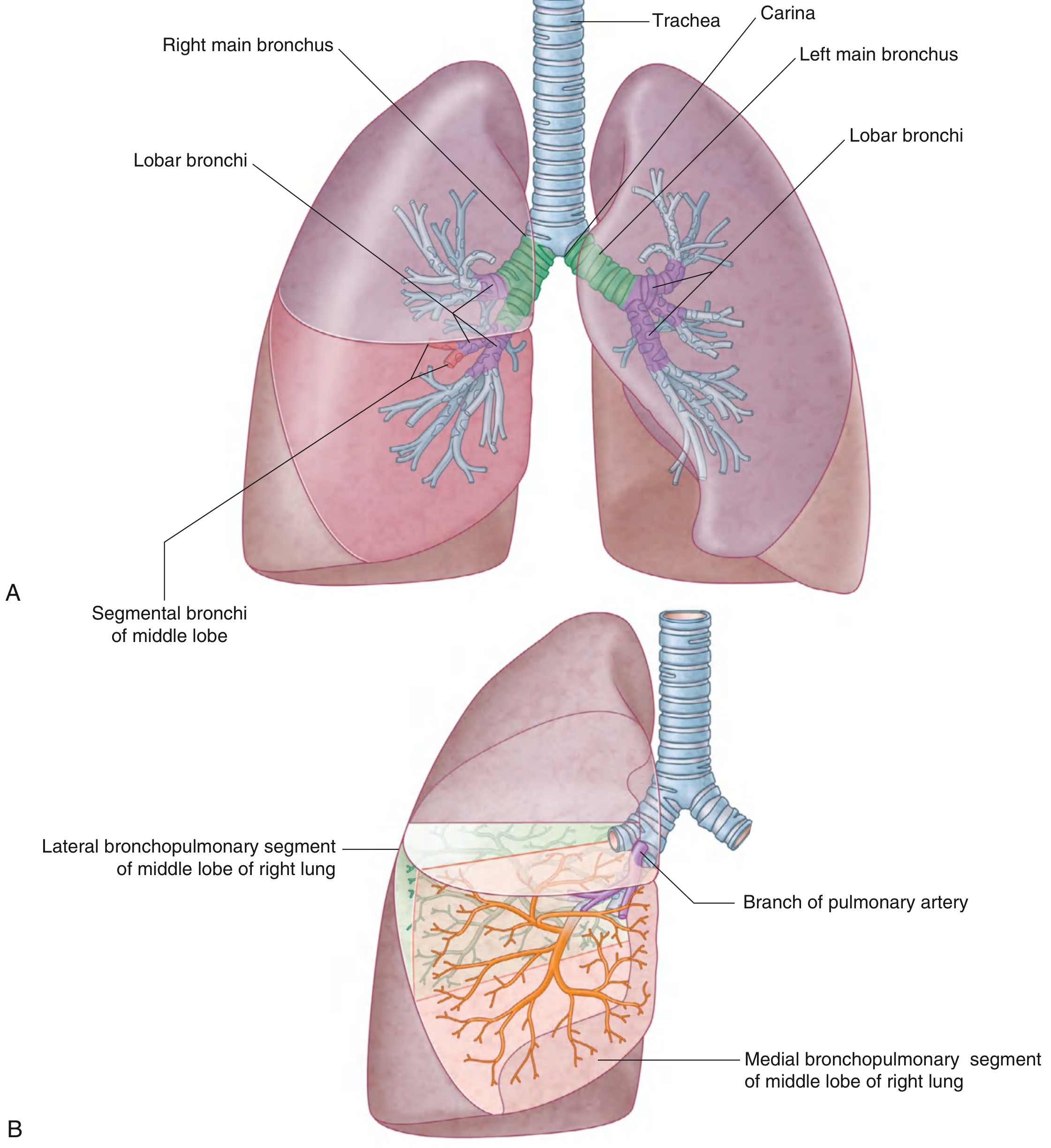
General shape
Each lung is a half-cone with:
- A base resting on the diaphragm
- An apex projecting above rib I into the root of the neck
- Two surfaces: the costal surface (against the ribs/intercostal spaces) and the mediastinal surface (against the mediastinum/vertebral column), which carries the comma-shaped hilum where structures enter and leave
- Three borders: sharp inferior and anterior borders, and a smooth, rounded posterior border
Root and hilum
The root is a short bundle of structures connecting the lung to the mediastinum, covered by a pleural sleeve that becomes visceral pleura at the hilum. Within each root are: a pulmonary artery, two pulmonary veins, a main bronchus, bronchial vessels, nerves, and lymphatics. Generally the artery sits superiorly, the veins inferiorly, and the bronchi somewhat posteriorly. A pulmonary ligament (a pleural fold) hangs from the root and helps stabilize the lower lobe.
Right lung
Three lobes (superior, middle, inferior) separated by two fissures:
- Oblique fissure - separates the inferior lobe from the superior/middle lobes
- Horizontal fissure - separates the superior from the middle lobe
Its medial surface relates to the heart, superior and inferior vena cava, azygos vein, and esophagus.
Left lung
Smaller, with only two lobes (superior and inferior) separated by a single, more oblique oblique fissure. It lacks a middle lobe; instead the superior lobe has a tongue-like lingula projecting over the cardiac notch (an indentation caused by the heart bulging into the left pleural cavity). Its medial surface relates to the heart, aortic arch, thoracic aorta, and esophagus.
Bronchial tree
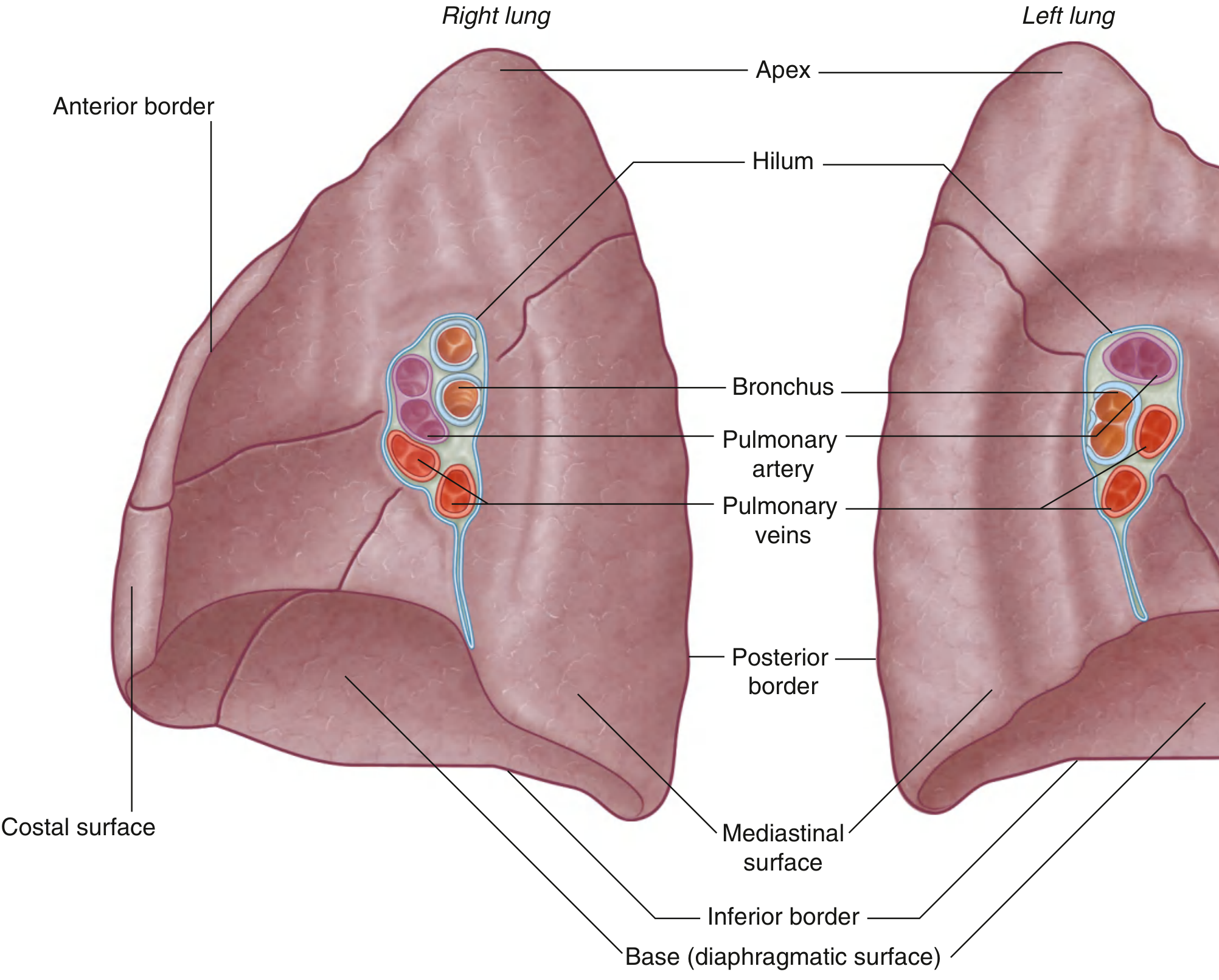
The trachea bifurcates at vertebral level T4/T5 into right and left main bronchi at the carina. The right main bronchus is wider, shorter, and more vertical than the left, which is why inhaled foreign bodies more often lodge in the right lung. Each main bronchus divides into lobar bronchi (3 on the right, 2 on the left), which further divide into segmental bronchi.
Bronchopulmonary segments
Each segmental bronchus with its accompanying pulmonary artery branch supplies a bronchopulmonary segment - a cone-shaped, functionally independent unit of lung tissue (apex at the bronchus origin, base at the lung surface). There are 10 segments per lung (some fuse on the left), and each is the smallest unit of lung that can be surgically resected without affecting neighboring segments. Pulmonary vein tributaries drain intersegmentally, running between and around segment margins rather than within them.
Blood supply
The pulmonary trunk bifurcates into right and left pulmonary arteries, carrying deoxygenated blood from the right ventricle to the lungs for gas exchange; oxygenated blood returns via the pulmonary veins to the left atrium. The right pulmonary artery is longer and passes horizontally across the mediastinum.
Source: Gray's Anatomy for Students, pp. 204-211
A quick literature check found no recent systematic reviews/meta-analyses that would revise this core anatomical description (thoracic anatomy is stable, unlike drug/treatment evidence), so no contradicting updates to flag.
This is a shared conversation. Sign in to Orris to start your own chat.