
Symmetric tonic neck reflex vs landau reflex
Symmetric Tonic Neck Reflex (STNR) vs Landau Reflex
Symmetric Tonic Neck Reflex (STNR)
| Feature | Details |
|---|---|
| Stimulus | Head extension or flexion while infant is in supported sitting position |
| Response - Head extension | Upper extremities (UEs) extend + lower extremities (LEs) flex |
| Response - Head flexion | Upper extremities (UEs) flex + lower extremities (LEs) extend |
| Timing | Appears at ~5 months; not present in most normal children; disappears by 8-9 months |
| Category | Primitive reflex |
| Mnemonic | Think "cat" stretching - when the head goes back, arms straighten and legs fold under; when head goes down, arms fold and legs extend |
- When the STNR is present (between 5-9 months), it is thought to help transition the infant from lying flat to getting up onto hands and knees (quadruped position)
- Persistence beyond 8-9 months is abnormal and suggests CNS dysfunction (e.g., cerebral palsy)
- A retained STNR in older children can interfere with crawling, sitting still at a desk, and handwriting
Landau Reflex (Landau Response)
| Feature | Details |
|---|---|
| Stimulus | Infant is held prone (horizontally suspended, face-down, with examiner's hand under the chest/abdomen) |
| Response | Sequential extension: first the head lifts up, then the trunk straightens, then the legs extend - forming an arc or "banana shape" |
| Timing | Appears at 2-3 months; resolves by 12-24 months |
| Category | Postural reaction (not purely a primitive reflex - it is a higher-level righting reaction) |
| Importance | Early measure of developing trunk control; a prerequisite to sitting and standing |
- Absent Landau at 3-6 months suggests hypotonia, motor neuron disease, or intellectual disability
- The Landau response is abnormal in Down syndrome and cerebral palsy where it may be absent or significantly delayed
- It is used as an early screening tool for motor and trunk developmental problems
Side-by-Side Comparison
| Feature | STNR | Landau Reflex |
|---|---|---|
| Also called | "Cat" reflex | Landau response |
| Position | Supported sitting | Prone horizontal suspension |
| Stimulus | Head flexion or extension | Gravity + prone suspension (no additional stimulus needed) |
| Response | UE/LE reciprocal changes based on head position | Whole-body extension (head → trunk → legs) |
| Appears | ~5 months | 2-3 months |
| Disappears | 8-9 months | 12-24 months |
| Type | Primitive reflex | Postural righting reaction |
| Persistence = abnormal? | Yes, beyond 8-9 months | Yes, beyond 24 months; absence before 6 months is also abnormal |
| Clinical use | Screen for CP, neurodevelopmental delay | Screen for hypotonia, trunk control deficits, CP, Down syndrome |
Key Memory Hook
-
STNR = "cat" reflex - the position of the head changes what the arms and legs do
-
Landau = "flying superman" - the baby held prone arches upward like a flying arc; flexing the head collapses the whole body
-
The Harriet Lane Handbook (23rd ed.), Table 9.6 - Primitive Reflexes and eTABLE 9.1 - Postural Reactions
-
Bradley and Daroff's Neurology in Clinical Practice, Ch. 30 - Localization of primitive reflexes in hypotonia
Give me a pictorial representation of position and how to elicit them
Medical educational diagram showing two infant reflexes side by side: LEFT PANEL - "Symmetric Tonic Neck Reflex (STNR) - The Cat Reflex": Top row labeled "Head EXTENSION": Draw a baby in supported sitting position with head tilted back. Arms are straight/extended forward, legs are bent/flexed under. Arrow pointing to head going back. Labels: "UE = EXTEND", "LE = FLEX" Bottom row labeled "Head FLEXION": Same baby with head bent forward/down. Arms are bent/flexed, legs are straight/extended out. Arrow pointing to head going down. Labels: "UE = FLEX", "LE = EXTEND" Position note: "Infant in supported sitting" RIGHT PANEL - "Landau Reflex - The Flying Superman": Top image labeled "NORMAL RESPONSE (2-3 months)": Baby held horizontally prone (face down) by examiner's hand under chest. Baby arcs upward like a bow - head lifted, back arched, legs extended up. Arrows showing the sequential extension: head first, then trunk, then legs. Label: "Head lifts → Trunk extends → Legs extend" Bottom image labeled "HEAD FLEXION = BODY COLLAPSES": Same prone suspension, but examiner passively pushes head down. Baby's whole body droops/flexes in response. Label: "Flex head → trunk and legs collapse" Position note: "Infant held prone horizontally (ventral suspension)" Use clean medical illustration style with clear labels, blue and orange color coding for the two reflexes, timing info (STNR: appears 5mo, gone by 8-9mo; Landau: appears 2-3mo, gone by 12-24mo), white background
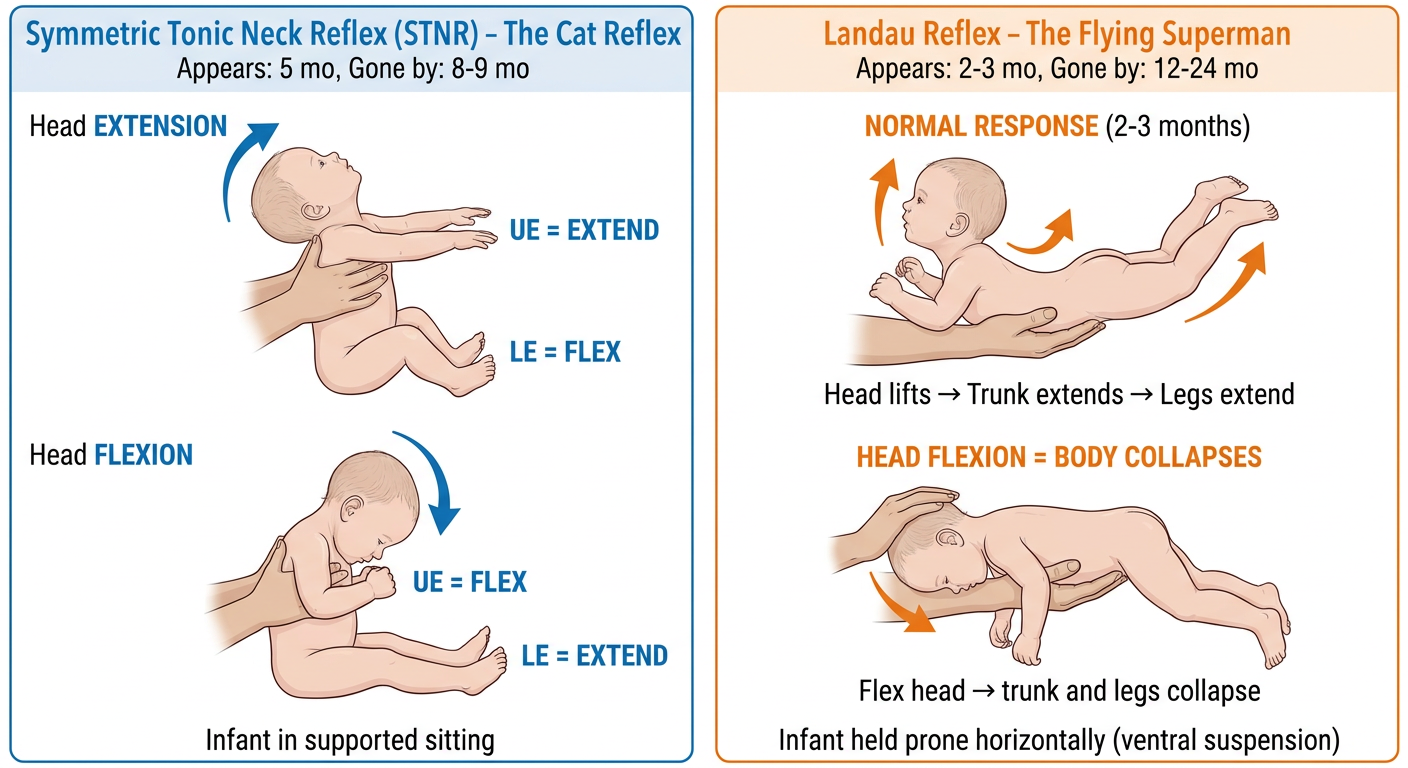
STNR (Left Panel) - How to Elicit
- Place the infant in supported sitting (on your lap or supported at the trunk)
- Extend the head (tilt back) → watch arms extend, legs flex
- Flex the head (tilt forward/chin to chest) → watch arms flex, legs extend
- The limb responses are always opposite between upper and lower
Landau Reflex (Right Panel) - How to Elicit
- Hold the infant prone horizontally - your hand flat under the chest/abdomen (ventral suspension)
- Observe passively - a normal infant will arc upward: head lifts, back straightens, legs extend
- To confirm linkage: passively flex the head downward - the trunk and legs will immediately collapse into flexion
- STNR = head moves, limbs respond in opposite UE/LE pattern (cat stretching)
- Landau = whole body acts as one arc; flex the head and the whole arc collapses