
Eisenmenger syndrome maternal risk how
I'll look this up in the medical library first before responding.
Searching sources...
Reading File
Now I'll search the library and PubMed in parallel.
Finding Sources
Searching PubMed
"Eisenmenger syndrome" AND pregnancy AND maternal mortality
Excellent - now I'll read the most relevant sections in parallel: the maternal-fetal medicine textbook (most directly relevant) and Braunwald's management section.
Reading File
Reading File
Reading File
I now have comprehensive data from multiple authoritative sources. Let me also fetch the circulatory diagram and get the PubMed abstract for the systematic review.
Loading Image
Reading Article
PMID: 38781778
I now have a complete picture from multiple authoritative sources. Here is the full answer:
Eisenmenger Syndrome: Maternal Risk in Pregnancy
What Is Eisenmenger Syndrome?
Eisenmenger syndrome occurs when a large unrepaired left-to-right shunt (most commonly VSD, PDA, or AVSD) causes progressive pulmonary vascular injury. Pulmonary vascular resistance (PVR) rises until it equals or exceeds systemic vascular resistance (SVR), reversing the shunt direction to right-to-left and causing chronic cyanosis with secondary erythrocytosis.
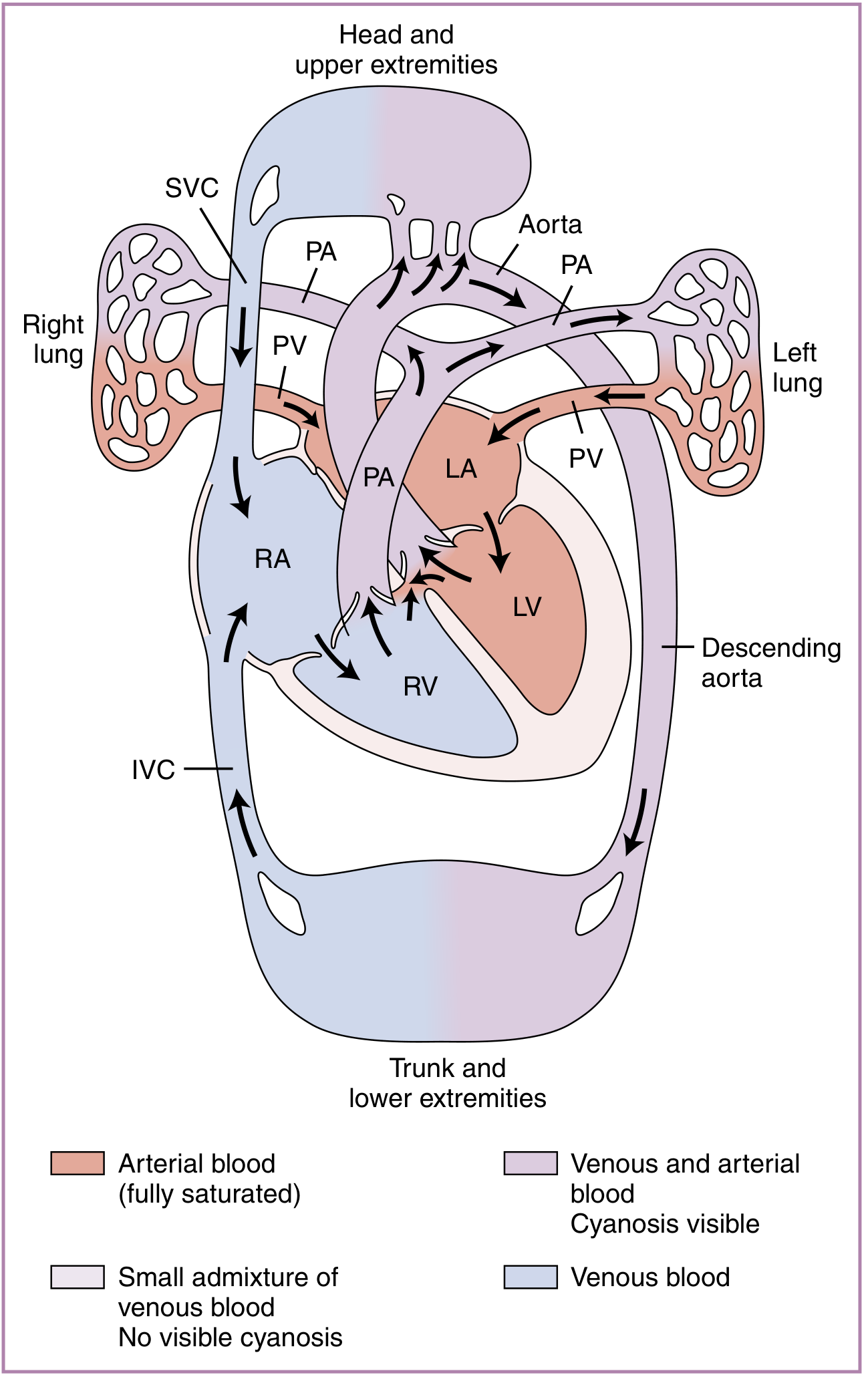
Eisenmenger complex: mixed venous and arterial blood (shown in purple) circulates systemically, causing visible cyanosis. (Creasy & Resnik's Maternal-Fetal Medicine, p. 1253)
Why Pregnancy Is So Dangerous
The normal hemodynamic changes of pregnancy are catastrophic in Eisenmenger syndrome:
| Physiological change in pregnancy | Effect in Eisenmenger syndrome |
|---|---|
| SVR falls (vasodilation) | PVR now greatly exceeds SVR - shunt shifts more right-to-left |
| Blood volume increases | RV already volume- and pressure-overloaded |
| Ventilation restricted (gravid uterus) | Worsens hypoxemia and cyanosis |
| Peripartum blood loss | Acute drop in SVR - sudden severe desaturation |
| Hypercoagulable state | Increases risk of thromboembolism and paradoxical emboli |
The fall in SVR is the key mechanism: it amplifies right-to-left shunting, worsening hypoxemia at a time when oxygen demand is already elevated. - Braunwald's Heart Disease, 15th ed., p. 906; Creasy & Resnik's MFM, p. 1253
Maternal Mortality Figures
- Maternal mortality ~36% - Creasy & Resnik's Maternal-Fetal Medicine (p. 1253)
- Maternal mortality >30% - Braunwald's Heart Disease (Conditions to Avoid table)
- Maternal mortality 26.2% in a 2024 systematic review (Cruz et al., IJOA 2024) across 66 studies (1967-2021), which also showed mortality was falling over time (11.6% pre-2015 to 8.2% post-2015 for PH overall, but Eisenmenger remained the highest-risk subgroup)
This places Eisenmenger syndrome among the highest-risk conditions in pregnancy (WHO Cardiovascular Risk Class IV).
Fetal/Neonatal Risk
- Fetal demise rate: ~27% - driven by chronic maternal hypoxemia impairing placental oxygen delivery
- High rates of spontaneous abortion, preterm birth, and intrauterine growth restriction
- Creasy & Resnik's MFM, p. 1253
Clinical Recommendations
1. Contraception is mandatory
Pregnancy is absolutely contraindicated. Braunwald's explicitly lists pregnancy in the "Conditions to Avoid" table with the rationale: "High risk of maternal mortality (>30%). High risk of spontaneous abortion or miscarriage."
Acceptable contraceptive options:
- Intrauterine devices (IUDs)
- Depo-Provera (medroxyprogesterone) injections
- Progesterone-eluting subcutaneous implants (e.g., Nexplanon)
- Avoid: Estrogen-containing contraception (increases thrombotic risk)
2. If pregnancy occurs
- Early termination should be strongly recommended
- Termination must be performed at a specialized center with Adult Congenital Heart Disease (ACHD) accreditation - anesthesia itself carries high risk in complex cyanotic CHD
- Creasy & Resnik's MFM, p. 1253
3. If the patient refuses termination
Management at a multidisciplinary ACHD/maternal-fetal medicine center with:
- Pulmonary vasodilator therapy (prostacyclin analogues, sildenafil, inhaled nitric oxide)
- Avoid endothelin receptor antagonists (teratogenic)
- Planned delivery before term, typically by cesarean section under regional or general anesthesia with extreme care to maintain SVR
- Anticoagulation consideration (balance thrombotic vs. hemorrhagic risk)
- ECMO may be needed peripartum in refractory cases (a 2026 case series in BMC Pregnancy Childbirth documented ECMO use for PAH-related peripartum crises, PMID 41535768)
Summary
| Risk | Magnitude |
|---|---|
| Maternal mortality | ~30-36% |
| Fetal demise | ~27% |
| Spontaneous abortion | High |
| WHO pregnancy risk class | Class IV (contraindicated) |
Eisenmenger syndrome represents one of the few remaining absolute contraindications to pregnancy in cardiology. The main killer is the SVR-PVR mismatch that deepens right-to-left shunting, combined with inability to tolerate the hemodynamic stress of delivery and blood loss.
Recent evidence note: The Cruz et al. 2024 systematic review (PMID 38781778) suggests overall PH-in-pregnancy outcomes are improving over time with better targeted therapy, but Eisenmenger syndrome mortality remains distinctly higher (26.2%) than idiopathic PAH. This does not change the absolute contraindication status.
This is a shared conversation. Sign in to Orris to start your own chat.