
Explain glycolysis
Glycolysis is the 10-step metabolic pathway that breaks down one glucose molecule (6 carbons) into two pyruvate molecules (3 carbons each), producing a net gain of 2 ATP and 2 NADH. It occurs in the cytoplasm and does not require oxygen. The pathway has two phases: an energy investment phase (steps 1-5, consuming 2 ATP) and an energy payoff phase (steps 6-10, producing 4 ATP and 2 NADH).
Searching sources...
Reading File
Finding Sources
Searching the Web
glycolysis steps enzymes ATP production overview
The best sources are Lippincott (overview), Basic Medical Biochemistry, and Harper's. Let me read the most relevant sections in parallel.
Reading File
Reading File
Reading File
Now let me read the detailed steps of glycolysis from Lippincott and fetch the pathway diagram image.
Reading File
Loading Image
Loading Image
Now let me read more of the detailed steps from Lippincott and fetch a regulation diagram:
Reading File
I now have sufficient material for a thorough, well-structured answer. Let me compose it.
Glycolysis
Glycolysis is a universal 10-step metabolic pathway that converts one molecule of glucose (6C) into two molecules of pyruvate (3C), generating a net gain of 2 ATP and 2 NADH. It occurs in the cytoplasm of virtually all cells and does not require oxygen, making it the cell's only ATP-producing pathway under anaerobic conditions.
Overview Diagrams
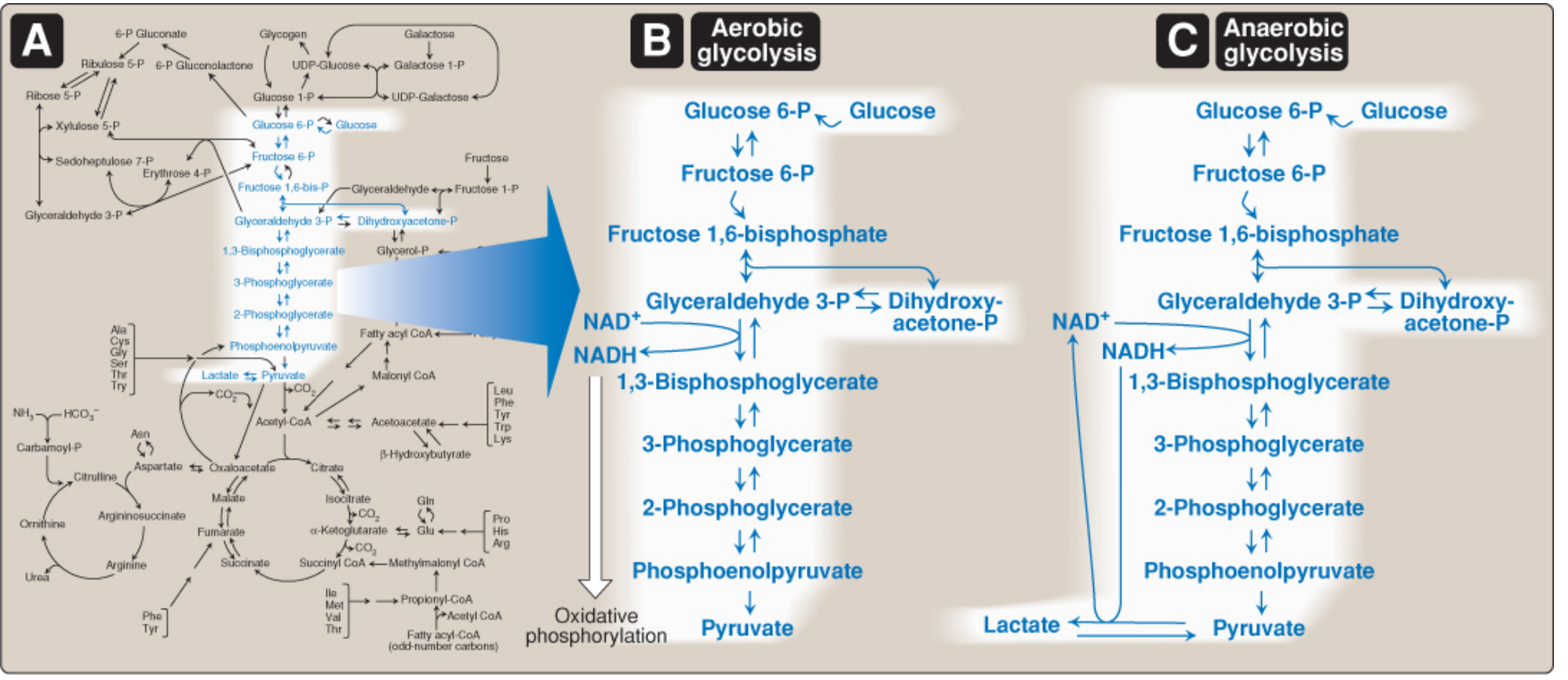
Aerobic vs. Anaerobic Glycolysis:
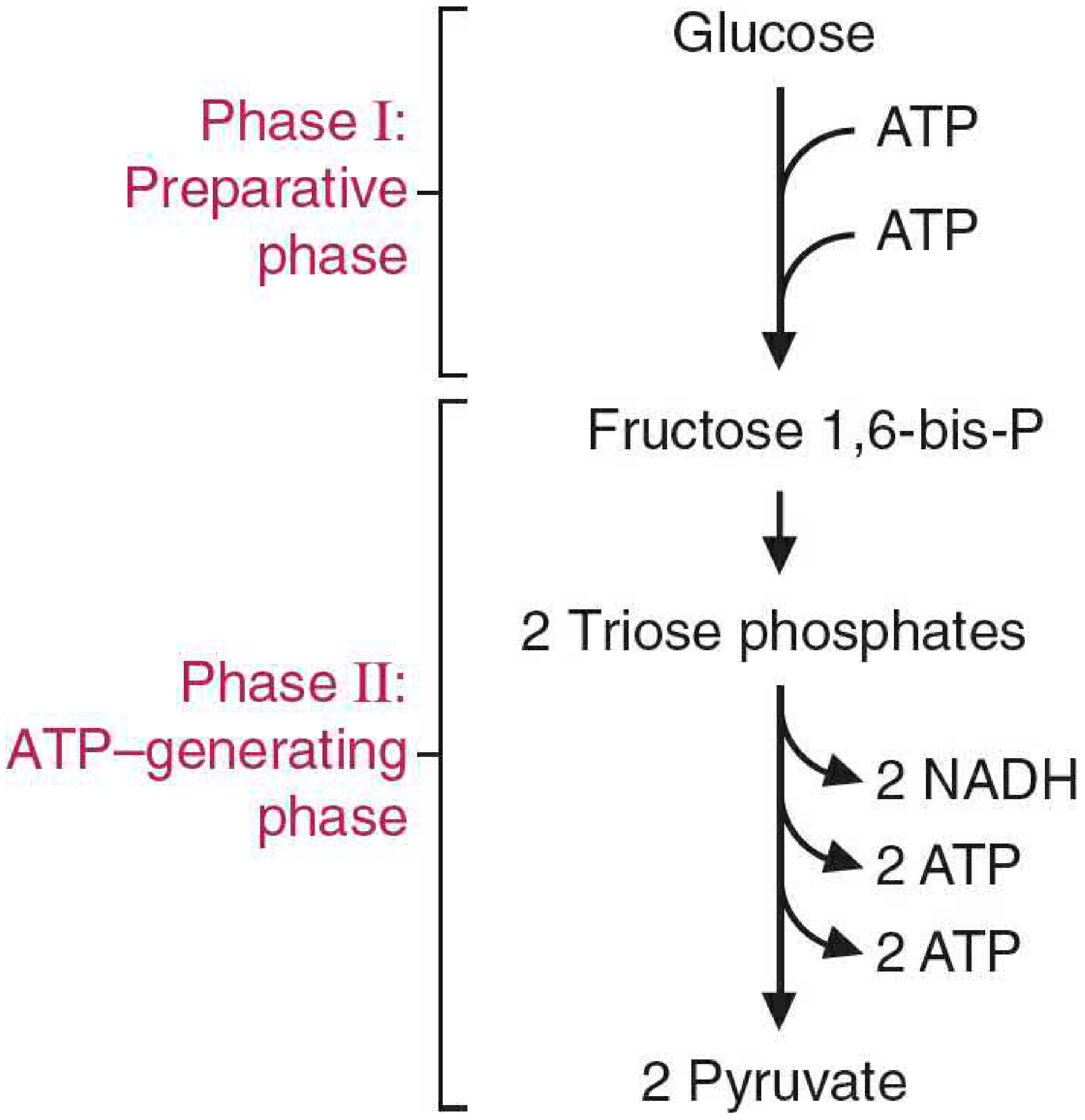
Two-Phase Summary:
The Two Phases
Phase I: Energy Investment (Preparatory) Phase - Steps 1-5
The cell "primes the pump" by spending 2 ATP to phosphorylate glucose into a highly reactive intermediate.
| Step | Reaction | Enzyme | Notes |
|---|---|---|---|
| 1 | Glucose → Glucose 6-phosphate (G6P) | Hexokinase (HK I-III) or Glucokinase (HK IV in liver/beta cells) | Irreversible, ATP-consuming. G6P traps glucose inside the cell. HK I-III have low Km (high affinity); Glucokinase has high Km - acts as a glucose sensor |
| 2 | G6P → Fructose 6-phosphate (F6P) | Phosphoglucose isomerase | Aldose-ketose isomerization; reversible |
| 3 | F6P → Fructose 1,6-bisphosphate (F1,6BP) | Phosphofructokinase-1 (PFK-1) | Irreversible, ATP-consuming. Rate-limiting and committed step; major regulatory point |
| 4 | F1,6BP → Glyceraldehyde 3-phosphate (G3P) + Dihydroxyacetone phosphate (DHAP) | Aldolase | Cleaves the 6C sugar into two 3C fragments |
| 5 | DHAP → G3P | Triose phosphate isomerase (TPI) | Converts DHAP into G3P; both 3C units now enter the payoff phase |
At this point: 1 glucose has become 2 G3P molecules, at the cost of 2 ATP.
Phase II: Energy Payoff (ATP-Generating) Phase - Steps 6-10
Each step occurs twice per glucose (once for each G3P). All energy is recovered here.
| Step | Reaction | Enzyme | Notes |
|---|---|---|---|
| 6 | G3P + NAD+ → 1,3-Bisphosphoglycerate (1,3-BPG) | Glyceraldehyde 3-phosphate dehydrogenase (GAPDH) | Oxidation coupled to phosphorylation; produces 2 NADH |
| 7 | 1,3-BPG → 3-Phosphoglycerate (3-PG) | Phosphoglycerate kinase (PGK) | Substrate-level phosphorylation - generates 2 ATP (×2) |
| 8 | 3-PG → 2-Phosphoglycerate (2-PG) | Phosphoglycerate mutase | Shifts phosphate group; reversible |
| 9 | 2-PG → Phosphoenolpyruvate (PEP) + H2O | Enolase | Dehydration creates a high-energy compound; inhibited by fluoride (used in lab tubes) |
| 10 | PEP → Pyruvate | Pyruvate kinase (PK) | Irreversible, generates 2 ATP (×2). Third key regulatory enzyme |
Net Energy Yield
| Molecule | Invested | Produced | Net |
|---|---|---|---|
| ATP | 2 | 4 | +2 ATP |
| NADH | 0 | 2 | +2 NADH |
| Pyruvate | - | 2 | 2 pyruvate |
What Happens to Pyruvate?
The fate of pyruvate depends on oxygen availability:
- Aerobic conditions (O2 present): Pyruvate enters the mitochondria, is converted to acetyl-CoA by pyruvate dehydrogenase, and feeds into the TCA cycle and oxidative phosphorylation - generating ~30-32 ATP total per glucose.
- Anaerobic conditions (no O2): Pyruvate is reduced to lactate by lactate dehydrogenase, regenerating NAD+ so glycolysis can continue. This is the only ATP source for red blood cells (no mitochondria), rapidly exercising muscle, and hypoxic tissues.
Regulation - The Three Irreversible Steps
Glycolysis is regulated primarily at its three irreversible (thermodynamically favorable) steps:
1. Hexokinase / Glucokinase (Step 1)
- Hexokinase (I-III): Inhibited by its product G6P (product inhibition). Prevents glucose from being phosphorylated faster than it can be used.
- Glucokinase (liver/beta cells): Not inhibited by G6P; acts as a glucose sensor and responds proportionally to blood glucose.
2. Phosphofructokinase-1 / PFK-1 (Step 3) - The Master Regulator
- Inhibited by: High ATP (energy-rich signal), citrate (signals TCA cycle saturation)
- Activated by: AMP (energy-depleted signal), fructose 2,6-bisphosphate (most potent activator)
- Hormonal control: Insulin (fed state) increases fructose 2,6-bisphosphate via PFK-2, activating glycolysis. Glucagon (fasting) does the opposite.
3. Pyruvate Kinase (Step 10)
- Inhibited by: High ATP, acetyl-CoA, alanine (allosteric)
- Activated by: F1,6BP (feed-forward activation)
- Hormonal control: Glucagon (via cAMP/PKA) phosphorylates and inactivates liver PK during fasting
Clinical Connections
| Condition | Enzyme/Mechanism Involved |
|---|---|
| Pyruvate kinase deficiency | Most common glycolytic enzyme defect; causes hemolytic anemia in RBCs (sole ATP source is glycolysis) |
| Warburg effect (cancer) | Tumor cells preferentially use anaerobic glycolysis even in O2 - generates biosynthetic precursors for rapid growth |
| Ischemia/hypoxia | Switch to anaerobic glycolysis → lactate accumulation → lactic acidosis |
| Arsenic poisoning | Inhibits GAPDH (step 6), blocking ATP production |
| Fluoride in blood tubes | Inhibits enolase (step 9), preventing further glucose metabolism - used to preserve glucose in lab specimens |
Key Summary
- Location: Cytoplasm
- Inputs: 1 glucose + 2 ATP + 2 NAD+ + 2 Pi
- Outputs: 2 pyruvate + 4 ATP (net +2) + 2 NADH + 2 H2O
- Three irreversible steps: Steps 1, 3, 10 (enzymes: hexokinase, PFK-1, pyruvate kinase)
- Rate-limiting step: Step 3 (PFK-1)
- Universal: Occurs in all living cells; the most ancient metabolic pathway
Sources: Lippincott Illustrated Reviews: Biochemistry 8e, pp. 294-310; Basic Medical Biochemistry: A Clinical Approach 6e, pp. 791-800
This is a shared conversation. Sign in to Orris to start your own chat.