
Ecmo
Reading File
ECMO (Extracorporeal Membrane Oxygenation) is a form of prolonged cardiopulmonary bypass used for severe cardiac and/or respiratory failure when conventional therapies are insufficient. It oxygenates blood outside the body and returns it, giving the heart and lungs time to recover.
Searching sources...
Finding Sources
Searching PubMed
"extracorporeal membrane oxygenation" AND outcomes
Reading File
Reading File
Reading File
Reading File
Reading File
Reading File
Loading Image
Reading File
Here is a thorough overview of ECMO drawn from authoritative textbook sources:
Extracorporeal Membrane Oxygenation (ECMO)
What Is ECMO?
ECMO (also called extracorporeal life support) is a form of prolonged cardiopulmonary bypass that oxygenates and removes CO2 from the blood outside the body, providing support when the heart and/or lungs fail. Its origins trace back to Gibbon's extracorporeal circuit first used successfully for open-heart surgery in 1953.
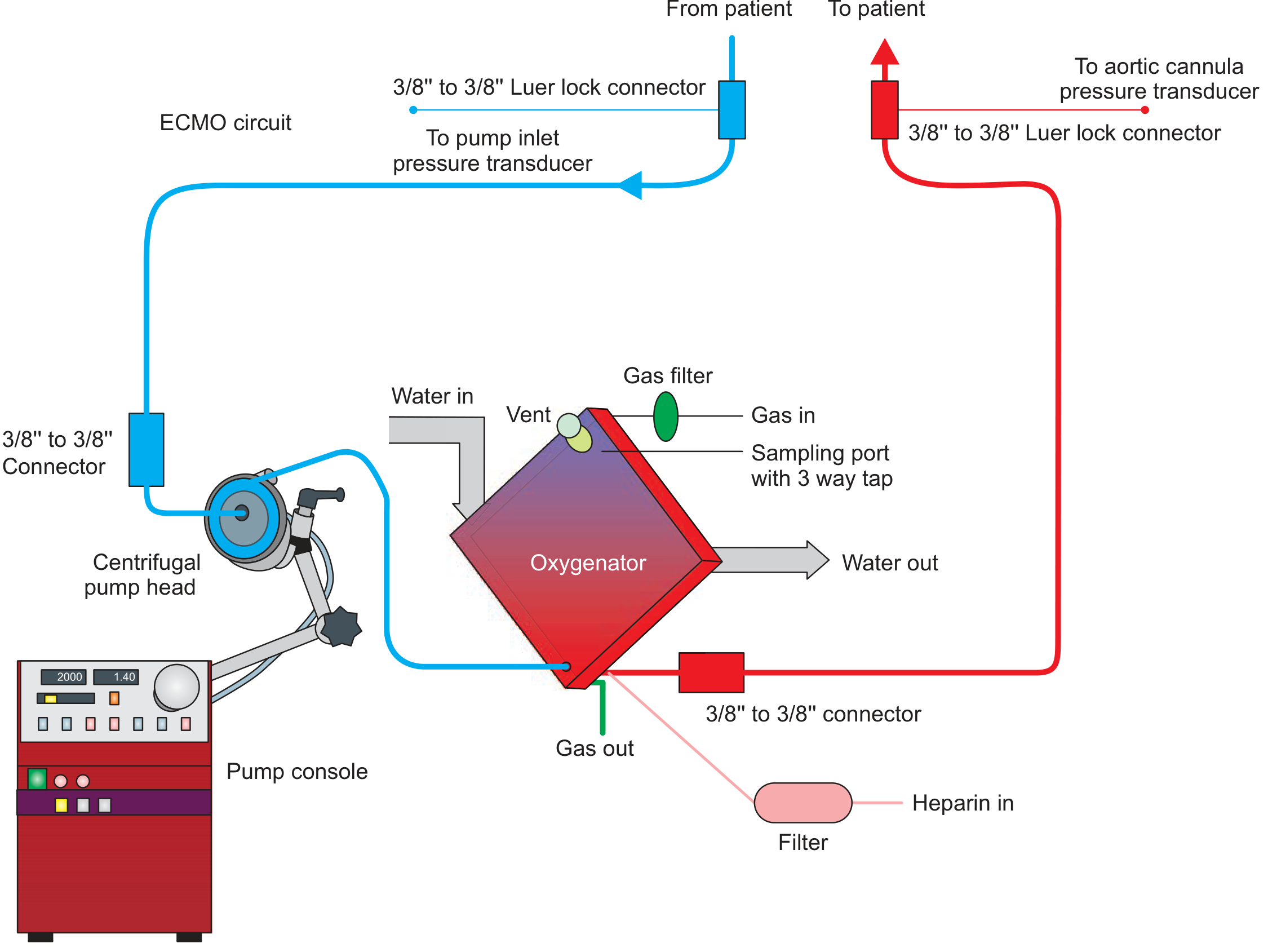
The basic circuit consists of:
- An inflow cannula - drains blood from the patient
- A centrifugal pump - maintains blood flow (magnetically levitated, preload-dependent, afterload-sensitive)
- A membrane oxygenator - gas exchange surface (~2 m² vs. ~143 m² in the human lung)
- An outflow cannula - returns oxygenated blood to the patient
- A heat exchanger - prevents heat loss across the oxygenator
- Continuous heparin infusion to prevent thrombosis
Two Main Types
1. Veno-Venous (VV) ECMO
- Purpose: Lung support only
- Cannulation: Venous drainage and venous return (e.g., femoral vein in, internal jugular vein out via dual-lumen cannula)
- Indication: Severe acute respiratory failure (ARDS, pneumonia, bridging to lung transplant)
- Advantage: Preserves native cardiac output; lower risk of limb ischemia
- Limitation: Does not provide hemodynamic (cardiac) support
2. Veno-Arterial (VA) ECMO
- Purpose: Heart AND lung support
- Cannulation: Venous drainage (femoral/internal jugular), arterial return (femoral artery, or via subclavian graft)
- Indications: Cardiogenic shock, cardiac arrest, refractory hypoxemia, bi-ventricular failure, myocarditis, myocardial stunning
- Key concern: Can cause pulmonary edema and LV fluid overload because it bypasses the LV without unloading it. Often requires additional strategies: inotropes, vasodilators, IABP, or Impella to unload the LV
- Bridges to recovery, VAD placement, or heart transplant
3. Hybrid Configurations
- VAV ECMO and Oxygenated RVAD (Protek Duo): Used when RV failure accompanies respiratory failure (e.g., ARDS with cor pulmonale)
Indications
| Condition | Mode |
|---|---|
| Severe ARDS / acute respiratory failure | VV ECMO |
| Bridge to lung transplant | VV ECMO (awake, ambulatory preferred) |
| Cardiogenic shock | VA ECMO |
| Refractory cardiac arrest (E-CPR) | VA ECMO |
| Myocarditis / myocardial stunning | VA ECMO |
| Biventricular failure + hypoxemia | VA or VAV ECMO |
| RV failure + ARDS | Oxygenated RVAD / VAV ECMO |
Circuit Physiology & Key Parameters
- To achieve adequate O2 delivery (~260 mL O2/min) with post-oxygenator PaO2 >300 mmHg, blood flow of ~4 L/min must be maintained
- CO2 removal is efficient even at low flow rates (<1 L/min with high sweep gas)
- Transmembrane pressure drop should not exceed 30 mmHg (inlet ~250 mmHg, outlet ~220 mmHg)
- Tubing length/surface area matters: activates the inflammatory cascade, consumes clotting factors, and alters pharmacokinetics of antibiotics, opioids, and sedatives
Anticoagulation
Anticoagulation is required continuously to prevent circuit thrombosis:
| Agent | Notes |
|---|---|
| Unfractionated heparin (UFH) | Most common; easy reversal, familiar monitoring (PTT/ACT); risks: heparin resistance, HIT |
| Bivalirudin | Direct thrombin inhibitor; lower HIT risk; renally cleared; t½ ~25 min; no FDA-approved reversal |
| Argatroban | Direct thrombin inhibitor; hepatically cleared; t½ ~45-50 min |
A single-center retrospective study found bivalirudin significantly reduced major bleeding events (11.7% vs. 40.7% with heparin) and decreased circuit thrombosis.
Complications
Hemorrhagic
- Epistaxis, GI bleeding (most common)
- Rare: intracranial hemorrhage, pulmonary hemorrhage
- Mechanism: thrombocytopenia, platelet destruction, clotting factor consumption, anticoagulation
Thrombotic
- Circuit thrombosis (clot in oxygenator or tubing)
- Arterial embolism (especially with VA ECMO)
Hemodynamic (VA ECMO specific)
- LV distension and pulmonary edema (LV cannot eject against the increased afterload from arterial return)
- North-South syndrome (mixing of deoxygenated native LV output with oxygenated ECMO return)
Circuit/Technical
- Pneumothorax and arterial injury during cannulation
- Hemopericardium from guidewire cardiac injury
- Air embolism (especially with awake VV ECMO cannulation)
- Hemolysis (increases exponentially if a second extracorporeal circuit, e.g., CRRT, is added)
- Oxygenator failure (monitor by pressure drop and post-membrane gas values)
Systemic
- Inflammatory cascade activation (cytokine storm)
- Altered drug pharmacokinetics (sequesters antibiotics, sedatives, opioids in tubing)
- Acute kidney injury requiring CRRT (associated with OR 6.5 for in-hospital mortality)
Monitoring & Imaging
- TEE (Transesophageal echocardiography): Before and during cannulation to assess RV/LV function, detect PFO/ASD/VSD, rule out pericardial effusion, guide cannula tip position
- Fluoroscopy: Guides stiff wire and cannula placement
- Ultrasound: Linear surface ultrasound for percutaneous vascular access
- Pre/post-membrane pressure sensors + flow monitoring: Continuous circuit surveillance; transmembrane pressure >30 mmHg signals oxygenator failure
Bridge Strategies
| Goal | Notes |
|---|---|
| Bridge to recovery | Days to weeks; heart/lungs recover; device removed |
| Bridge to VAD | Transition to durable LVAD or BiVAD when no cardiac recovery |
| Bridge to transplant | VV ECMO as bridge to lung transplant (5% of lung transplants as of 2017, rising); awake ambulatory preferred to avoid ventilator-induced injury |
Lung transplant outcomes with VV ECMO bridge: 88% survival to discharge were alive at 1 year; 83% alive at 5 years (Tipograf et al., n=70 successfully transplanted).
Limitations
- VA ECMO does not compensate for severely impaired LV function and may worsen pulmonary congestion
- Not a permanent solution; prone to infection and complications with prolonged use
- Highly institution-dependent: deployment, monitoring, and troubleshooting require dedicated, experienced teams
- Large prime volume causes acute hemodilution at initiation
- Allosensitization risk if blood-primed in pre-transplant patients
Recent Evidence
- ECMO for interstitial lung disease (2024 meta-analysis) - Systematic review in ASAIO J examining outcomes of ECMO in ILD patients [PMID: 38810214]
- Mechanical circulatory support in cardiogenic shock (Lancet 2024) - Individual patient data meta-analysis of temporary MCS (including ECMO) in infarct-related cardiogenic shock at 6-month follow-up [PMID: 39236726]
Sources: Fishman's Pulmonary Diseases and Disorders (Chapter 149, pp. 2641-2660); Fischer's Mastery of Surgery 8th ed. (pp. 345-346)
This is a shared conversation. Sign in to Orris to start your own chat.