
Hemolytic uremic syndrome
Reading File
Finding Sources
Finding Sources
Searching Images
hemolytic uremic syndrome pathology blood smear
Now let me read the most comprehensive sources — Robbins Pathology (for pathology/mechanisms) and Tintinalli (for emergency/clinical management):
Reading File
Reading File
Reading File
Let me get the Robbins pathology section and Tintinalli treatment continuation:
Finding Sources
Reading File
Reading File
Loading Image
I now have comprehensive information from multiple authoritative sources. Let me compile the full answer.
Hemolytic Uremic Syndrome (HUS)
Definition
HUS is a thrombotic microangiopathy (TMA) characterized by the clinical triad of:
- Microangiopathic hemolytic anemia (MAHA)
- Thrombocytopenia
- Acute kidney injury (AKI)
It is the most common cause of AKI requiring dialysis/transplantation in children aged 1–5 years, with an annual incidence of ~6.1 cases per 100,000 population.
— Andrews' Diseases of the Skin, p. 3327; Tintinalli's Emergency Medicine, p. 2112
Classification
Typical HUS (Epidemic, Diarrhea-Positive, STEC-HUS)
- ~90% of pediatric cases
- Caused by Shiga toxin-producing E. coli (STEC), most commonly O157:H7
- Preceded by a prodrome of bloody diarrhea
- Source: undercooked meat, unpasteurized milk, contaminated produce
- 10–15% of children with STEC infection develop HUS
Atypical HUS (aHUS, Diarrhea-Negative, Nonepidemic)
- Complement dysregulation is the dominant mechanism
- Triggers include: S. pneumoniae infection (~5%), pregnancy/postpartum, OCP use, antiphospholipid syndrome, systemic sclerosis, genetic mutations
- Worse prognosis than typical HUS
— Tintinalli's Emergency Medicine, p. 2113; Robbins, Cotran & Kumar, p. 853–854
Pathophysiology
Typical HUS (Shiga Toxin-Mediated)
Shiga-like toxins (resembling Shigella dysenteriae toxins) are absorbed from the gut into the circulation and:
- Activate endothelial cells → increased leukocyte adhesion molecules and endothelin, decreased nitric oxide
- Cause endothelial apoptosis (facilitated by cytokines such as TNF)
- Inhibit Factor H (a complement regulatory protein) → possible complement hyperactivation
- Net result: platelet activation, vasoconstriction, microthrombus formation in renal vessels → glomerular ischemia, oliguria, AKI
— Robbins, Cotran & Kumar, p. 853–854
Atypical HUS (Complement-Mediated)
Mutations in alternative complement pathway regulatory proteins allow uncontrolled C3b activity and complement activation on endothelial surfaces:
| Mutation | Protein Function | Prognosis |
|---|---|---|
| Factor H (CFH) — most common | Degrades C3b; major downregulator of alternative pathway | Death/ESRD >50%; recurrence >75% |
| Factor I (CFI) | Cleaves C3b and C4b | Death/ESRD >50%; recurrence >75% |
| Membrane Cofactor Protein (CD46/MCP) | Cofactor for CFI | Better prognosis |
| Complement Factor B | Component of C3 convertase | Severe |
| Thrombomodulin | Activates complement regulators | Death/ESRD >50% |
| C3 itself | Direct gain-of-function | Severe |
| Anti-CFH autoantibodies (~6%) | Block CFH activity | Autoimmune HUS |
Heterozygous CFH mutations are most common; abnormal CFH complexes with normal CFH, inactivating it. Compound heterozygotes (mutations in two genes) present earlier.
— Andrews' Diseases of the Skin, p. 3333–3334
S. pneumoniae-Associated HUS
Pneumococcal neuraminidase cleaves N-acetylneuraminic acid from RBC and endothelial cell surfaces, exposing the Thomsen-Friedenreich (T) antigen → immune response → TMA. Higher mortality than STEC-HUS.
— Tintinalli's Emergency Medicine, p. 2117
Renal Pathology (Morphology)
In acute disease:
- Patchy or diffuse cortical necrosis and subcapsular hemorrhages (grossly)
- Glomeruli: thickened capillary walls, mesangiolysis, microthrombi (fibrin/platelet) in capillary loops
- Arterioles and small arteries: endothelial swelling and detachment, subendothelial accumulation of fluffy material, RBC fragmentation ("onion-skin" lesions in chronic/recurrent disease)
- Renal vessels are especially vulnerable because the exposed subendothelial membrane is susceptible to complement-mediated damage
The morphologic findings of typical HUS, atypical HUS, and TTP are indistinguishable from each other on biopsy alone.
— Robbins, Cotran & Kumar, p. 853–855; Andrews' Diseases of the Skin, p. 3331
Clinical Features
| Feature | Typical HUS | Atypical HUS |
|---|---|---|
| Age | Children <10 y (most common) | Any age; 67% childhood |
| Prodrome | Bloody diarrhea (1 week prior) | Variable; no diarrhea |
| Fever | Usually absent | Variable |
| Renal involvement | Universal; hallmark | Universal; often severe |
| Neurologic symptoms | <50% | Possible |
| Skin | Unusual; petechiae/retiform purpura | Similar |
| Recurrence | Low | High (CFH/CFI >75%) |
Symptoms after GI prodrome resolves (~1 week): pallor, edema, oliguria, shortness of breath, seizures/encephalopathy. Other complications: hypertension, heart failure, intussusception, DM, metabolic acidosis, colitis.
— Tintinalli's Emergency Medicine, p. 2119; Andrews' Diseases of the Skin, p. 3329
Laboratory Evaluation
| Test | Finding |
|---|---|
| Hemoglobin | 5–9 g/dL (severe MAHA) |
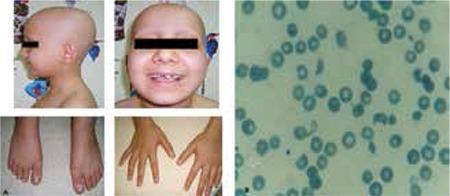
| Peripheral smear | Schistocytes, helmet cells, burr cells (fragmented RBCs) |
| Platelet count | <150,000/mm³ |
| WBC | May be elevated (poor prognosis) |
| Coombs test | Negative (mechanical/non-immune hemolysis) |
| Electrolytes | Hyponatremia, hyperkalemia, metabolic acidosis |
| Bilirubin | Elevated (hemolysis) |
| Renal function | Elevated creatinine, BUN |
| Urinalysis | Hematuria (gross or micro), granular/hyaline casts, proteinuria |
| Stool culture | For STEC; test for Shiga toxin |
| ADAMTS13 | Normal (distinguishes from TTP) |
Peripheral smear showing schistocytes — a hallmark of microangiopathic hemolytic anemia:
— Tintinalli's Emergency Medicine, p. 2121–2123
HUS vs. TTP
| Feature | HUS | TTP |
|---|---|---|
| Dominant organ | Kidney (severe AKI) | Brain (neurologic symptoms) |
| ADAMTS13 | Normal | Very low (<10%) |
| Mechanism | Shiga toxin / complement | ADAMTS13 deficiency → vWF multimers |
| Fever | Usually absent | Present (part of pentad) |
| Renal failure | Common, severe | Uncommon |
| Treatment response to plasma exchange | Moderate | Excellent (>80% response) |
— Robbins, Cotran & Kumar, p. 854
Treatment
Typical HUS (STEC-HUS)
- Supportive care is the primary approach
- IV fluids (early aggressive volume expansion, 10–20 mL/kg NS) may improve outcomes in the absence of fluid overload
- Correct electrolyte disturbances (hyperkalemia, hyponatremia)
- Blood transfusion for severe anemia
- Platelet transfusion: contraindicated — worsens thrombotic process
- Antibiotics: contraindicated in diarrheal illness — increase risk of HUS (possibly by releasing more toxin)
- Antiperistaltic agents: contraindicated
- Renal replacement therapy required in ~50% of acute cases
- Eculizumab or plasma exchange may be helpful (evidence remains limited for STEC-HUS)
- ~95% of children survive the acute phase; most regain normal renal function
Atypical HUS (aHUS)
- Eculizumab (humanized anti-C5 monoclonal antibody): FDA-approved for complement-mediated aHUS; proven effective for CFH and CFI mutations — removes terminal complement activation
- Cost: ~$400,000/year (a practical consideration)
- Plasma exchange: removes autoantibodies and provides functional complement factors, but less effective than in TTP
- Immunosuppressants (corticosteroids, azathioprine, MMF, rituximab, vincristine): used in atypical/autoimmune HUS
- Kidney transplantation: role is unclear — high recurrence risk; success depends on mutation type (MCP mutations have best outcomes post-transplant)
- OCP use should be avoided — can trigger aHUS in patients with CFH (8%) and CFI (20%) mutations
Disposition
- All HUS patients require hospitalization
- Neurologic symptoms + oliguric renal failure → ICU admission
— Tintinalli's Emergency Medicine, p. 2129–2132; Andrews' Diseases of the Skin, p. 3337–3339
Prognosis
| Type | Acute mortality | Long-term |
|---|---|---|
| Typical (STEC-HUS) | ~5% in children | Only 40% normal renal function at 15–25 years |
| S. pneumoniae-HUS | Higher than STEC | Worse renal outcomes |
| aHUS (CFH/CFI mutations) | High | >50% death or ESRD; recurrence >75% |
| aHUS (MCP mutations) | Lower | Better prognosis |
Despite surviving the acute phase, long-term renal outcomes in typical HUS are more guarded than often assumed — in one study, only 10 of 25 patients had normal renal function at 15–25 year follow-up.
— Robbins, Cotran & Kumar, p. 853–854; Andrews' Diseases of the Skin, p. 3333–3335
This is a shared conversation. Sign in to Orris to start your own chat.