
Triceps approach orthopedcis in chrinic elbow disslocation
Reading File
The triceps approach to the elbow is used in chronic/neglected elbow dislocations to restore motion and stability. It typically involves a posterior incision with triceps reflection or splitting to access the joint, address contracture, and reduce the dislocation. Let me search the textbooks for detailed surgical technique.
Searching sources...
Finding Sources
Finding Sources
Searching PubMed
"elbow dislocation" AND "triceps" AND "chronic" OR "neglected"
Campbell's Operative Orthopaedics has a dedicated section on chronic elbow dislocation. Let me read that along with the Rockwood and Green's content on elbow dislocation surgical management.
Reading File
Finding Sources
Searching PubMed
"chronic elbow dislocation" AND surgical treatment
Excellent content found. Let me read more of the Campbell's chronic elbow dislocation section and the Campbell's triceps approach technique.
Reading File
Reading File
Now let me read the full surgical open reduction section from Campbell's for chronic elbow dislocation and the Campbell TECHNIQUE 1.108 for the posterolateral triceps approach:
Reading File
Reading File
I found the key surgical technique (TECHNIQUE 66.11 - Speed's V-Y triceps lengthening for chronic elbow dislocation). Let me read the rest of this technique and the full operative steps:
Reading File
I now have comprehensive detail on the triceps approach for chronic elbow dislocation. Let me compile the full answer.
Loading Image
Here is a comprehensive, textbook-based overview of the triceps approach in chronic (neglected) elbow dislocation:
Triceps Approach in Chronic Elbow Dislocation
Definition and Context
A chronic (neglected) elbow dislocation is generally defined as a dislocation remaining unreduced for more than 3 weeks. Posterolateral dislocations are the most common type. The arm is typically fixed in extension or very slight flexion with severely limited pronation/supination (supination predominates because the biceps wraps around the humeral condyles and tensions the forearm into supination).
These injuries are more common in developing countries. The key pathological findings include:
- Extensive heterotopic ossification around the joint
- Marked shortening and contracture of the triceps muscle
- Tightening of the ulnar nerve with any attempt at flexion
- Ossification or dense fibrous thickening of the joint capsule
- Dense fibrous tissue filling the olecranon and coronoid fossae
- "Radial humeral horn" - ossification of periosteal hematoma near the radial head
- Possible ankylosis
Treatment Options
| Option | Indication |
|---|---|
| Closed reduction | Virtually impossible after 3 weeks |
| Open reduction | Preferred if dislocation < 3 months; acceptable results |
| Open reduction with V-Y triceps lengthening | Most established approach for chronic dislocation |
| Excision arthroplasty / interposition arthroplasty | Older patients, salvage situations |
| Total elbow arthroplasty | End-stage cases |
| Arthrodesis | Rare salvage option |
In children, open reduction is worthwhile regardless of duration, as children regain useful arcs of motion.
The Triceps Approach: Core Principle
Because the triceps shortens and contracts significantly in chronic dislocation, the posterior approach must address this. The primary technique is Speed's V-Y Triceps Lengthening with Open Reduction (Technique 66.11) - a posterolateral approach that divides and lengthens the triceps aponeurosis in a V-Y fashion to gain length while providing complete joint exposure.
TECHNIQUE 66.11 - Speed's Open Reduction with V-Y Triceps Lengthening
(Campbell's Operative Orthopaedics, 15th Ed., 2026)
Incision and Exposure
-
Make an incision over the posterolateral aspect of the elbow, beginning in the midline 10 cm proximal to the olecranon. Continue distally to just proximal to the olecranon tip, then curve slightly laterally over the lateral humeral condyle and the radial head, extending a further 5 cm distally on the forearm.
-
Undermine and retract wound edges to expose the tendinous insertion/aponeurosis of the triceps muscle on the posterior elbow.
-
Locate and protect the ulnar nerve - dissect it free from its groove in the medial humeral condyle and carefully retract it medially throughout the procedure.
Triceps Mobilization (the V-Y Step)
-
Beginning proximally with sharp dissection, reflect the triceps aponeurosis distally to form a flap of tissue still attached to the olecranon.
-
Beginning 7.5 cm proximal to the joint, make an incision in the midline of the arm through the triceps muscle fibers distally to the olecranon, then curve this deep incision around the lateral edge of the olecranon to the distal end of the skin incision.
Subperiosteal Mobilization
-
Subperiosteally strip all muscle attachments from the distal humerus, both anteriorly and posteriorly. Release all capsular and collateral ligament attachments around the condyles. The lower end of the humerus must be completely mobilized - the medial condyle and anterior humeral surface are the most difficult areas.
-
Remove all callus on the posterior humerus and in the olecranon fossa (from periosteal elevation at time of injury) along with any scar tissue.
-
Expose the radial head and clear the trochlear notch of the ulna.
Reduction
-
Rotate the forearm and gently press on the anterior surface of the capitellum to bring the radial head anteriorly into its normal position.
-
If the radial head cannot be reduced easily, widen the soft-tissue dissection rather than using force - the contracted tissues must be released before reduction is attempted.
Closure (the V-Y Lengthening)
- Fill the distal defect in the triceps tendon with the inverted V-shaped portion of the triceps fascia, and close the proximal defect by suturing the remaining two margins of the triceps together.
- Repair the triceps tendon, posterior capsule, and triceps aponeurosis with strong interrupted sutures.
Campbell's Posterolateral Approach (Technique 1.108) - Triceps Aponeurosis Tongue
Used for elbow contracture/exposure alongside chronic dislocation:
- Posterior longitudinal incision, reflect wound edges
- Identify and protect the ulnar nerve
- Free a tongue of triceps aponeurosis and reflect it distally (still attached at olecranon)
- Deviate the incision distally and medially through the triceps aponeurosis to separate the anconeus from the extensor carpi ulnaris
- Divide the posterior capsule in the same line
- Reflect the triceps tendon distally, dividing muscle tissue obliquely with care; stay well clear of the radial nerve
- Reflect anconeus and underlying capsule medially
- Behind the lateral epicondyle, work in the interval between anconeus and common extensor origin; partially reflect the common extensor origin, lateral collateral ligament, and adjacent capsule to increase exposure
- Apply varus strain on the elbow to further increase visualization
- Closure: repair triceps tendon, posterior capsule, and aponeurosis with strong interrupted sutures
Triceps Management Considerations
The triceps must be addressed in virtually all chronic dislocations:
- V-Y lengthening (Speed technique) is the most commonly used and described method when the muscle is significantly contracted
- Some surgeons use needle barbotage to incrementally lengthen the tendon (used in 25% of cases in Anderson et al.'s series)
- The triceps tendon can often be left intact (Anderson et al., 32 patients) - using complete soft-tissue release, intraarticular scar excision, and ulnar nerve transposition, without tendon lengthening or transfer - achieving 97% good-to-excellent results (Mayo Elbow Performance Index) at ~2 years
- Lengthening via V-Y is still considered standard by most authors when the elbow is fixed in extension with a contracted triceps
Additional Intraoperative Considerations
- Ulnar nerve transposition is commonly performed given the nerve is almost always tethered and at risk with flexion
- Heterotopic bone/callus removal from the olecranon fossa and posterior humerus is essential for restoration of motion
- External fixation or Internal Joint Stabilizer (IJS): After wide soft-tissue release, the elbow may be too unstable for early mobilization. The IJS device (Skeletal Dynamics) is now preferred over hinged external fixators - it maintains concentric reduction while allowing immediate range-of-motion exercises. It also protects early ligament reconstruction from failure. Elective removal at 4-6 months.
- "Cruciate" intraarticular ligament reconstruction has also been described for joint stabilization after reduction
Postoperative Care
- Early range-of-motion exercises are paramount - capsular release without prompt mobilization leads to re-stiffening
- IJS or hinged external fixation facilitates this even with ligamentous instability
- Active mobilization gradually introduced; unrestricted motion encouraged as early as tolerated
- Triceps-splitting approaches typically require a brief period of protected motion before unrestricted exercises (unlike paratricipital or lateral approaches)
Complications
- Radial nerve injury (especially with extensile lateral dissection)
- Ulnar nerve injury/neuropathy
- Heterotopic ossification
- Re-dislocation / instability
- Stiffness and loss of terminal extension (most common residual deficit)
- Avascular necrosis of the distal humerus
Source: Campbell's Operative Orthopaedics, 15th Ed. 2026 - Chapter 66 (Technique 66.11; pp. 3829-3831); Chapter 1 (Technique 1.108); Rockwood and Green's Fractures in Adults, 10th Ed. 2025
Recent case series note: PMID 34227592 reports good outcomes with open reduction using an internal fixator for chronic elbow dislocation (2021), and PMID 37587970 describes the IJS surgical technique specifically for this indication (2022) - both consistent with the IJS-first approach in Campbell's.
Noo like tricpes sparing otherr
The triceps-sparing (paratricipital) approach to the elbow avoids detaching the triceps mechanism entirely, working on either side of it. Let me pull the exact textbook content.
Searching sources...
Finding Sources
Finding Sources
Reading File
Reading File
Reading File
Now let me also get the application of this approach specifically to elbow dislocation / complex elbow management from Rockwood & Green:
Reading File
Reading File
Excellent - I now have all the detail needed. Here is the focused answer on triceps-sparing approaches at the elbow:
Triceps-Sparing Approaches to the Elbow
There are actually two distinct approaches commonly called "triceps-sparing," and they are importantly different - worth knowing both.
1. Paratricipital Approach (True Triceps-Sparing / Triceps-On)
First described by Alonso-Llames (1972) for pediatric supracondylar fractures, now widely used for distal humerus fractures and elbow arthroplasty.
Core Principle
Creates two surgical windows - medial and lateral to the triceps - without ever detaching or incising the triceps tendon or its insertion on the olecranon. The triceps insertion remains completely intact.
Step-by-Step Technique
- Skin incision: Extensive posterior longitudinal midline incision
- Ulnar nerve: Identify and mobilize from the arcade of Struthers through the flexor carpi ulnaris (FCU) fascia; place a Penrose drain around it for protection throughout the case
- Medial window:
- Develop the interval between the triceps muscle and the medial intermuscular septum
- Elevate the triceps muscle subperiosteally off the posterior humerus
- Excise the medial intermuscular septum for improved access
- Lateral window:
- Elevate the triceps muscle off the lateral intermuscular septum and posterior humerus, in continuity with the anconeus
- The anconeus and triceps are retracted together laterally
- Exposure achieved: Medial and lateral columns, olecranon fossa, and posterior aspect of the trochlea are visible
Optional Third Window (Boyd Interval Modification)
- A third window can be added between the anconeus and the lateral olecranon (Boyd interval)
- This improves visualization of the distal humerus articular surface when needed
Advantages
- No olecranon osteotomy - avoids nonunion and symptomatic hardware
- Triceps insertion is undisturbed - allows immediate active range of motion postoperatively
- Preserves innervation and blood supply of the anconeus (which provides dynamic posterolateral stability)
- Can be converted to olecranon osteotomy if more exposure is needed intraoperatively
- Can be extended proximally using the Gerwin approach (triceps elevated lateral to medial), exposing 95% of the posterior humeral shaft and radial nerve
Disadvantages
- Limited articular visualization - inadequate for highly comminuted articular fractures (OTA/AO type C3)
- More technically demanding than triceps-splitting
Indications
Best for OTA/AO fracture types: A2, A3, B1, B2, C1, C2; also preferred when proceeding directly to total elbow arthroplasty (TEA) for unrepairable distal humerus fractures
Postoperative Care
Unrestricted active range of motion is encouraged immediately after surgery (no restriction needed since triceps insertion is intact)
2. Bryan-Morrey Approach (Commonly Mislabeled "Triceps-Sparing")
Important clarification from Rockwood & Green (2025): "The approach has been termed triceps-sparing, which has led to confusion. The approach does NOT 'spare' the triceps, but rather detaches the triceps tendon in continuity with the ulnar periosteum and anconeus creating a large reflection or sleeve."
So Bryan-Morrey is technically a triceps-reflecting approach, not a true triceps-sparing approach - but it is commonly taught under the "triceps-sparing" label in many curricula.
Step-by-Step Technique
- Posterior longitudinal skin incision
- Identify and protect the ulnar nerve (always transpose in primary and revision TEA)
- Starting medially, sharply reflect the triceps insertion and ulnar periosteum off the proximal ulna in a medial-to-lateral direction as a continuous sleeve
- This sleeve incorporates the anconeus muscle - the entire extensor mechanism is reflected laterally as one unit
- Release the medial and lateral collateral ligaments to allow joint dislocation for implant insertion (in TEA)
Closure
- Repair triceps tendon back to olecranon with transosseous sutures - this is mandatory and critical
- Postoperative triceps protection required for 6 weeks (no active extension against resistance)
Advantages over Paratricipital
- Better visualization of the proximal ulna - important for ulnar component preparation in TEA
- Familiar, widely taught approach
Comparison Summary
| Feature | Paratricipital (True Triceps-On) | Bryan-Morrey ("Triceps-Sparing") |
|---|---|---|
| Triceps insertion | Completely intact | Detached and reflected |
| Repair required | No | Yes (transosseous sutures) |
| Postop restriction | None - immediate ROM | 6 weeks triceps protection |
| Articular visualization | Moderate | Good |
| Risk of extensor failure | None | Yes |
| Preferred for | Fractures, direct-to-TEA | TEA, better ulna access |
Application in Chronic Elbow Dislocation
For chronic dislocation specifically, the paratricipital approach is valuable because:
- It preserves the extensor mechanism in a joint that has already undergone significant soft-tissue scarring
- It allows immediate postoperative mobilization, which is paramount after capsular release (re-stiffening is the main enemy)
- The medial window provides direct access for ulnar nerve transposition (almost always needed)
- The lateral window allows access to the radiocapitellar joint and lateral column for release
However, if the triceps is severely contracted (fixed extension deformity), a triceps-lengthening approach (V-Y Speed technique) may still be required as the triceps must be lengthened to achieve reduction - in that case a paratricipital approach alone is insufficient.
Sources: Rockwood and Green's Fractures in Adults, 10th Ed. 2025 (pp. 1594-1597, 1623); Miller's Review of Orthopaedics, 9th Ed. (p. 171); Campbell's Operative Orthopaedics, 15th Ed. 2026
Procedure where tricpes is not detached
The paratricipital (triceps-on) approach is exactly the one where the triceps is never detached. Let me pull the full step-by-step technique from the textbooks.
Searching sources...
Finding Sources
Finding Sources
Reading File
Finding Sources
Reading File
Reading File
Loading Image
Loading Image
Here is the focused, complete answer on the approach where the triceps is never detached:
Paratricipital (Triceps-On) Approach - Complete Technique
What Makes It "Triceps-On"
The triceps insertion on the olecranon is never cut, detached, reflected, or disturbed at any point. Instead, surgical windows are created on either side of the intact triceps to access the distal humerus. The muscle and tendon simply slide medially or laterally as needed.
Also known as: bilaterotricipital approach / triceps-sparing approach / triceps slide
First described by: Alonso-Llames, 1972
Patient Positioning
- Supine with the affected arm across the chest, sandbag under ipsilateral shoulder
- OR lateral decubitus position with arm over a padded support
- Sterile tourniquet applied; limb exsanguinated before inflation
- Mark the medial and lateral epicondyles before draping to remind the team of ulnar nerve location
Step-by-Step Surgical Technique
Step 1 - Skin Incision
- Straight posterior longitudinal incision, curved slightly medially around the olecranon tip
- Extend proximally as needed (typically 10-12 cm above olecranon, distally 5 cm below)
- Raise full-thickness medial and lateral subcutaneous flaps until the margins of the triceps are clearly visible on both sides
Step 2 - Ulnar Nerve (Critical First Step)
- Identify the ulnar nerve in its groove behind the medial epicondyle
- Mobilize it from the arcade of Struthers proximally down through the flexor carpi ulnaris (FCU) fascia distally
- Place a Penrose drain around the nerve and keep it visible throughout the entire procedure
- Plan for anterior transposition at closure
Step 3 - Medial Window
- Develop the interval between the triceps muscle belly and the medial intermuscular septum
- Excise the medial intermuscular septum - this is important as it improves mobility of the triceps and protects the ulnar nerve from tethering
- Elevate the triceps muscle subperiosteally off the posterior aspect of the distal humerus
- This exposes the medial column and the posterior aspect of the trochlea
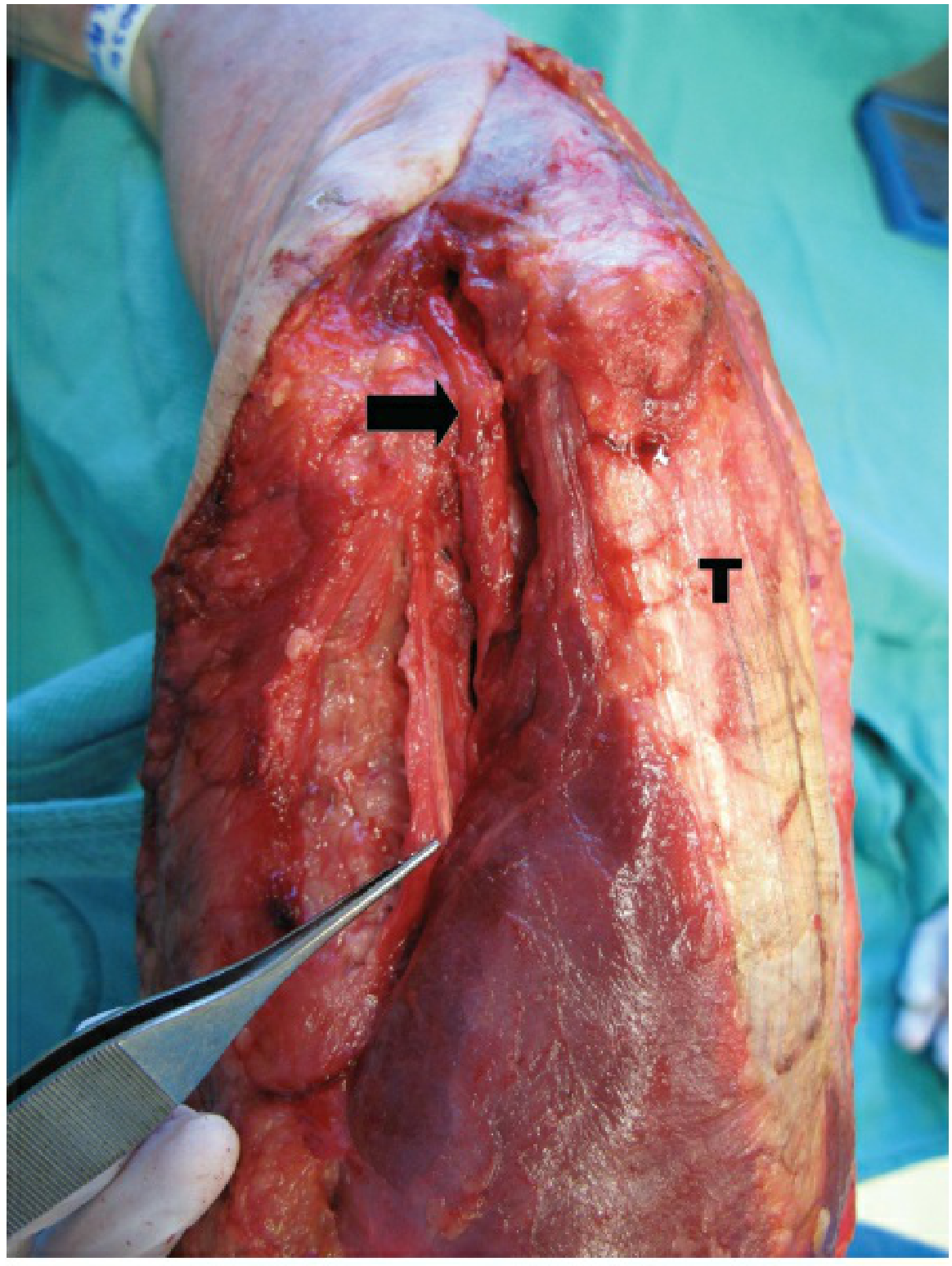
Step 4 - Lateral Window
- On the lateral side, elevate the triceps off the lateral intermuscular septum and posterior humerus, working in continuity with the anconeus
- The triceps and anconeus are retracted together as one unit laterally
- This exposes the lateral column, olecranon fossa, and posterior trochlea
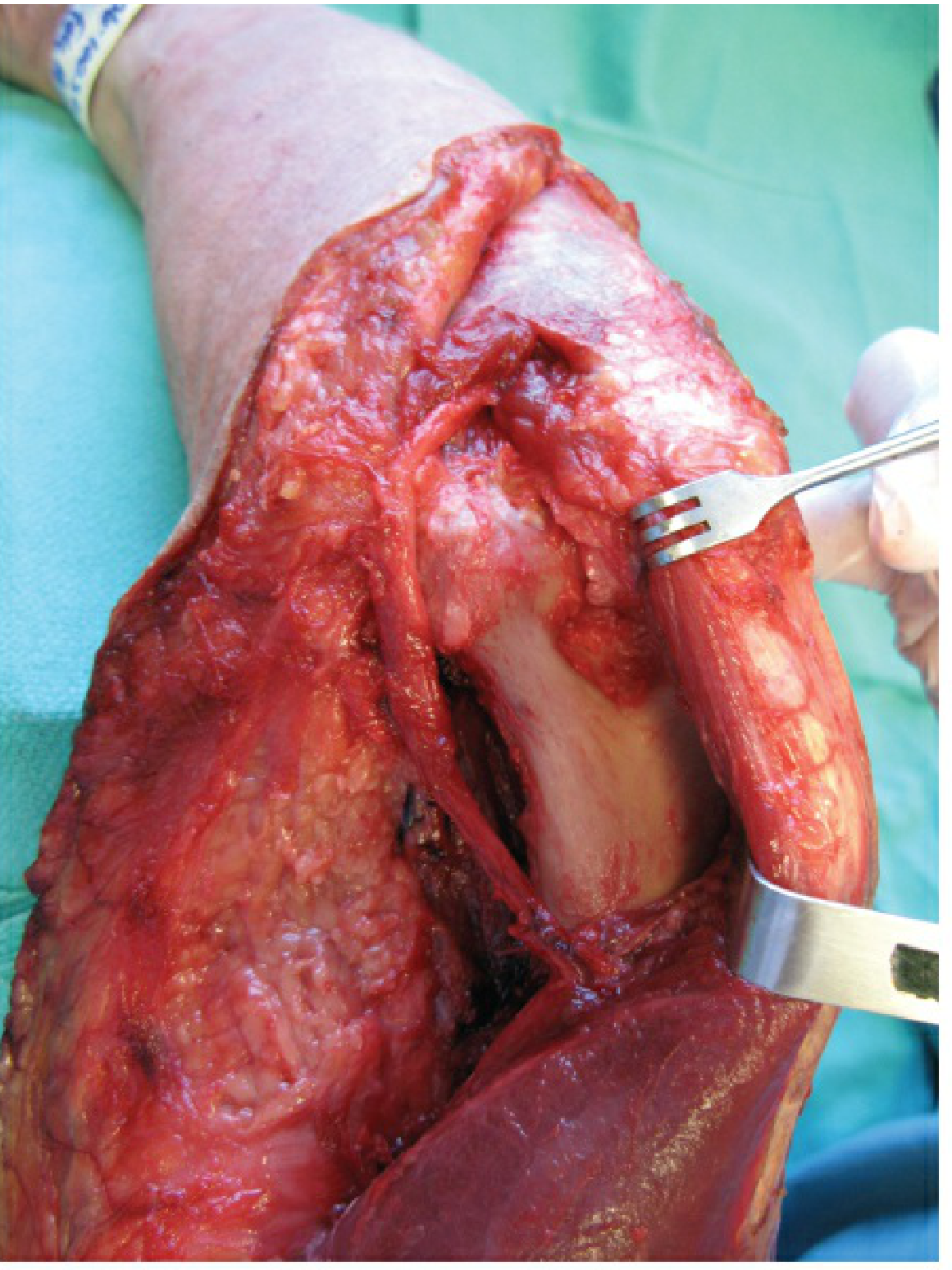
Step 5 - Para-Olecranon Variant (Campbell's preferred for TEA)
- Additionally, reflect the lateral cubital retinaculum and anconeus off the lateral ulna as a single unit, keeping the direct triceps attachment on the olecranon tip undisturbed
- Excise the posterior capsule and fat pad for joint entry
- Collateral ligaments are released on each side to allow elbow dislocation for implant insertion (when doing TEA)
Step 6 - Third Window (Boyd Interval - Optional)
- When more articular visualization is needed, a third window can be added between the anconeus and the lateral border of the olecranon (Boyd interval)
- Increases visualization of the articular surface without touching the triceps
What Is Exposed
| Structure | Visible? |
|---|---|
| Medial column | Yes |
| Lateral column | Yes |
| Olecranon fossa | Yes |
| Posterior aspect of trochlea | Yes |
| Full articular surface (C3 fractures) | Inadequate - main limitation |
| Proximal ulna (for TEA) | Limited (better with para-olecranon variant) |
Closure
- No triceps repair needed - the insertion was never touched
- Reattach/repair the anconeus to the ulna if elevated (fascial sutures)
- Anterior transposition of ulnar nerve
- Layered wound closure
Postoperative Care
- Immediate unrestricted active range of motion - flexion, extension, pronation, supination - all allowed from day 1
- No triceps protection or restriction required whatsoever
- Sling for comfort only
- Strengthening avoided for first 3 months; lifting limited to 5 lbs for 3 months, then 10 lbs thereafter
Advantages vs. All Other Posterior Approaches
| Approach | Triceps detached? | Repair needed? | Immediate ROM? |
|---|---|---|---|
| Paratricipital (triceps-on) | No | No | Yes - unrestricted |
| Bryan-Morrey | Yes (reflected as sleeve) | Yes - transosseous | No - 6 wk protection |
| Triceps-splitting | Yes (split) | Yes | No - 3 month restriction |
| Olecranon osteotomy | Yes (with bone) | Yes - fixation required | No |
- No risk of triceps rupture or weakness postoperatively
- Avoids olecranon osteotomy complications (nonunion, symptomatic hardware)
- Preserves anconeus innervation and blood supply (dynamic posterolateral stabilizer)
- Convertible intraoperatively to olecranon osteotomy if more exposure unexpectedly needed
- Convertible to Gerwin approach proximally (exposes 95% of posterior humeral shaft) if shaft fracture present
Key Danger - Do NOT Do This
Never divide the triceps transversely in this approach - this converts it into a triceps-cutting approach and nullifies the entire benefit. The rule: work beside the triceps, never through it.
Source: Rockwood and Green's Fractures in Adults, 10th Ed. 2025 (pp. 1594-1596); Campbell's Operative Orthopaedics, 15th Ed. 2026 (Technique 15.5, p. 812); Miller's Review of Orthopaedics, 9th Ed. (p. 171)
This is a shared conversation. Sign in to Orris to start your own chat.