

IMG_4760.jpeg
Detailed answers according to your weightage from standard surgery textbooks
I can see this is a surgery exam preparation list focused on ANUS topics. Let me read the skill file and search the medical library for all these topics simultaneously.
Reading File
The image shows surgery exam topics on ANUS. Given the budget constraints, I'll launch parallel searches across all major topics simultaneously.Now running parallel searches across all major topics:
Finding Sources
Finding Sources
Finding Sources
Finding Sources
Good - found fistula-in-ano sections. Now let me search with broader terms and read the key textbook blocks in parallel:
Finding Sources
Finding Sources
Finding Sources
Finding Sources
Excellent! Found all the key sections. Now let me read the most important blocks in parallel:
Reading File
Reading File
Reading File
Reading File
Reading File
Finding Sources
Reading File
Finding Sources
I now have rich textbook content from Sabiston, Bailey & Love, and Mulholland & Greenfield. Let me compile the comprehensive answer.Now let me compile the complete, exam-ready answers for all topics:
ANUS - Surgery Exam Answers
1. VAAFT (Video-Assisted Anal Fistula Treatment)
VAAFT is a minimally invasive endoscopic technique for treating complex anal fistulae while preserving sphincter integrity.
Equipment
- A specially designed rigid fistulascope (Karl Storz) with a working channel for instruments
- An electrode for fulguration, a brush for debridement, a forceps
- Saline irrigation for distension and visibility
- A monopolar diathermy probe
Principle
The procedure works in two phases:
- Diagnostic phase - the fistuloscope is inserted through the external opening under direct vision to map the entire fistula tract, identify internal opening, and detect secondary tracks or branches
- Operative phase - granulation tissue is debrided with a brush, the tract is ablated under direct vision with a monopolar electrode without dividing sphincter muscle. The internal opening is closed with a stapler or suture ligation
Advantages
- No sphincter division - preserves continence
- Direct visualization of the entire tract
- Can identify secondary tracks missed clinically
- Can be repeated if initial attempt fails
- Applicable to complex transsphincteric fistulae
Results
Healing rates of 71-85% with minor or no fecal incontinence at 2 years of follow-up. Described as having "encouraging short-term results" (Sabiston 28e).
Comparison with FiLaC
- FiLaC (Fistula Laser Closure) uses a radially emitting laser probe to ablate the tract rather than an electrode. Meta-analysis shows 65% healing at median 24 months.
- Both techniques follow the same principle: ablate from inside without dividing sphincter
Source: Sabiston Textbook of Surgery, Bailey & Love 28e, Current Surgical Therapy 14e
2. Management of Fissure in Ano
Definition
An anal fissure is a linear tear in the anoderm distal to the dentate line, most commonly in the posterior midline (90%), less often anterior midline (10%, especially in women).
Pathophysiology
Chronic fissures are sustained by internal anal sphincter (IAS) hypertonia causing ischaemia of the posterior commissure. The ischaemic cycle: spasm → pain → more spasm.
Classification
- Acute fissure: <6 weeks, fresh tear, no sentinel pile
- Chronic fissure: >6 weeks, indurated edges, sentinel pile, hypertrophied papilla at proximal end, exposed sphincter fibers at base
Treatment
Conservative (Acute Fissures)
- High-fiber diet, stool softeners, increased fluid intake
- Warm sitz baths for symptom relief
- Topical anesthetics (lidocaine)
Medical (Chronic Fissures) - Chemical Sphincterotomy
| Drug | Mechanism | Dose | Healing Rate | Side Effect |
|---|---|---|---|---|
| GTN (0.2-0.4%) | NO donor - relaxes IAS | Apply 8-hourly | 50-80% | Headache (20-30%) |
| Diltiazem (2%) | CCB - relaxes IAS | Apply BD | 65-95% | Minimal |
| Nifedipine 0.3% | CCB | Apply BD | Similar to diltiazem | - |
| Botulinum toxin | Blocks Ach at neuromuscular junction | 20 IU injection into IAS | 60-80% | Temporary incontinence (rare) |
Diltiazem is preferred over GTN due to fewer side effects and equivalent efficacy.
Surgical - Lateral Internal Sphincterotomy (LIS)
- Gold standard for chronic anal fissure
- Healing rates 92-95% - the standard by which all treatments are measured
- Divides the IAS at the lateral position (3 or 9 o'clock) to reduce hypertonia
- Can be open (conventional) or closed (Parks) technique
- Done under local, regional, or general anesthesia
- Risk: fecal incontinence (minor soiling 0-36%, significant incontinence rare)
Other Surgical Options
- Anal dilatation (Lord's procedure) - largely abandoned due to high incontinence rates
- Fissurectomy with or without advancement flap - for complex cases
- Posterior midline sphincterotomy - avoided (risk of keyhole deformity)
Source: Sabiston 28e, Bailey & Love 28e, Sleisenger & Fordtran's GI Disease, Goldman-Cecil Medicine
3. Management of Fistula in Ano + Recent Advances
Definition
An anal fistula is a chronic abnormal communication between the anorectal lumen (internal opening at dentate line) and the perianal skin (external opening). About 50% of perianal abscesses develop fistulae.
Etiology
- Idiopathic/cryptoglandular (majority) - infection of anal glands at dentate line (cryptoglandular theory)
- Crohn's disease, TB, actinomycosis, lymphogranuloma venereum, foreign body, malignancy
Goodsall's Rule
- External opening posterior to a transverse line through the anus → fistula tracks in a curved manner to a posterior internal opening
- External opening anterior to the transverse line → fistula tracks directly to the nearest internal opening
Parks Classification
- Intersphincteric (45%) - track confined to intersphincteric plane, does not cross external sphincter
- Transsphincteric (30%) - track traverses external sphincter; can be low (lower 1/3) or high (upper 2/3)
- Suprasphincteric (20%) - track passes above puborectalis, loops over it
- Extrasphincteric (5%) - track passes outside both sphincters; often iatrogenic or from pelvic disease
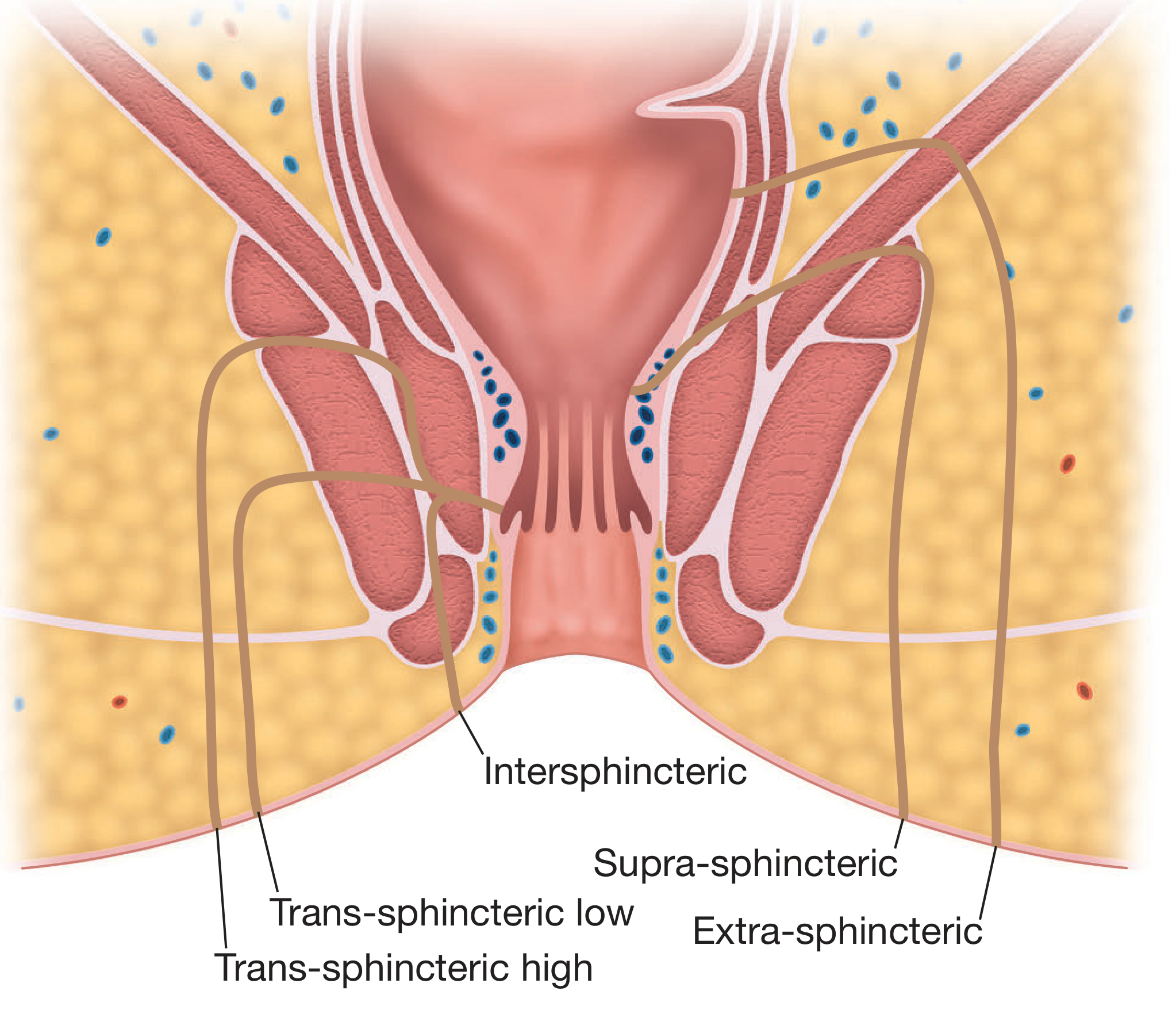
AGA Classification (Clinical)
- Simple fistula: low (intersphincteric or low transsphincteric), single external opening, no abscess
- Complex fistula: high transsphincteric/extrasphincteric/suprasphincteric, multiple openings, abscess, Crohn's
Investigations
- EAUS (Endoanal Ultrasound) with H2O2 instillation - determines simple vs complex
- MRI (STIR sequence) - gold standard; identifies secondary extensions, pus, and granulation tissue without contrast
Surgical Treatment
1. Fistulotomy (Laying Open)
- For intersphincteric and low transsphincteric fistulae (<30% external sphincter)
- Best results when <1/3 of sphincter is divided
- Marsupialisation of wound edges speeds healing
- Continence maintained if minimum 2 cm of external sphincter retained
2. Seton Technique
- Cutting seton (tightening seton): Progressively tightened to gradually cut through sphincter with fibrosis preventing incontinence. Largely replaced by other techniques.
- Draining/loose seton: Used for high/complex fistulae to drain sepsis and allow fibrosis before definitive repair. Often used as first stage.
3. LIFT (Ligation of Intersphincteric Fistula Tract)
- Rojanasakul technique (2007)
- Access via intersphincteric plane, ligate the tract at both sides and divide
- Preserves external sphincter; healing 50-80%
- If it fails, often results in a simpler intersphincteric fistula amenable to fistulotomy
4. Endorectal Advancement Flap
- For complex transsphincteric fistulae
- Excise fistula tract; close rectal/internal opening with vascularized mucosal flap from proximal rectum
- Healing rates 66-87%
- Risk of incontinence if internal sphincter included in flap
5. Fistula Plug (Surgisis)
- Biological absorbable plug inserted into tract
- Does not require sphincter division
- Healing rates variable (25-87%); less predictable
Recent Advances (High Yield)
| Technique | Mechanism | Healing Rate |
|---|---|---|
| VAAFT | Endoscopic fulguration of tract | 71-85% |
| FiLaC | Laser ablation of tract | 65% at 24 months |
| OTSC (Over-the-Scope Clip) | Endoscopic clipping of internal opening | Limited data |
| Stem cell injection (Darvadstrocel) | Adipose-derived mesenchymal stem cells around complex Crohn's fistulae | ~50% remission (phase III - ADMIRE-CD trial) |
| Video-enhanced LIFT | LIFT under endoscopic guidance | Emerging |
Source: Sabiston 28e, Bailey & Love 28e, Current Surgical Therapy 14e
4. Surgical Anatomy of Anal Canal
Length and Position
- Surgical anal canal: 4 cm long - extends from the anorectal ring (puborectalis) above to the anal verge below
- Anatomical anal canal: 2 cm - from dentate line to anal verge
- The surgical length is what matters clinically
Lining / Zones (Craniocaudal)
| Zone | Epithelium | Extent |
|---|---|---|
| Columnar zone | Columnar mucosa | Above ATZ |
| ATZ (Anal Transitional Zone) | Mixed columnar + squamous (cloacogenic) | 6-12 mm above dentate line |
| Dentate line (Pectinate line) | Junction | At level of anal valves/crypts |
| Pecten (Zona alba) | Modified squamous (non-hairy) | Dentate line to anal verge |
| Perianal skin | Squamous with hair follicles | Below anal verge |
Dentate Line - Surgical Importance
The dentate line is the key landmark separating:
- Above: No somatic pain sensation (only visceral pressure), columnar epithelium, lymphatics drain to internal iliac nodes, venous drainage to portal system (superior rectal vein)
- Below: Somatic pain sensation (inferior rectal nerve), squamous epithelium, lymphatics drain to inguinal nodes, venous drainage to systemic (inferior/middle rectal veins)
Anal Columns of Morgagni
- 8-14 longitudinal folds of mucosa above the dentate line
- At their bases are anal crypts where anal glands open
- Cryptoglandular infection here is origin of fistula/abscess
Anal Sphincter Complex
| Structure | Type | Function | Nerve |
|---|---|---|---|
| Internal anal sphincter (IAS) | Smooth muscle, involuntary | Maintains 85% of resting tone | Sympathetic (L1-L2), Parasympathetic (S2-4) |
| External anal sphincter (EAS) | Striated muscle, voluntary | Active squeeze pressure | Pudendal nerve (S2,3,4) |
| Puborectalis | Striated, part of levator ani | Maintains anorectal angle (~90°); critical for continence | Pudendal nerve |
Continence Mechanism
- IAS - resting tone
- EAS - voluntary squeeze
- Puborectalis - anorectal angle (normal ~90°; relaxes to 130° during defecation)
- Anal cushions/haemorrhoids - fine-tune closure
- Anal sampling reflex (RAIR - rectoanal inhibitory reflex): relaxation of IAS allows ATZ to "sample" content
Blood Supply
- Arterial: Superior rectal artery (inferior mesenteric) + inferior rectal artery (internal pudendal) + middle rectal artery (internal iliac)
- Venous: Superior rectal vein (portal) → portal hypertension causes internal haemorrhoids; Inferior rectal vein (systemic)
Lymphatic Drainage
- Above dentate line → Internal iliac nodes
- Below dentate line → Superficial inguinal nodes
5. Management of Haemorrhoids
Definition
Haemorrhoids are vascular cushions - a normal anatomical structure in the anal canal at the left lateral, right anterior, and right posterior positions (3, 7, 11 o'clock) that aid continence. They become symptomatic when engorged, prolapsed, or thrombosed.
Classification (Grade)
| Grade | Description |
|---|---|
| I | Bleeding; no prolapse |
| II | Prolapse on straining; spontaneous reduction |
| III | Prolapse requiring manual reduction |
| IV | Irreducible prolapse (may be strangulated) |
Symptoms
- Bright red rectal bleeding (painless, fresh, on paper/pan) - most common
- Prolapse
- Mucus discharge, pruritus ani
- Discomfort (pain only if strangulated/thrombosed)
- Anaemia (rare, chronic)
External vs Internal Haemorrhoids
- Internal: Above dentate line, no pain sensation, covered by columnar/transitional epithelium; graded I-IV
- External: Below dentate line, painful when thrombosed, covered by squamous epithelium
Management
Conservative (All grades initially)
- High-fiber diet, increased fluid, stool softeners, avoid straining
- Sitz baths for comfort
Office Procedures (Grade I-III)
| Procedure | Mechanism | Best For |
|---|---|---|
| Rubber Band Ligation (RBL) | Strangulates pedicle → fibrosis | Grades I-III (most effective non-surgical) |
| Injection Sclerotherapy | 5% phenol in almond oil; induces fibrosis | Grade I-II |
| Infrared Coagulation | Heat-induced protein coagulation | Grade I-II |
| Cryotherapy | Tissue destruction by freezing | Less popular |
RBL is the most commonly used and most effective non-surgical office procedure.
Surgical (Grade III-IV, failed office procedures)
- Milligan-Morgan Haemorrhoidectomy (open) - standard; three piles excised with V-shaped wounds left open; most widely practiced
- Ferguson Haemorrhoidectomy (closed) - wounds sutured closed; popular in USA
- Stapled Haemorrhoidopexy (PPH - Procedure for Prolapse and Haemorrhoids) - circular stapling device removes a ring of mucosa and submucosa above the haemorrhoids, returning prolapsed piles to normal position. Less pain, faster return to work. Risk: recurrence, persistent prolapse.
- HALO (Haemorrhoidal Artery Ligation Operation) - Doppler-guided ligation of superior rectal artery branches; can be combined with mucopexy (RAR - rectoanal repair). RCT (HubBLe trial, Lancet 2016) showed RBL superior for recurrence vs HALO at 1 year, but HALO had less pain.
Acute/Emergency
- Acutely thrombosed external haemorrhoid: Excision under local anesthesia within 48-72 hours if severe pain; after 72 hours - conservative management
- Prolapsed strangulated internal haemorrhoids: Emergency haemorrhoidectomy can be done safely even in emergency setting
Source: Schwartz's Principles of Surgery 11e, Sabiston 28e, Harrison's 22e
6. Benign Perianal Disease & its Management
Conditions:
- Haemorrhoids - see above
- Anal Fissure - see above
- Fistula in Ano - see above
- Perianal/Anorectal Abscess
- Pilonidal Disease
- Pruritus Ani
- Anal Condylomata
Perianal/Anorectal Abscess
Classification (by space involved)
- Perianal abscess (most common, ~40%) - just under perianal skin
- Ischiorectal abscess - in ischiorectal fossa
- Intersphincteric abscess - in intersphincteric plane
- Supralevator abscess (rarest) - above levator ani
Principles
- Cryptoglandular theory: all start from infection of anal glands at dentate line
- Horseshoe abscess: spreads across deep postanal space to both ischiorectal fossae
Treatment
- Incision and drainage (I&D) is the cornerstone; never try to aspirate or antibiotics alone
- Antibiotics only if cellulitis, Crohn's, diabetes, immunocompromise, or valvular heart disease
- After drainage: ~50% will develop fistula - may be found at time of drainage and treated simultaneously
Pilonidal Sinus
- Sinus in the natal cleft, containing hair tufts; common in young hirsute males
- Pit-picking (Bascom procedure) for acute abscess
- Definitive management: Karydakis flap or Bascom cleft lift (off-midline closure) - superior to midline closure (higher recurrence)
- Rhomboid (Limberg) flap - for complex/recurrent disease
7. Anatomy of Ischiorectal Fossa & Surgical Importance
Boundaries
| Wall | Structure |
|---|---|
| Medial | External anal sphincter + levator ani |
| Lateral | Obturator fascia + obturator internus muscle |
| Posterior | Sacrotuberous ligament + gluteus maximus |
| Anterior | Perineal body (transverse perinei) |
| Roof | Junction of medial and lateral walls |
| Floor | Perianal skin |
Contents
- Fat - the bulk (important surgical tissue plane)
- Inferior rectal (pudendal) vessels and nerve - traverse the fossa in Alcock's canal (pudendal canal) on the lateral wall
- Inferior rectal artery - branch of internal pudendal artery
- Inferior rectal nerve - branch of pudendal nerve (S2,3,4) - supplies EAS and perianal skin
- Perineal branch of S4
Alcock's Canal (Pudendal Canal)
- Fascial canal in the lateral wall of the ischiorectal fossa
- Contains: internal pudendal artery and vein, pudendal nerve
- Nerve divides here into: dorsal nerve of penis/clitoris, perineal nerve, inferior rectal nerve
Surgical Importance
-
Perianal/Ischiorectal Abscess: The ischiorectal fossa is a common site of anorectal abscess. Infection can spread across the deep postanal space (Courtney's space) behind the EAS to form a horseshoe abscess.
-
Anal Fistula Surgery: Transsphincteric fistulae pass through the EAS to reach the ischiorectal fossa. Knowledge of the fossa anatomy is essential to identify and drain secondary extensions.
-
Haemorrhoidectomy: The inferior rectal nerves in the fossa must be preserved.
-
APR (Abdominoperineal Resection): The perineal dissection proceeds through the ischiorectal fossae on both sides, and inadvertent entry into Alcock's canal can damage the pudendal nerve causing sexual dysfunction.
-
ELAPE (Extralevator APR): Newer technique that excises levator ani en-bloc; proceeds lateral to the ischiorectal fossa rather than through it, reducing positive circumferential resection margin rates.
-
Drainage of Supralevator Abscess: Incorrect drainage through the ischiorectal fossa can create a iatrogenic extrasphincteric fistula.
8. Anorectal Malformations (ARM) & Management
Incidence & Genetics
- 1 in 5000 live births; slight male predominance
- 95% have some form of fistulization
- Associated anomalies: VACTERL (Vertebral, Anal, Cardiac, Tracheo-Esophageal, Renal, Limb defects) - screen all ARM cases
Classification (Wingspread Classification)
| Level | Male | Female |
|---|---|---|
| High | Rectoprostatic urethral fistula (most common in males), rectovesical, no fistula | Rectovaginal fistula, no fistula |
| Intermediate | Rectobulbar urethral fistula | Rectovestibular, rectovaginal |
| Low | Anocutaneous (perineal) fistula, anal stenosis | Anovestibular, anocutaneous, anal stenosis |
| Special | Rectal atresia | Cloaca (most complex - single perineal orifice for rectum, vagina, urethra) |
Key Clinical Points
- Males without visible perineal fistula → assume high ARM (rectourethral fistula) until proven otherwise
- Females: most common malformation is rectovestibular fistula
- Cloaca (females only): single channel for all three structures; requires complex reconstruction
- Low lesions have better prognosis for fecal continence than high lesions
Diagnosis
- Invertogram (Wangensteen-Rice) - inverted lateral X-ray at 24 hours of life; gas bubble level vs perineum (largely replaced by MRI/US)
- Cross-table lateral X-ray with prone positioning - gas ascends to rectal pouch
- Perineal US - identify distance of rectal pouch from perineum (<1 cm = low; >1 cm = high)
- MRI - gold standard for defining sphincter muscle complex
- Micturating Cystourethrogram (MCUG) - to identify urethral fistula
- Renal/spinal US, echocardiogram - screen for VACTERL
Management
Low ARM (perineal fistula present)
- Anal transposition (PSARP - posterior sagittal anorectoplasty) without colostomy - can be done in neonatal period
- Or simple cutback procedure for perineal fistula in female (anal stenosis)
High/Intermediate ARM
- Step 1: Neonatal colostomy (sigmoid divided colostomy) - defunctioning + provides distal limb for later contrast study
- Step 2: Definitive repair at 1-3 months - PSARP (Peña procedure) - posterior sagittal approach
- Patient placed prone, midline incision from sacrum to perineum
- Identify sphincter complex with electrical stimulation
- Mobilize rectum, divide fistula, place rectum within sphincter complex
- Step 3: Colostomy closure - 6-8 weeks after PSARP when healed
PSARP (Peña Procedure) - Key Points
- Devised by Alberto Peña
- Excellent visualization of sphincter complex
- Electrical stimulator identifies external sphincter boundaries
- Rectum is mobilized and placed accurately within the sphincter complex
- Fistula is divided and closed
- Continence depends on quality of sphincter complex and accuracy of placement
Complications
- Urethral injury - commonest serious complication in males
- Fecal incontinence - related to level of lesion and sphincter quality
- Constipation (paradoxically common after repair) - treated with bowel management program
Source: Mulholland & Greenfield's Surgery 7e, Sabiston 28e, Yamada's Gastroenterology
9. Total Mesorectal Excision (TME)
Definition
TME is the sharp dissection and complete removal of the rectum with its investing mesorectal envelope (the mesorectum - containing fat, lymphatics, blood vessels, and lymph nodes) intact as a complete cylinder, following the embryological tissue planes.
Introduced by Bill Heald (1982) - the most important advance in rectal cancer surgery.
Anatomical Basis
- The mesorectum is the fatty tissue posterior and lateral to the rectum, enclosed within the visceral fascia (fascia propria of the rectum/mesorectal fascia)
- It contains: superior rectal vessels, lymphatics, autonomic nerve plexuses, perirectal lymph nodes
- A clear plane exists between the mesorectal (visceral) fascia and the parietal (presacral) fascia - the "holy plane" of Heald
Surgical Principle
Dissection proceeds in the avascular plane between the mesorectal fascia and presacral fascia - under direct vision with sharp scissors or diathermy, NOT blunt dissection.
Extent
- Total TME: For mid and low rectal tumours - mesorectum removed to the pelvic floor; used with anterior resection (sphincter-preserving) or APR
- Partial TME: For upper rectal tumours - mesorectum divided 5 cm distal to lower edge of tumour (adequate distal clearance)
Key Oncological Importance
| Parameter | TME Impact |
|---|---|
| Local recurrence | Reduced from 30-40% to <10% |
| Circumferential resection margin (CRM) | Intact mesorectum ensures negative CRM (<1 mm = positive = key prognostic factor) |
| Lymph node harvest | Complete mesorectal nodes retrieved |
| Survival | Improved 5-year survival |
Structures at Risk During TME
- Hypogastric nerves (sympathetic) - at level of sacral promontory; injury → retrograde ejaculation, dry orgasm
- Pelvic plexus (S2,3,4 - parasympathetic) - lateral pelvic sidewall; injury → bladder dysfunction, erectile dysfunction
- Neurovascular bundles of Walsh - posterolateral to prostate/vagina; injury → sexual dysfunction
- Ureter - must be identified bilaterally
- Middle rectal vessels - controlled laterally
Anastomosis After TME
- Low anterior resection (LAR) with TME → colorectal/coloanal anastomosis with defunctioning loop ileostomy (to protect the low anastomosis)
- Colonic J-pouch or side-to-end anastomosis to improve functional outcomes (low anterior resection syndrome)
Laparoscopic and Robotic TME
- Laparoscopic TME: equivalent oncological outcomes to open (COLOR II, COREAN trials); faster recovery
- Robotic TME: technically easier in narrow male pelvis; improved visualization; data accumulating
- Transanal TME (TaTME): newest approach - simultaneous transanal and transabdominal dissection, particularly for obese males with narrow pelvis
Source: Bailey & Love 28e, Sabiston 28e, Schwartz's Surgery 11e
Summary of Exam Weightage (from your notes)
| Topic | Year Appeared | Marks |
|---|---|---|
| VAAFT | Recent | 10 |
| Mx Fissure in Ano | 2014, 2018 | 20 |
| Mx Fistula in Ano + Recent Advances | 2014, 2018 | 20 |
| Benign Perianal Disease | 2015, 2013 | 10 |
| Surgical Anatomy Anal Canal + Mx Haemorrhoids | 2021 | 20 |
| Anorectal Malformation | 2023 | 10 |
| Anatomy Ischiorectal Fossa | 2023 | 10 |
| Total Mesorectal Excision | 2026 | 10 |
| Anatomy Anal Canal + Surgical Importance (2016, 2017) | 80 marks | |
| Recent Trends - Benign Perianal Disease | 2017 | - |
High-priority topics (by frequency and marks): Fistula-in-ano management, Haemorrhoids, Anal canal anatomy, and Fissure-in-ano management.
Sources: Sabiston Textbook of Surgery 28e | Bailey & Love's Short Practice of Surgery 28e | Schwartz's Principles of Surgery 11e | Current Surgical Therapy 14e | Mulholland & Greenfield's Surgery 7e | Harrison's Principles of Internal Medicine 22eAll 8 topics have been covered in full. Here's a quick orientation to what's above:
What's Covered (Topic-by-Topic Summary)
| # | Topic | Key Points Included |
|---|---|---|
| 1 | VAAFT | Equipment, 2-phase technique, healing rates (71-85%), comparison with FiLaC |
| 2 | Mx Fissure in Ano | Pathophysiology, acute vs chronic, GTN/Diltiazem/Botox, LIS (gold standard, 92-95% healing) |
| 3 | Mx Fistula in Ano + Recent Advances | Parks classification with image, Goodsall's rule, AGA classification, fistulotomy/seton/LIFT/advancement flap, + VAAFT/FiLaC/OTSC/stem cells |
| 4 | Surgical Anatomy Anal Canal | Zones, dentate line (above vs below), columns of Morgagni, sphincters, RAIR, blood supply, lymphatics |
| 5 | Mx Haemorrhoids | Grading I-IV, RBL/sclerotherapy/stapled PPH/HALO (HubBLe trial), Milligan-Morgan vs Ferguson, emergency management |
| 6 | Benign Perianal Disease | Overview of all conditions including anorectal abscess classification + pilonidal disease |
| 7 | Ischiorectal Fossa | Boundaries, contents, Alcock's canal, surgical significance in abscess/fistula/APR/ELAPE |
| 8 | TME | Heald's contribution, holy plane, oncological impact (local recurrence <10%), structures at risk, laparoscopic/robotic/TaTME |
High-priority exam focus based on your notes: Fistula-in-ano (LIFT, VAAFT, classification), Anal canal anatomy (80-mark question in 2016/17), and Haemorrhoids (grading + surgical options).


+4 more
Detailed answer according to your weightage from standard textbooks
I can see 4 question papers from MS General Surgery Year-1, January 2025. Let me extract all questions and search the medical library in parallel.
Reading File
The 4 papers contain these questions. Let me search all topics simultaneously:
Paper 1: Acute pancreatitis (30m) | Urolithiasis/renal stone Mx (30m) | Liver hydatid + Anal Fissure (20m) | Therapeutic UGI Endoscopy + Gastritis (20m)
Paper 2: Hand sewn vs Stapled anastomosis + staplers (30m) | Iatrogenic Bile Duct Injury classification/Mx + Lap cholecystectomy prevention (30m) | Bioengineered skin substitutes + ERAS (20m) | Re-implantation of limb + Loss of domain hernia (20m)
Paper 3: Gallbladder stones + Safe cholecystectomy (30m) | LUTS + BPH management (30m) | Acute appendicitis + Non-palpable testes (20m) | Ulcerative colitis + Intestinal obstruction (20m)
Paper 4: Pathophysiological changes in laparoscopic surgery (30m) | Surgical anatomy anal canal + Fistula in ano (30m) | Professional hazards + Informed consent (20m) | Esophageal motility + Neonatal abdominal wall defect (20m)
Finding Sources
Finding Sources
Finding Sources
Finding Sources
Finding Sources
Finding Sources
Finding Sources
Finding Sources
Reading File
Finding Sources
Reading File
Finding Sources
I have sufficient textbook content. Now let me compile the complete comprehensive answers for all 4 question papers:
Last answers
The user wants the complete answers for all 4 question papers from the MS General Surgery Year-1 January 2025 exam. Let me retrieve the key textbook content for all topics simultaneously.
Searching sources...
Finding Sources
Finding Sources
Finding Sources
Finding Sources
Reading File
Reading File
Finding Sources
Finding Sources
Reading File
Finding Sources
Finding Sources
Finding Sources
Finding Sources

IMG_4740.jpeg
Detailed answers according to the weightage from standard surgery textbooks
I can see this is a HERNIA topic list. Let me read the skill and search all topics simultaneously.
Reading File
Searching sources... - Running all hernia topic searches in parallel:
Finding Sources
Finding Sources
Finding Sources
Finding Sources
Reading File
Finding Sources
Finding Sources
Reading File
Finding Sources
Finding Sources
Reading File
Finding Sources
Reading File
Finding Sources
I now have rich textbook content. Let me compile the complete exam-ready answers for all hernia topics.
HERNIA - Detailed Exam Answers
1. Recent Advances in Management of Incisional Hernia (30 marks)
Definition
An incisional hernia is a protrusion of abdominal contents through a defect in the abdominal wall at the site of a previous surgical incision. It occurs in 10-15% of laparotomy wounds.
Etiology / Risk Factors
- Wound infection (most important risk factor)
- Obesity (BMI >30)
- Malnutrition, hypoalbuminaemia
- Diabetes mellitus
- Steroid/immunosuppressive therapy
- Technical errors: tension on closure, mass closure with inadequate bites, wrong suture material
- Emergency surgery, re-exploration
- Chronic cough, constipation, prostatism (raised intra-abdominal pressure)
Classification (European Hernia Society - EHS)
- Width: W1 (<4 cm), W2 (4-10 cm), W3 (>10 cm)
- Location: Midline (M) vs lateral (L)
- Recurrent vs primary
- Loss of domain: herniated volume >20% of total abdominal cavity volume
TRADITIONAL OPEN REPAIR TECHNIQUES
1. Mayo's "Vest over Pants" Repair
- Overlapping flap repair for small umbilical/epigastric hernias
- High recurrence (>30%) with primary suture repair alone - largely abandoned for large hernias
2. Rives-Stoppa Retromuscular Repair
- Gold standard open technique
- Mesh placed in the retromuscular/preperitoneal space (sublay position) posterior to the rectus muscle and anterior to the posterior rectus sheath
- Wide mesh overlap (minimum 5 cm in all directions)
- Reduced recurrence (<5%) due to intraabdominal pressure pushing mesh against the wall
3. Onlay Repair
- Mesh placed anterior to the anterior rectus sheath after fascial closure
- High SSO and wound complication rates
- Acceptable where other planes are unavailable
COMPONENT SEPARATION TECHNIQUES (Recent Advance)
Anterior Component Separation (ACS) - Ramirez, 1990
- Division of external oblique aponeurosis 2 cm lateral to semilunar line from rib to inguinal ligament
- Allows 3-10 cm of medialization per side
- Disadvantage: large skin flaps - high wound complication rate (seroma, necrosis)
Posterior Component Separation - TAR (Transversus Abdominis Release)
- Developed by Novitsky (2012) - the most important recent advance in incisional hernia repair
- Technique: Division of posterior lamella of internal oblique followed by division of the transversus abdominis muscle, entering the plane between transversalis fascia and the retromuscular space
- Provides >10 cm medialization per side
- Allows placement of a large uncoated mesh in the retromuscular space
- Can be performed MIS (minimally invasive) - robotic/laparoscopic TAR
- Avoids large skin flaps - lower wound complication rate than ACS
- Currently the preferred technique for complex/large incisional hernias
Posterior Component Separation Steps (TAR):
- Posterior rectus sheath release (enter retrorectus space)
- Reach linea semilunaris
- Divide posterior lamella of internal oblique
- Divide transversus abdominis muscle
- Dissect transversalis fascia off underside of transversus
- Reach midaxillary line and beyond
- Posterior flaps approximated in midline with running suture
- Large uncoated mesh placed in retromuscular space
MESH POSITIONS (from deep to superficial)
| Position | Location | Recurrence | SSO Risk |
|---|---|---|---|
| Intraperitoneal (IPOM) | Inside peritoneal cavity | Low | Low |
| Retromuscular/Sublay | Behind rectus, in front of posterior sheath | Lowest | Lowest |
| Interposition/Inlay (bridge) | Bridging defect only | Highest | Moderate |
| Onlay | Anterior to anterior rectus sheath | High | Highest |
MESH TYPES
| Mesh Type | Material | Properties | Use |
|---|---|---|---|
| Polypropylene (PP) | Monofilament | Lightweight/heavyweight; macroporous; strong integration | Most widely used; open sublay |
| Polyester | Multifilament | High tensile strength | Retromuscular position |
| PTFE (Gore-Tex) | Non-absorbable | Minimal tissue ingrowth; resistant to adhesion | IPOM |
| Composite mesh | PP + anti-adhesion coating (e.g. Parietex, Symbotex) | One side integrates, other anti-adhesion | IPOM (laparoscopic) |
| Biologic mesh | Porcine/bovine dermis (e.g. Permacol, Strattice) | Absorbable scaffold; resists infection | Contaminated field |
| Biosynthetic (slowly absorbable) | e.g. Phasix, BIO-A | 18-24 month resorption; temporary scaffold | Contaminated field, bridge |
LAPAROSCOPIC INCISIONAL HERNIA REPAIR (LIHR)
IPOM (Intraperitoneal Onlay Mesh)
- Most common laparoscopic technique
- Composite mesh placed intraperitoneally, fixed with tacks ± transfascial sutures
- Advantages: minimal wound complications, early recovery
- Disadvantages: mesh in peritoneal cavity; higher recurrence with bridging repair
IPOM-Plus
- Primary fascial closure before mesh placement (reduces recurrence and bulge)
Robotic/MIS TAR
- Increasing adoption for complex large hernias
- Same principles as open TAR but with MIS advantages
LOSS OF DOMAIN
- Herniated viscera have "lost domain" in abdominal cavity - >20% abdominal contents outside
- Forcible reduction may cause abdominal compartment syndrome (ACS)
- Preoperative management:
- Progressive pneumoperitoneum (Goñi Moreno technique) - progressive CO2 insufflation of peritoneal cavity to stretch abdominal wall over weeks
- Botulinum toxin injection to lateral abdominal wall muscles - causes temporary paralysis, elongation, and increased compliance
- Weight loss/nutritional optimization
- Surgery: TAR with large mesh; biologic mesh if contaminated
COMPLICATIONS OF INCISIONAL HERNIA REPAIR
- Wound infection/SSO (seroma, hematoma, wound dehiscence)
- Mesh infection (require mesh explantation in 50%)
- Bowel injury (especially adhesiolysis)
- Recurrence
- Abdominal compartment syndrome (in loss of domain cases)
- Adhesive small bowel obstruction (IPOM)
- Chronic pain
Source: Sabiston Textbook of Surgery 28e, Mulholland & Greenfield's Surgery 7e
2. Loss of Domain of Hernia (20 marks)
Definition
Loss of domain occurs when the herniated viscera can no longer be returned to the abdominal cavity without causing dangerous elevation of intra-abdominal pressure. Defined when herniated contents exceed 20% of total abdominal cavity volume on CT volumetry.
Pathophysiology
- Chronic herniation → abdominal wall muscle atrophy and retraction → lateral muscles shorten
- Abdominal wall becomes fixed in shortened configuration
- Forcible reduction raises intra-abdominal pressure (IAP >20 mmHg = ACS)
- ACS causes: respiratory failure (diaphragm elevation), renal failure (renal vein compression), cardiac compromise (IVC compression), bowel ischaemia
Assessment
- CT abdomen with volumetry: measure hernia volume and peritoneal cavity volume; ratio >20% = loss of domain
- Assess muscle atrophy (CT: measuring muscle cross-sectional area)
- Functional respiratory test (spirometry) - predict post-repair respiratory compromise
Preoperative Preparation
- Botulinum toxin A injection (Ibáñez Aguirre technique) - injected into bilateral lateral abdominal muscles (external oblique, internal oblique, transversus abdominis) 4-6 weeks before surgery. Causes temporary paralysis and lengthening, increasing abdominal wall compliance and permitting closure
- Progressive pneumoperitoneum (Goñi Moreno, 1947) - serial CO2 insufflation of peritoneal cavity over 7-14 days pre-op; stretches abdominal wall; allows accommodation
- Nutritional optimization - correct malnutrition, optimize albumin
- Weight loss - aim BMI <30 pre-op where possible
- Chest physiotherapy - prepare for post-op respiratory demands
Surgical Strategy
- TAR with large mesh (60 x 40 cm if needed)
- Component separation mandatory
- Biologic/biosynthetic mesh if contaminated
- Consider staged repair in extreme cases
- Post-op: high-dependency care, respiratory support, vigilance for ACS
3. TAR (Transversus Abdominis Release) / Posterior Component Separation (10 marks)
See detailed description under Recent Advances in Incisional Hernia (Section 1 above)
Key Points Summary
- Introduced by Novitsky et al., 2012
- Divides: posterior lamella of internal oblique + transversus abdominis muscle
- Creates wide retromuscular space for large uncoated mesh
- Provides >10 cm advancement per side (more than anterior CS)
- Preserves perforators to overlying skin (lower wound morbidity than ACS)
- Can be performed open or MIS (robotic/laparoscopic)
- Indications: large midline hernias (W2/W3), recurrent hernias, those requiring wide mesh coverage
4. Laparoscopic Ventral Hernia Repair - Complications, Limitations, Principles & Mesh
Principles
- Reduce hernia contents
- Close or bridge the defect
- Reinforce with prosthetic mesh with wide overlap
- Fix mesh with trans-fascial sutures ± tacks (spiral fixation)
Steps of Laparoscopic IPOM
- Patient supine; 3-port technique (lateral ports)
- Adhesiolysis (careful; bowel injury risk)
- Reduce hernia sac contents
- Optionally close the fascial defect (IPOM-Plus)
- Composite mesh - anti-adhesion side inward, ingrowth side against abdominal wall
- Min 5 cm overlap all sides
- Transfascial sutures at cardinal points + spiral tack fixation every 1.5 cm at periphery
Advantages vs Open
| Factor | Laparoscopic | Open |
|---|---|---|
| Wound infection | Lower | Higher |
| Hospital stay | Shorter | Longer |
| Recovery | Faster | Slower |
| SSO (seroma/hematoma) | Lower | Higher |
| Adhesiolysis | Easier visualization | More difficult |
| Cost | Higher (mesh cost) | Lower |
Limitations of Laparoscopic Hernia Repair
- Cannot achieve fascial closure easily (bridging repair = higher recurrence)
- Inability to address loss of domain
- Strangulated/incarcerated hernia with bowel involvement: requires bowel resection, prevents mesh use
- Adhesions from previous surgery (high bowel injury risk)
- Large hernias (W3): inadequate coverage
- Cannot perform component separation laparoscopically easily (except MIS-TAR)
- Learning curve is steep
- Requires general anaesthesia (open can be done under local)
Complications of Laparoscopic Hernia Repair
- Intraoperative: bowel injury (most feared), major vascular injury, solid organ injury, bladder injury
- Mesh-related: seroma (very common, 15-20%), mesh migration, mesh folding, mesh adhesion to bowel
- Chronic pain: from tacks/transfascial sutures
- Recurrence: higher with bridging repair
- Conversion: to open in dense adhesions
- Port site hernia: at 10-12 mm ports
5. Surgical Anatomy in Relation to Laparoscopic Inguinal Hernia Repair (Preperitoneal Anatomy)
The "Landmarks of Danger" (Laparoscopic View)
Myopectineal Orifice (MPO) of Fruchaud
- Single potential weak area through which all groin hernias protrude
- Bounded by: internal oblique/transversus above; iliopsoas lateral; Cooper's ligament below; rectus sheath medial
- Divided by inguinal ligament into: upper (direct/indirect inguinal hernia) and lower (femoral hernia) compartments
- One large mesh (15x10 cm) covers the entire MPO - basis of laparoscopic repair
Key Preperitoneal Landmarks (TEP/TAPP view)
| Structure | Position | Significance |
|---|---|---|
| Cooper's ligament (pectineal ligament) | Superior pubic ramus | Medial mesh fixation |
| Iliopubic tract | Condensation of transversalis fascia | Inferior boundary for tack/staple fixation |
| Corona mortis | Aberrant obturator artery from external iliac (25% people) | Can cause fatal haemorrhage if injured |
| Triangle of Doom | Between vas deferens medially and testicular vessels laterally | Contains external iliac vessels - NO tacks here |
| Triangle of Pain | Lateral to testicular vessels, inferior to iliopubic tract | Contains femoral nerve, lateral femoral cutaneous nerve, genitofemoral nerve - NO tacks here |
| Vas deferens | Medial landmark | Must be preserved |
| Testicular (gonadal) vessels | Lateral landmark | Must be preserved |
"3 Things to Look For - 2 to Preserve, 1 to Avoid"
- Preserve: vas deferens + testicular vessels
- Avoid: external iliac vessels (Triangle of Doom)
Hesselbach's Triangle (site of direct inguinal hernia)
- Medial: lateral edge of rectus abdominis
- Lateral: inferior epigastric vessels
- Inferior: inguinal ligament (medial half) / Cooper's ligament
6. Surgical Anatomy of Inguinal Canal + Clinical Tests + Strangulated Inguinal Hernia
Inguinal Canal - Anatomy
Length: 4 cm in adult; Direction: downward, medially, and forwards
| Boundary | Structure |
|---|---|
| Anterior wall | External oblique aponeurosis (entire length); internal oblique (lateral 1/3) |
| Posterior wall | Transversalis fascia (entire); conjoint tendon (medial 1/3) |
| Roof (superior wall) | Arching fibres of internal oblique + transversus abdominis |
| Floor (inferior wall) | Inguinal (Poupart's) ligament + lacunar (Gimbernat's) ligament medially |
| Deep (internal) ring | Defect in transversalis fascia; at midpoint of inguinal ligament (midinguinal point) |
| Superficial (external) ring | Triangular opening in external oblique aponeurosis; above pubic tubercle |
Contents of Inguinal Canal
- Male: Spermatic cord (vas deferens, testicular artery, pampiniform plexus, cremasteric artery, artery to vas, genital branch of genitofemoral nerve, sympathetic fibres, processus vaginalis remnant) + ilioinguinal nerve (outside spermatic cord)
- Female: Round ligament of uterus + ilioinguinal nerve
Clinical Tests for Inguinal Hernia
| Test | Description | Positive Finding |
|---|---|---|
| Cough impulse | Patient coughs; examiner's finger at external ring | Expansile impulse at external ring = inguinal hernia |
| Zieman's test | Middle finger at deep ring, index at superficial ring, ring finger at femoral ring; patient coughs | Impulse felt at middle finger = indirect; at index = direct; at ring = femoral |
| Deep ring occlusion test | Reduce hernia, occlude deep ring with thumb, ask patient to cough | Hernia does not reappear = indirect (sac passes through deep ring); reappears = direct |
| Ring finger test | Invaginate scrotum and insert fingertip into superficial ring; patient coughs | Hernia strikes side of finger = indirect; end of finger = direct |
| Malgaigne's bulging | Bilateral bulging of inguinal regions on straining/coughing | Indirect hernia |
Anatomical Basis of Tests
- Indirect hernia: enters deep ring (lateral to inferior epigastric vessels), travels through canal in spermatic cord; comes straight down the finger when finger invaginates scrotum
- Direct hernia: pushes directly through posterior wall of inguinal canal (Hesselbach's triangle); strikes the end of the examining finger; not controlled by deep ring occlusion
- Zieman's test maps the three rings - the site of impulse corresponds to which ring the hernia passes through
Strangulated Inguinal Hernia - Clinical Features & Management
Clinical Features
- Sudden increase in size of pre-existing hernia with pain
- Irreducible - cannot be reduced manually
- Tender on palpation - progressive tenderness
- No cough impulse (tense)
- Signs of bowel obstruction if small bowel involved: colicky pain, vomiting, distension, constipation
- Signs of strangulation (bowel ischaemia): continuous pain (not colicky), fever, tachycardia, localized peritonism
- Richter's hernia: only part of bowel wall (antimesentric) is strangulated; may strangulate without features of obstruction
Pathophysiology of Strangulation
- Tight neck of hernia compresses contents
- Venous congestion → oedema → arterial occlusion → ischaemia → gangrene
- Bowel: mucosal necrosis → bacterial translocation → sepsis → peritonitis
Femoral hernia strangulates more commonly than inguinal (tight narrow neck)
Management
Resuscitation:
- IV fluids (correct dehydration/electrolytes)
- IV antibiotics (broad spectrum - 2nd gen cephalosporin + metronidazole)
- Nasogastric tube (if obstructed)
- Urinary catheter
- Analgesia
Surgery (emergency):
- Incision: oblique inguinal incision (same as for elective repair)
- Open the sac carefully - warm saline-soaked pack over bowel while strangulation is released
- Assess bowel viability after releasing constriction:
- Viable: pink colour, peristalsis present, mesentery pulsations visible
- Doubtful: warm packs for 5 minutes; if no recovery → non-viable
- Non-viable: resect and anastomose (usually via separate incision)
- Reduction: do NOT reduce without visual assessment (to avoid reducing gangrenous bowel - "reduction en masse")
- Repair: if clean field → mesh repair (Lichtenstein) acceptable; if contaminated → tissue repair (Bassini/Shouldice); no mesh in contaminated field
- Antibiotics continued post-op
7. Diaphragmatic Hernia - Classification, Features & Management
Classification
A. Congenital Diaphragmatic Hernia (CDH)
| Type | Defect | Contents | Notes |
|---|---|---|---|
| Bochdalek hernia | Posterolateral (left 75-85%) | Small bowel, large bowel, stomach, spleen | Most common CDH; presents at birth with respiratory distress; pulmonary hypoplasia |
| Morgagni hernia | Anterior (parasternal/retrosternal) | Omentum, transverse colon | Rare; usually right-sided; often incidental in adults |
| Central tendon defect | Central tendon | Variable | Rare |
| Agenesis | Complete absence of diaphragm | Entire abdominal contents | Fatal without surgery |
B. Traumatic Diaphragmatic Hernia
- Blunt (motor vehicle) or penetrating injury
- Left side more common (liver protects right)
- May present late (weeks-years) as stomach/bowel herniates
C. Hiatal Hernia (most common in adults)
| Type | Description |
|---|---|
| Type I (Sliding, 95%) | GEJ slides into chest; no peritoneal sac; associated with GORD |
| Type II (Rolling/Paraesophageal) | GEJ normal position; gastric fundus herniates alongside oesophagus through a peritoneal sac |
| Type III (Mixed) | Both GEJ and fundus herniate |
| Type IV | Large defect; other organs (colon, spleen, small bowel) in chest |
Features
Bochdalek Hernia (Newborn)
- Respiratory distress at birth (scaphoid abdomen)
- Cyanosis, tachypnoea
- Bowel sounds in chest
- CXR: bowel loops in chest, mediastinal shift to contralateral side
- Pulmonary hypoplasia (main determinant of prognosis)
Hiatal Hernia (Adult)
- Heartburn, regurgitation, dysphagia
- Shortness of breath with large paraesophageal hernias
- Volvulus/strangulation in type II-IV (emergency)
- CXR: retrocardiac air-fluid level
Management
Congenital (Bochdalek)
- Pre-op stabilization: ECMO if severe pulmonary hypertension; NO immediate surgery until stabilized
- Surgical repair: once stable (not emergency)
- Reduce herniated viscera
- Close diaphragm primarily or with mesh
- Approach: open (transabdominal) or laparoscopic in selected cases
- Prognosis: depends on degree of pulmonary hypoplasia
Hiatal Hernia
- Type I (Sliding): Treat underlying GORD medically (PPI); surgery (Nissen/Toupet fundoplication) if failed medical treatment or Barrett's oesophagus
- Type II/III/IV (Paraesophageal/Mixed): Elective surgery recommended (risk of volvulus); laparoscopic repair preferred
- Reduce contents, excise sac, close crura (posterior cruroplasty ± mesh reinforcement)
- Add fundoplication to prevent GORD
Traumatic
- Always repair surgically (elective or emergency)
- Thoracoscopic or laparoscopic repair if stable
8. Umbilical Hernia (10 marks)
Types
- Congenital/Infantile umbilical hernia: defect in linea alba at umbilicus; very common; usually closes spontaneously by age 3-5 years; repair if persists beyond 5 years, enlarging, or symptomatic
- Acquired/Adult umbilical hernia: through umbilicus or just above (para-umbilical); contains omentum, small bowel, transverse colon
Predisposing Factors (Adult)
- Obesity (most common)
- Multiple pregnancies
- Ascites (cirrhosis)
- Chronic increase in intra-abdominal pressure
- Previous umbilical surgery
Clinical Features
- Swelling at umbilicus - reducible initially, irreducible later
- Discomfort/dragging pain
- Narrow neck (para-umbilical) → high risk of strangulation (especially small bowel, omentum)
- Skin changes: thinning, ulceration in large hernias with ascites
Management
Conservative
- Infants <5 years: watchful waiting (most close spontaneously)
- Truss: not recommended (narrow neck strangulation risk)
Surgical
- Indication: All adult umbilical hernias should be repaired (strangulation risk is high due to narrow neck)
- Mayo's repair (vest-over-pants): overlapping fascial repair for small defects; acceptable for <2 cm
- Mesh repair: for defects >2 cm; lower recurrence than Mayo's
- Sublay (retromuscular) or onlay mesh
- Laparoscopic IPOM: good results for defects 2-6 cm
- Ascites management: correct ascites pre-op (TIPS/diuretics) otherwise hernia will recur
- Emergency: strangulated umbilical hernia - resuscitate, emergency repair with bowel assessment
9. Rare Abdominal Wall Hernias
Spigelian Hernia
- Through Spigelian fascia (aponeurosis between semilunar line and lateral border of rectus)
- At the level of arcuate line (below umbilicus) - junction of Spigelian fascia and posterior rectus sheath
- Interparietal: lies between internal oblique and external oblique - external oblique intact → bulge NOT visible (clinical exam unreliable)
- Diagnosis: CT abdomen/ultrasound (most accurate)
- Symptoms: lateral abdominal wall pain ± tender mass
- Management: repair as soon as diagnosed (high risk of strangulation); open or laparoscopic mesh repair
Obturator Hernia
- Through obturator canal (obturator foramen, covered by obturator membrane)
- More common in elderly, thin, multiparous women ("little old lady hernia")
- Contains small bowel (usually)
- Howship-Romberg sign: pain on medial aspect of thigh aggravated by medial rotation of hip (obturator nerve compression) - pathognomonic
- Hannington-Kiff sign: absent adductor reflex with preserved knee jerk
- Often presents with intestinal obstruction
- Diagnosis: CT (definitive)
- Management: emergency - median laparotomy/laparoscopy; reduce contents, assess bowel viability, close defect (suture or mesh); high mortality (30%) due to late diagnosis
Lumbar Hernia
- Through lumbar triangles:
- Superior lumbar triangle (Grynfeltt): bounded by 12th rib, internal oblique, serratus posterior - larger, more common
- Inferior lumbar triangle (Petit): bounded by iliac crest, external oblique, latissimus dorsi - smaller
- Presents as reducible lateral flank lump
- Management: open mesh repair (usually with sublay mesh)
Gluteal Hernia
- Through greater sciatic foramen
- Contains small bowel, sigmoid
- Management: repair via transperitoneal route
Perineal Hernia
- After AP resection or pelvic surgery
- Protrudes through pelvic floor into perineum
Epigastric Hernia
- Through linea alba above umbilicus
- Often contain pre-peritoneal fat only (not bowel)
- May be multiple
- Management: small (<2 cm) - direct suture repair; larger - mesh repair
10. Umbilical Adenoma (Umbilical Granuloma)
Definition
Umbilical adenoma (Sister Mary Joseph's nodule) is a firm, indurated nodule at the umbilicus representing metastatic carcinoma to the umbilicus via lymphatic or peritoneal routes.
Sister Mary Joseph's Nodule
- Named after: Sister Mary Joseph Dempsey (a nursing superintendent at Mayo Clinic who first described this finding to Dr William Mayo)
- Represents umbilical metastasis from intra-abdominal or pelvic malignancy
- Found in ~10% of GI and gynaecological cancers at some point
Primary Sources
- GI: Stomach (most common overall) > colon/rectum > pancreas > appendix
- Gynaecological: Ovary (most common in females) > uterus > cervix
- Others: bladder, prostate, renal cell carcinoma
Routes of Spread
- Lymphatic channels (ligamentum teres/round ligament)
- Direct transperitoneal spread
- Haematogenous
- Via patent urachus or vitelline duct remnants
Clinical Features
- Hard, indurated, fixed umbilical nodule
- May be painful or bleed
- Skin changes: ulceration, discharge
- Signs of primary malignancy elsewhere
Investigations
- CT abdomen/pelvis/chest - identify primary tumour and staging
- FNA/core biopsy of nodule - tissue diagnosis
- Tumour markers: CA-125 (ovary), CEA (GI), CA 19-9 (pancreas)
- Diagnostic laparoscopy - assess peritoneal disease
Management
- Primarily treat the underlying malignancy (palliative chemotherapy, radiotherapy)
- Surgical resection of primary with umbilicectomy only if curative resection is feasible
- Prognosis is generally poor - median survival 10-11 months; represents advanced/disseminated disease
Differential Diagnosis of Umbilical Nodule
- Umbilical hernia (reducible)
- Umbilical granuloma (pink, bleeds - in newborns after cord separation)
- Endometriosis (cyclical pain + blue-black discoloration)
- Urachal cyst/fistula
- Sister Mary Joseph's nodule (hard, fixed)
- Primary umbilical malignancy (rare)
11. Anatomical Basis of Clinical Tests for Inguinal Hernia
(Fully covered in Section 6 above - Zieman's test, deep ring occlusion test, ring finger test, cough impulse)
12. Anatomical Basis of Inguinal Hernia Repair
Open Repairs - Anatomical Basis
| Operation | Anatomical Basis | Principle |
|---|---|---|
| Bassini (1887) | Posterior wall reconstructed by suturing conjoined tendon to inguinal ligament | Restores posterior wall |
| Shouldice (1945) | 4-layer continuous suture repair of posterior wall; imbrication of transversalis fascia | Best tissue repair; recurrence ~1% in expert hands |
| McVay/Cooper's ligament repair | Conjoined tendon sutured to Cooper's ligament (for femoral hernia too) | Closes femoral ring |
| Lichtenstein (1989) | Tension-free mesh repair; mesh sutured to inguinal ligament and conjoint tendon; gold standard open repair; 1-1.6% recurrence | No tension; mesh reinforces posterior wall |
| Plug and Patch | Polypropylene plug into internal ring + flat mesh | Plugs the defect |
Laparoscopic Repairs - Anatomical Basis
- TEP/TAPP: Use preperitoneal space to place a large mesh (15x10 cm) covering the entire myopectineal orifice (MPO)
- MPO is the common weak area for ALL groin hernias
- One mesh covers direct, indirect, and femoral spaces simultaneously
13. TEP (Total Extra-Peritoneal) Repair of Inguinal Hernia
Principle
Access and repair the hernia entirely in the preperitoneal space without entering the peritoneal cavity. A large mesh is placed to cover the entire MPO.
Patient Position
- Supine, general anaesthesia; lateral tilt away from hernia side
Steps (TEP)
- Access: 1 cm infraumbilical incision; dissect down to anterior rectus sheath; incise sheath; retract rectus muscle laterally; enter preperitoneal space
- Balloon dissector: Hassan balloon or blunt trocar used to develop preperitoneal space with CO2 (10-12 mmHg)
- Port placement: 3 ports in the midline (10 mm at umbilicus, two 5 mm ports below)
- Dissection:
- Identify Cooper's ligament, iliopubic tract, vas deferens, testicular vessels
- Reduce indirect hernia sac from internal ring
- Reduce direct hernia defect (no sac to open)
- Clear cord structures and fat (lipoma of cord)
- Mesh placement: 15x10 cm polypropylene mesh; covers entire MPO with 3 cm overlap beyond defect edges
- Fixation: tacks to Cooper's ligament and above iliopubic tract ONLY (avoid Triangle of Pain and Triangle of Doom); some perform no-fixation TEP
- Desufflation: CO2 released; mesh held in place by intraabdominal pressure (Pascal's principle)
- Port closure
Advantages of TEP over TAPP
| Factor | TEP | TAPP |
|---|---|---|
| Peritoneal cavity | Not entered | Entered |
| Adhesion risk | None | Present (peritoneal breach) |
| Visceral injury | Minimal | Possible |
| Peritoneal tear | Problem (can convert to TAPP) | N/A |
| Technical difficulty | Harder (limited space) | Easier |
| Bilateral hernia | Excellent | Excellent |
Contraindications to TEP
- Previous extraperitoneal surgery (e.g., previous open prostatectomy, pelvic surgery)
- Large scrotal/irreducible hernias
- Uncontrolled coagulopathy
- Cannot tolerate general anaesthesia (relative)
14. Open vs Laparoscopic Inguinal Hernia Repair - Merits & Demerits
Open (Lichtenstein) vs Laparoscopic (TEP/TAPP)
| Parameter | Open (Lichtenstein) | Laparoscopic (TEP/TAPP) |
|---|---|---|
| Anaesthesia | Local/regional/GA | GA mandatory |
| Recurrence | 1-1.6% | 1-2% (similar) |
| Acute pain | Moderate | Less |
| Chronic pain/numbness | Higher (~15%) | Lower (~5%) |
| Return to work | 2-4 weeks | 1-2 weeks |
| Wound infection | Higher | Lower |
| Operative time | 30-45 min | 45-60 min |
| Cost | Lower | Higher |
| Bilateral hernia | Two incisions needed | One access; both repaired |
| Recurrent hernia (after open) | Difficult (scar tissue) | Excellent (virgin plane) |
| Recurrent hernia (after lap) | Excellent (virgin plane) | Difficult |
| Learning curve | Short | Long (50-100 cases for TEP) |
| Visceral injury | Very rare | Possible (TAPP) |
| Vascular injury | Rare | Rare but catastrophic |
| Laparoscopy-related | None | CO2 related complications |
Indications for Laparoscopic Repair
- Bilateral inguinal hernias (best indication)
- Recurrent hernia after open repair (virgin preperitoneal plane)
- Patient preference (occupation requiring early return to work)
- Femoral hernia (excellent visualization)
Indications for Open Repair
- Strangulated hernia (emergency)
- Previous extraperitoneal surgery (relative CI to TEP)
- Cannot tolerate GA
- Large scrotal hernia
- Recurrent hernia after laparoscopic repair
- Rural/limited resource settings
15. Recent Trends in Management of Inguinal Hernia
1. Robotic Inguinal Hernia Repair
- TAPP approach preferred for robotics (more space)
- No significant benefit over laparoscopic in current evidence (RIVAL trial: longer operative time, higher cost, no difference in outcomes)
2. Extended-View TEP (eTEP) / Trans-inguinal Preperitoneal (TIPP)
- Extended dissection of preperitoneal space allowing bilateral repair + ventral hernia repair in same operation
- Useful for combined inguinal + incisional hernia
3. No-Fixation Mesh Technique
- Pascal's principle: intraabdominal pressure holds mesh in place
- Avoids tack-related chronic pain
- Safe for hernias <4 cm in largest dimension
4. Self-Gripping Mesh (Progrip, TiMesh)
- Mesh with microgrips that adhere to tissue
- No sutures or tacks required
- Reduces chronic pain rates
5. 3D Mesh (ProFlor, Bard 3D)
- Conical or curved mesh matching inguinal canal anatomy
- Minimal fixation required
6. HerniaSurge Guidelines (2018)
- Most comprehensive international guidelines for inguinal hernia
- Recommend: Lichtenstein or TEP/TAPP equally; all repairs should use mesh; no-fixation TEP for non-large hernias
- Annual surveillance for asymptomatic hernias in males as watchful waiting is acceptable option
7. Glue Fixation
- Fibrin glue (Tisseel) or synthetic glue for mesh fixation
- Equivalent to tacks; lower chronic pain rates
8. Day Care/Ambulatory Hernia Surgery
- 95%+ of inguinal hernia repairs now performed as day surgery globally
Sources: Sabiston Textbook of Surgery 28e | Mulholland & Greenfield's Surgery 7e | Bailey & Love's Short Practice of Surgery 28e | Schwartz's Principles of Surgery 11e | Fischer's Mastery of Surgery 8e | Current Surgical Therapy 14e
Exam Weightage Summary (from your notes)
| Topic | Year | Marks |
|---|---|---|
| Recent advances Mx incisional hernia | 2023 | 30 |
| Loss of domain | 2023 | 20 |
| TAR / Posterior component separation | 2021/2018 | 10 |
| Laparoscopic ventral hernia (complications/limitations) | 2017 | varies |
| Open vs Lap inguinal hernia repair + anatomy | 2018 | varies |
| Surgical anatomy + lap inguinal (preperitoneal) | 2018 | varies |
| TEP repair | listed | 10 |
| Diaphragmatic hernia | listed | 10 |
| Umbilical hernia | listed | 10 |
| Rare hernias | listed | varies |
| Umbilical adenoma | highlighted | 10 |
This is a shared conversation. Sign in to Orris to start your own chat.