
Visual pathway
Reading File
Finding Sources
Searching Images
visual pathway optic nerve chiasm tract cortex diagram
Reading File
Loading Image
Loading Image
Loading Image
Here is a comprehensive overview of the visual pathway, from retina to cortex.
The Visual Pathway
Overview
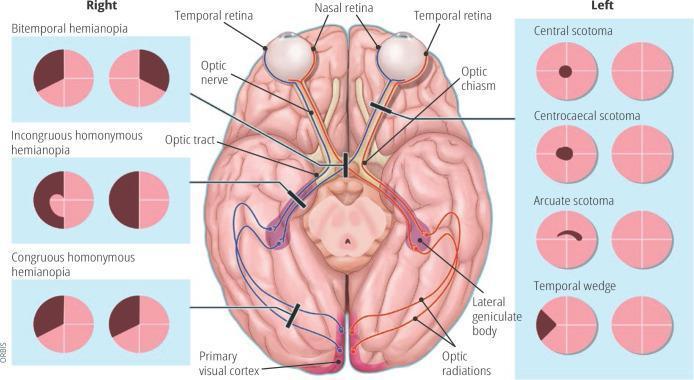
The visual pathway carries information from the retina to the primary visual cortex in the occipital lobe. It comprises five major anatomical segments: optic nerve → optic chiasm → optic tract → lateral geniculate nucleus (LGN) → optic radiations → primary visual cortex.
1. Retina & Optic Disc
- Photoreceptors (rods and cones) convert light into electrical signals.
- Retinal ganglion cell axons converge at the optic disc — a region devoid of photoreceptors, creating the physiological blind spot.
2. Optic Nerve (CN II)
- Axons leaving the optic disc form the optic nerve, which acquires a myelin sheath from oligodendrocytes (not Schwann cells) and is covered by cranial meninges — classifying it as CNS tissue, not a true peripheral nerve.
- The two optic nerves converge just anterior to the infundibular stalk at the optic chiasm.
3. Optic Chiasm
- The critical decussation point:
- Nasal (medial) retinal fibers → cross to the contralateral optic tract
- Temporal (lateral) retinal fibers → remain ipsilateral
- Each optic tract therefore carries information from the contralateral visual field of both eyes.
4. Optic Tract
- Courses posteriorly around the midbrain.
- The majority of fibers synapse in the lateral geniculate nucleus (LGN) of the thalamus.
- A small contingent diverges to the pretectal area and superior colliculus — mediating the pupillary light reflex (not vision itself).
5. Lateral Geniculate Nucleus (LGN)
- A 6-layered thalamic relay nucleus.
- Receives input from both eyes in separate laminae (layers 1, 4, 6 = contralateral eye; layers 2, 3, 5 = ipsilateral eye).
- Projects via the optic radiations to the primary visual cortex.
6. Optic Radiations (Geniculocalcarine Tract)
Two divisions:
| Division | Path | Visual Field Represented | Cortical Target |
|---|---|---|---|
| Upper (parietal) | Parietal lobe → occipital lobe | Inferior visual field | Upper bank of calcarine sulcus |
| Lower (temporal) — Meyer's loop | Loops anteriorly around temporal horn of lateral ventricle | Superior visual field | Lower bank of calcarine sulcus |
Meyer's loop is clinically important: temporal lobe lesions (e.g., surgery for epilepsy, tumors) can interrupt it, causing a "pie in the sky" contralateral superior quadrantanopia.
7. Primary Visual Cortex (V1 / Area 17 / Striate Cortex)
- Located on either side of the calcarine sulcus in the occipital lobe.
- Organized retinotopically — the macula (central vision) has a disproportionately large representation at the occipital pole.
Lesion Localization & Visual Field Defects
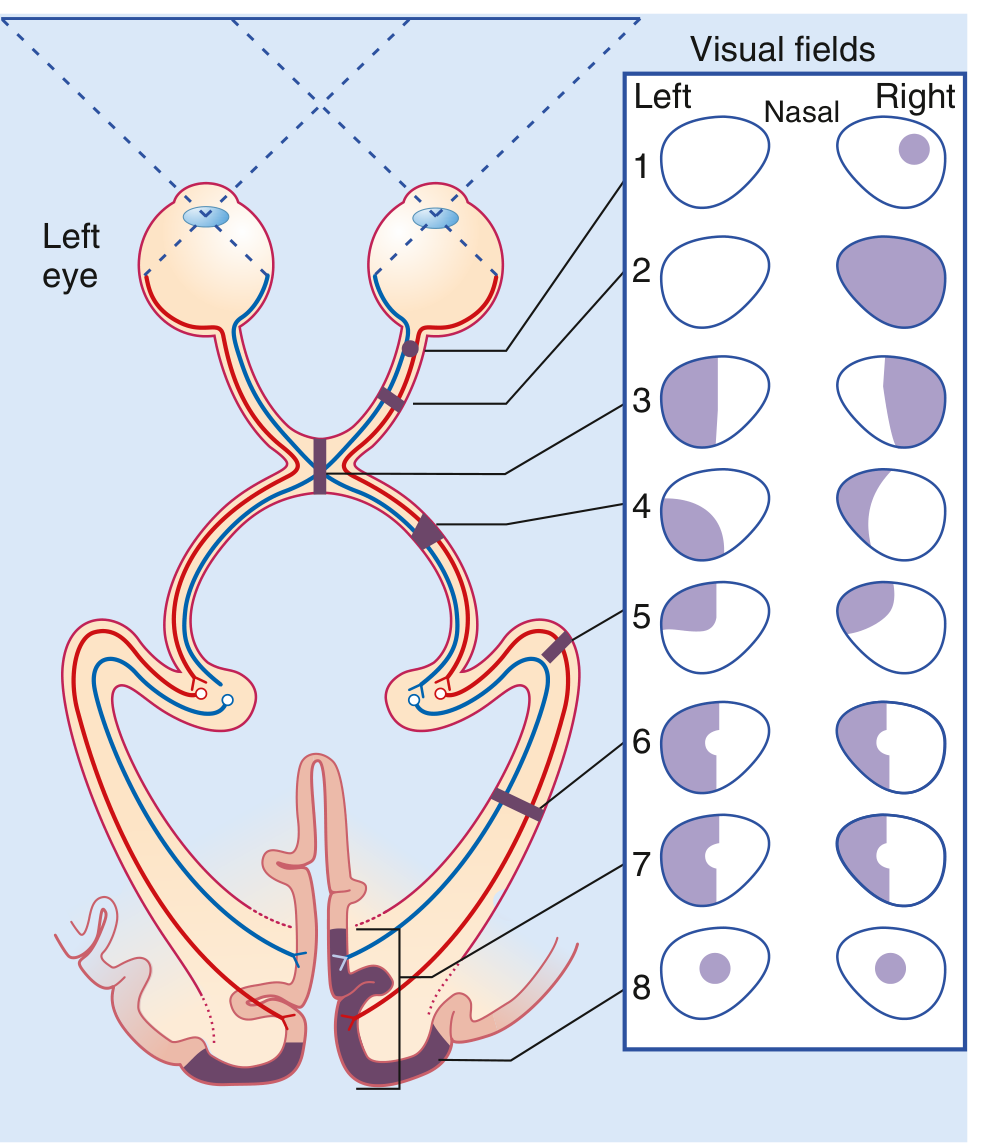
| Site of Lesion | Visual Field Defect | Classic Cause |
|---|---|---|
| 1. Optic nerve (unilateral) | Ipsilateral monocular scotoma | Optic neuritis, MS |
| 2. Optic nerve (complete) | Monocular blindness | Central retinal artery occlusion |
| 3. Optic chiasm (central) | Bitemporal hemianopia | Pituitary adenoma |
| 4. Optic tract | Contralateral homonymous hemianopia (incongruous) | Craniopharyngioma |
| 5. Meyer's loop (temporal) | Contralateral superior quadrantanopia ("pie in sky") | Temporal lobe tumor |
| 6. Parietal optic radiation | Contralateral inferior quadrantanopia ("pie on floor") | Parietal lobe lesion |
| 7. Optic radiation (complete) | Congruous homonymous hemianopia | MCA territory infarct |
| 8. Occipital cortex | Congruous homonymous hemianopia with macular sparing | PCA infarct |
Macular sparing in occipital cortex lesions occurs because the macular cortical representation at the occipital pole receives dual blood supply from both the PCA and MCA.
Key Principles
- Pre-chiasmal lesions → monocular defects (one eye only)
- Chiasmal lesions → bitemporal defects (crossing fibers)
- Post-chiasmal lesions → homonymous defects (same side of both visual fields)
- More posterior the lesion (approaching V1) → more congruous the defect
— Gray's Anatomy for Students, p. 1346–1347
This is a shared conversation. Sign in to Orris to start your own chat.