Ab main apka complete, detailed answer likhta hoon — everything from virology to treatment to case studies.
HERPES — Complete Veterinary & Medical Guide
Note: Yeh topic veterinary aur human medicine dono mein important hai. Is guide mein dono perspectives cover kiye gaye hain — virology, pathogenesis, clinical signs, diagnosis, treatment, prevention, aur cases. Jo terms difficult hain unhe bracket mein explain kiya gaya hai.
PART 1: CLASSIFICATION & TAXONOMY (Virus ka Khandaan)
Herpes virus ek Family Herpesviridae ka member hai.
Subfamily aur Types:
| Subfamily | Examples |
|---|
| Alphaherpesvirinae | HSV-1, HSV-2, Varicella Zoster Virus (VZV), Equine Herpesvirus (EHV), Feline Herpesvirus (FHV), Bovine Herpesvirus (BHV), Canine Herpesvirus (CHV), Pseudorabies virus (PRV) |
| Betaherpesvirinae | Cytomegalovirus (CMV), HHV-6, HHV-7 |
| Gammaherpesvirinae | Epstein-Barr Virus (EBV), HHV-8 (Kaposi Sarcoma) |
Vet ke liye sabse important: Alphaherpesvirinae subfamily — yahi janwaron mein disease karte hain.
PART 2: STRUCTURE (Virus ki Banawat)
Herpesvirus ek large virus hai — size 150–200 nm diameter.
Uski layers bahar se andar:
1. ENVELOPE (Outer lipid layer)
   ↓
2. TEGUMENT (Proteins ka layer — viral kinases hain iske andar)
   ↓
3. NUCLEOCAPSID (100 nm diameter, icosahedral shape, 162 capsomeres)
   ↓
4. CORE (Linear double-stranded DNA genome — 120-240 kb)
Icosahedral (eye-koh-SAH-hee-dral) = ek geometric shape hai jisme 20 triangular faces hote hain — soccer ball ki tarah.
Tegument = Capsid aur envelope ke beech ka protein layer — reactivation mein rol ada karta hai.
Genome: Linear, double-stranded DNA (dsDNA) — 120 to 240 kilobase pairs — itna bada hai ke approximately 80 proteins encode ho sakti hain.
Kyon important hai structure jaanna?
- Lipid envelope hone ki wajah se yeh virus ether aur detergents se destroy ho jaata hai
- Envelope glycoproteins (gB, gC, gD, gE/gI) attachment, entry, immune evasion ke kaam aate hain
- Yahi glycoproteins vaccine targets hain
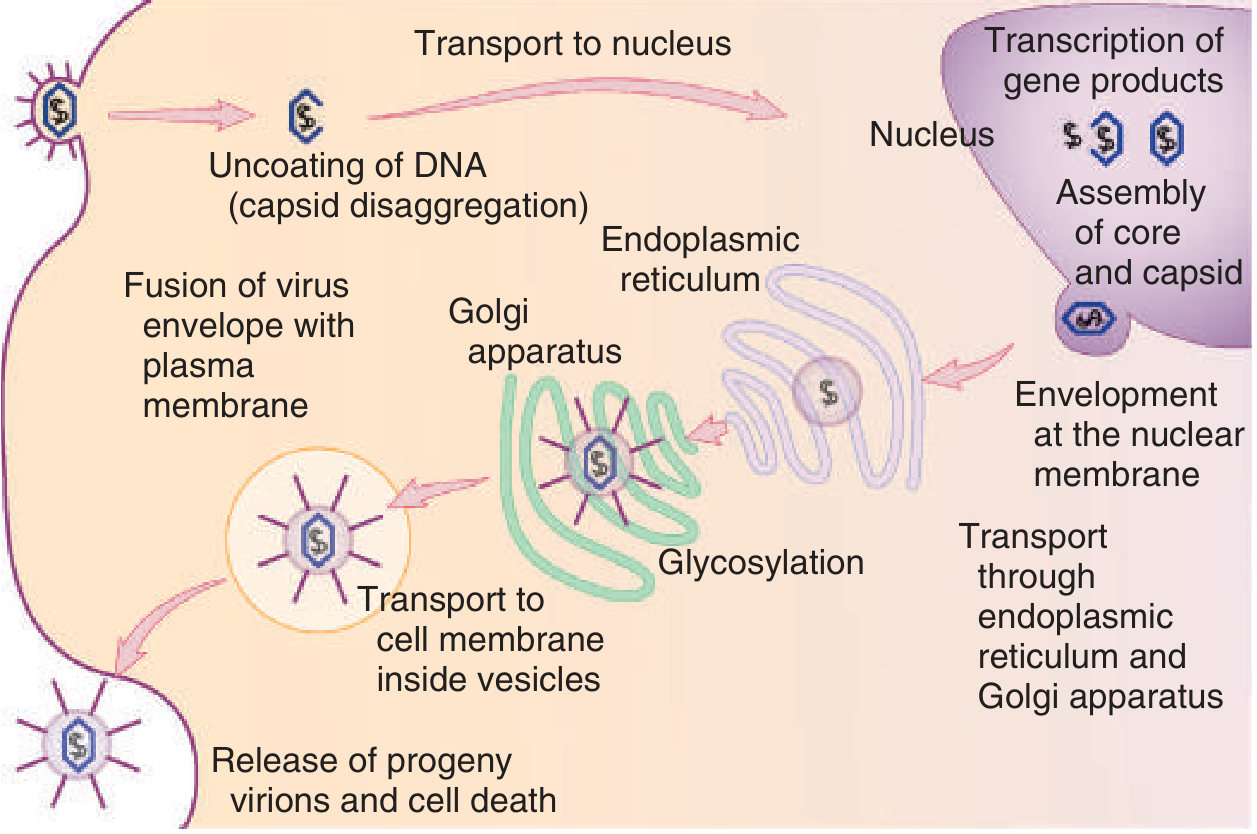
PART 3: REPLICATION CYCLE (Virus Kaise Copy Karta Hai)
Yeh samajhna zaroori hai taake aap treatment ka mechanism samajh sakein.
Step-by-step:
Step 1 — Attachment:
- Virus pehle heparan sulfate proteoglycan se loosely attach hota hai (cell surface pe hota hai)
- Phir Nectin-1 receptor se tightly bind karta hai (yeh intercellular adhesion molecule hai, immunoglobulin family se)
- Aur HveA (Herpesvirus Entry Mediator A) se bhi — yeh TNF receptor family member hai, neurons pe express hota hai
Step 2 — Penetration/Entry:
- Envelope aur cell plasma membrane fuse ho jaate hain
- Capsid cytoplasm mein release hota hai
- Saath mein viral kinase aur cytotoxic proteins bhi release hoti hain
Step 3 — Nuclear Transport:
- Capsid nuclear pore ke paas jaata hai
- DNA genome nucleus mein inject hota hai
Step 4 — Transcription (3 waves):
- Immediate Early (IE) genes — pehle express hote hain, DNA-binding proteins banate hain
- Early (E) genes — DNA polymerase, thymidine kinase banate hain
- Late (L) genes — structural proteins (capsid, envelope glycoproteins)
Step 5 — DNA Replication:
- Pehle circular concateneric forms bante hain
- Phir rolling circle mechanism se linear DNA banata hai (toilet paper roll ki tarah!)
Step 6 — Assembly:
- Core + capsid nucleus mein assemble hota hai
- Envelopment nuclear membrane se hota hai
- Endoplasmic reticulum aur Golgi se transport — glycosylation Golgi mein hoti hai
Step 7 — Release:
- Mature virions vesicles mein cell surface par aate hain
- Release ke saath cell death hoti hai
Important: Lytic infection = fibroblasts aur epithelial cells mein; Latent infection = neurons mein
PART 4: PATHOGENESIS — LATENCY & REACTIVATION (Sabse Important Concept!)
Yeh herpesvirus ka signature feature hai — yeh zindagi bhar host mein rehta hai.
Primary Infection ka Sequence:
- Virus mucosal surface ya skin pe inoculate hota hai
- Epithelial cells mein replicate karta hai (incubation 4–6 days)
- Cell lysis se vesicles banate hain erythematous base ke saath
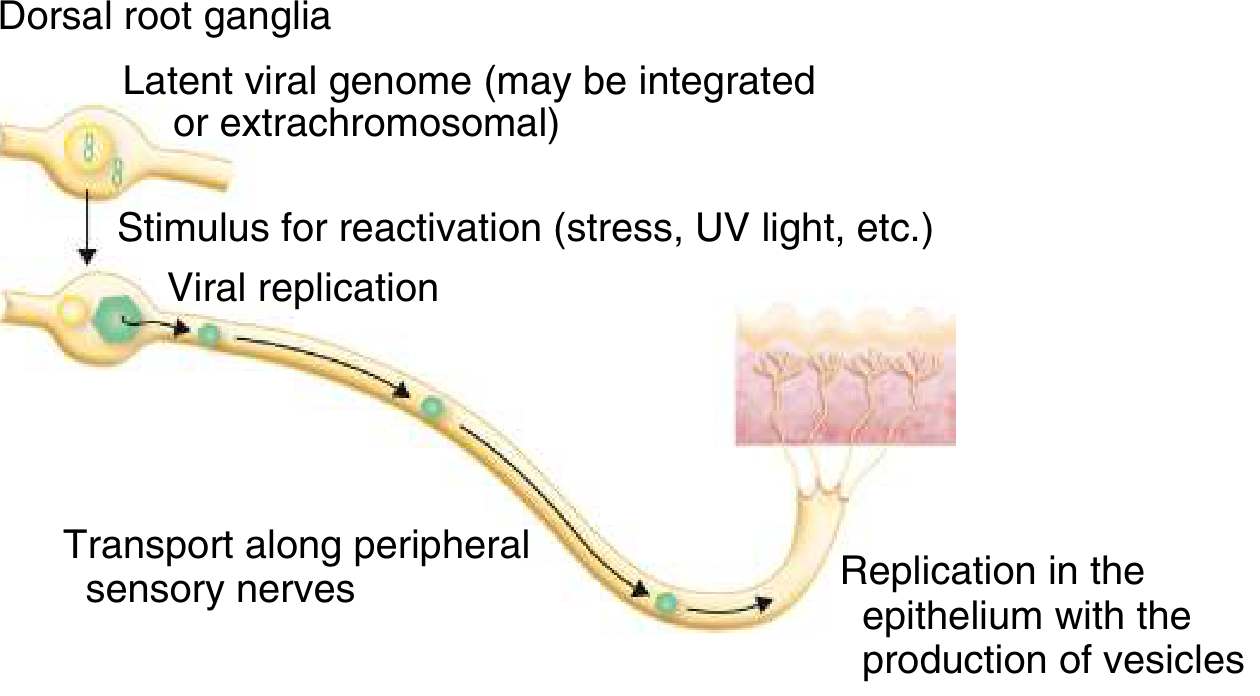
- Virus sensory nerve endings mein ghusta hai
- Retrograde transport (periphery se nucleus ki taraf) sensory neuron ke axon mein
- Dorsal Root Ganglia (DRG) mein pahunhcta hai — yahan latent ho jaata hai
Latency kya hota hai?
- Virus ki DNA extrachromosomal ya integrated form mein neuron nucleus mein rehti hai
- Sirf LAT (Latency-Associated Transcripts) express hote hain — yeh micro-RNAs banate hain jo immediate early genes ko suppress karte hain
- Virus "so raha hota hai" — immune system pakad nahi sakta
Reactivation kya hota hai?
- Koi trigger aata hai → LAT expression kamm hoti hai → IE genes on hote hain → virus replicate karta hai
- Anterograde transport (nucleus se periphery ki taraf) peripheral nerve ke zariye
- Skin/mucosa mein vapas aake vesicles banata hai
Triggers of Reactivation:
- Stress (physical ya psychological)
- Fever / systemic illness
- UV light (sunlight)
- Immunosuppression
- Menstruation (progesterone effect on immunity)
- Surgical/dental trauma
- Malnutrition, parasitic burden
PART 5: IMPORTANT ANIMAL HERPESVIRUSES
Yeh vet ke liye MOST important section hai:
5A. Equine Herpesvirus (EHV) — Ghore
Types:
- EHV-1: Abortion, neonatal foal disease, rhinopneumonitis (naak ki soojan), myeloencephalopathy (brain/spinal cord disease)
- EHV-4: Predominantly respiratory disease (rhinopneumonitis)
- EHV-3: Coital exanthema (genitalia pe lesions)
Clinical Signs of EHV-1/4:
- Naak se discharge, khansee, bukhar
- Lymphadenopathy (lymph nodes ki sujaish)
- Pregnant mares mein: Abortion (usually last trimester, bina kisi warning ke) — "abortion storm" — ek herd mein multiple abortions
- Neurological form (EHV-1 Myeloencephalopathy): Hindlimb ataxia (larkhat), urinary incontinence, recumbency
Pathology:
- Intranuclear inclusion bodies (Cowdry Type A)
- Endothelial vasculitis → ischemia
5B. Feline Herpesvirus (FHV-1) — Billi
Disease: Feline Viral Rhinotracheitis (FVR)
Clinical Signs:
- Severe sneezing, nasal discharge (pehle serous, phir mucopurulent)
- Conjunctivitis (ankhein red, discharge)
- Keratitis — corneal ulcers → dendritic ulcers → possible blindness
- Bukhar, anorexia, depression
- Neonatal kittens mein: Severe systemic disease, encephalitis, death
Latency: Trigeminal ganglion mein
Reactivation trigger: Stress (new cat, boarding, illness)
Pakistan mein relevance: Shelter aur breeding cats mein endemic — imported/pedigree cats zyada vulnerable
5C. Canine Herpesvirus (CHV-1) — Kutta
Disease: Fading Puppy Syndrome (neonatal deaths)
Clinical Signs in Neonates (< 3 weeks):
- Sudden onset, rapid progression
- Crying, weakness, nasal discharge
- Abdominal pain, yellowish-green feces
- Scattered hemorrhagic petechiae on body
- Death within 24–48 hours
Adults mein: Usually subclinical, mild respiratory signs, vaginal/penile vesicles
Kyon neonates mein itna severe?
- CHV-1 optimal replication temperature: 35–36°C (normal puppy body temp is < 37°C)
- Puppy thermoregulation karna nahi jaanta → body temp low → virus multiply karta raha
- Immunity nahi hoti neonatal period mein
Pathology: Multifocal hemorrhagic necrosis in kidneys, lungs, liver, spleen, brain
5D. Bovine Herpesvirus 1 (BHV-1) — Gaye/Bail
Diseases:
- IBR (Infectious Bovine Rhinotracheitis): Nasal/respiratory disease, bukhar, red nose (yahi "Red Nose Disease" kehte hain)
- IPV (Infectious Pustular Vulvovaginitis): Female genitalia pe pustules
- IPB (Infectious Pustular Balanoposthitis): Male genitalia pe pustules
- Neonatal systemic disease: Encephalitis, death
Clinical Signs of IBR:
- High fever (40–42°C)
- Serous → mucopurulent nasal discharge
- Nasal mucosa bright red → "fire nose"
- Conjunctivitis, lacrimation
- Dyspnea, coughing
- Doodh production mein giraaawat
- Pregnant cows: abortion (usually 4–8 months gestation)
Latency: Trigeminal ganglion (respiratory form) ya sacral ganglia (genital form)
5E. Pseudorabies Virus (PRV) / Aujeszky's Disease — Sooar (Pig)
Host: Pig primary host, spill-over to cattle, sheep, dogs, cats (cattle/dogs mein fatal)
Clinical Signs:
- Pigs (Adults): Respiratory disease, mild
- Pigs (Piglets): CNS signs — tremors, convulsions, death
- Cattle/sheep/dogs (dead-end hosts): Intense pruritus (khujli) — "Mad Itch" → animal khud ko damage kar leta hai, death
Note: Humans ko nahi hota (mostly)
5F. Marek's Disease Virus (MDV) — Murgi (Poultry)
Technically: Gallid herpesvirus 2 — Gammaherpesvirus
Disease: Marek's Disease
Clinical Signs:
- Classic form: Peripheral nerve paralysis — "Splits" posture (ek pair age, ek peeche) — sciatic nerve
- Acute form: Sudden deaths, lymphoma in visceral organs
- Tumor formation in organs (liver, spleen, gonads)
- Iris ka grey ya white hona (greyeye)
Pakistan mein: Broiler aur layer flocks mein endemic — vaccine (Rispens + HVT) essential
PART 6: GENERAL PATHOLOGY (Histopathology)
Yeh lab exam aur post-mortem mein important hai:
Macroscopic (Naked Eye):
- Vesicles on erythematous base — "dew drop on a rose petal"
- Vesicle → Pustule → Ulcer → Crust → Healing (scar uncommon)
- Mucosal erosions, nasal discharge, conjunctivitis
Microscopic (Under Microscope):
- Ballooning degeneration of infected cells — cells phool jaate hain
- Multinucleated Giant Cells (Syncytia) — multiple cells fuse ho jaate hain — yeh herpes ki HALLMARK hai
- Cowdry Type A Intranuclear Inclusion Bodies — nucleus ke andar basophilic ya eosinophilic inclusions — viral assembly sites hain
- Intense inflammatory infiltrate (mononuclear cells)
- Vascular changes: perivascular cuffing, hemorrhagic necrosis (especially CNS mein)
Tzanck Smear (clinical bedside test):
- Lesion ki base se scraping lao
- Multinucleated giant cells aur Cowdry Type A inclusions dikhte hain
- Simple, quick — no special equipment needed
PART 7: LABORATORY DIAGNOSIS
1. Direct Microscopy / Tzanck Smear:
- Scraping se multinucleated giant cells dekho
- Fast, cheap — but not type-specific
2. Virus Isolation / Cell Culture:
- Vesicle fluid, nasal swab, CSF lao → cell culture (HeLa cells, human embryonic fibroblasts) mein inoculate karo
- HSV 1–3 days mein cytopathic effect (CPE) deta hai — cells round, enlarged ho jaate hain
- Syncytia bhi ban sakti hain
- Specimens cold (4°C) rakhna — freeze mat karo
3. PCR (Polymerase Chain Reaction):
- Gold standard aaj kal
- Vesicle fluid, CSF, nasal swab se viral DNA detect karo
- HSV-1 vs HSV-2 distinguish kar sakta hai
- Sensitivity bahut high hai
4. Immunofluorescence / Immunohistochemistry:
- Tissue ya smear pe antibodies lagate hain fluorescent label ke saath
- Specific viral antigen detect karta hai
5. Serology:
- Primary infection ke diagnosis ke liye useful (rising antibody titers)
- Recurrent disease mein NOT useful — antibodies already hain, significant rise nahi aati
- Type-specific ELISA available hai
6. ELVIS System:
- β-galactosidase expressing cell line use hoti hai
- HSV infection pe enzyme produce hoti hai → colored substrate se detect hoti hai
- Modern virology labs mein use hota hai
PART 8: TREATMENT PROTOCOL (Complete & Accurate)
Mechanism of Antiviral Drugs
Acyclovir (acycloguanosine) ka mechanism:
Step 1: Virus thymidine kinase → Acyclovir ko MONOPHOSPHATE banata hai
         (sirf infected cells mein yeh step hota hai — selectivity yahan se aati hai)
Step 2: Host cell kinases → Diphosphate → Triphosphate
Step 3: Acyclovir Triphosphate → Viral DNA polymerase ko compete karta hai
Step 4: DNA mein incorporate ho jaata hai → Chain TERMINATE ho jaati hai
         (kyunki acyclovir mein 3'-OH group nahi hota — extension nahi ho sakti)
Key point: Uninfected cells mein viral thymidine kinase nahi hota → acyclovir activate nahi hota → selective toxicity → safe drug
Resistance mechanism:
- Thymidine kinase mutation → drug activate nahi ho sakta
- DNA polymerase mutation
- Mainly immunocompromised patients mein milta hai
Treatment Protocols (Human — Reference ke liye)
Primary Genital Herpes:
- Acyclovir 200 mg 5x/day OR 400 mg TID × 7–10 days
- Valacyclovir 1000 mg BD × 7–10 days
- Famciclovir 250 mg TID × 7–10 days
Suppressive Therapy (Recurrent cases):
- Acyclovir 400 mg BD (chronic)
- Valacyclovir 500 mg OD
Severe HSV (IV):
- Acyclovir 5 mg/kg TID (IV) × 7 days
HSV Encephalitis:
- Acyclovir 10 mg/kg TID (IV) × 14–21 days
Orolabial Herpes:
- Acyclovir 15 mg/kg 5x/day (oral suspension) × 7 days (peds)
- Valacyclovir 1g BD × 7 days (adults)
Veterinary Treatment Protocols
Feline Herpesvirus (FHV-1):
| Drug | Dose | Route | Frequency | Duration |
|---|
| Famciclovir | 90 mg/kg | Oral | Every 12 hrs | 3–4 weeks |
| L-Lysine | 500 mg/cat | Oral | BD | Long-term (controversial) |
| Idoxuridine 0.1% drops | Topical ocular | Eye drops | 5x/day | Until healed |
| Cidofovir 0.5% | Topical ocular | Eye drops | BD | Until healed |
| Trifluridine 1% | Topical ocular | Eye drops | 5–9x/day | Until healed |
Note: Cats mein Acyclovir toxic hai (renal toxicity) — use mat karo unless vet specialist ne supervise kiya ho. Famciclovir sabse safe aur effective hai cats mein.
Equine Herpesvirus (EHV):
| Drug | Dose | Route | Notes |
|---|
| Acyclovir | 10 mg/kg TID | Oral | Poor bioavailability in horses |
| Valacyclovir | 27–40 mg/kg TID–QID | Oral | Better bioavailability |
| NSAIDs (Flunixin meglumine) | 1.1 mg/kg | IV/IM BD | Fever, inflammation control |
| DMSO | 1 g/kg (10% solution) | IV, slow | Anti-inflammatory, CNS edema |
| Supportive care | Fluids, nutrition | IV | Essential |
Bovine Herpesvirus (BHV-1) / IBR:
- No specific antiviral for cattle in routine practice
- Supportive treatment:
- NSAIDs (Flunixin meglumine 2.2 mg/kg IV BD, Meloxicam 0.5 mg/kg IV/IM)
- Antibiotics for secondary bacterial pneumonia (Enrofloxacin, Oxytetracycline, Penicillin + Streptomycin)
- Intranasal oxygen if severe dyspnea
- IV fluids, vitamins (A, C, E)
- Isolation of affected animals
Canine Herpesvirus (CHV-1) Neonates:
- Warming puppies (incubator 29–32°C) — temperature raise karne se viral replication ruk jaati hai
- Hyperimmune serum (agar available ho)
- Supportive fluids (glucose solution SQ)
- Antiviral: Acyclovir cautiously (nephrotoxic in pups)
- Prognosis: Poor if symptomatic neonates
Pseudorabies (PRV) — No Treatment:
- Dead-end hosts (cattle, dogs) — invariably fatal
- Affected animals euthanize karo
- No specific antiviral approved
Marek's Disease:
- No treatment — Prevention only (vaccine)
PART 9: PAKISTAN MEIN AVAILABLE BRANDS
Antiviral Drugs
| Generic Name | Pakistan Brands | Form |
|---|
| Acyclovir | Cyclovir (Sami), Herpex (Glaxo), Zovirax (GSK), Acivir | Tablets 200mg/400mg/800mg, IV vial 250mg, Cream 5%, Eye ointment 3% |
| Valacyclovir | Valtrex (GSK), Valcivir | Tablets 500mg/1000mg |
| Famciclovir | Famvir (Novartis), Famciclo | Tablets 125mg/250mg/500mg |
Veterinary Specific (Pakistan):
- IBR Vaccine: Bovilis IBR (MSD Animal Health) — intranasal ya injectable
- EHV Vaccine: Duvaxyn EHV 1,4 — horses ke liye
- FHV Vaccine: Felocell CVR-C (Zoetis), Nobivac Tricat — cats ke liye
- Marek's Vaccine: Rispens + HVT bivalent vaccine — chicks ke liye (hatchery level)
- PRV (Aujeszky's) Vaccine: Suis Porvac — pigs ke liye
Supportive Drugs (Vet Practice)
| Drug | Brand (Pakistan) | Use |
|---|
| Flunixin Meglumine | Finadyne (MSD), Flunixin (Ferozsons) | Anti-inflammatory, antipyretic |
| Meloxicam | Metacam (Boehringer), Melonex | NSAIDs |
| Oxytetracycline | Terramycin (Zoetis), Oxytatr | Secondary infections |
| Enrofloxacin | Baytril (Bayer/Elanco), Enrocin | Secondary infections |
| Penicillin + Streptomycin | Penstrep (Norbrook) | Secondary infections |
| Vitamins A+D3+E | Adrophen, Vitasel | Immune support |
| Normal Saline / Ringer's Lactate | Multiple brands | IV fluids |
| DMSO | Available in vet pharmacies | EHV neurological cases |
PART 10: PREVENTION & CONTROL
Vaccination:
- IBR (BHV-1): Killed or modified live vaccine — herd vaccination zaroori
- EHV-1/4: Killed vaccine every 6 months — especially pregnant mares
- FHV-1: Core vaccine for all cats — killed or MLV
- CHV-1: Eurican Herpes vaccine (Europe mein available) — bred bitches ko
- Marek's: Day-old chicks ko hatchery mein — HVT + Rispens bivalent
Biosecurity:
- New animals quarantine (minimum 2–3 weeks)
- Separate stressed/sick animals
- Disinfectants effective (bleach 1:32, Virkon, Glutaraldehyde — lipid envelope destroy karte hain)
- Separate nasal/vaginal discharge contaminated equipment
- Heat aur drying bhi virus kill karta hai
- Gloves pehno — herpetic whitlow (finger mein lesion) humans ko bhi ho sakta hai
Stress management:
- Overcrowding avoid karo
- Adequate nutrition, vitamins
- Minimize transport stress
- Proper ventilation
PART 11: CONCEPT SUMMARY TABLE — Kaunsa Virus, Kaunsa Animal, Kya Disease?
| Virus | Animal | Disease | Latency Site |
|---|
| HSV-1 | Human | Cold sores, encephalitis | Trigeminal ganglion |
| HSV-2 | Human | Genital herpes | Sacral DRG |
| VZV | Human | Chickenpox / Shingles | DRG |
| EHV-1 | Horse | Abortion, rhinopneumonitis, neuro | Trigeminal ganglion |
| EHV-4 | Horse | Rhinopneumonitis (mild) | Trigeminal ganglion |
| FHV-1 | Cat | Viral rhinotracheitis, keratitis | Trigeminal ganglion |
| CHV-1 | Dog | Fading puppy syndrome | — |
| BHV-1 | Cattle | IBR, IPV, abortion | Trigeminal / sacral ganglion |
| PRV | Pig (→ others) | Aujeszky's / Mad Itch | Cranial nerve ganglia |
| MDV | Chicken | Marek's disease, lymphoma | Lymphocytes |
PART 12: REVIEW QUESTIONS
Q1: Herpesvirus ki DNA genome kya hoti hai?
Ans: Linear, double-stranded DNA (dsDNA), 120–240 kb
Q2: Herpesvirus latency kis cell type mein establish hoti hai aur kyon neurons ko prefer karta hai?
Ans: Sensory neurons (dorsal root ganglia mein) — kyunki neurons divided nahi hote (non-dividing cells) aur immune surveillance low hai; LAT transcripts immediate early genes ko suppress rakhte hain
Q3: Acyclovir ka mechanism of action kya hai aur yeh uninfected cells ko kyon affect nahi karta?
Ans: Viral thymidine kinase specifically infected cells mein acyclovir ko monophosphate mein convert karta hai; host kinases further activate karte hain; Acyclovir triphosphate viral DNA polymerase ko compete karke chain termination karta hai. Uninfected cells mein viral TK nahi hota → drug activate nahi hota.
Q4: Cats mein acyclovir kyon dangerous hai?
Ans: Cats mein acyclovir ki bioavailability poor hai aur nephrotoxicity ka risk high hai; Famciclovir preferred hai.
Q5: "Fading Puppy Syndrome" mein temperature therapy kyon kaam karti hai?
Ans: CHV-1 optimal replication 35–36°C pe hoti hai; puppies ko warm rakhne se body temperature 38°C se upar jati hai, jo viral replication inhibit karta hai.
Q6: Tzanck smear mein kya dikhta hai?
Ans: Multinucleated giant cells (syncytia) aur Cowdry Type A intranuclear inclusion bodies
Q7: Equine herpesvirus "abortion storm" kya hota hai?
Ans: EHV-1 infected herd mein multiple pregnant mares mein simultaneously ya rapidly abortion — usually last trimester mein — bina prior warning ke; endothelial vasculitis se placental ischemia aur fetal death
Q8: PRV (Pseudorabies) cattle mein "Mad Itch" kyon karta hai?
Ans: Cattle dead-end host hain — PRV CNS infection severe pruritus produce karta hai; animal compulsively scratch karta hai skin tear ho jaane tak; invariably fatal; no treatment
PART 13: CLINICAL CASES
CASE 1: Equine Herpesvirus — Abortion + Neurological Form
History:
Dr. Ayesha ek stud farm pe buli jaati hain. Farm owner kehta hai ke pichle 2 haftono mein 5 pregnant mares ne 7–8 month ke bacche gira diye hain. Abhi ek mare hai jo 3 din se peeche se girr rahi hai, urination control nahi kar rahi.
Signalment: Thoroughbred stud farm, 25 mares, 5 affected. One mare — 6 years old, last trimester, hindlimb ataxia.
Clinical Examination:
- Fever 40.5°C
- Hindlimb weakness, ataxia (larkhat)
- Bladder distension (urine retain kar rahi hai)
- Nasal discharge — serous
- Aborted fetuses: autolyzed, no obvious external lesions
Clinical Thinking:
- Multiple abortions → herd level disease → infectious etiology
- Neurological signs + abortion combination → EHV-1 Myeloencephalopathy (EHM)
- EHV-4 usually sirf respiratory karta hai, abortion rare
- DDx: Leptospirosis (abortion), Rhinopneumonitis (respiratory), Viral Arteritis
Diagnosis:
- Nasopharyngeal swab → PCR for EHV-1 → Positive
- Aborted fetus: placenta, fetal tissues → PCR positive, intranuclear inclusions on histopath
- Paired serology (acute + convalescent) → rising titers
Treatment:
- Affected mare: Valacyclovir 40 mg/kg QID oral
- Flunixin meglumine 1.1 mg/kg IV BD
- DMSO 1 g/kg (10%) IV slow drip — spinal cord edema ke liye
- Bladder catheterize karo (urinary retention)
- Corticosteroids (dexamethasone) — controversy hai but kuch vets use karte hain acute EHM mein
- IV fluids, nutritional support
Control:
- Affected horses ISOLATE karo — minimum 3 weeks
- Aborted mares ko separate stall
- All horses temperature monitor karo twice daily
- New horses quarantine
- Emergency vaccination consider karo (EHV-1,4 killed vaccine)
- Disinfect paddocks, equipment
Outcome: Mare partially recovered, hindlimb function improve hui lekin bladder dysfunction residual rahi. 2 more mares developed respiratory signs — all recovered.
Learning Points:
- EHV-1 ek hi virus se 3 syndromes: respiratory, abortion, neurological
- Abortion storm + neurological signs = EHV-1 until proven otherwise
- Valacyclovir horses mein better bioavailability > acyclovir
- Latency trigeminal ganglion mein — stress se reactivate
CASE 2: Feline Herpesvirus — Shelter Cat with Eye Disease
History:
Ek Lahore animal shelter ka worker ek 3-month-old male kitten lata hai jo ek haftay se ankhein bandh kar ke baitha hai, naak se bhi discharge aa raha hai. Kitten rescued tha 2 hafte pehle — shelter mein aane ke 4–5 din baad signs shuru hue.
Signalment: 3-month DSH kitten, male, shelter cat, unvaccinated.
Clinical Examination:
- Bilateral conjunctivitis (severe) — ankhein puri tarah bandh — purulent discharge
- Nasal discharge — mucopurulent
- Sneezing frequent
- Temp 39.9°C
- Cornea — left eye mein dendritic ulcer visible under slit lamp (fluorescein stain se green glow)
- Body condition: poor, thin
- Lymphadenopathy — submandibular nodes enlarged
Clinical Thinking:
- Shelter environment → stress → primary FHV-1 infection OR reactivation
- Respiratory signs + conjunctivitis + keratitis = FHV-1 (Feline Viral Rhinotracheitis)
- DDx: Calicivirus (oral ulcers prominent), Chlamydophila felis (conjunctivitis only, no corneal), Bordetella
- Dendritic corneal ulcer → highly specific for FHV-1
Diagnosis:
- Conjunctival swab → PCR for FHV-1 → Positive
- Fluorescein corneal stain → dendritic branching ulcer → confirms herpetic keratitis
Treatment:
Systemic:
- Famciclovir 90 mg/kg PO BD × 3 weeks (safe in cats — do NOT use acyclovir)
- Doxycycline 5 mg/kg PO OD × 3 weeks (secondary bacterial + rules out Chlamydophila)
- Lysine 250 mg PO BD (arginine antagonist — some benefit)
Ocular:
- Cidofovir 0.5% eye drops — BD (better than trifluridine, less frequent dosing)
- Artificial tears q4h — keep cornea lubricated
- E-collar (Elizabethan collar) — rubbing prevent karo
- DO NOT use corticosteroid eye drops — yeh herpes mein contraindicated hain — corneal perforation ho sakti hai
Supportive:
- Nutritional support — high-protein wet food
- Steam inhalation (nasal congestion ke liye)
- Warm place rakhna
Outcome: 3 weeks mein conjunctivitis resolve. Left eye ka corneal ulcer healed with scar — partial vision affected. Cat adopted, owner ko bataya ke virus latent rahega — stress mein reactivate ho sakta hai.
Long-term management:
- Vaccination schedule follow karo (FHV-1 core vaccine)
- Stress minimize karo
- On reactivation: famciclovir course repeat
Learning Points:
- Acyclovir cats mein nephrotoxic → Famciclovir use karo
- Dendritic ulcer = FHV-1 hallmark
- Corticosteroid eye drops contraindicated herpes keratitis mein
- Shelter stress → latent virus reactivation → disease
- Kitten unvaccinated tha → vaccination zaroori
Sources:
- Medical Microbiology 9e (Murray) — HSV structure, replication, pathogenesis, diagnosis
- Goldman-Cecil Medicine — HSV pathobiology, clinical manifestations, treatment
- Andrews' Diseases of Skin — Genital herpes, orolabial herpes, treatment protocols
- Lippincott Pharmacology — Acyclovir mechanism of action
- Jawetz Medical Microbiology — Herpesviridae family overview
Umeed hai yeh complete explanation aapke liye helpful rahi. Agar kisi specific animal species (jaise buffalo herpesvirus, poultry Marek's disease in depth, ya koi specific topic) aur zyada detail chahiye, ya koi concept aur clear nahi hua — pooch lijiye!