
Elbow anatomy stability it's biomechanics complete details in total with appropriate images illustrations
Reading File
Finding Sources
Finding Sources
Searching Images
elbow joint anatomy ligaments bones biomechanics
Reading File
Finding Sources
Searching Images
elbow medial lateral collateral ligament anatomy diagram
Reading File
Reading File
Reading File
Reading File
Loading Image
Loading Image
Reading File
Loading Image
Reading File
Reading File
I now have comprehensive material from multiple authoritative textbooks. Let me compile the full answer with the images I've retrieved.
Elbow Anatomy, Stability & Biomechanics
1. Osseous Anatomy
The elbow is a compound synovial joint consisting of three distinct articulations enclosed within a single joint capsule:
| Articulation | Bones | Movement |
|---|---|---|
| Humeroulnar | Trochlea of humerus × trochlear (sigmoid) notch of ulna | Flexion/Extension |
| Humeroradial (Radiocapitellar) | Capitellum × radial head | Flexion/Extension + Forearm rotation |
| Proximal Radioulnar | Radial head × radial notch of ulna | Pronation/Supination |
Distal Humerus
- The trochlea — pulley-shaped medially — articulates with the trochlear notch of the ulna
- The capitellum — spherical laterally — articulates with the radial head
- The medial epicondyle — common flexor origin; the ulnar nerve runs in its posterior groove
- The lateral epicondyle — common extensor origin
- Coronoid fossa (anterior): receives coronoid process in flexion
- Radial fossa (anterior): receives radial head in flexion
- Olecranon fossa (posterior): receives olecranon in extension
- The coronoid and olecranon fossae are separated by the thin supratrochlear septum
Proximal Ulna
- The trochlear (greater sigmoid) notch — wraps around the trochlea; the primary stabilizing articulation of the elbow due to its bony congruence
- The olecranon forms the superior wall of the trochlear notch; posterior bony landmark
- The coronoid process (13–18 mm) forms the inferior wall; provides:
- Anterior buttress against posterior translation
- Resistance to varus and rotational forces
- Insertion for the anterior joint capsule, anterior bundle of the medial ulnar collateral ligament (MCL), annular ligament, and brachialis
- The radial notch — lateral surface of the ulna; articulates with the radial head for pronation/supination
- The sublime tubercle — insertion point of the anterior MCL bundle
Proximal Radius
- The radial head — elliptical (not circular), mean diameter ~2 cm; 360° convex articular surface; 240° covered by cartilage; articulates with capitellum proximally and radial notch of ulna circumferentially
- The radial neck — narrow portion just distal to the head
- The radial tuberosity — biceps brachii insertion
Hueter's Line and Triangle
In extension: the medial epicondyle, lateral epicondyle, and olecranon lie on a straight line (Hueter's line). In flexion, viewed from behind, these three points form an equilateral triangle (Hueter's triangle). This relationship is disrupted by fractures and dislocations.
2. Joint Capsule
The elbow capsule is a synovial-lined fibrous envelope shared by all three articulations:
- Anterior capsule: inserts proximally above the coronoid and radial fossae; distally attaches to the anterior margin of the coronoid process and to the annular ligament
- Posterior capsule: attaches just above the olecranon fossa, extends down along supracondylar columns
- The inner surface is lined by synovial membrane, which does not extend over articular cartilage
- Ligaments are focal thickenings of the joint capsule
- The capsule is thin normally but contributes to stability at the extremes of flexion and extension
- The quadrate ligament lies below the annular ligament, extending from the radial neck to the supinator fossa of the ulna
3. Ligamentous Anatomy
Medial (Ulnar) Collateral Ligament Complex (MCL/UCL)
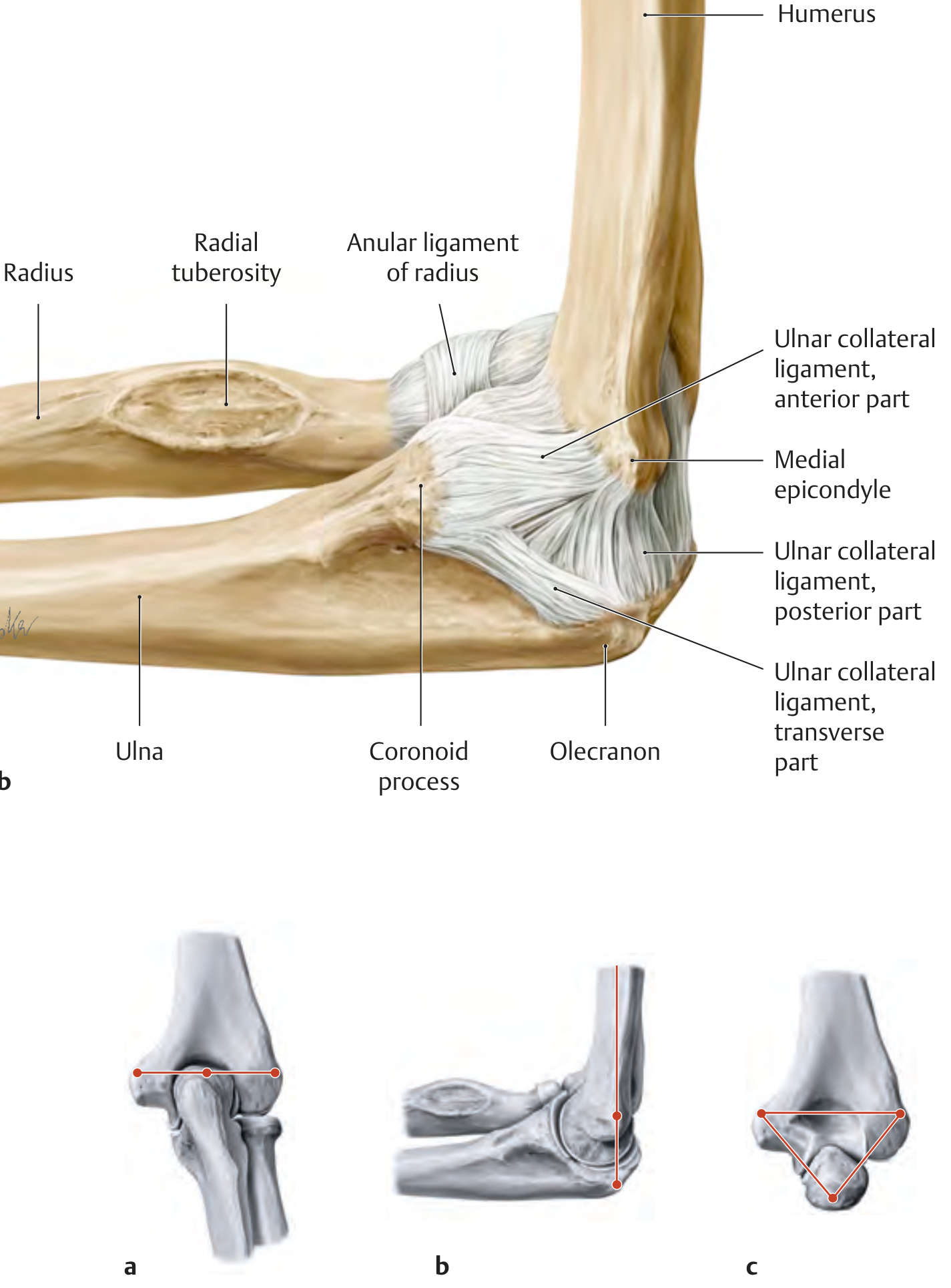
The MCL is the primary valgus stabilizer of the elbow, with three bundles:
a. Anterior Bundle (most important)
- Origin: anteroinferior aspect of medial epicondyle
- Insertion: sublime tubercle of the coronoid process
- Contains two bands: anterior band (most important; taut 30–120° flexion) and posterior band (taut 60–120° flexion)
- The primary static stabilizer against valgus stress and internal rotation
- Mean length of the anterior common tendon: ~28 mm
b. Posterior Bundle (Bardinet's Ligament)
- Origin: posterior aspect of medial epicondyle
- Insertion: medial aspect of the olecranon
- Fan-shaped; forms the floor of the cubital tunnel
- Provides secondary stability at extremes of flexion; also resists valgus forces and ulnar rotation
c. Transverse Bundle (Cooper's Ligament)
- Runs between the coronoid process and olecranon
- Contributes minimally to stability as it spans two points on the same bone (ulna)
During elbow flexion, the flexor carpi ulnaris (FCU) aponeurosis tenses while the MCL relaxes and bulges — this decreases cubital tunnel volume and increases pressure within it, explaining ulnar nerve vulnerability in flexion.
Lateral Collateral Ligament Complex (LCL)
The LCL is the primary varus and posterolateral rotational stabilizer:
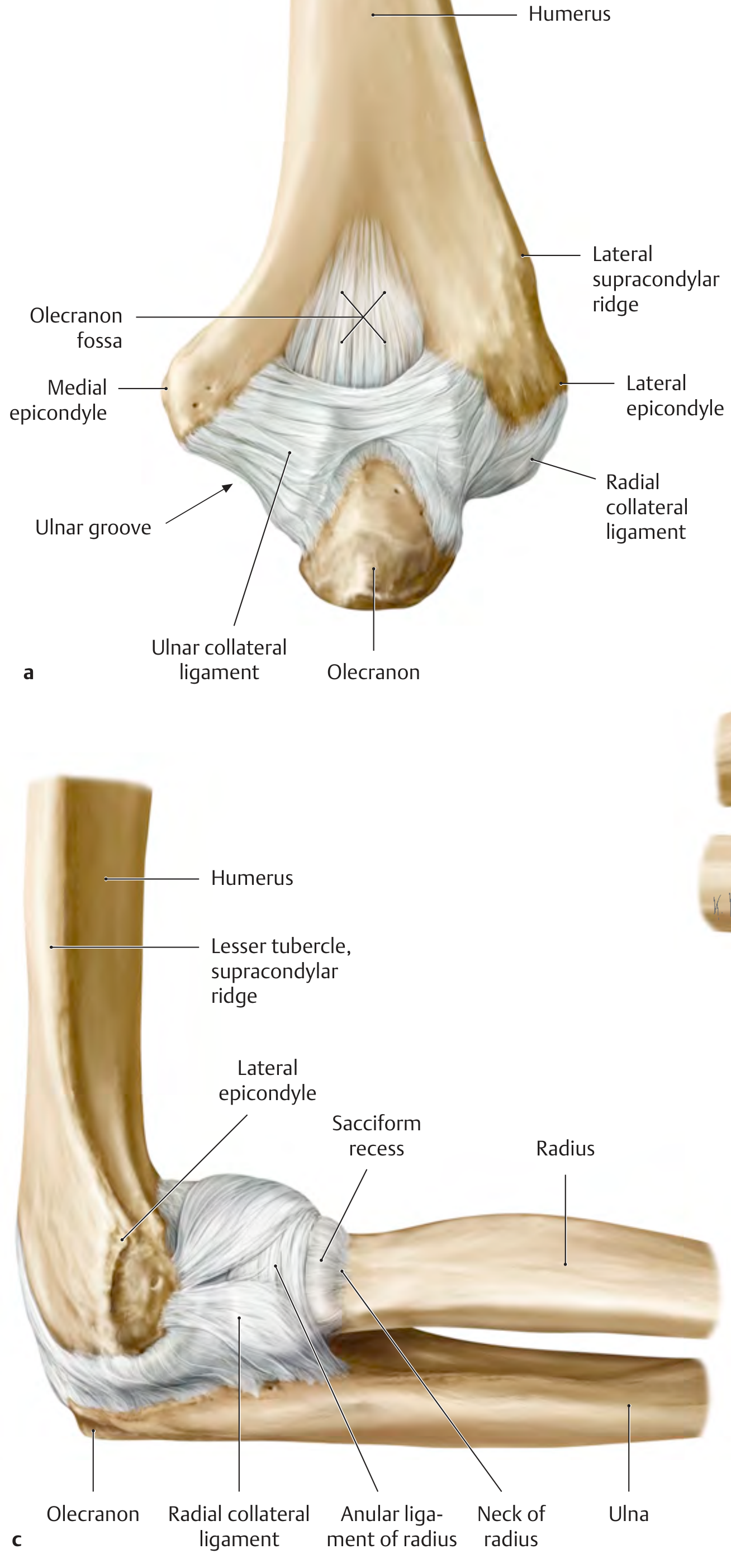
a. Radial Collateral Ligament (RCL)
- Origin: lateral epicondyle
- Blends distally with the annular ligament
b. Annular Ligament
- Encircles the radial head, attaching to the anterior and posterior margins of the radial notch of the ulna
- Maintains the radial head within the radial notch, allowing pronation/supination
- The radial head is surrounded by the annular ligament — a sacciform recess forms above it
c. Lateral Ulnar Collateral Ligament (LUCL)
- Origin: lateral epicondyle (posterior to RCL)
- Insertion: crista supinatoris (supinator crest) of the proximal ulna, just distal to the annular ligament
- Wraps around the posterior aspect of the radial neck
- Critical for preventing posterolateral rotatory instability (PLRI)
4. Stability — Static and Dynamic Restraints
"Elbow stability is provided equally by the soft tissue structures surrounding the joint and by the bony articulations of the joint itself." — Rockwood and Green's Fractures in Adults, 10th ed.
Static Stabilizers
| Structure | Primary Role |
|---|---|
| Humeroulnar articulation (bony) | Primary intrinsic stabilizer; bony congruence resists translation |
| Anterior MCL bundle | Primary valgus stabilizer |
| LCL complex / LUCL | Primary varus & posterolateral rotational stabilizer |
| Joint capsule | Contributes at extremes of flexion/extension |
| Coronoid process | Anterior buttress; resists posterior displacement, varus, rotation |
| Radial head | Secondary stabilizer against valgus; important when MCL injured |
Three necessary and sufficient constraints for stability: (1) articular congruity, (2) medial ligamentous complex, (3) lateral ligamentous complex.
Dynamic Stabilizers
| Muscle Group | Role |
|---|---|
| Biceps, brachialis, triceps | Compressive stability via joint-reactive forces; critical when static stabilizers fail |
| Common extensor muscles | Varus stability |
| Common flexor muscles | Valgus stability |
Pronation stabilizes the LCL-deficient elbow; supination decreases stability in this setting.
5. Biomechanics
Range of Motion (ROM)
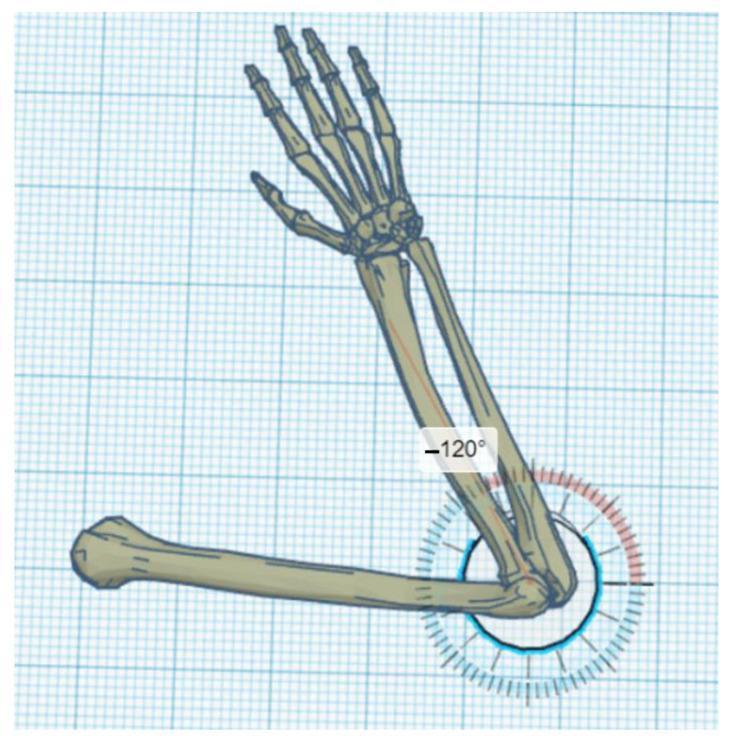
- Flexion/Extension: 0° (full extension) to ~145° flexion; functional arc = 30–130°
- Pronation/Supination: ~85° each direction; functional arc = 50° pronation / 50° supination
- The carrying angle (cubitus valgus): ~10–15° in adults (greater in females)
Joint Reaction Forces
- The elbow experiences high compressive loads during everyday activities
- During activities of daily living: joint forces of 1–3× body weight
- During heavy loading/throwing: forces can exceed 3× body weight
- The humeroradial joint bears approximately 60% of axial load through the elbow in forearm neutral rotation
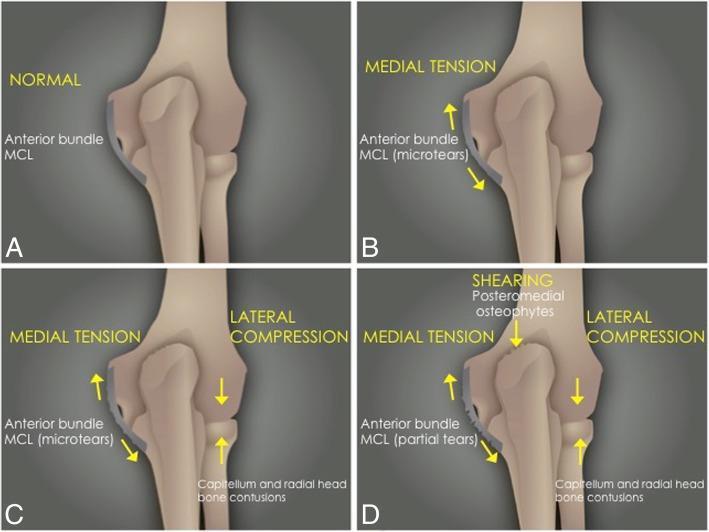
The Valgus-Extension Overload Mechanism (in throwers)
The throwing motion generates repetitive valgus stress:
- Medial tension → microtears of the anterior MCL bundle
- Lateral compression → capitellum–radial head impaction → bone contusions/osteochondral injury
- Posteromedial shear → olecranon–trochlear impaction → posteromedial osteophytes
Carrying Angle and Valgus Alignment
- The normal valgus orientation means most everyday activities exert a varus force on the elbow
- Therefore, residual instability after injury is more commonly due to LCL incompetence (not MCL), since varus loads predominate during activities of daily living
Forearm Rotation Axis
- Pronation-supination occurs about an axis running from the radial head to the distal ulna
- The proximal radioulnar joint (annular ligament + radial notch) and the distal radioulnar joint function as a linked unit
The "Drop Sign"
- After surgical management of elbow dislocation, a drop sign (posterior sag) may indicate LCL laxity
- Often resolves spontaneously with restoration of muscle tone
6. Illustrations
Elbow Capsule and Ligaments — Posterior and Lateral Views
UCL Bundles — Medial View
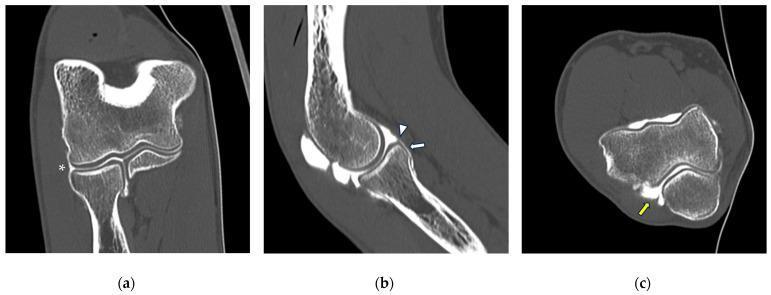
CT Arthrography — Normal Elbow Ligaments
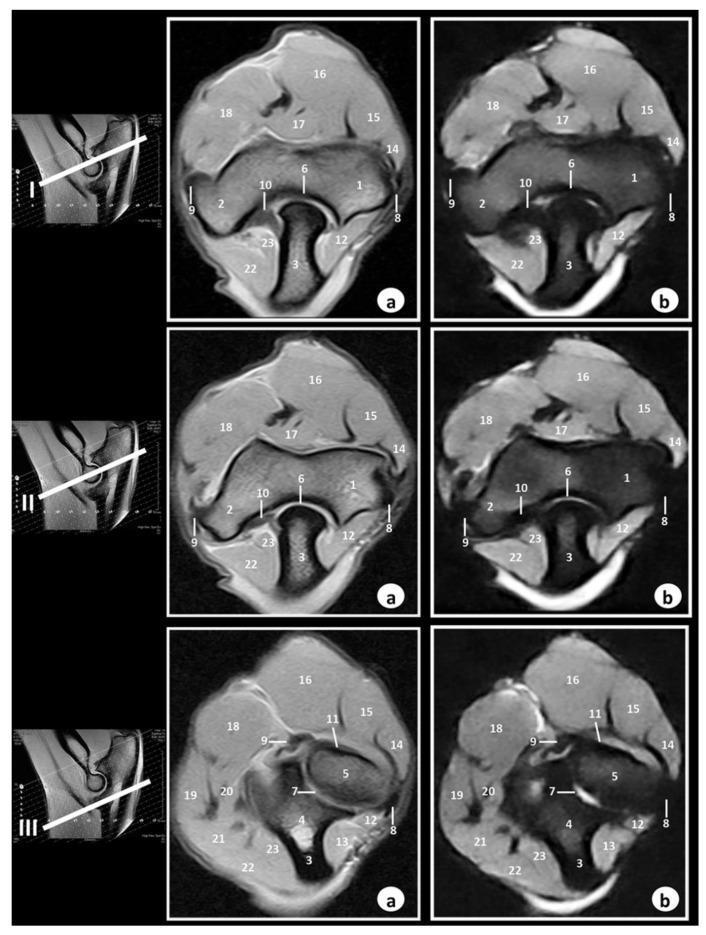
MRI Cross-Sections — Elbow Ligament Anatomy
Valgus Stress Mechanism (Throwing)
Elbow Flexion Biomechanics — ROM
Summary Table: Stability Contributions
| Stabilizer | Type | Force Resisted |
|---|---|---|
| Humeroulnar joint | Static (bony) | All translational forces |
| Anterior MCL bundle | Static (ligament) | Valgus, internal rotation |
| LCL/LUCL | Static (ligament) | Varus, posterolateral rotation |
| Annular ligament | Static (ligament) | Radial head subluxation (longitudinal) |
| Coronoid process | Static (bony) | Posterior translation, varus, rotation |
| Radial head | Static (bony) | Secondary valgus (when MCL torn) |
| Biceps/Brachialis/Triceps | Dynamic | Compression (all directions) |
| Common flexors | Dynamic | Valgus |
| Common extensors | Dynamic | Varus |
Sources:
- Rockwood and Green's Fractures in Adults, 10th ed. 2025
- Imaging Anatomy: Text and Atlas Vol. 3, Bones, Joints, Vessels and Nerves (Thieme)
- General Anatomy and Musculoskeletal System, THIEME Atlas of Anatomy
Elbow anatomy stability it's biomechanics complete details in total with appropriate images illustrations
Reading File
Finding Sources
Finding Sources
Searching Images
elbow joint anatomy bones ligaments stability biomechanics diagram
Finding Sources
Searching Images
elbow medial ulnar collateral ligament lateral collateral ligament anatomy
Reading File
Reading File
Loading Image
Finding Sources
Reading File
Loading Image
Reading File
Loading Image
Reading File
Searching Images
elbow joint articulations humeroulnar humeroradial proximal radioulnar carrying angle cubitus valgus
Reading File
Loading Image
Loading Image
Reading File
Finding Sources
This is a shared conversation. Sign in to Orris to start your own chat.