
Thalassemia make every important points
Reading File
Finding Sources
Finding Sources
Searching Images
thalassemia blood smear clinical features
Reading File
Reading File
Reading File
Reading File
I now have comprehensive information from Robbins Pathology and Robbins & Kumar. Let me compile the complete answer with the key images.
Loading Image
Loading Image
Loading Image
Here is a comprehensive, exam-ready breakdown of all the important points on Thalassemia.
Thalassemia — Complete Overview
1. Definition
Thalassemia is a genetically heterogeneous disorder caused by germline mutations that decrease synthesis of either α-globin or β-globin chains, leading to:
- Hemoglobin deficiency → hypochromic, microcytic anemia
- Imbalance in globin chain synthesis → excess unpaired chains → intracellular precipitates → hemolysis
- Two mechanisms of anemia: decreased red cell production (ineffective erythropoiesis) + decreased red cell lifespan (hemolysis)
"Thalassa" means "sea" in Greek — the disease is named for its prevalence around the Mediterranean.
— Robbins, Cotran & Kumar Pathologic Basis of Disease, p. 602
2. Genetics & Chromosomal Location
| Globin Chain | Gene Location | Type of Mutation |
|---|---|---|
| β-globin | Chromosome 11 (single gene) | Mainly point mutations |
| α-globin | Chromosome 16 (two identical genes in tandem = 4 total) | Mainly gene deletions |
Inheritance: Autosomal codominant
3. Epidemiology
- Endemic in the Mediterranean basin, Middle East, tropical Africa, Indian subcontinent, Asia
- Among the most common inherited disorders of humans
- High prevalence explained by protection against falciparum malaria in heterozygous carriers (similar to HbS)
4. β-Thalassemia
Molecular Pathogenesis
Over 100 causative mutations identified, divided into:
| Mutation Type | Effect | Result |
|---|---|---|
| β⁰ | No β-globin synthesized | Absent chain production |
| β⁺ | Reduced β-globin synthesized | Decreased (not absent) chain production |
Three major classes:
- Splicing mutations — Most common cause of β⁺-thalassemia. Destroy normal RNA splice junctions (→ β⁰) or create ectopic splice sites (→ β⁺, since some normal mRNA still made)
- Promoter region mutations — Reduce transcription by 75–80%; always → β⁺
- Chain terminator mutations — Most common cause of β⁰-thalassemia; nonsense mutations (premature stop codon) or frameshift mutations (small insertions/deletions) block translation entirely
Pathogenesis of Anemia (Two Mechanisms)
- Reduced HbA synthesis → hypochromic, microcytic RBCs with low oxygen-carrying capacity
- Excess unpaired α-chains precipitate within RBC precursors → insoluble inclusions → membrane damage → apoptosis of RBC precursors (ineffective erythropoiesis) + hemolysis of mature RBCs in spleen
Clinical Classification
| Syndrome | Genotype | Clinical Features |
|---|---|---|
| β-Thalassemia Major | Homozygous (β⁰/β⁰, β⁺/β⁰, β⁺/β⁺) | Severe anemia; requires regular blood transfusions |
| β-Thalassemia Intermedia | Variable | Moderately severe; transfusions not required |
| β-Thalassemia Minor (Trait) | Heterozygous (β⁰/β, β⁺/β) | Asymptomatic/mild anemia; red cell abnormalities on smear |
5. β-Thalassemia Major (Cooley's Anemia) — Key Features
Onset: Symptoms appear 6–9 months after birth (when HbF → HbA switch occurs)
Clinical Features:
- Severe microcytic hypochromic anemia with hemoglobin as low as 3–4 g/dL
- Hepatosplenomegaly — from extramedullary hematopoiesis + RBC destruction
- Expansion of the erythroid marrow → skeletal changes:
- "Chipmunk facies" — maxillary hyperplasia, prominent cheekbones
- Frontal bossing
- "Crew-cut" appearance on skull X-ray — from hair-on-end striations
- Thinning of cortical bone → pathological fractures
- Growth retardation
- Iron overload (secondary hemochromatosis) — from chronic transfusions + increased GI absorption
- Organ damage: cardiac failure (most common cause of death), liver cirrhosis, endocrine failure (diabetes, hypogonadism)
- Jaundice (unconjugated hyperbilirubinemia)
- Gallstones (pigment stones from chronic hemolysis)
"Thalassemic Facies"
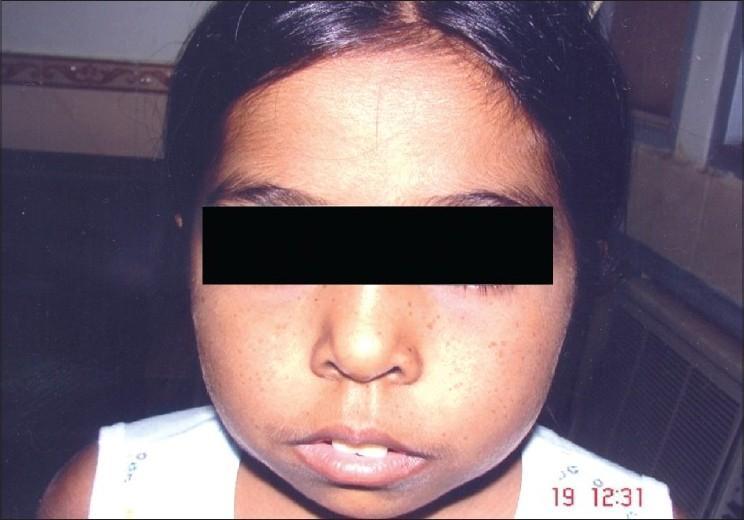
Classic facial features of β-thalassemia major: frontal bossing, maxillary hyperplasia, flattened nasal bridge ("chipmunk facies") from bone marrow expansion.
Hepatosplenomegaly + Peripheral Smear
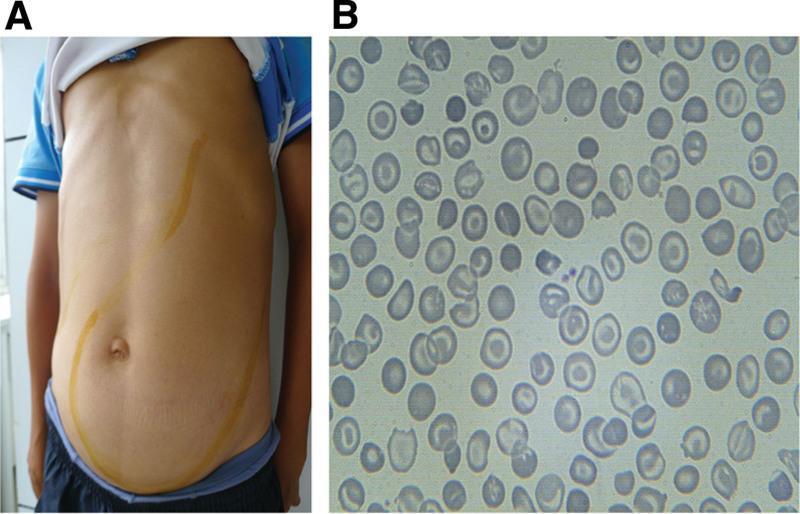
A: Massive hepatosplenomegaly from extramedullary hematopoiesis. B: Peripheral smear showing marked microcytosis, hypochromia, target cells (codocytes), and schistocytes.
Lab Findings:
- ↓ Hb, ↓ MCV, ↓ MCH
- Target cells, microcytes, hypochromic cells, nucleated RBCs, basophilic stippling on smear
- ↑ Reticulocytes (modest — less than expected due to ineffective erythropoiesis)
- ↑ Serum iron, ↑ ferritin
- ↑ HbF (compensatory); ↑ HbA2 (in β-thalassemia minor)
- Absent or ↓ HbA
Peripheral Blood Smear (Hb E/β-thalassemia)
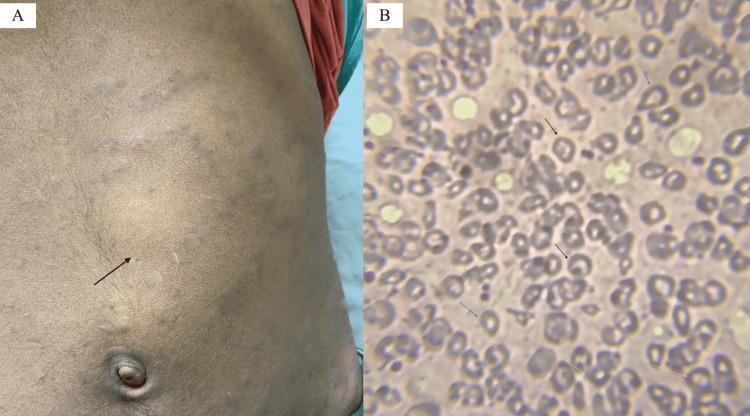
Leishman stain (200×): target cells, teardrop cells, and basophilic stippling — classic findings in thalassemia.
6. β-Thalassemia Minor (Trait)
- Heterozygous: one normal + one mutated β-globin allele
- Asymptomatic — incidental finding
- Mild microcytic hypochromic anemia (Hb 9–11 g/dL)
- ↑ HbA2 (>3.5%) — diagnostic hallmark
- Mild ↑ HbF possible
- No treatment required; important for genetic counseling
7. α-Thalassemia
Caused by deletion of α-globin genes (usually). Severity depends on how many of the 4 α-globin genes are deleted.
| Syndrome | Genotype | Features |
|---|---|---|
| Silent carrier | −/α, α/α (1 gene deleted) | Asymptomatic; slight microcytosis only |
| α-Thalassemia trait | −/−, α/α or −/α, −/α (2 genes deleted) | Asymptomatic; resembles β-thal minor; normal HbA2 |
| HbH disease | −/−, −/α (3 genes deleted) | Moderately severe anemia; resembles β-thal intermedia |
| Hydrops fetalis (α-thal major) | −/−, −/− (4 genes deleted) | Lethal in utero or at birth |
HbH Disease
- Only 1 α-globin gene functioning → excess β-chains form tetramers (HbH = β₄)
- HbH has extremely high O₂ affinity → delivers little O₂ to tissues
- HbH oxidizes easily → precipitates → RBC inclusions → sequestration in spleen
- Moderately severe hemolytic anemia
Hydrops Fetalis (α-Thalassemia Major)
- All 4 α-globin genes deleted → excess γ-chains form Hb Bart's (γ₄)
- Hb Bart's has very high O₂ affinity → severe fetal tissue hypoxia
- Presents in third trimester with:
- Severe pallor
- Generalized edema (hydrops)
- Massive hepatosplenomegaly
- Historically fatal; intrauterine transfusion now saves many infants
- Lifelong transfusion dependence → risk of iron overload
- Hematopoietic stem cell transplantation (HSCT) can be curative
Ethnic note:
- Asian populations: −/− haplotype common → at risk for HbH disease and hydrops fetalis
- African populations: −/α, −/α genotype → symptomatic α-thal is rare
8. Compensatory Mechanisms & Complications
| Mechanism | Consequence |
|---|---|
| Extramedullary hematopoiesis (liver, spleen, lymph nodes, bones) | Hepatosplenomegaly, skeletal deformities |
| Expansion of erythroid marrow | Facial/skeletal changes, osteoporosis |
| Increased GI iron absorption | Iron overload even without transfusions |
| Transfusion therapy | Secondary hemochromatosis → cardiac failure, cirrhosis, endocrinopathy |
| ↑ HbF production | Partially compensates in β-thalassemia; HbF does not require β-chains |
9. Diagnosis
| Test | Findings |
|---|---|
| CBC | ↓ Hb, ↓ MCV (microcytic), ↓ MCH (hypochromic) |
| Peripheral smear | Target cells, microcytes, nucleated RBCs, basophilic stippling, teardrop cells |
| Hemoglobin electrophoresis / HPLC | ↑ HbA2 (β-thal minor), ↑ HbF (major), absent HbA (major), HbH or Hb Bart's (α-thal) |
| Serum iron/ferritin | Elevated (unlike iron deficiency) |
| DNA analysis / PCR | Confirms specific mutation; used in prenatal diagnosis |
| Bone marrow | Erythroid hyperplasia |
| Prenatal | Chorionic villus sampling (CVS) or amniocentesis + DNA analysis |
Key distinction from iron deficiency anemia:
- In thalassemia: ↑ serum iron, ↑ ferritin, ↑ HbA2
- In iron deficiency: ↓ serum iron, ↓ ferritin, normal HbA2
10. Treatment
| Treatment | Indication |
|---|---|
| Regular blood transfusions | β-Thalassemia major (every 3–4 weeks to keep Hb >9 g/dL) |
| Iron chelation therapy (deferoxamine, deferasirox, deferiprone) | Prevent iron overload from transfusions |
| Hematopoietic stem cell transplantation (HSCT) | Curative; best results in young patients without organ damage |
| Splenectomy | Reduces transfusion requirements; risk of post-splenectomy sepsis (vaccinate against encapsulated organisms) |
| Folic acid | Supports increased erythropoiesis |
| Hydroxyurea | Increases HbF production (especially in β-thalassemia intermedia) |
| Gene therapy / gene editing | Emerging; luspatercept (activin receptor ligand trap) approved to reduce transfusion burden |
| Intrauterine transfusion | Hydrops fetalis (α-thal major) |
11. Thalassemia & Malaria
- Heterozygous carriers are protected against Plasmodium falciparum malaria — explains high gene frequency in malaria-endemic regions (similar selective advantage as HbS in sickle cell trait)
12. Genetic Counseling
- Both parents β-thalassemia minor → 25% risk of major, 50% risk of minor, 25% normal
- Prenatal diagnosis by DNA analysis (CVS at 10–12 weeks or amniocentesis at 15–18 weeks)
- Important in populations of Mediterranean, Middle Eastern, South Asian, and Southeast Asian ancestry
Sources: Robbins, Cotran & Kumar — Pathologic Basis of Disease, pp. 602–611 | Robbins & Kumar — Basic Pathology, pp. 380–388
This is a shared conversation. Sign in to Orris to start your own chat.