
CVP and its importantance . Make md anaesthesia notes
Reading File
Finding Sources
Finding Sources
Reading File
Reading File
Reading File
Reading File
Reading File
Finding Sources
Reading File
Reading File
Now I have comprehensive information. Let me compile this into detailed anaesthesia notes.
Reading File
Now I have all the material needed. Let me write the comprehensive anaesthesia notes as a markdown file.
Running Command
ls -la /home/daytona/workspace/ 2>/dev/null || echo "workspace not found"
Writing File
~/CVP_Anaesthesia_Notes.md
# Central Venous Pressure (CVP) — Anaesthesia Notes
---
## 1. Definition
**Central Venous Pressure (CVP)** is the blood pressure measured in the superior vena cava or right atrium. It approximates **right atrial pressure (RAP)** and therefore serves as an index of:
- Right ventricular preload
- Circulating blood volume
- Venous tone
- Right ventricular performance
> Normal CVP: **2–8 mmHg** (supine, at rest)
---
## 2. Physiological Basis
CVP reflects the balance between venous return to the right heart and the ability of the right ventricle to eject that volume. It is influenced by:
| Factor | Effect on CVP |
|--------|---------------|
| Hypovolaemia | ↓ CVP |
| Hypervolaemia | ↑ CVP |
| Right heart failure | ↑ CVP |
| Cardiac tamponade | ↑ CVP |
| Tension pneumothorax | ↑ CVP |
| PEEP / high intrathoracic pressure | ↑ CVP |
| Vasodilation (sepsis, anaesthesia) | ↓ CVP |
| Tricuspid regurgitation | ↑ CVP (ventricularised waveform) |
> **Key limitation**: CVP reflects **right-sided** heart function, NOT left ventricular performance.
---
## 3. Indications for CVP Monitoring / CVC Insertion
*(Miller's Anaesthesia, 10e — Box 32.5)*
### Monitoring indications
- CVP and haemodynamic monitoring in unstable patients / major surgery
- Pulmonary artery catheterisation
- Transvenous cardiac pacing
### Access indications
- Infusion of vasoactive drugs (adrenaline, noradrenaline, vasopressin)
- Hyperalimentation / total parenteral nutrition (TPN)
- Chemotherapy or agents irritating to peripheral veins
- Prolonged antibiotic therapy (e.g., endocarditis)
- Rapid fluid resuscitation via large-bore introducer sheath
- Trauma or major surgery
- Aspiration of venous air emboli
- No adequate peripheral IV access
- Repeated blood sampling
---
## 4. Access Sites
| Site | Advantages | Disadvantages |
|------|-----------|---------------|
| **Right internal jugular (RIJ)** | Most direct route to RA/RV; highest success rate; preferred for pacing wire / PA catheter | Carotid artery risk; patient discomfort |
| **Left internal jugular** | Alternative when right unavailable | Longer to SVC (3–5 cm extra); thoracic duct risk |
| **Subclavian** | Patient comfort; lower infection risk | Higher pneumothorax risk — avoid in severe emphysema; difficult to compress if bleeding |
| **External jugular** | Easy in some patients | Kinks in lateral decubitus (problem during thoracotomy / OLV) |
| **Femoral** | Useful when neck immobilised (trauma) | Infection risk; catheter may not reach central circulation reliably |
| **Antecubital (PICC)** | Minimally invasive | Longer insertion; positional |
### Site selection principles
- **Coagulopathic patients** → internal or external jugular (compressible); avoid subclavian
- **Severe emphysema** → internal jugular (lower pneumothorax risk vs subclavian)
- **Emergency transvenous pacing** → right internal jugular (most direct route to RV)
- **Cervical collar / trauma** → femoral or subclavian approach
---
## 5. Technique Essentials
- Use **real-time ultrasound guidance** — strongly recommended, especially for internal jugular (reduces complications, increases first-pass success)
- Use **maximal barrier precautions** (cap, mask, sterile gown, sterile gloves, full-body drape)
- **Seldinger technique**: needle → guide wire → dilator → catheter
- Confirm venous placement with **waveform manometry or pressure measurement** before use
- Verify catheter tip position on **chest X-ray** — tip should lie in SVC above the right atrial junction (within 2 cm of cardiac silhouette on AP CXR for PA catheter)
---
## 6. CVP Waveform
### 6.1 Normal Waveform Components
*(Miller's Anaesthesia 10e — Table 32.3)*
| Component | Phase | Mechanical Event | ECG Timing |
|-----------|-------|------------------|------------|
| **a wave** | End-diastole | Atrial contraction ("atrial kick") | After P wave |
| **c wave** | Early systole | Isovolumic ventricular contraction; tricuspid valve bulges into RA | End of QRS |
| **x descent** | Mid-systole | Atrial relaxation + descent of tricuspid annulus toward apex | Before T wave |
| **v wave** | Late systole | Venous filling of atrium while tricuspid is closed | End of T wave |
| **y descent** | Early diastole | Tricuspid valve opens; blood flows RA → RV | Before P wave |
| **h wave** | Mid-to-late diastole | Diastolic plateau (only seen at slow HR or elevated CVP) | — |
**Mnemonic**: a = Atrial contraction; c = Closure of tricuspid; x = eXit of blood (atrial relaxation); v = Venous filling; y = Yield to ventricle
> CVP is read at the **base of the c wave at end-expiration** (Fishman's Pulmonary, 5e)
### 6.2 CVP Waveform Image
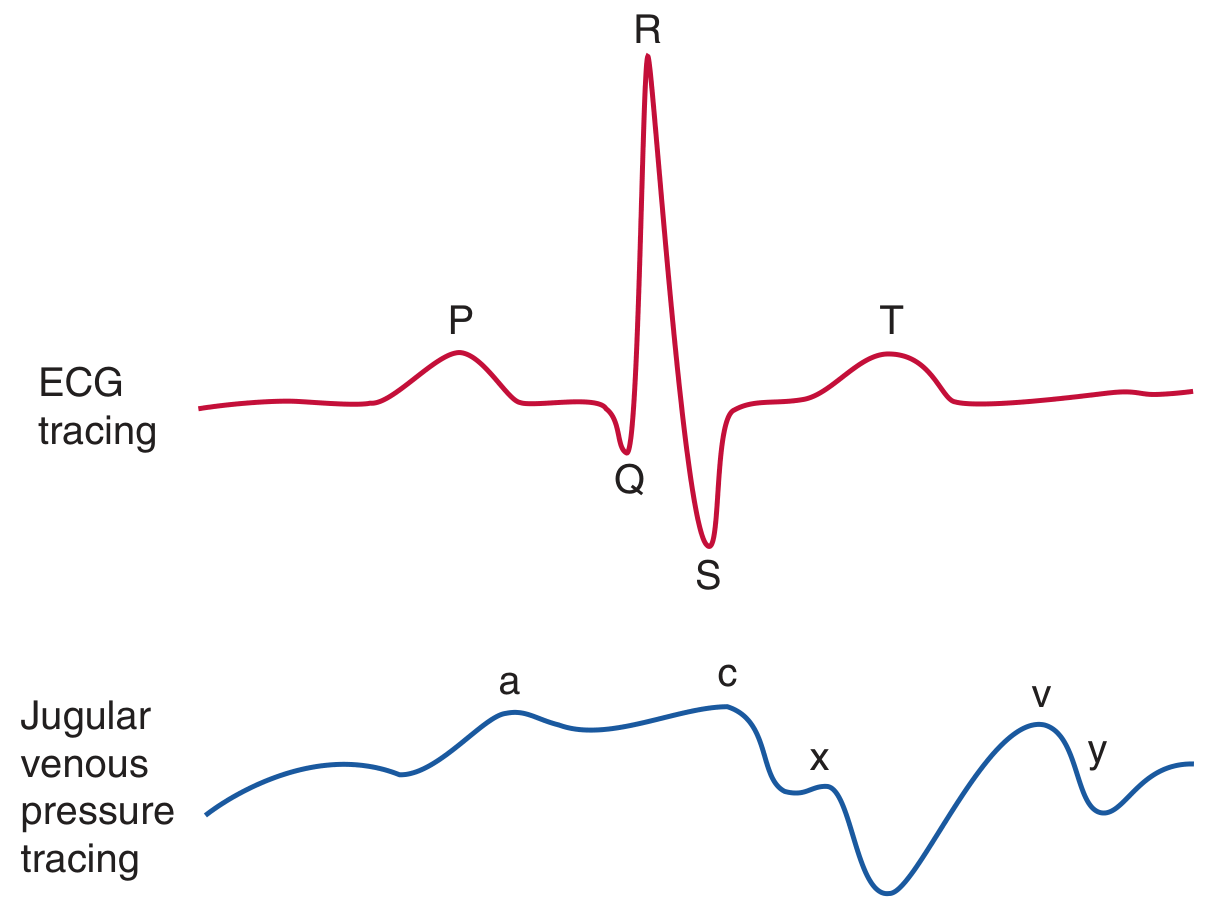
*CVP waveform with simultaneous ECG. The a wave follows the P wave; the c wave follows the QRS; the v wave peaks after the T wave.*
---
## 7. CVP Waveform Abnormalities
*(Miller's Anaesthesia 10e — Table 32.3 Abnormalities)*
| Condition | Waveform Change | Mechanism |
|-----------|----------------|-----------|
| **Atrial fibrillation** | Loss of a wave; prominent c wave | No organised atrial contraction |
| **AV dissociation / complete heart block** | Cannon a waves | Atrium contracts against closed tricuspid |
| **Tricuspid regurgitation** | Tall systolic c-v wave; loss of x descent ("ventricularised" waveform) | Regurgitant systolic filling of RA |
| **Tricuspid stenosis** | Tall a wave; attenuated y descent | Impaired diastolic emptying of RA |
| **Cardiac tamponade** | Dominant x descent; attenuated y descent ("x without y") | Equalised pressures; impaired RA filling in diastole |
| **Pericardial constriction** | Tall a and v waves; steep x AND y descents; M or W pattern | Impaired ventricular filling with exaggerated pressure equalisation |
| **RV ischaemia / infarction** | Tall a and v waves; steep x and y descents; M or W pattern | Poor RV compliance |
| **Junctional rhythm** | Loss of a wave | No P wave → no organised atrial contraction |
---
## 8. Measurement Technique
### Zeroing and levelling
- Zero reference point: **5 cm below the sternal angle** (uppermost fluid level in RA) OR **one-third of thoracic AP dimension** (mid-RA level)
- Commonly: mid-thoracic level (phlebostatic axis)
- Consistency throughout monitoring period is **most important**
### Respiratory variation
- Measure at **end-expiration** in both spontaneous and positive-pressure ventilation
- PEEP elevates CVP — account for this when interpreting values
---
## 9. Clinical Interpretation
### CVP in shock
| Shock Type | Expected CVP |
|------------|-------------|
| Hypovolaemic | Low (↓) |
| Distributive (sepsis, anaphylaxis) | Low (↓) |
| Cardiogenic (right heart failure) | High (↑) |
| Obstructive (tamponade, tension pneumothorax, massive PE) | High (↑) |
> These are generalisations — CVP must be interpreted in the full clinical context.
### CVP and fluid responsiveness
**CVP is a POOR predictor of fluid responsiveness.** (Miller's Anaesthesia 10e; Barash Clinical Anaesthesia 9e)
- Multiple RCTs and systematic reviews show **very poor relationship between CVP and circulating blood volume**
- A single static CVP value **cannot predict** response to a fluid challenge
- **Dynamic variables are preferred** for guiding fluid therapy:
- Pulse pressure variation (PPV)
- Stroke volume variation (SVV)
- Passive leg raise response
- Oesophageal Doppler
- Point-of-care echocardiography
> *"Consensus guidelines recommend against using static measures like CVP to assess the likelihood of fluid responsiveness, favouring use of dynamic variables."* — Fishman's Pulmonary Diseases and Disorders, 5e
---
## 10. Complications of CVC Insertion
*(Miller's Anaesthesia 10e — Box 32.6)*
Up to **15%** of patients may experience some adverse event.
### Mechanical
- **Arterial puncture** — most common acute complication (1.9–15%); can cause haematoma, AV fistula, pseudoaneurysm, or stroke (carotid)
- **Pneumothorax** — higher with subclavian approach; catastrophic if in dependent lung during OLV
- **Haemothorax / hydrothorax / haemomediastinum**
- **Chylothorax** (left subclavian / left IJ — thoracic duct injury)
- **Air embolism** — risk during insertion (Trendelenburg position reduces risk)
- **Catheter malposition** — tip in wrong vessel or chamber
- **Arrhythmias** — guide wire irritation of RV/RA
### Thromboembolic
- **Deep vein thrombosis** — especially femoral and subclavian sites
- **Pulmonary embolism**
- **Catheter-related thrombosis**
### Infectious
- **Central line-associated bloodstream infection (CLABSI)** — significant cause of ICU morbidity/mortality
- Prevention: maximal barrier precautions, chlorhexidine skin prep, standardised insertion checklists, daily review of necessity
---
## 11. Specific Anaesthetic Contexts
### Thoracic surgery / pneumonectomy
- CVP catheter commonly placed for oesophagectomy and pneumonectomy
- **Avoid subclavian approach** — pneumothorax risk in dependent lung during OLV is catastrophic
- **External jugular should be avoided** during thoracotomy — kinks when patient turned to lateral decubitus
- CVP no longer considered accurate guide for fluid responsiveness in thoracic surgery
- *(Barash Clinical Anaesthesia 9e)*
### Cardiac surgery / haemodynamically unstable patients
- CVP used alongside other haemodynamic monitors (PA catheter, TOE)
- PA catheter placed through right IJ via the CVC site
- Characteristic pressure waveforms confirm passage through RA → RV → PA → wedge position
### Transvenous pacing emergencies
- **Right internal jugular** preferred — most direct route to RV
---
## 12. Summary — Key Points for Exams
1. CVP = right atrial pressure ≈ RV preload (NOT LV preload)
2. Normal: **2–8 mmHg**; measured at **end-expiration** at the **base of the c wave**
3. CVP waveform: **a, c, v** waves and **x, y** descents — timed against ECG
4. **Cannon a waves** = AV dissociation; **loss of a wave** = AF; **c-v fusion + loss of x** = tricuspid regurgitation
5. **CVP is a poor predictor of fluid responsiveness** — dynamic variables are preferred
6. **Right internal jugular** = preferred site for pacing wires and PA catheters
7. **Subclavian** has highest pneumothorax risk — avoid in emphysema and OLV cases
8. Complications: arterial puncture, pneumothorax, CLABSI, arrhythmias, air embolism
9. Always use **ultrasound guidance** (strongly recommended for IJ)
10. Waveform abnormalities are diagnostically useful — especially tamponade (dominant x, absent y) vs. constriction (steep x AND y)
---
*Sources: Miller's Anaesthesia 10e (Elsevier); Barash, Cullen & Stoelting's Clinical Anaesthesia 9e; Fishman's Pulmonary Diseases and Disorders 5e; Morgan & Mikhail's Clinical Anaesthesiology 7e*
Here are your comprehensive anaesthesia notes on CVP:
CVP Anaesthesia Notes
MD File · MD
Central Venous Pressure (CVP) — Anaesthesia Notes
1. Definition
CVP = pressure in the superior vena cava / right atrium ≈ right atrial pressure (RAP)
Reflects:
- RV preload
- Circulating blood volume
- Venous tone
- RV performance
Normal CVP: 2–8 mmHg
2. Physiological Basis
| Factor | Effect on CVP |
|---|---|
| Hypovolaemia | ↓ |
| Right heart failure | ↑ |
| Cardiac tamponade | ↑ |
| Tension pneumothorax | ↑ |
| PEEP | ↑ |
| Vasodilation (sepsis, anaesthesia) | ↓ |
| Tricuspid regurgitation | ↑ (ventricularised) |
CVP reflects right-sided heart function — NOT left ventricular performance. (Barash Clinical Anaesthesia 9e)
3. Indications for CVC Insertion
- CVP monitoring in haemodynamically unstable patients and major surgery
- Transvenous cardiac pacing
- Infusion of vasoactive drugs, TPN, chemotherapy, vesicant agents
- Rapid fluid resuscitation (large-bore introducer)
- Pulmonary artery catheterisation
- Aspiration of air emboli
- No peripheral access; repeated blood sampling
4. Access Sites
| Site | Key Points |
|---|---|
| Right IJ | Highest success; direct route to RA/RV; preferred for pacing + PA catheter |
| Subclavian | Highest pneumothorax risk — avoid in emphysema and OLV cases |
| Left IJ / EJ | 3–5 cm longer to SVC; EJ kinks in lateral decubitus (problem in thoracotomy) |
| Femoral | Useful when neck immobilised (trauma); infection risk |
Site selection:
- Coagulopathy → IJ or EJ (compressible); avoid subclavian
- Emergency pacing → right IJ (most direct to RV)
- Trauma with cervical collar → femoral or subclavian
- OLV / thoracic surgery → avoid subclavian; avoid EJ (Barash 9e)
5. CVP Waveform — Normal Components
(Miller's Anaesthesia 10e — Table 32.3)
| Wave | Phase | Mechanical Event | ECG timing |
|---|---|---|---|
| a | End-diastole | Atrial contraction (atrial kick) | After P wave |
| c | Early systole | Tricuspid closure + isovolumic RV contraction | End QRS |
| x descent | Mid-systole | Atrial relaxation + annular descent | Before T wave |
| v | Late systole | Venous atrial filling (tricuspid still closed) | After T wave |
| y descent | Early diastole | Tricuspid opens; RA → RV filling | Before next P |
| h wave | Mid-diastole | Plateau (only at slow HR or high CVP) | — |
Mnemonic: atrial contraction → closure of tricuspid → exit (atrial relaxation) → venous filling → yield to ventricle

Read CVP at the base of the c wave at end-expiration
6. CVP Waveform Abnormalities
| Condition | Change | Mechanism |
|---|---|---|
| Atrial fibrillation | Loss of a wave | No organised atrial contraction |
| AV dissociation | Cannon a waves | Atrium contracts against closed tricuspid |
| Tricuspid regurgitation | Tall systolic c-v wave; loss of x descent | Regurgitant RA filling in systole |
| Tricuspid stenosis | Tall a wave; attenuated y descent | Impaired diastolic RA emptying |
| Cardiac tamponade | Dominant x descent; absent/attenuated y | Extrinsic compression; impaired diastolic filling |
| Pericardial constriction | Steep x AND y descents; M/W pattern | Exaggerated pressure equalisation |
| RV ischaemia / infarction | Tall a + v; steep x + y; M/W pattern | Reduced RV compliance |
7. Measurement — Practical Points
- Zero reference: 5 cm below sternal angle OR mid-thoracic level (phlebostatic axis)
- Always consistent levelling throughout monitoring period
- Measure at end-expiration (both spontaneous and PPV)
- PEEP artificially elevates CVP — factor this in
- Use ultrasound guidance (strongly recommended; mandatory for IJ per most guidelines) (Miller's 10e)
8. CVP and Fluid Responsiveness
CVP is a POOR predictor of fluid responsiveness. Multiple RCTs and systematic reviews confirm:
- No reliable relationship between CVP and circulating blood volume
- A single static CVP cannot predict haemodynamic response to a fluid bolus
- Guidelines recommend dynamic variables instead:
| Dynamic Variable | Method |
|---|---|
| Pulse pressure variation (PPV) | Arterial line |
| Stroke volume variation (SVV) | LiDCO / Vigileo |
| Passive leg raise (PLR) | Clinical |
| Oesophageal Doppler | Probe |
| Point-of-care echocardiography (POCUS) | TOE / TTE |
(Fishman's Pulmonary 5e; Miller's Anaesthesia 10e)
9. CVP in Shock
| Shock Type | Expected CVP |
|---|---|
| Hypovolaemic | ↓ Low |
| Distributive (sepsis, anaphylaxis) | ↓ Low |
| Cardiogenic (right heart failure) | ↑ High |
| Obstructive (tamponade, tension PTX, massive PE) | ↑ High |
10. Complications
Up to 15% of patients experience some adverse event. (Miller's 10e)
Mechanical
- Arterial puncture (1.9–15%) — most common acute complication
- Pneumothorax (↑ subclavian)
- Haemothorax / hydrothorax / chylothorax (L subclavian)
- Air embolism
- Catheter malposition, arrhythmias (guide wire in RV)
Thromboembolic
- DVT, PE, catheter-related thrombosis
Infectious
- CLABSI (central line-associated bloodstream infection)
- Prevention: chlorhexidine prep, maximal sterile barrier, insertion checklist, daily need review
11. Exam Summary — 10 High-Yield Facts
- CVP = RAP ≈ RV preload — not LV preload
- Normal: 2–8 mmHg; read at end-expiration, base of c wave
- Waveform: a, c, v peaks; x, y descents — timed against ECG
- Cannon a waves = AV dissociation; loss of a = AF; c-v fusion + no x = tricuspid regurgitation
- Tamponade: dominant x descent, absent y — Constriction: steep x AND y (M/W)
- CVP is a poor predictor of fluid responsiveness — dynamic variables preferred
- Right IJ = best site for pacing wires and PA catheters
- Subclavian = highest pneumothorax risk; avoid in emphysema and OLV
- EJ kinks in lateral decubitus — avoid for thoracotomy
- Always use ultrasound guidance; complications occur in up to 15% of insertions
Sources: Miller's Anaesthesia 10e; Barash, Cullen & Stoelting's Clinical Anaesthesia 9e; Fishman's Pulmonary Diseases and Disorders 5e; Morgan & Mikhail's Clinical Anaesthesiology 7e
This is a shared conversation. Sign in to Orris to start your own chat.