
freys syndrome for ent pg exam essay
Reading File
Frey's syndrome (auriculotemporal syndrome) is a post-parotidectomy complication where aberrant reinnervation of parasympathetic secretomotor fibers to sweat glands causes gustatory sweating - sweating and flushing of the cheek during eating. It's a classic ENT PG exam topic.
Searching sources...
Finding Sources
Finding Sources
Searching PubMed
"Frey syndrome" parotidectomy
Excellent results. Now let me read the most comprehensive sections from Scott-Brown's and KJ Lee's, plus Bailey and Love's.
Reading File
Reading File
Reading File
Now let me read the Cummings section and the KJ Lee section for additional details on treatment and Minor's test:
Reading File
Reading File
Reading File
Now let me fetch the clinical image of Frey's syndrome from Scott-Brown's:
Loading Image
Loading Image
I now have comprehensive data from all major ENT textbooks. Let me compose the full essay.
Frey's Syndrome (Auriculotemporal Syndrome / Gustatory Sweating)
Definition
Frey's syndrome, also called auriculotemporal syndrome or gustatory sweating, is a condition characterised by sweating, flushing, and a sensation of warmth over the skin in the distribution of the auriculotemporal nerve and/or greater auricular nerve, occurring in response to any gustatory (taste or smell) stimulus. It is the most distressing long-term sequela reported by patients more than five years after parotid surgery for benign disease.
- Scott-Brown's Otorhinolaryngology Head & Neck Surgery, p. 6776
- Cummings Otolaryngology Head and Neck Surgery, p. 1521
Historical Note
First described by Lucja Frey in 1923. She attributed the syndrome to lesions of the auriculotemporal nerve, a branch of the mandibular division (V3) of the trigeminal nerve.
Anatomy of Parotid Innervation (Basis of the Syndrome)
Understanding the nerve supply is essential:
- Preganglionic parasympathetic fibers arise from the inferior salivatory nucleus (medulla) and travel with CN IX (glossopharyngeal nerve).
- The Jacobson's nerve (tympanic branch of CN IX) enters via the inferior tympanic canaliculus and forms the tympanic plexus in the middle ear.
- The lesser petrosal nerve (carrying preganglionic parasympathetic fibers) exits the middle ear, passes through the foramen ovale, and synapses at the otic ganglion in the infratemporal fossa.
- Postganglionic secretomotor parasympathetic fibers exit the otic ganglion and join the auriculotemporal nerve (branch of V3), which carries them to the parotid gland.
- The sympathetic supply (from superior cervical ganglion) normally innervates the sweat glands of the overlying skin.
- Bailey and Love's Short Practice of Surgery 28th Edition, p. 854
Pathophysiology (Misdirected Nervous Regeneration)
The mechanism is aberrant cross-reinnervation - the key concept for the PG exam:
- During parotidectomy, both the postganglionic parasympathetic fibers of the auriculotemporal nerve (supplying the parotid gland) and the sympathetic fibers supplying local sweat glands are sectioned.
- During neural regeneration, parasympathetic fibers grow along the distal ends of sympathetic fibers toward the skin vessels and sweat glands.
- When a gustatory stimulus is received, acetylcholine (ACh) released from the misdirected parasympathetic fibers activates sweat glands (normally a sympathetic function) - producing sweating + flushing.
- ACh acts as a neurotransmitter for both postganglionic sympathetic and parasympathetic fibers - this dual action explains why aberrant reinnervation can stimulate sweat gland secretion.
The latent period (typically 5 weeks to several months, occasionally up to 30 years post-surgery) is explained by the time required for nerve fiber regeneration.
- Scott-Brown's, p. 6792-6794
- Bailey and Love's, p. 2924-2926
Etiology / Causes
| Category | Example |
|---|---|
| Most common | Parotidectomy (superficial or total) |
| Trauma | Forceps delivery injury in neonates (misdiagnosed as food allergy in children) |
| Temporomandibular joint surgery or trauma | |
| Inflammatory | Parotitis, parotid abscess |
| Vascular surgery | Carotid endarterectomy |
| Submandibular gland surgery | (involves different nerve, not auriculotemporal) |
- Incidence after parotidectomy: ranges widely in literature from 2.6% to 97.6% (subjective), but up to 96% have subclinical manifestation detectable on Minor's starch iodine test.
- Cummings Otolaryngology, p. 1521 estimates 35-60% true incidence post-parotidectomy.
- Scott-Brown's (Rustemeyer et al.) reports 23.5% developing clinical FS at an average of 12 months post-surgery, with only 44% of these being symptomatic.
Clinical Features
- Sweating (diaphoresis) over the preauricular/cheek region
- Flushing (erythema)
- Warmth and tingling sensation
- Confined to the distribution of the auriculotemporal nerve (preauricular area, temple, cheek)
- Triggered by any gustatory stimulus - taste, smell, or even thought of food
- Typically appears within the first year post-parotidectomy, but onset may be delayed for years
- Causes significant social embarrassment
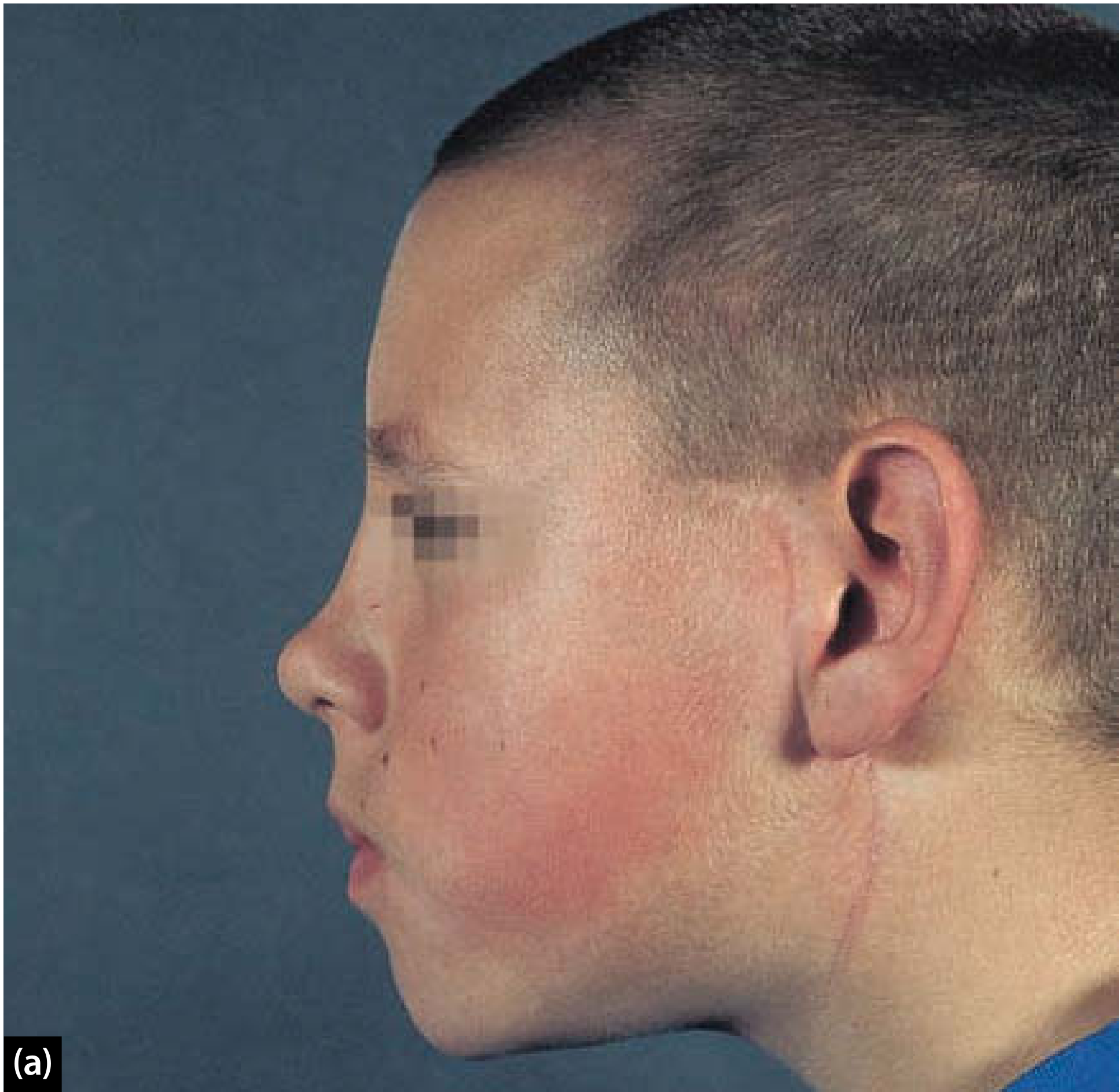
Clinical photograph (a): Classical facial blush in a child elicited by eating flavoured crisps:
Diagnosis
Clinical Diagnosis
- Primarily based on history and symptoms - sweating over the parotid region triggered by eating.
Minor's Starch-Iodine Test (Gold Standard)
The objective confirmatory test:
- Paint the ipsilateral side of the face and neck with iodine solution - allow to dry.
- Dust starch powder over the painted area.
- Ask the patient to chew a sialagogue (e.g., lemon wedge or flavoured crisps) for several minutes.
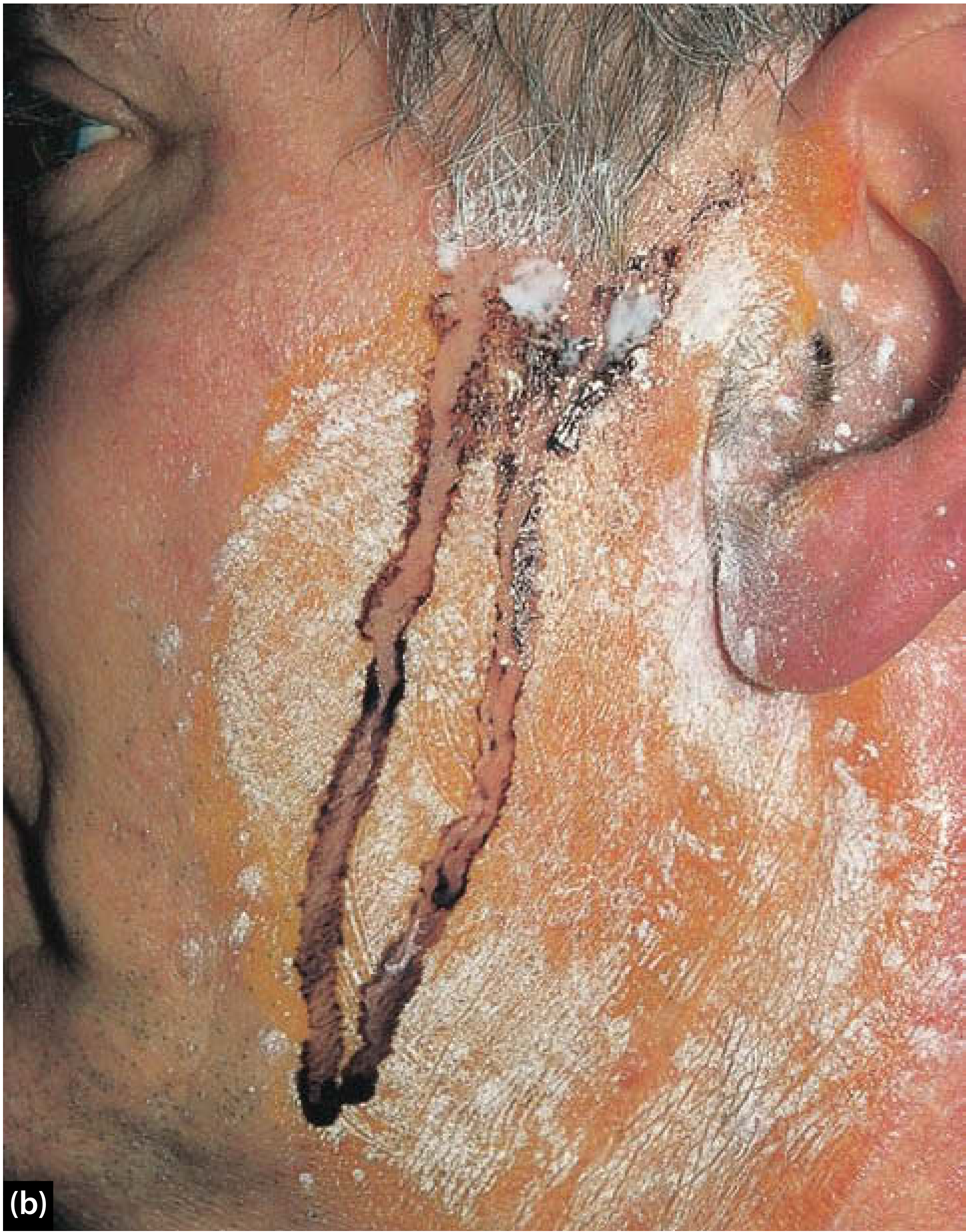
- Blue-black spots appear in areas of sweating - this is due to the chemical reaction between dissolved starch and iodine.
"Minor's starch iodine test, allowing visual confirmation of the blue-black reaction in the sweating area, is thought to be the gold standard of diagnosis." - Scott-Brown's, p. 6803
Clinical photograph (b): Minor's starch-iodine test demonstrating gustatory sweating:
Management
Many patients require no treatment.
Conservative (Topical)
- Antiperspirants (e.g., aluminium chlorohydrate) applied over the affected skin area - simple first-line measure.
- Glycopyrrolate 1% roll-on lotion (topical anticholinergic) - effective in controlling symptoms.
Medical - Botulinum Toxin A (Treatment of Choice)
- Intracutaneous (subdermal) injection of Botulinum toxin A into the affected skin is currently the most effective treatment.
- Benefit lasts approximately 1.5 years in 60% of patients (Scott-Brown's), requiring repeat injections at 6-12 monthly intervals.
- Mechanism: blocks ACh release at the aberrant parasympathetic-sweat gland junction.
Surgical
-
Tympanic neurectomy (Jacobson's neurectomy) - surgical interruption of the secretory fibers at the level of the tympanic plexus via the middle ear. Denervates the parasympathetic supply upstream.
-
Used when conservative measures fail.
-
Cummings Otolaryngology, p. 1521
-
Scott-Brown's, p. 6808-6810
-
Bailey and Love's, p. 4334-4336
Prevention
Strategies to reduce post-parotidectomy Frey's syndrome:
- More conservative parotidectomy - partial/superficial parotidectomy reduces nerve damage.
- Thick skin flap elevation during surgery - creates a physical barrier between the auriculotemporal nerve and overlying sweat glands.
- SMAS flap preservation/repair - restoring the integrity of the superficial muscular aponeurotic system provides a barrier. This is the most effective preventive strategy.
- Sternocleidomastoid (SCM) muscle flap interposition - creates a barrier but evidence is conflicting; total prevention is not achieved with any technique.
- Other interposition materials (e.g., AlloDerm, fat, fascia lata) have also been described.
"Data concerning the efficacy of prevention strategies remain inconclusive. A systematic review suggests total prevention is unlikely with any technique." - Scott-Brown's, p. 6813-6817
Key Points for PG Exam (Summary Box)
| Point | Detail |
|---|---|
| Synonym | Auriculotemporal syndrome, gustatory sweating |
| Nerve involved | Auriculotemporal nerve (branch of V3, mandibular) |
| Most common cause | Parotidectomy |
| Mechanism | Aberrant parasympathetic reinnervation of sweat glands |
| Latent period | 5 weeks to several months (regeneration time) |
| Neurotransmitter | Acetylcholine (ACh) |
| Gold standard test | Minor's starch-iodine test |
| Best treatment | Botulinum toxin A injection |
| Prevention | SMAS flap repair, thick skin flap, conservative surgery |
| Paediatric mimic | Forceps delivery injury - misdiagnosed as food allergy |
Nerve Pathway Diagram (for Memory)
Inferior salivatory nucleus (medulla)
        ↓ (CN IX / Glossopharyngeal)
Jacobson's nerve → Tympanic plexus (middle ear)
        ↓
Lesser petrosal nerve → Foramen ovale
        ↓ synapse at
Otic ganglion (infratemporal fossa)
        ↓ postganglionic
Auriculotemporal nerve → Parotid gland (normal)
                                   ↓ [after parotidectomy - aberrant]
                       Sweat glands of overlying skin → FREY'S SYNDROME
Sources: Scott-Brown's Otorhinolaryngology Head & Neck Surgery | Cummings Otolaryngology Head and Neck Surgery | Bailey and Love's Short Practice of Surgery 28th Edition | K.J. Lee's Essential Otolaryngology
This is a shared conversation. Sign in to Orris to start your own chat.