
Nitroglycerin - therapeutic uses, routes of administration, adverse effects moa,precaution 2. Coronary Steal Phenomenon - explain, clinical significance precaution 3. Nifedipine and Verapamil - compare and contrast 4. Nitrates - MOA theraputic uses adverse effect precautions
2mbbs pharmacology refer kd t
Reading File
Now let me search the library for all four topics simultaneously.
Finding Sources
Finding Sources
Finding Sources
Good results. Now let me search specifically for KD Tripathi-style pharmacology content and read the most relevant blocks.
Finding Sources
Reading File
Reading File
Reading File
Finding Sources
Finding Sources
Excellent content. Let me now read the Goodman & Gilman nitrates section (critical for complete coverage) and Lippincott for nifedipine/verapamil comparison + coronary steal.
Reading File
Reading File
Reading File
I now have very rich content. Let me also grab the Goodman & Gilman section on nitrate therapeutic uses, adverse effects, and Lippincott nifedipine/verapamil comparison to complete the picture.
Reading File
Reading File
I now have enough comprehensive content from Goodman & Gilman and Lippincott to write a thorough, 2nd MBBS-level pharmacology answer. Let me fetch the CCB comparison image for visual clarity and also quickly look at the nitrate therapeutic uses section.
Loading Image
Reading File
I now have all the content I need for a thorough 2nd MBBS pharmacology answer. Let me compile the comprehensive response.
2nd MBBS Pharmacology - Cardiovascular Drugs
Sources: Goodman & Gilman's Pharmacological Basis of Therapeutics, Lippincott Illustrated Reviews: Pharmacology, Katzung's Basic & Clinical Pharmacology, Braunwald's Heart Disease
1. Nitroglycerin (Glyceryl Trinitrate / GTN)
Mechanism of Action
Nitroglycerin is an organic nitrate that acts as a nitric oxide (NO) donor. The key steps are:
- GTN enters vascular smooth muscle and is converted to NO (bioactivation requires mitochondrial aldehyde dehydrogenase, ALDH2).
- NO activates soluble guanylyl cyclase (sGC), which converts GTP to cGMP.
- Elevated cGMP activates protein kinase G (PKG), which:
- Reduces myosin light chain kinase (MLCK) activity
- Increases myosin light chain phosphatase activity
- Reduces intracellular Ca²⁺
- Result: vascular smooth muscle relaxation and vasodilation
Selectivity: At low/therapeutic doses, GTN preferentially dilates venous capacitance vessels (preload reduction) and large conductance coronary arteries. At higher doses, arteriolar dilation also occurs (afterload reduction).
Antianginal MOA - Reduction of O₂ Demand
The dominant antianginal effect is NOT increased O₂ delivery - it is reduced O₂ demand:
| Effect | Mechanism | Benefit |
|---|---|---|
| Venodilation | Reduced venous return → decreased preload (↓LVEDP, ↓wall tension - Law of Laplace) | ↓ O₂ consumption |
| Arteriodilation (higher doses) | Decreased peripheral resistance → ↓afterload | ↓ Cardiac work |
| Coronary dilation | Dilates large epicardial arteries, relieves coronary vasospasm | ↑ O₂ delivery in Prinzmetal's angina |
| Subendocardial perfusion | Reduced LVEDP increases transmural perfusion pressure gradient | Favors subendocardial blood flow |
Key fact: When GTN is injected directly into the coronary artery, it does NOT abort anginal pain, confirming that its major effect is preload reduction, not direct coronary dilation. - Goodman & Gilman
Therapeutic Uses
- Stable angina (exertional) - sublingual GTN for acute relief
- Unstable angina (ACS) - IV nitroglycerin for ongoing ischemia
- Vasospastic (Prinzmetal's) angina - directly relieves coronary spasm
- Acute left ventricular failure / pulmonary edema - venodilation reduces preload and pulmonary congestion; IV dose 20-400 µg/min
- Hypertensive emergencies - IV nitroglyerin for BP control
- Acute MI - reduces preload and myocardial O₂ demand
- Esophageal spasm - smooth muscle relaxation (diagnostic/therapeutic)
Routes of Administration
| Route | Form | Onset | Duration | Use |
|---|---|---|---|---|
| Sublingual | Tablet / spray | 1-3 min | 15-30 min | Acute angina attack |
| Buccal/transmucosal | Tablet | 2-3 min | 3-5 hours | Short-term prophylaxis |
| Oral | Sustained release | 30-60 min | 8-12 hours | Prophylaxis |
| Transdermal patch | Patch | 30-60 min | 24 hours (apply 12h/day) | Prophylaxis |
| Topical ointment | 2% ointment | 15-30 min | 4-8 hours | Prophylaxis |
| Intravenous | Infusion | Immediate | Infusion-dependent | Acute HF, ACS, hypertensive emergency |
Note: The sublingual spray may act even faster than the sublingual tablet.
Adverse Effects
- Headache - most common; due to meningeal arterial dilation. Usually decreases after a few days of continued use.
- Postural hypotension / dizziness / weakness - reflex tachycardia may occur
- Flushing - facial/neck vasodilation (low doses can cause facial flush without systemic hypotension)
- Reflex tachycardia - baroreceptor-mediated compensatory response to hypotension
- Methemoglobinemia - at very high doses (more clinically relevant with sodium nitroprusside/amyl nitrite)
- Bezold-Jarisch reflex - paradoxical bradycardia and hypotension with sublingual GTN (vagally mediated)
- Nitrate tolerance - with continuous use (see below)
- Nitrate dependence - withdrawal angina in industrial workers exposed chronically
Nitrate Tolerance
- Develops with repeated high-dose/continuous exposure
- Mechanisms: depletion of sulfhydryl groups, free radical generation, neurohumoral activation (RAAS, sympathetics), plasma volume expansion, ALDH2 inactivation
- Prevention: Nitrate-free interval of 8-12 hours daily (usually at night for exertional angina)
- Eccentric twice-daily dosing for ISDN maintains efficacy
Precautions and Contraindications
- Sildenafil (and PDE5 inhibitors) - ABSOLUTE CONTRAINDICATION. Both increase cGMP; combined use causes severe, potentially fatal hypotension.
- Hypovolemia - preload-dependent states; GTN worsens hypotension
- Hypotension (SBP <90 mmHg) - contraindicated
- Right ventricular infarction - RV depends on preload; GTN can cause severe hypotension
- Hypertrophic obstructive cardiomyopathy (HOCM) - reduces preload, worsens outflow obstruction
- Increased intracranial pressure / head injury - meningeal vasodilation worsens ICP
- Closed-angle glaucoma - increases intraocular pressure
- Autonomic dysfunction (e.g., diabetic autonomic neuropathy) - compensatory sympathetic response impaired; severe hypotension/syncope possible
- Abrupt withdrawal - can precipitate rebound angina after chronic use
2. Coronary Steal Phenomenon
Definition
"Coronary steal" refers to the paradoxical diversion of blood flow away from ischemic myocardium toward well-perfused regions when a non-selective coronary arteriolar dilator is administered.
Pathophysiology
In a patient with partial coronary artery obstruction:
- In ischemic zones: arterioles are already maximally dilated due to local autoregulatory factors (adenosine, CO₂, reduced O₂). They cannot dilate further.
- In normal zones: arterioles are not maximally dilated and retain vasodilatory reserve.
When a potent arteriolar vasodilator (e.g., dipyridamole, adenosine, isoflurane) is given:
- Only the normal-zone vessels respond and dilate further
- Blood is preferentially redirected to the normal zones
- The ischemic zone loses flow → worsening ischemia
Normal zone: vasodilatory reserve present → DILATES → receives MORE blood
Ischemic zone: already maximally dilated → CANNOT dilate → receives LESS blood ("stolen")
Agents That Can Cause Coronary Steal
- Dipyridamole - major clinical example; inhibits adenosine uptake, causing widespread arteriolar dilation. Used in pharmacological stress testing precisely because it causes steal.
- Adenosine and regadenoson - both carry FDA black-box warnings for this effect
- Sodium nitroprusside - non-selective arteriolar/venous dilator; may cause steal in active MI
- Isoflurane - historic controversy in anesthetic practice (largely resolved; steal is possible but uncommon at clinical doses)
Clinical Significance
- Dipyridamole stress test (pharmacologic stress echo/nuclear scan) exploits coronary steal to provoke ischemia in CAD patients - deliberately induces steal to detect vulnerable myocardium.
- In unstable angina, inadvertent coronary steal from dipyridamole can precipitate MI.
- In coronary artery fistulas, the fistula creates a steal by diverting blood away from the myocardium, causing angina.
- Sodium nitroprusside is not recommended in acute MI patients because its non-selective vasodilation may induce steal.
Precautions
- Avoid dipyridamole in patients with unstable angina or severe CAD outside of controlled diagnostic settings
- Dipyridamole stress testing should be performed with resuscitation facilities available; aminophylline (adenosine receptor antagonist) is the antidote to reverse the effect
- Avoid drugs with non-selective arteriolar dilation in active MI
3. Nifedipine vs. Verapamil - Compare and Contrast
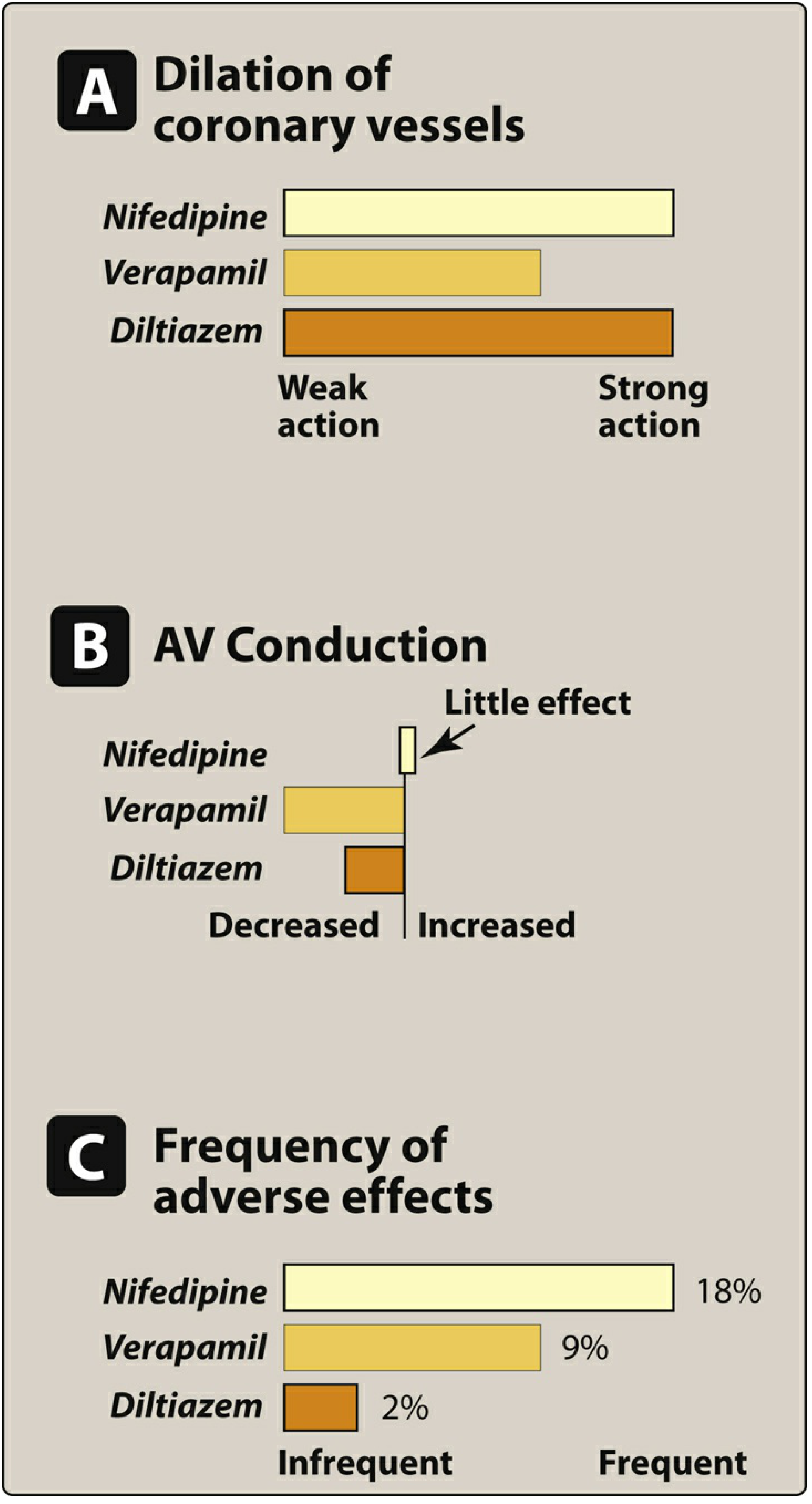
From Lippincott Illustrated Reviews: Pharmacology - Actions of CCBs
Basic MOA (Common)
All CCBs block voltage-gated L-type Ca²⁺ channels (bind to the α₁ subunit):
- Nifedipine binds to transmembrane segments of domains III and IV
- Verapamil binds to transmembrane segment 6 of domain IV (IVS6)
- Calcium influx blocked → smooth muscle relaxation (vasodilation) + decreased cardiac contractility/conduction
Comparison Table
| Feature | Nifedipine (Dihydropyridine) | Verapamil (Phenylalkylamine) |
|---|---|---|
| Drug class | Dihydropyridine (DHP) | Phenylalkylamine |
| Primary selectivity | Vascular smooth muscle >> cardiac | Cardiac > vascular |
| Vasodilation | Potent (especially peripheral arterioles) | Moderate |
| Heart rate | ↑ (reflex tachycardia due to hypotension) | ↓ (direct negative chronotropy on SA node) |
| AV conduction | Minimal effect | Strongly slows AV conduction (↑ PR interval) |
| Cardiac contractility | Minimal negative inotropy | Significant negative inotropy |
| SA node | Minimal effect | Slows automaticity |
| Antiarrhythmic use | NOT used (no AV node effect) | YES - SVT, AF rate control |
| Angina | YES - vasospastic and stable | YES - vasospastic, stable, and unstable |
| Hypertension | Preferred (potent arteriolar dilation) | Used but less preferred |
| Heart failure | Avoid (reflex tachycardia worsens demand; negative inotropy) | Avoid (negative inotropy) |
| Adverse effects | Headache, flushing, dizziness, reflex tachycardia, peripheral edema, gingival hyperplasia (18% adverse effect rate) | Constipation, bradycardia, AV block, lassitude, peripheral edema (9% adverse effect rate) |
| Constipation | No | Yes (common dose-dependent ADR) |
| Bioavailability | Low (first-pass); short-acting short t½ | ~20% oral bioavailability; t½ 4-7 hours |
| Interaction with digoxin | Minimal | Increases digoxin plasma levels (↑ toxicity risk) |
| Interaction with β-blockers | Can combine (heart rate control) | Dangerous combination - AV block and severe bradycardia |
| Use in AV block | Safer (no AV nodal effect) | CONTRAINDICATED |
| Use in WPW + AF | Not used | Contraindicated (enhances accessory pathway) |
| Use if VT misdiagnosed as SVT | Relatively safer | DANGEROUS - can cause hemodynamic collapse |
| Migraine prevention | Not used | Yes |
| Raynaud's phenomenon | YES (peripheral vasodilation) | Less effective |
| Tocolysis | Yes (relaxes uterine smooth muscle) | Not used for this |
| HOCM | Contraindicated | Can be used (reduces outflow obstruction via negative inotropy) |
Key Distinguishing Points (Exam Focused)
- Nifedipine = "vascular selective" → treats HTN and angina; causes reflex tachycardia; NO antiarrhythmic use
- Verapamil = "cardiac selective" → antiarrhythmic; constipation is hallmark ADR; DO NOT combine with β-blockers or use in AV block
- Verapamil is the prototype Phenylalkylamine; Nifedipine is the prototype Dihydropyridine
- Verapamil blocks both activated and inactivated T-type Ca²⁺ channels - frequency/use-dependent block
- Amlodipine (another DHP) is preferred over short-acting nifedipine in hypertension due to longer t½ (30-50 hours)
4. Nitrates (as a Class)
Members
| Drug | Route | Onset | Duration | Key Use |
|---|---|---|---|---|
| Nitroglycerin (GTN) | SL, transdermal, IV, oral SR | 1-3 min (SL) | 15-30 min (SL) | Acute angina, ACS |
| Isosorbide dinitrate (ISDN) | SL, oral | 3-6 min (SL) | 4-6 hours (oral) | Angina prophylaxis |
| Isosorbide-5-mononitrate (ISMN) | Oral only | ~30-60 min | 8-12 hours | Prophylaxis (no first-pass) |
| Amyl nitrite | Inhaled | 30 sec | 3-5 min | Cyanide poisoning (antidote), formerly acute angina |
ISMN has high oral bioavailability because it does not undergo significant first-pass hepatic metabolism.
MOA (Class)
All organic nitrates → release NO → activate sGC → ↑ cGMP → activate PKG → ↓ MLCK activity + ↓ intracellular Ca²⁺ → smooth muscle relaxation and vasodilation
The key signaling sequence: Nitrate → NO → sGC → cGMP → PKG → Vasodilation
Therapeutic Uses (Class)
- Stable angina - acute relief (SL GTN) and prophylaxis (ISDN, ISMN, transdermal GTN)
- Unstable angina - IV GTN reduces ischemia and preload
- Prinzmetal's (variant) angina - directly relieves coronary arterial spasm; drug of choice
- Acute MI - IV GTN in first 24-48 hours reduces preload, wall stress, infarct size
- Acute decompensated heart failure - venodilation rapidly reduces pulmonary congestion
- Hypertensive urgency/emergency - IV GTN or ISDN
- Esophageal spasm - smooth muscle relaxation
- Pulmonary hypertension - inhaled NO in neonates
- Anal fissures - topical GTN relaxes internal anal sphincter
Adverse Effects (Class)
| ADR | Mechanism |
|---|---|
| Throbbing headache | Meningeal arterial dilation (most common; decreases with continued use) |
| Postural hypotension | Venodilation → reduced venous return → ↓ BP |
| Reflex tachycardia | Baroreceptor response to hypotension |
| Flushing | Facial/neck vasodilation |
| Dizziness / syncope | Hypotension ("nitrate syncope") |
| Methemoglobinemia | High doses; amyl nitrite and nitroprusside are more relevant |
| Tolerance | Continuous high-dose exposure depletes SH groups, activates RAAS |
| Withdrawal angina | Rebound after chronic use; especially in industrial workers (Monday Disease) |
| Bezold-Jarisch reflex | Paradoxical bradycardia + hypotension with SL GTN |
Precautions (Class)
| Situation | Reason | Action |
|---|---|---|
| PDE5 inhibitors (sildenafil, tadalafil, vardenafil) | Both ↑ cGMP → severe synergistic hypotension | ABSOLUTE CONTRAINDICATION (at least 24-48h gap) |
| Right ventricular MI | RV preload dependent; venodilation → severe ↓ BP | Avoid nitrates |
| Hypovolemia | Worsens hypotension | Correct volume first |
| Severe aortic stenosis / HOCM | Fixed outflow obstruction; venodilation reduces CO severely | Avoid or use cautiously |
| Hypotension (SBP <90 mmHg) | Further BP drop dangerous | Contraindicated |
| ↑ ICP / head trauma | Cerebral vasodilation worsens ICP | Contraindicated |
| Autonomic dysfunction | Cannot compensate for BP drop | Use with extreme caution |
| Glaucoma (closed-angle) | May raise IOP | Avoid |
| Tolerance prevention | Continuous use → loss of efficacy | Maintain 8-12 hour nitrate-free interval |
| Abrupt withdrawal | Rebound angina / vasospasm | Taper gradually |
Nitrate-Free Interval Strategy
- Exertional angina: remove patch/omit night dose (patient sleeps without nitrate)
- Nocturnal / rest angina: omit daytime dose instead
- Always add another antianginal agent (β-blocker or CCB) to cover the nitrate-free period
Summary for Exams:
- Nitrates/GTN: NO donor → cGMP → vasodilation (mainly venous); key contraindication = PDE5 inhibitors + RV MI
- Coronary steal: maximum arteriolar dilation in normal zones diverts blood from ischemic zones; caused by dipyridamole, adenosine; used in stress testing; dangerous in unstable angina
- Nifedipine: vascular-selective DHP; reflex tachycardia; no AV node effect; gingival hyperplasia; 18% ADR rate
- Verapamil: cardiac-selective; antiarrhythmic; constipation; AV block risk; dangerous with β-blockers + digoxin; 9% ADR rate
This is a shared conversation. Sign in to Orris to start your own chat.