
Ectopic pregnancy
Reading File
Now let me search the medical library for ectopic pregnancy content in parallel.
Finding Sources
Searching PubMed
"ectopic pregnancy"[MeSH Terms] AND management
Excellent sources found. Let me read the most comprehensive ones in parallel - Creasy & Resnik's (maternal-fetal medicine), Rosen's Emergency Medicine, and Robbins pathology.
Reading File
Reading File
Reading File
Good data so far. Let me now read the Rosen's Emergency Medicine section more deeply (it has the most clinical content) and also get the Roberts & Hedges clinical procedures section for management details.
Reading File
Reading File
I have excellent clinical content. Let me fetch the ultrasound image and read the management section more fully.
Loading Image
Finding Sources
Now let me get the Berek & Novak methotrexate section and also the management/disposition section from Rosen's.
Reading File
Reading File
I now have comprehensive information to write a thorough answer. Let me compile everything.
Ectopic Pregnancy
An ectopic pregnancy is a pregnancy that implants outside the uterine cavity. It accounts for approximately 1-2% of all pregnancies and is the most common obstetric cause of maternal death in the first trimester, responsible for 4-10% of pregnancy-related deaths.
Definition & Sites of Implantation
Implantation occurs outside the uterine corpus. Sites (by frequency):
| Site | Frequency |
|---|---|
| Fallopian tube (most common) | ~95% |
| - Ampulla | ~70% of tubal |
| - Isthmus | ~12% |
| - Fimbria | ~11% |
| Ovary | ~3% |
| Cervix | ~1% |
| Abdominal cavity | ~1% |
| Cornual/interstitial | ~2-3% |
A heterotopic pregnancy (simultaneous IUP + ectopic) occurs in ~1:4000 pregnancies naturally, but is far more common after assisted reproduction.
Risk Factors
(Rosen's Emergency Medicine; Berek & Novak's Gynecology)
High risk:
- Prior tubal surgery (for sterilization or prior ectopic)
- Pelvic inflammatory disease / prior salpingitis (accounts for 50% of cases; risk increases ~3x after PID)
- Prior ectopic pregnancy (subsequent risk up to 22%)
Moderate risk:
- IUD use (prevents endometrial implantation but not ectopic)
- History of infertility or assisted reproduction (especially multiple embryo transfers)
- Prior spontaneous or induced abortion
- Smoking
Other:
- Advanced maternal age
- Anatomic abnormalities of the fallopian tubes
- Abnormal endometrium
Note: All forms of contraception except the IUD and tubal sterilization decrease the risk of ectopic pregnancy.
Pathophysiology
Fertilization normally occurs in the ampulla of the fallopian tube, and the embryo reaches the uterine cavity around day 4-5. Implantation of the fertilized ovum occurs approximately 8-9 days after ovulation. Anything that delays or obstructs transport of the embryo - such as tubal scarring from salpingitis, congenital anomalies, or anatomical distortion - increases the risk of ectopic implantation.
Once implanted in the tube, trophoblastic invasion erodes the thin tubal wall. The tube cannot expand like the uterine myometrium, so rupture occurs, typically between 6-10 weeks, causing hemoperitoneum. Rupture is a life-threatening emergency that can lead to exsanguination and death.
Clinical Presentation
The classic triad is:
- Abdominal/pelvic pain
- Amenorrhea (missed period)
- Vaginal bleeding
However, this classic triad is only present in a minority of patients. Ectopic pregnancy can mimic a threatened miscarriage in early stages. Full clinical picture may include:
- Vascular collapse / hemodynamic instability (in ~20% at presentation)
- Shoulder tip pain (diaphragmatic irritation from hemoperitoneum)
- Rectal or back pain
- Syncope
- Cervical or adnexal tenderness
- Adnexal mass (~60%)
- Leukocytosis
Important: Blood in the peritoneal cavity does not consistently correlate with peritoneal irritation, blood pressure, or pulse rate. Bradycardia in the presence of significant intraperitoneal bleeding is not unusual. In a series of 300 consecutive ectopic pregnancies, 50% of patients were evaluated at least twice before the correct diagnosis was made.
Diagnosis
1. Serum β-hCG
- A positive urine or serum pregnancy test is mandatory before any further workup.
- Discriminatory zone: β-hCG >1500-2000 IU/L - at this level, a normal IUP should be visible on transvaginal ultrasound (TVUS).
- With a normal IUP, β-hCG doubles approximately every 48 hours. In ectopic pregnancy, the rise is typically slower and suboptimal (but not always).
- Serial β-hCG levels (every 48h) are used to stratify risk.
2. Progesterone
- Levels >20 ng/mL suggest a viable IUP; levels <5 ng/mL exclude a viable IUP and indicate either a failed IUP or ectopic.
- Useful when hCG is low, ultrasound is indeterminate, and D&C or laparoscopy is being considered.
3. Transvaginal Ultrasound (TVUS) - Cornerstone
The most rapid and accurate initial test.
Diagnostic of ectopic pregnancy:
- Ectopic gestational sac with yolk sac or fetal pole outside the uterus
- Ectopic fetal cardiac activity (definitive)
Highly suggestive:
- Adnexal mass without IUP
- Moderate or large free fluid in the cul-de-sac without IUP
Indeterminate:
- Empty uterus
- Nonspecific fluid collections
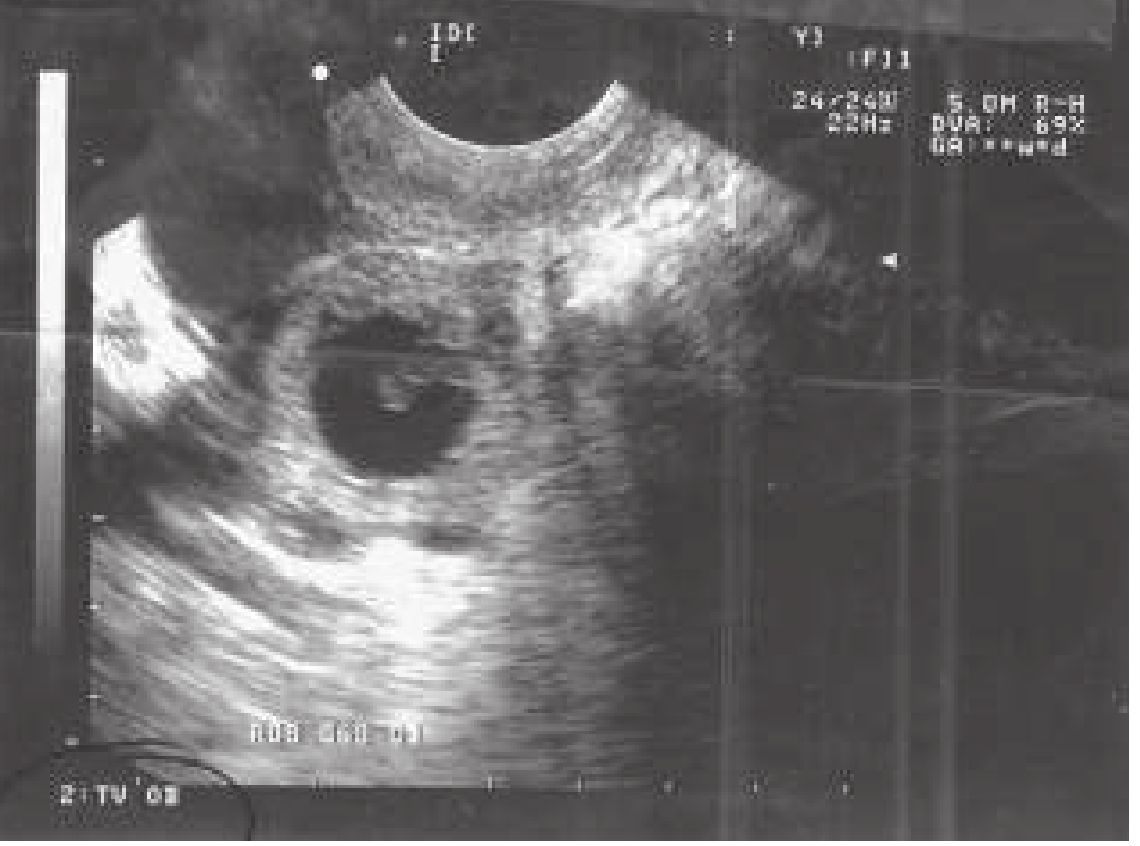
Fig. 1 - Pregnancy in the fallopian tube on TVUS, diagnostic of ectopic pregnancy. (Rosen's Emergency Medicine)
4. Dilation & Curettage (D&C)
- Used in patients without a visible IUP or ectopic on ultrasound to differentiate intrauterine miscarriage from ectopic.
- Identification of chorionic villi in endometrial samples (~70%) excludes ectopic pregnancy.
5. Laparoscopy
- Gold standard for diagnosis and treatment.
- Indicated for hemodynamically unstable patients with peritoneal signs, or when there is peritoneal fluid or a visible ectopic gestation.
Management
Unstable Patients (~20% of presentations)
- Immediate IV access, fluid resuscitation, blood products as needed
- Baseline hemoglobin, type and crossmatch
- Urgent surgery if the patient remains unstable
- Laparoscopy for patients who stabilize or have peritoneal signs
- Rh-negative patients: give Rh immune globulin 50 mcg IM
Stable Patients - Medical Management
Methotrexate (MTX) is the standard medical therapy. About 35% of ectopic pregnancies are candidates for primary MTX therapy.
Mechanism: Folate antagonist that inhibits dihydrofolate reductase, preventing DNA synthesis in rapidly dividing trophoblastic cells, causing involution of the pregnancy.
Dose: 50 mg/m² IM (single-dose protocol) - success rate ~90%.
Candidates for Methotrexate:
- Hemodynamically stable
- No evidence of rupture
- Confirmed or high suspicion of ectopic pregnancy
- Able to comply with follow-up
Absolute Contraindications to MTX:
| Contraindication |
|---|
| Intrauterine pregnancy |
| Hemodynamically unstable |
| Ruptured ectopic |
| Breastfeeding |
| Immunodeficiency |
| Moderate-severe anemia, leukopenia, or thrombocytopenia |
| Active pulmonary disease |
| Active peptic ulcer disease |
| Significant hepatic or renal dysfunction |
| Known sensitivity to methotrexate |
Relative Contraindications:
- Ectopic pregnancy >4 cm on TVUS
- Embryonic cardiac motion detected
- β-hCG >5,000 mIU/mL
- Unable to comply with follow-up
- Refusal of blood transfusion
Dosing Regimens:
- Single-dose: 50 mg/m² IM on Day 1; check β-hCG on Day 4 and Day 7. Success with one dose ~75-90%.
- Two-dose: Day 1 and Day 4 IM injections; fewer retreatments needed vs single-dose.
- Multi-dose: Alternating MTX/leucovorin (folinic acid rescue) on Days 1, 3, 5, 7; highest success rate but more side effects and lower compliance.
Post-treatment monitoring: Serial β-hCG weekly until undetectable; CBC, LFTs, and renal function checked before and 1 week after treatment.
Stable Patients - Surgical Management
- Salpingostomy (tube-preserving): preferred if stable and technically feasible, especially when future fertility is desired. Requires post-operative β-hCG monitoring for persistent ectopic.
- Salpingectomy (tube removal): indicated for uncontrolled bleeding, severely damaged tube, or repeat ectopic in the same tube.
Both are typically performed laparoscopically. Laparotomy is reserved for hemodynamically unstable patients or when laparoscopy is not feasible.
Prognosis & Reproductive Outcomes
- After MTX treatment, the risk of subsequent ectopic pregnancy is approximately 10%.
- After salpingostomy, future fertility rates are similar to MTX.
- After salpingectomy, intrauterine pregnancy rates remain acceptable as the contralateral tube assumes ovum transport.
- The recurrence risk of ectopic pregnancy after any ectopic is up to 22%.
Special Types of Ectopic Pregnancy
| Type | Notes |
|---|---|
| Interstitial (cornual) | In the intramural portion of the tube; may grow larger before rupture due to surrounding myometrium; higher mortality |
| Cervical | Rare; can present with painless, heavy bleeding; managed with MTX or surgical evacuation |
| Ovarian | Often confused with corpus luteum cyst; requires salpingo-oophorectomy or wedge resection |
| Abdominal | Extremely rare; can rarely advance to near-viability; very high maternal morbidity |
| Heterotopic | Simultaneous IUP + ectopic; especially after IVF; challenging diagnosis as hCG is normal |
Key takeaways:
- Always consider ectopic pregnancy in any woman of reproductive age with abdominal pain, vaginal bleeding, or amenorrhea and a positive pregnancy test.
- TVUS + serial β-hCG is the cornerstone of diagnosis.
- MTX is the primary medical option for stable, unruptured ectopics without contraindications.
- Rupture is a surgical emergency requiring immediate intervention.
Sources: Rosen's Emergency Medicine, 9e | Berek & Novak's Gynecology | Roberts & Hedges' Clinical Procedures in Emergency Medicine | Robbins & Kumar Basic Pathology
This is a shared conversation. Sign in to Orris to start your own chat.