
Causes for fever when cbc is completely normal
Fever with a completely normal CBC is a common and important clinical scenario. Quick answer first:
Common causes include viral infections (most frequent - viruses don't cause leukocytosis), early bacterial infections (before WBC rises), intracellular pathogens (TB, typhoid, brucella, rickettsia), autoimmune/inflammatory diseases (SLE, Still's disease, vasculitis), drug fever, and malignancies (lymphoma, solid tumors). The CBC is often normal in the first 24-48 hours of many infections and throughout the course of many non-infectious conditions.
Searching sources...
Reading File
Now let me search the medical library and web in parallel for comprehensive coverage.
Finding Sources
Finding Sources
Searching the Web
causes of fever with normal CBC differential diagnosis
Now let me read the most relevant textbook sections in parallel:
Reading File
Reading File
Let me get the full FUO section from Frameworks for Internal Medicine and Goldman-Cecil:
Reading File
Reading File
I now have excellent material. Let me fetch the FUO classification diagram from Frameworks for Internal Medicine since it directly categorizes causes:
Loading Image
Reading File
I now have comprehensive information from multiple authoritative sources. Here is a thorough, well-organized answer:
Fever with a Normal CBC: Causes and Approach
A normal CBC (including a normal WBC count and differential) in the setting of fever does not rule out serious pathology. Many infections, inflammatory diseases, and malignancies cause fever while leaving the CBC completely unaffected - at least initially.
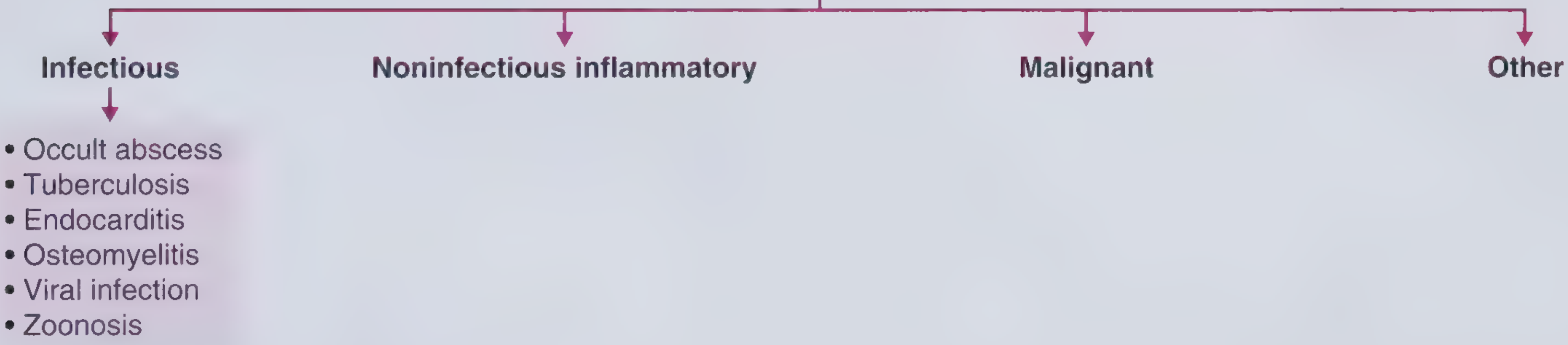
1. INFECTIOUS CAUSES (20-40% of FUO cases)
These are pathogens that either live intracellularly, suppress WBC response, or cause localized infection that doesn't reliably elevate the WBC.
Viral Infections (most common overall cause)
- EBV (infectious mononucleosis), CMV, HIV (acute seroconversion), hepatitis A/B/C, arboviral fevers (dengue, Zika, chikungunya)
- Viruses characteristically do NOT cause neutrophilia - they may cause lymphocytosis or a completely normal CBC, especially early
- Influenza and most upper respiratory viruses fall here
Intracellular Bacteria (the "classic" CBC-normal bacterial fevers)
- Typhoid fever (Salmonella typhi) - causes relative bradycardia and leukopenia or normal WBC; this is a hallmark feature
- Brucellosis - animal/dairy exposure; CBC often normal or shows leukopenia
- Rickettsia (Rocky Mountain spotted fever, typhus) - the rash and normal/low WBC combination is characteristic
- Q fever (Coxiella burnetii) - livestock exposure; hepatitis + normal WBC
- Leptospirosis - fresh water exposure; fever, conjunctival suffusion, AKI with normal or slightly elevated WBC early
Mycobacterial Infections
- Tuberculosis - especially extrapulmonary (miliary TB, hepatic TB, spinal TB). The CBC may be entirely normal; key investigations are TST/IGRA, culture, and biopsy - Harrison's Principles of Internal Medicine 22E
- Chest X-ray can be normal in miliary TB and in immunocompromised patients
Occult / Localized Infections
- Intra-abdominal abscess (liver, spleen, perirenal, subphrenic) - most common infectious cause of FUO in industrialized countries; WBC may not be elevated if well-walled off
- Subacute bacterial endocarditis (SBE) - can present for weeks with fever but normal WBC; blood cultures and echocardiography are key
- Osteomyelitis - vertebral osteomyelitis especially in elderly can smolder with normal CBC
- Culture-negative endocarditis - caused by HACEK organisms, Bartonella, Coxiella, Tropheryma whipplei
Fungal Infections
- Histoplasmosis, cryptococcosis, coccidioidomycosis - endemic mycoses often present with prolonged fever and normal CBC; more common in endemic regions or immunocompromised
Parasitic
- Malaria (early or between cycles), leishmaniasis, toxoplasmosis - may have normal WBC; malaria can cause thrombocytopenia as a clue
- Cat-scratch disease (Bartonella henselae) - fever + tender regional lymphadenopathy
2. NON-INFECTIOUS INFLAMMATORY DISEASES (10-30%)
These are a major cause of normal-CBC fever because the inflammatory process is cytokine-driven but does not necessarily mobilize neutrophils.
| Condition | Clues |
|---|---|
| SLE (Lupus) | Leukopenia is actually common; ANA, dsDNA positive |
| Adult-onset Still's disease (AOSD) | Quotidian fever, salmon-pink rash during fever, markedly elevated ferritin (often >2000 ng/mL) - Frameworks for Internal Medicine |
| Giant cell arteritis / Polymyalgia rheumatica | >50 years, jaw claudication, elevated ESR/CRP, normal WBC |
| Vasculitis (PAN, Wegener's/GPA) | Multi-system involvement; ANCA testing |
| Sarcoidosis | Hilar lymphadenopathy, granulomas on biopsy |
| Rheumatoid arthritis / juvenile RA | RF, anti-CCP; joint findings |
| Inflammatory bowel disease | GI symptoms; can present with fever alone |
| Periodic fever syndromes | Familial Mediterranean fever (FMF), TRAPS, CAPS; highly responsive to colchicine (FMF) or anakinra |
3. MALIGNANCIES (20-30%)
Tumor fever is mediated by cytokines (IL-1, IL-6, TNF) from the tumor itself, not by infection - hence CBC may be normal or even show lymphopenia.
- Lymphoma (Hodgkin's and Non-Hodgkin's) - classic cause; "B symptoms" (fever, night sweats, weight loss)
- Renal cell carcinoma - produces ectopic pyrogens; CBC may be normal
- Hepatocellular carcinoma
- Solid tumors with occult metastases
- Leukemia (early or aleukemic phases) - the WBC can paradoxically be normal early
- Atrial myxoma - rare but classic cause of sterile fever with normal WBC
4. DRUG FEVER
- A common and often overlooked cause
- Virtually any drug can cause drug fever; classic offenders include beta-lactam antibiotics, sulfonamides, phenytoin, allopurinol, heparin, hydralazine, methyldopa
- Typically occurs 1-3 weeks after starting the drug
- CBC is usually normal; may see eosinophilia as a clue
- Diagnosis is by exclusion and resolution after stopping the drug
5. MISCELLANEOUS / OTHER CAUSES
- Pulmonary embolism - a notorious cause of low-grade fever with normal WBC; must be considered in any hospitalized patient
- Factitious fever - malingering; temperature manipulation
- Thyroid storm / hyperthyroidism - can cause fever; TSH is diagnostic
- Adrenal insufficiency - can present with low-grade fever
- Subacute thyroiditis (de Quervain's) - painful thyroid, elevated ESR
- Pericarditis / myocarditis - fever + chest pain + normal WBC
- Hemophagocytic lymphohistiocytosis (HLH) - extremely high ferritin, pancytopenia can come later
- PFAPA syndrome (in children) - periodic fever with aphthous stomatitis, pharyngitis, adenitis
Why the CBC Can Be Normal: Pathophysiological Basis
| Reason | Examples |
|---|---|
| Pathogen is intracellular | Rickettsia, Salmonella typhi, Brucella, Mycobacteria |
| Non-bacterial process (no stimulus for neutrophilia) | Viral infections, autoimmune disease, malignancy |
| Early phase of infection (<24-48 hrs) | Any bacterial infection in the first day |
| Suppression of WBC response | Typhoid (endotoxin suppresses marrow), SLE (immune neutropenia) |
| No systemic bacteremia (localized focus) | Walled-off abscess, endocarditis |
| Non-infectious cytokine-driven fever | Drug fever, tumor fever, autoinflammatory syndromes |
Key Investigations When CBC is Normal
Since the CBC is uninformative, the workup should pivot to:
- Inflammatory markers: CRP and procalcitonin are more sensitive than WBC for detecting bacterial infection, per a study in febrile adults with normal WBC but elevated CRP - 82% of such patients had infection as the cause
- Blood cultures x3 (for endocarditis, occult bacteremia)
- LFTs, uric acid, LDH, ferritin
- TSH, ANA, ANCA, RF, complement levels
- TST/IGRA, chest X-ray
- CT chest/abdomen/pelvis to look for occult abscess or lymphoma
- Peripheral blood smear (malaria, atypical lymphocytes)
- Serology for viruses (EBV, CMV, HIV, hepatitis), Rickettsia, Brucella, Coxiella
A useful clinical pearl from AAFP guidelines on FUO: FUO is "more often an atypical presentation of a common disease rather than an unusual disease." Always think common things first - TB, lymphoma, SLE, viral infection.
Sources: Harrison's Principles of Internal Medicine 22E; Goldman-Cecil Medicine; Frameworks for Internal Medicine; Rosen's Emergency Medicine
This is a shared conversation. Sign in to Orris to start your own chat.